Skip to content
No results
  • Home
  • About Us
  • Blog
  • Service
    • Decision Support
    • Product Auditing
    • Product Selection
    • Stack Optimization
  • Contact Us
MSSP Security Consulting | Product Strategy & Auditing Experts
  • Home
  • About Us
  • Blog
  • Service
    • Decision Support
    • Product Auditing
    • Product Selection
    • Stack Optimization
  • Contact Us
MSSP Security Consulting | Product Strategy & Auditing Experts
  • using threat intelligence triage

Using Threat Intelligence Triage to Cut Fatigue

A flat vector illustration of a SOC analyst at a minimalist workstation. The left monitor shows a chaotic influx of red threat icons, which pass through a central "Alert Processing Pipeline" to the right monitor. This visualization of using threat intelligence triage shows raw data being transformed into organized blocks labeled "Contextual Enrichment," "Risk Scoring," and "Validated Alerts."

Using threat intelligence triage cuts through alert noise. It uses external data, like known malware or attacker methods, to quickly validate alarms. Good programs see false positives drop by 30%.  This turns a flood of data into a short list…

  • Richard K. Stephens
  • March 29, 2026
  • risk based alert prioritization

Risk Based Alert Prioritization That Cuts Noise

A 16:9 flat vector illustration demonstrating risk based alert prioritization in a Security Operations Center. The left side shows a chaotic cluster of generic "High Severity" red alerts. A central funnel labeled "Risk-Based Prioritization" filters this noise into the right side, which displays only a few high-impact cards such as "Active Threat" and "Critical Asset," accompanied by a risk meter shifting from red to green.

You’re staring at a dashboard blinking with a thousand identical red warnings. Which one is the real fire? Traditional alerting doesn’t know. It treats a vulnerability on a public database the same as one on a developer’s test machine. The…

  • Richard K. Stephens
  • March 28, 2026
  • security alert validation techniques

Security Alert Validation Techniques That Cut Burnout

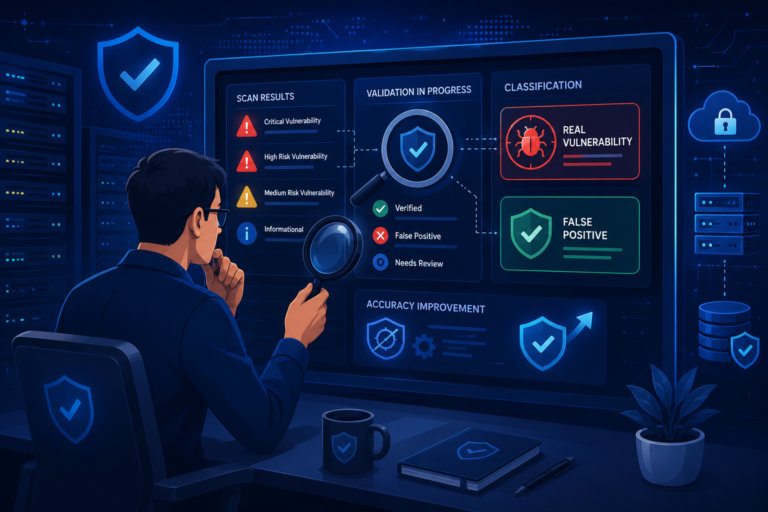
A flowchart illustrating common security alert validation techniques, including cross-referencing log data, checking threat intelligence feeds, and performing behavioral analysis to confirm a breach.

The noise is drowning out the signal. You’re not just getting security alerts; you’re getting buried by them. Alert validation is the systematic process of verifying which of those pings are genuine threats and which are just digital ghosts. It’s…

  • Richard K. Stephens
  • March 27, 2026
  • Reducing Alert Fatigue SOC

Reducing Alert Fatigue SOC Teams Actually Feel

A flat vector illustration titled "From Alert Overload to Risk-Based Prioritization," demonstrating the process of reducing alert fatigue SOC. A chaotic dashboard on the left with red alerts flows through a central "Alert Triage" funnel, resulting in a clean, prioritized view of critical security events on the right.

Alert fatigue is the slow, grinding burnout that happens when your security team drowns in a sea of meaningless notifications. It’s not just about volume, it’s about value. When analysts face thousands of alerts daily, with a staggering 99% being…

  • Richard K. Stephens
  • March 26, 2026
  • how security alerts are prioritized

How Security Alerts Are Prioritized to Cut Noise

Flat vector illustration of a modern SOC dashboard showing how security alerts are prioritized by filtering a large volume of gray icons through a funnel into a few high-priority red alerts.

You can’t fight every fire at once. How security alerts are prioritized is the triage system that stops your team from drowning in noise and focuses them on the real breaches. It’s the difference between chasing false positives and neutralizing…

  • Richard K. Stephens
  • March 25, 2026
  • Newsroom

We Found 92% of Enterprises Can’t See Their AI Agents, And That’s a Crisis

By MSSP Security Consulting Research Team Look, we spend our days inside MSSP stacks. We audit them, we optimize them, and lately, we’ve been noticing something disturbing. The tools everyone relies on to detect threats? They’re blind to half the…

  • Richard K. Stephens
  • March 25, 2026
  • MSSP Alert Triage Process Explained, MSSP Alert Triage Process Explained

MSSP Alert Triage Process Explained for Better Results

A clean 2D vector illustration of the MSSP alert triage process explained via a horizontal pipeline, showing red alerts being filtered and enriched into high-priority incidents for an analyst.

We watched an analyst waste forty minutes on a false alarm yesterday. He jumped between six screens for a “high severity” ransomware alert. It was just a clumsy admin tool. While he worked, three more alarms piled up. This is…

  • Richard K. Stephens
  • March 24, 2026
  • mssp alert handling process review

MSSP Alert Handling Process Review: Cut Response Times

Flat vector illustration of a modern SOC dashboard highlighting an mssp alert handling process review that successfully cut response times through risk-based prioritization.

A good MSSP alert handling process cuts through the noise. It uses a standard workflow to separate real threats from false alarms, so your team isn’t swamped by thousands of meaningless alerts.  The real work happens after you invert that…

  • Richard K. Stephens
  • March 23, 2026
  • Alert Triage Prioritization Process

A Better Alert Triage Prioritization Process Saves Your Analysts

Flat vector illustration of a security analyst using an AI-driven alert triage prioritization process to filter chaotic signals into an organized, risk-scored dashboard.

Your SOC is overwhelmed, and the traditional “first in, first out” alert queue is failing you. The answer isn’t more analysts. It’s a smarter alert triage prioritization process. By embedding context and risk scoring directly into the workflow, you transform…

  • Richard K. Stephens
  • March 22, 2026
  • Inside an MSSP SOC Workflow

5 Steps in the 24/7 SOC Monitoring Process

Security operations center team reviewing incident alerts in a 24/7 SOC monitoring process environment

24/7 SOC monitoring process means continuous security monitoring that detects, analyzes, and responds to threats across networks, endpoints, and cloud systems in real time. Many organizations underestimate how long attackers can stay hidden. Research suggests, breaches can remain unnoticed for…

  • Richard K. Stephens
  • March 21, 2026
Prev
1 … 3 4 5 6 7 8 9 … 40
Next
MSSP Security Consulting | Product Strategy & Auditing Experts

MSSP Security provides vendor-neutral product strategy, independent auditing, and security stack optimization purpose-built for Managed Security Service Providers. We help MSSPs cut through vendor noise — evaluating, selecting, and maximizing the right cybersecurity tools based solely on your operational needs and client outcomes. No hidden partnerships. No affiliate bias. Just clear, objective guidance that drives measurable results across your entire security practice.

Request a Consultation →
  • Service
  • Decision Support
  • Product Auditing
  • Product Selection
  • Stack Optimization

Copyright © 2026 MSSP Security. All Rights Reserved.