

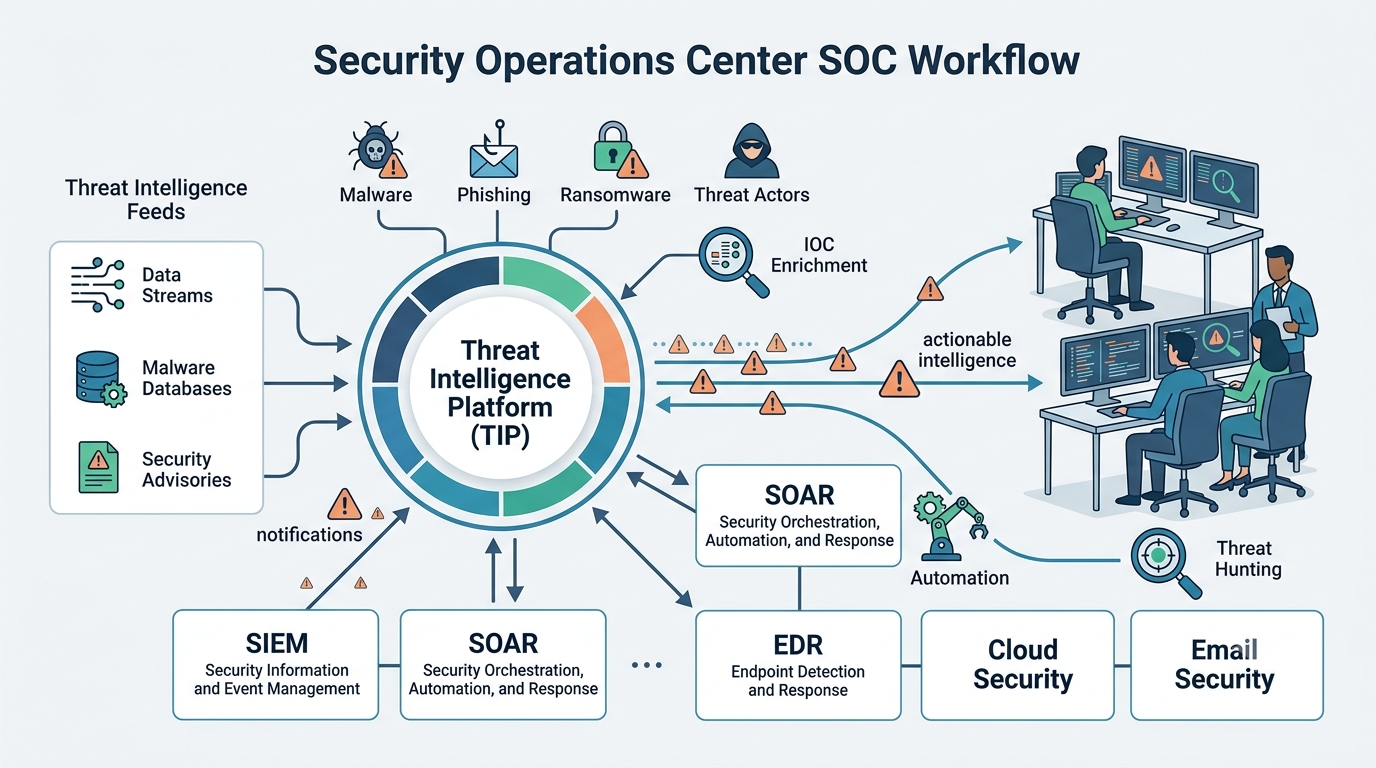
Threat Intelligence Platform (TIP) benefits help security teams detect, investigate, and respond to threats more efficiently by turning scattered threat data into actionable intelligence. A TIP brings together information from multiple sources, adds context, and helps analysts prioritize what matters most.
At MSSP Security, we’ve seen how the right implementation reduces repetitive work and supports faster. Microsoft also notes that a TIP helps organize cyber threat intelligence throughout the security lifecycle, making it easier to act on evolving threats. Keep reading to see how these benefits improve SOC performance and long-term security outcomes.
Threat Intelligence Platform Benefits at a Glance
A well-integrated Threat Intelligence Platform helps security teams detect threats faster, automate repetitive work, and make better decisions with trusted intelligence. These core benefits work together to improve SOC efficiency and strengthen long-term cyber resilience.
- A Threat Intelligence Platform centralizes, enriches, and prioritizes threat intelligence to reduce analyst workload and improve security operations.
- Proper SIEM, SOAR, and endpoint integrations enable faster investigations, proactive threat hunting, and automated incident response.
- At MSSP Security, we have seen firsthand that a well-integrated TIP supports scalable security operations while helping organizations mature their cyber defense without adding unnecessary complexity.
What Does a Threat Intelligence Platform Actually Do?
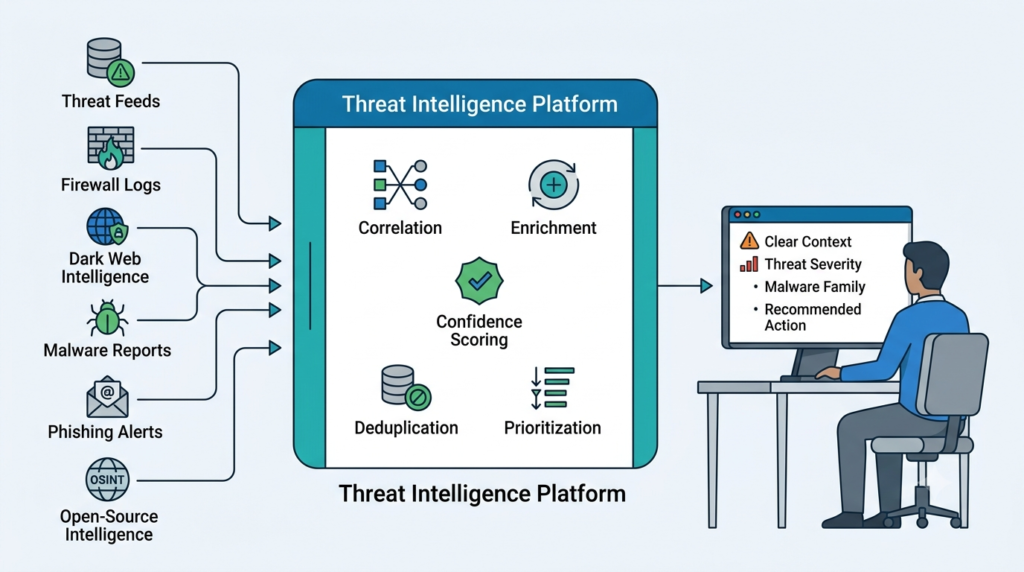
Think of a Threat Intelligence Platform (TIP) as the brain of your security operations. It takes in raw data, feeds, internal alerts, dark web reports, and turns it into clear instructions. We’ve seen teams drown in data without one.
Analysts waste hours checking the same bad IP address across five different tools. A good TIP fixes that. It sorts, checks, and prioritizes everything in one place. The goal isn’t just to collect more data. It’s to make the data you have work for you. Platforms use things like confidence scoring and expiration dates to keep intelligence fresh.
At MSSP Security, we help teams connect their TIP directly to their daily work. The real benefit comes when an analyst gets an alert that’s already been checked against known malware and linked to a specific hacker group. That’s when they can act fast.
Common sources a TIP organizes include:
- Paid commercial intelligence feeds
- Alerts and logs from your own tools
- Information from open-source communities
- Shared reports from industry groups (ISACs)
- Monitoring from the dark web
This process turns noise into something you can actually use.
How Do You Choose the Right Threat Intelligence Platform?
Choosing a Threat Intelligence Platform (TIP) isn’t about who has the most features. It’s about what fits your team’s actual workflow. A huge enterprise system might overwhelm a smaller team. You need to start by asking what you really need from your intelligence.
We always tell our clients to look at how the platform will support their analysts. Can it connect to your existing SIEM and SOAR? Does it support standard sharing formats like STIX/TAXII? These technical details matter more long-term than a flashy dashboard.
We worked with one company that was obsessed with getting the most feeds. They later realized that automating simple tasks, like enriching phishing alerts, saved their team more time than any new data source.
Here’s a simple way to break down what to look for:
| What to Evaluate | Why It’s Important |
| Data Quality | Good intelligence reduces false alarms. Bad intel creates more work. |
| Tool Integrations | It must work with the security tools you already use every day. |
| Automation Features | This cuts down on repetitive manual tasks for your team. |
| Ability to Grow | The system should handle more data as your needs change. |
The best platform is the one your team will actually use without a major fight.
How Does a TIP Improve Security Team Performance?
Credits: John Hubbard
The main benefit is simple: it lets your team act instead of just sifting through data. Microsoft has noted that good intelligence helps teams prioritize alerts faster, which reduces fatigue. Without a central platform, everything is manual. An analyst might see a suspicious domain and then spend 20 minutes checking it across various websites.
A TIP does that checking automatically. It adds context, like if the domain was registered last week, is linked to known malware, or has been seen in other attacks.
This turns a raw alert into a story and highlights the benefits using TIP security operations teams rely on every day. The result is that analysts get fewer, but more important, alerts to investigate. They can focus on real threats.
We see clients get better at specific tasks, like:
- Investigating phishing emails much faster.
- Knowing which software vulnerabilities to patch first.
- Understanding the latest ransomware tactics.
At MSSP Security, we’ve watched teams go from being reactive to proactive. The intelligence stops being a separate report and starts guiding every investigation. This is how you build a mature security operation.
How Should You Choose a TIP Vendor Solution in Fullerton?
Choosing a TIP vendor solution in Fullerton is about more than location. The right partner should understand your security operations and help the platform fit your existing workflow. We have seen projects move much faster when the focus stays on practical deployment instead of unnecessary features.
As consultants for MSSPs, we regularly help teams review, compare, and audit new security products before they invest. Some need stronger detection engineering using threat intelligence, while others care more about managed security threat intelligence services or building a mature CTI program. The best choice depends on daily operations, not the biggest feature list.
When evaluating vendors, we recommend looking at:
- MSSP threat intelligence integration
- Cloud security threat intelligence
- TIP scalability for large enterprises
- Multi-tenant threat intel for MSSP
- Threat intelligence platform best practices
Our experience shows that implementation often matters more than the software itself. Teams see better results when the platform supports existing analyst workflows instead of forcing major process changes. Long after deployment, regular tuning, governance reviews, and operational guidance continue improving results.
Why Should You Connect Your TIP with SIEM and SOAR?
A TIP sitting alone is like a library no one visits. Its real power comes from connecting to your SIEM and SOAR. Your SIEM collects all the logs. Your TIP enriches those logs with context. Your SOAR then automates responses based on that enriched information. It creates a smooth, intelligent workflow.
For example, when integrating TIP SIEM SOAR, a SIEM alert about a suspicious login can trigger the TIP to instantly check whether the IP address is on a known threat list. If it’s high risk, the SOAR can automatically block the IP and create a ticket before an analyst even logs in.
We help our clients set up these connections, and the difference is immediate. Analysts spend less time on manual lookups.
A mature setup handles:
- Automated SOAR playbooks that use live threat intel.
- Sending enriched alerts directly into your ticketing system.
- Blocking malicious sites at the email or web gateway.
- Providing context directly inside your endpoint detection tools.
The key is smart automation. You should automate the boring, repetitive checks so your people have time for the complex detective work.
How Can You Manage Threat Data More Effectively?
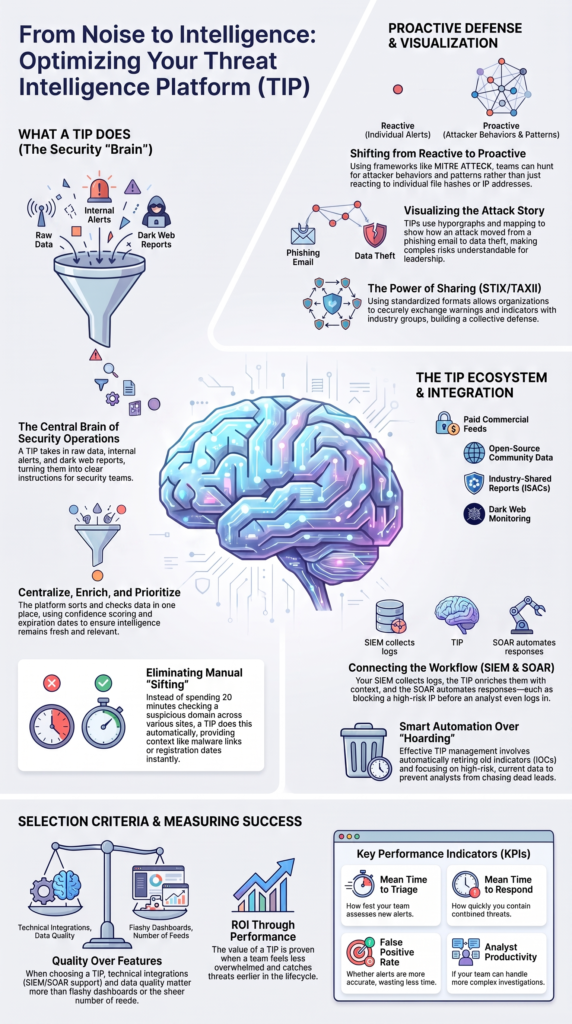
Managing Indicators of Compromise (IOCs) isn’t about hoarding them. It’s about keeping them useful. A bad IP address from two years ago probably isn’t a threat today. Guidance from CISA and MITRE ATT&CK emphasizes having a process to manage this lifecycle.
A good TIP helps with managing threat data IOCs TIP by attaching confidence scores and expiration dates to every piece of intelligence. It automatically retires old data and highlights what’s current and high-risk. This means your analysts aren’t wasting time chasing dead leads.
From our experience, teams start trusting their intelligence more when it’s clean and current. They know that if the platform says an indicator is high-risk, it probably is. This disciplined approach also helps you track hacker campaigns over time, not just individual indicators.
You need processes for:
- Scoring how reliable an indicator is.
- Deciding when an indicator expires.
- Correlating IOCs across different log sources.
- Regularly checking the quality of your intelligence feeds.
It’s less exciting than hunting hackers, but it makes the hunt possible.
How Does TIP Automation Reduce Manual Security Work?
Automation is where a TIP pays for itself. Automating threat intelligence enrichment takes the dull, time-consuming work off your analysts’ plates. Modern platforms can automatically check a suspicious file hash against malware databases, see what other domains are on the same server, and pull in registration records.
This happens in seconds. What used to be a 15-minute manual process now happens before the analyst even opens the case. We see this clearly in phishing investigations. Instead of manually looking up each malicious URL, the analyst gets a report showing it’s part of an ongoing campaign targeting their industry. They can move straight to containment.
Typical automated tasks include:
- Enriching IOCs with malware sandbox results and DNS history.
- Pulling in data from both paid and open-source intelligence feeds.
- Using simple machine learning to find connections between alerts.
But a word of caution: automation is only as good as the data you feed it. If your intelligence feeds are full of junk, you’ll just automate bad decisions. Quality always comes first.
How Does Threat Intelligence Improve Threat Hunting?
Threat hunting is about proactively looking for bad guys in your network before they trigger an alarm. Improving threat hunting TIP capabilities starts with giving analysts context on how hackers operate. MITRE ATT&CK teaches us to focus on behaviors, like how they move laterally or steal credentials, because these tactics change slower than their malware.
With a TIP, hunters can search for these behaviors. Instead of just looking for a bad IP, they can hunt for patterns linked to a specific threat group’s known methods. This is a game-changer. We’ve helped teams shift from just responding to alerts to running regular, intelligence-driven hunts.
Hunters use the TIP to:
- Build detection rules (like Sigma or YARA) based on latest intel.
- Monitor for signs of supply chain attacks.
- Track hacker infrastructure being discussed in threat reports.
- Set up DNS sinkholes based on known malicious domains.
This proactive stance is a sign of a truly advanced security team.
How Can Visualizing Attacks Improve Security Decisions?
A list of thousands of indicators is useless if you can’t see the story. Visualizing threat actor TTPs in a TIP helps connect the dots. It can map how an attack moved from a phishing email to a compromised user, then to data theft, all tied to specific MITRE ATT&CK techniques.
This makes complex attacks understandable at a glance. It’s also powerful for explaining risks to company leadership. A graph showing how different incidents are connected to the same hacker group is much clearer than a spreadsheet full of file hashes.
Research from Computers & Security
“We use hypergraphs to display tactics and techniques in cyber threat intelligence.” – Computers & Security
These visualizations help with:
- Profiling and tracking specific threat actors.
- Mapping your defenses against the ATT&CK framework.
- Seeing the full scope of an ongoing campaign.
- Tracking infrastructure used across multiple attacks.
For us, this is a key reporting tool. It turns technical data into a narrative that everyone, from the SOC analyst to the CEO, can understand and act on.
Why Is Threat Intelligence Sharing Important?
Threat intelligence gets better through threat intelligence sharing collaboration. A hacker attacking one company will likely target another in the same industry. Groups like ISACs and platforms like MISP exist so organizations can share warnings and indicators securely. CISA strongly encourages this collective defense model.
Sharing inside your own company is just as important. Your threat intel team, SOC analysts, and incident responders should all work from the same information. When one team finds a new threat, everyone else should know immediately. We’ve seen how this eliminates duplicate work and speeds up response times across the board.
As noted by the Hawaii International Conference on System Sciences
“Threat intelligence sharing is an effective security control to develop situational awareness of the rapidly growing number of new, increasingly sophisticated and targeted cyber threats.” – Hawaii International Conference on System Sciences
Effective collaboration means:
- Using trusted platforms like MISP for sharing.
- Participating in your industry’s ISAC.
- Using standards like STIX/TAXII to exchange data.
- Bringing intel into incident response and training exercises.
This teamwork builds a stronger defense for everyone involved.
How Do You Measure TIP Success?
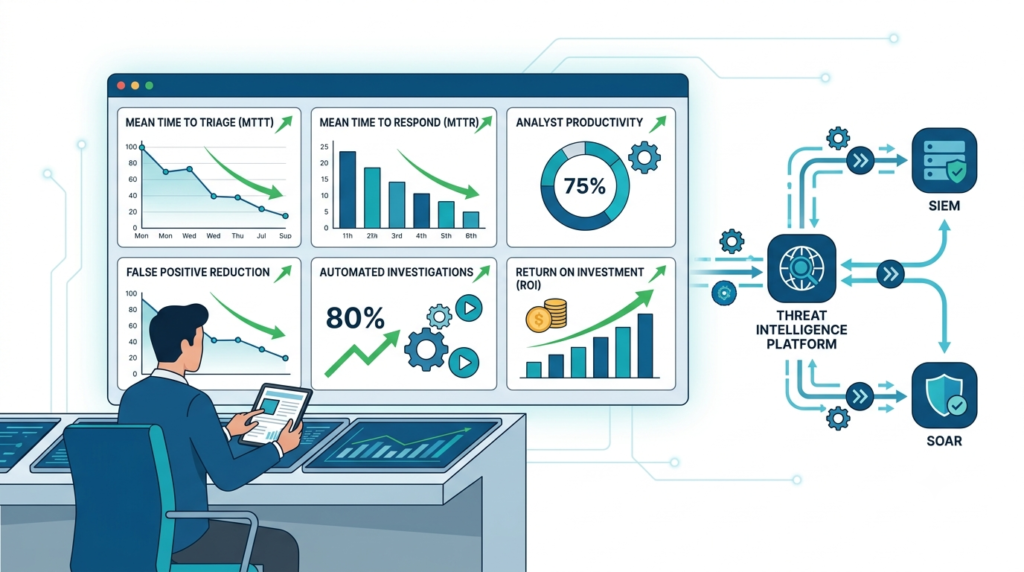
You can’t manage what you don’t measure. Measuring TIP value ROI starts with your security team’s performance, not just the software cost. Reports, like IBM’s on data breach costs, show that using advanced security tech like AI and automation can save millions.
You should track concrete metrics that show improvement. Did it take less time to investigate alerts? Are analysts handling more high-priority work? These numbers tell the real story.
Key metrics to watch include:
| Performance Indicator | What It Tells You |
| Mean Time to Triage | How fast your team assesses new alerts. |
| Mean Time to Respond | How quickly you contain confirmed threats. |
| False Positive Rate | Whether alerts are more accurate, wasting less time. |
| Analyst Productivity | If your team can handle more complex investigations. |
Other valuable measures are the reduction in manual research time and the number of threats caught earlier because of intelligence. At MSSP Security, we believe the best proof is when your team feels less overwhelmed and stops more attacks.
FAQ
Can a threat intelligence platform for SOC help small security teams?
Yes. A threat intelligence platform for SOC teams can help small security teams work more efficiently by reducing repetitive tasks and organizing threat data in one place. It also supports real-time threat intelligence updates, prioritized threat indicators for SOC, and contextualized threat alerts in SIEM.
These capabilities help analysts focus on real threats instead of spending valuable time reviewing low-priority alerts.
How do I choose between an open source threat intelligence platform and a commercial one?
The right choice depends on your security goals, budget, and internal expertise. An open source threat intelligence platform offers flexibility and customization but usually requires more management.
Commercial threat intelligence feeds often provide broader coverage and dedicated support. Compare your options by reviewing TIP selection criteria and checklist, evaluating threat intelligence vendors, and deciding whether on-premise vs SaaS TIP deployment best fits your environment.
What are the threat intelligence enrichment best practices?
Effective threat intelligence enrichment best practices begin with trusted data sources and well-defined processes. Organizations should focus on automating IOC enrichment workflows, applying indicator confidence scoring models, following IOC lifecycle management processes, and using IOC expiry and decay management.
These practices keep threat intelligence accurate, current, and actionable, allowing analysts to spend less time validating data and more time investigating threats.
How does a TIP improve threat hunting with threat intelligence?
A TIP improves threat hunting with threat intelligence by giving analysts the context they need to identify attacker behavior instead of relying only on individual indicators. It supports proactive cyber threat hunting, ATT&CK mapping in threat platforms, threat actor infrastructure tracking, and campaign-based threat intelligence.
This broader view helps security teams uncover hidden threats before they become major security incidents.
Why is STIX and TAXII based sharing important for cyber threat intelligence?
STIX and TAXII based sharing provide a common way for organizations to exchange cyber threat intelligence. These standards support a cyber threat intelligence sharing platform, improve ISAC threat intelligence collaboration, simplify MISP threat intelligence sharing, and enable automation of threat intel dissemination.
Using standardized formats also improves data quality, reduces manual work, and helps security teams share intelligence more quickly and consistently.
Strengthen Security With the Right Threat Intelligence Platform
A Threat Intelligence Platform delivers the most value when it supports your existing workflows and helps teams make faster, more informed decisions. Organizations that integrate intelligence with security operations often improve investigations, reduce manual effort, and strengthen long term resilience.
The right platform should simplify security operations, not add unnecessary complexity. Choosing a platform that fits your environment creates stronger security outcomes over time. Talk with MSSP Security to evaluate how a Threat Intelligence Platform can strengthen your security operations.
References
- https://www.sciencedirect.com/science/article/abs/pii/S0167404824004991
- https://scholarspace.manoa.hawaii.edu/items/e46fe42e-0052-46f1-854c-90c850c66cde
Related Articles
- https://msspsecurity.com/what-is-threat-intelligence-platform/
- https://msspsecurity.com/choosing-threat-intelligence-platform-(tip)/
- https://msspsecurity.com/benefits-using-tip-security-operations/
- https://msspsecurity.com/choosing-tip-vendor-solution-in-fullerton/
- https://msspsecurity.com/integrating-tip-siem-soar/
- https://msspsecurity.com/managing-threat-data-iocs-tip/
- https://msspsecurity.com/automating-threat-intelligence-enrichment/
- https://msspsecurity.com/improving-threat-hunting-tip/
- https://msspsecurity.com/visualizing-threat-actor-ttps-tip/
- https://msspsecurity.com/threat-intelligence-sharing-collaboration/
- https://msspsecurity.com/measuring-tip-value-roi/