


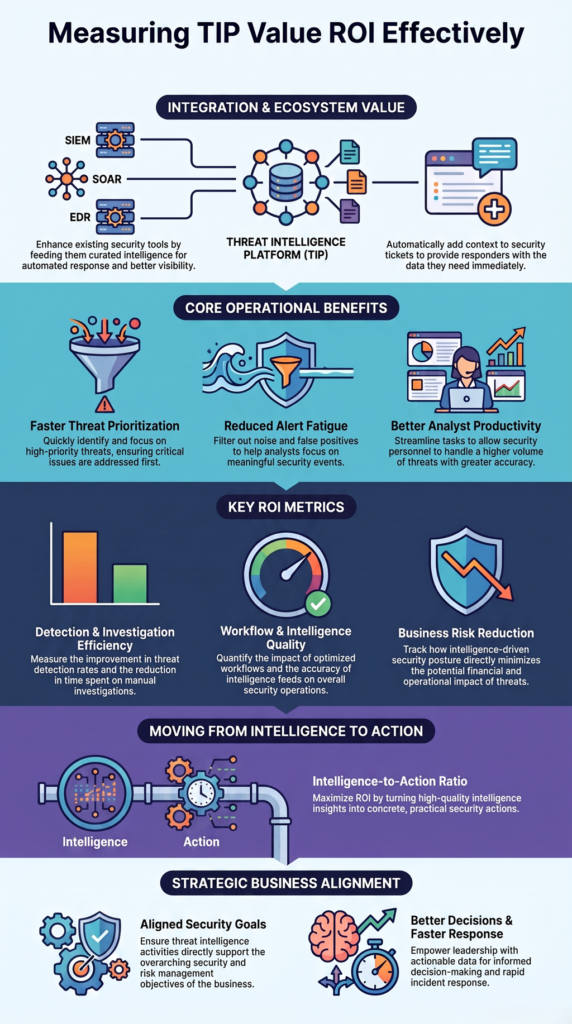
Measuring TIP value ROI shows how effectively a Threat Intelligence Platform improves security outcomes. Organizations should evaluate more than data collection by measuring how intelligence supports faster detection, better decisions, and reduced cyber risk.
A strong threat intelligence platform ROI analysis considers operational efficiency, intelligence quality, integration performance, and long-term impact. Based on our experience, effective TIP value measurement focuses on turning intelligence into practical actions.
At MSSP Security, we assess these factors to help organizations improve their intelligence strategy. Keep reading to learn the key metrics.
How Can Organizations Measure TIP Value ROI Effectively?
Understanding measuring TIP value ROI helps organizations identify how their Threat Intelligence Platform creates measurable security value. The key areas to evaluate include:
- Measure operational and business impact by analyzing improvements in detection, response, analyst productivity, risk reduction, and overall threat intelligence platform ROI.
- Evaluate intelligence quality and integration effectiveness through metrics such as indicator accuracy, actionable intelligence delivery, automation, and security workflow improvements.
- Continuously optimize TIP performance with KPI tracking, feedback loops, and maturity assessments to ensure threat intelligence supports long-term security goals.
Why Is Measuring Threat Intelligence ROI Important for Organizations?
Measuring threat intel ROI helps organizations understand whether their Threat Intelligence Platform creates real security and business value. Without proper measurement, teams may find it difficult to explain how intelligence investments improve decision-making, accelerate response, and reduce cyber risk.
A strong TIP ROI analysis should evaluate practical outcomes beyond platform capabilities, including:
- Improved detection coverage
- Reduced investigation time
- Better analyst decisions
- Faster incident response
- Improved risk visibility
These outcomes highlight the Threat Intelligence Platform (TIP) Benefits by showing how intelligence can strengthen security operations and support measurable improvements.
From our experience helping MSSPs evaluate and audit security products, we see that effective threat intelligence programs are built around daily security needs.
A TIP that delivers relevant threat context can help teams reduce false positives, prioritize remediation, and improve workflow efficiency.
By tracking threat intelligence ROI metrics, organizations can measure TIP business value, compare investments, and align intelligence strategies with long-term security goals.
At MSSP Security, we help MSSPs assess these capabilities to identify solutions that deliver measurable operational impact.
How Can Organizations Turn Threat Data Into Intelligence Value?

Measuring TIP value ROI requires organizations to look beyond the amount of threat data collected and focus on how intelligence supports real security outcomes. Threat feeds, indicators, and reports only create value when they help teams make better decisions, improve detection, and respond to risks faster.
A strong threat intelligence platform value approach evaluates whether intelligence improves:
- Faster threat prioritization
- Analyst productivity gains
- Incident response decisions
- Reduced alert fatigue
- Security workflow efficiency
“A threat intelligence program helps an organization generate their own threat intelligence information and track trends to inform defensive priorities to mitigate risk.” – MITRE ATT&CK
This highlights why effective TIP measurement should focus on how intelligence supports risk-based decisions and translates threat information into actionable security improvements.
From our experience helping MSSPs evaluate and audit security products, we see that the intelligence-to-action ratio is a key indicator of TIP effectiveness. Intelligence should lead to practical actions, not simply add more information for teams to review.
Understanding visualizing threat actor TTPs tip can further help teams transform threat intelligence into actionable insights by identifying attacker behaviors, improving detection strategies, and supporting proactive defense.
At MSSP Security, we help MSSPs assess whether security products can support effective threat intelligence operationalization.
By measuring operational impact, organizations can better understand their TIP return on investment and strengthen proactive security strategies.
What Metrics Help Measure TIP Effectiveness and Success?
Measuring TIP value ROI requires organizations to track metrics that show how effectively threat intelligence supports security operations and decision-making.
A Threat Intelligence Platform should not be evaluated only by the amount of data it processes, but by the improvements it creates across security workflows.
A strong threat intelligence ROI metrics framework should evaluate:
- Detection improvement
- Investigation efficiency
- Intelligence quality
- Workflow optimization
- Business risk reduction
| TIP Success Metric | What It Measures | Impact on TIP Value ROI |
| Detection Improvement | Measures how effectively threat intelligence improves threat identification and detection coverage | Helps security teams detect malicious activity faster and reduce security gaps |
| Investigation Efficiency | Evaluates how intelligence reduces investigation time and improves analyst productivity | Reduces operational workload and improves security team efficiency |
| Intelligence Quality | Measures indicator accuracy, feed reliability, and threat context relevance | Ensures analysts receive actionable intelligence instead of unnecessary data |
| Workflow Optimization | Evaluates how TIP supports security processes, automation, and integrations | Improves threat intel operationalization and reduces manual effort |
| Business Risk Reduction | Measures how intelligence supports risk prioritization and security decisions | Demonstrates measurable business value and return on security investment |
The intelligence-to-action ratio is an important indicator because it measures how often intelligence insights lead to practical security actions.
Organizations should also monitor TIP success metrics, including intelligence-driven investigations, analyst productivity, faster threat prioritization, and improved decision-making.
From our experience helping MSSPs evaluate and audit security products, we see that the decision support value of a TIP is a key success factor.
At MSSP Security, we assess whether intelligence aligns with security objectives and helps organizations make better risk decisions.
How Does Threat Intelligence Improve Security Operations?
Measuring TIP value ROI requires organizations to evaluate how a Threat Intelligence Platform improves daily security operations. The value of a TIP is reflected in how effectively it reduces manual effort, supports analysts, and helps teams prioritize critical threats.
Key indicators for measuring operational improvements include:
- Reduced alert fatigue
- Analyst productivity gains
- Threat intel workflow efficiency
- Security operations efficiency
- Faster threat prioritization
A TIP that enriches alerts with relevant threat context and improves indicator accuracy can help security teams reduce unnecessary investigations and respond to real threats faster.
This operational improvement becomes stronger when organizations implement threat intelligence sharing collaboration to improve intelligence exchange, enhance threat context, and support faster security responses.
From our experience helping MSSPs evaluate and audit security products, we see that stronger TIP business value comes from solutions that integrate well with existing workflows. At MSSP Security, we assess whether threat intelligence capabilities deliver measurable improvements for security teams.
How Does Intelligence Quality Impact TIP Effectiveness?
Measuring TIP value ROI requires organizations to evaluate whether their Threat Intelligence Platform delivers accurate, relevant, and actionable intelligence. The value of threat data depends on how effectively teams can use it to support security decisions rather than simply collecting large volumes of information.
Key areas for measuring intelligence quality include:
- Feed quality assessment
- Indicator relevance
- Indicator accuracy
- Intelligence enrichment value
- Actionable intelligence delivery
A strong feed quality assessment process helps organizations identify reliable intelligence sources and reduce unnecessary noise. Meanwhile, accurate indicators and enriched threat context help analysts understand attacker behavior, prioritize risks, and improve investigations.
From our experience helping MSSPs evaluate and audit security products, we see that intelligence quality directly affects TIP effectiveness.
At MSSP Security, we assess whether intelligence capabilities support better decision-making, reduce false positives, strengthen threat hunting, and improve threat intelligence platform ROI through measurable security outcomes.
How Do TIP Integrations Improve Security Technology Value?

Measuring TIP value ROI requires organizations to evaluate how effectively a Threat Intelligence Platform integrates with existing security technologies. A TIP creates greater value when intelligence can flow across security workflows instead of remaining isolated within a single platform.
Key areas for evaluating integration value include:
- SIEM integration value
- SOAR integration value
- EDR integration value
- Ticketing integration value
Effective integrations improve threat intelligence operations by enriching alerts, supporting automated enrichment, enabling automated triage, and helping analysts respond faster. SIEM integration improves detection context, while SOAR capabilities reduce manual tasks and streamline response workflows.
From our experience helping MSSPs select and audit security products, we see that successful integrations are measured by operational impact rather than the number of available connections.
At MSSP Security, we assess whether TIP integrations improve threat intel operationalization, workflow efficiency, detection coverage, and incident response effectiveness to maximize threat intelligence platform ROI.
How Does TIP ROI Connect With Risk Reduction and Business Outcomes?
Measuring TIP value ROI requires organizations to look beyond technical performance and understand how threat intelligence supports business objectives.
A Threat Intelligence Platform should help teams reduce risk, improve resilience, and make better security decisions based on relevant threat information.
Key areas for measuring business impact include:
- Cost avoidance
- Breach cost reduction
- Risk reduction measurement
- Security posture improvement
- Return on security investment
Threat intelligence helps organizations identify emerging threats earlier, understand attacker behavior, and prioritize mitigation efforts based on real-world risks. This supports measurable cyber risk reduction by helping teams focus resources on the threats that create the greatest impact.
From our experience helping MSSPs evaluate and audit security products, we see that strong TIP business value comes from connecting intelligence with strategic decisions.
At MSSP Security, we assess whether TIP capabilities improve risk visibility and deliver measurable outcomes that maximize threat intelligence platform ROI.
How Can Organizations Build a KPI Framework for TIP Success?
Measuring TIP value ROI requires organizations to track KPIs that show how effectively a Threat Intelligence Platform supports security operations and business objectives. A clear measurement framework helps teams evaluate intelligence performance beyond technical capabilities.
Key areas for KPI tracking for TIP include:
- TIP success metrics
- Coverage metrics
- Platform adoption rate
- Intelligence usage patterns
- Security workflow improvements
Effective coverage metrics measure whether intelligence supports relevant threats, assets, and security use cases rather than simply counting available sources. The platform adoption rate also plays an important role because TIP value increases when security teams actively use intelligence for threat hunting, incident response, and vulnerability prioritization.
“Effectiveness measures vary per use case and circumstance.” – NIST
This reinforces that organizations should define TIP KPIs based on their specific security objectives, operational requirements, and desired outcomes rather than relying on generic measurements.
From our experience helping MSSPs evaluate and audit security products, we see that strong use case alignment improves threat intelligence program value. At MSSP Security, we help organizations build practical KPI frameworks that connect TIP performance with measurable security improvements.
How Can Organizations Improve Threat Intelligence Maturity?
Measuring TIP value ROI requires organizations to evaluate not only current performance but also how effectively they improve their intelligence capabilities over time. A mature Threat Intelligence Platform depends on continuous optimization, strong processes, and the ability to adapt to changing threats.
Key areas for improving maturity include:
- Intelligence lifecycle management
- Analyst feedback loops
- Feedback loop enrichment
- Content-to-action conversion
- Threat intel maturity
A structured intelligence lifecycle covering collection, validation, enrichment, analysis, distribution, and improvement helps maintain intelligence quality. Meanwhile, feedback loops allow teams to refine intelligence sources, improve indicator accuracy, reduce unnecessary noise, and strengthen decision-making.
From our experience helping MSSPs evaluate and audit security products, we see that content-to-action conversion is a key measure of maturity.
At MSSP Security, we assess whether organizations have the right people, processes, and technology to operationalize threat intelligence and turn insights into measurable security outcomes.
How Can Strategic Alignment Maximize Threat Intelligence Program Value?
Measuring TIP value ROI requires organizations to evaluate how well their Threat Intelligence Platform aligns with security goals and business priorities.
A successful intelligence program should not only collect information but also help teams make better decisions, improve workflows, and reduce cyber risk.
Key outcomes of strategic alignment include:
- Better analyst decisions
- Improved threat hunting
- Faster incident response
- Prioritized mitigation
- Prioritized remediation
The decision conversion metric helps measure whether intelligence insights lead to practical actions, such as improving vulnerability prioritization, security controls, and response strategies. Organizations should also assess threat intelligence maturity through intelligence adoption, workflow integration, automation capabilities, and continuous improvement.
From our experience helping MSSPs evaluate and audit security products, we see that aligned intelligence programs deliver stronger threat intelligence program value.
At MSSP Security, we help organizations improve intelligence workflows and measurement frameworks to ensure their security investments create measurable, long-term outcomes.
How Does MSSP Security Help Organizations Improve TIP Value?
Credit: The L&D Academy
Measuring TIP value ROI requires more than analyzing platform features or intelligence volume. Organizations need to understand whether their Threat Intelligence Platform improves security operations, supports better decisions, and reduces cyber risk over time.
Through our experience helping MSSPs select and audit security products, we evaluate how intelligence capabilities fit into existing workflows, integrations, analyst activities, and business objectives. Key areas we review include:
- TIP performance measurement
- Threat intelligence ROI metrics
- Intelligence lifecycle management
- Security workflow efficiency
- Threat intelligence maturity
- Risk reduction measurement
By assessing how intelligence is collected, enriched, distributed, and operationalized, we help organizations identify improvement opportunities and maximize threat intelligence platform ROI.
At MSSP Security, we focus on whether a TIP creates measurable value through faster threat prioritization, improved detection coverage, and stronger security decisions. This approach helps organizations build a more efficient and proactive threat intelligence program.
FAQ
What is the best way to measure TIP value ROI?
Measuring TIP value ROI involves evaluating how effectively a Threat Intelligence Platform improves security operations, decision-making, and risk management. Organizations should measure factors such as detection improvement, analyst productivity, intelligence quality, integration performance, and threat intelligence ROI metrics to understand the platform’s overall impact.
Why is threat intelligence ROI important for organizations?
Threat intelligence ROI helps organizations prove whether their intelligence investments deliver measurable security benefits. By conducting a TIP ROI analysis, teams can identify improvements in detection coverage, incident response speed, risk visibility, reduced alert fatigue, and better resource prioritization.
What metrics should organizations track for TIP success?
Organizations should monitor TIP success metrics such as intelligence-driven investigations, threat prioritization speed, analyst productivity gains, coverage metrics, platform adoption rate, and the intelligence-to-action ratio. These measurements help determine whether intelligence is creating practical security outcomes.
How do TIP integrations affect threat intelligence platform ROI?
TIP integrations improve threat intelligence platform ROI by connecting intelligence with existing security technologies, including SIEM, SOAR, EDR, and ticketing systems. Effective integrations support automated enrichment, automated triage, improved detection coverage, and stronger threat intel operationalization.
How can MSSP Security help organizations improve TIP value measurement?
MSSP Security helps organizations evaluate and audit Threat Intelligence Platforms by reviewing intelligence quality, integrations, workflows, KPIs, and risk reduction capabilities. Through vendor-neutral consulting, we help MSSPs select suitable security products and improve their threat intelligence program value with measurable outcomes.
How Can Organizations Turn Threat Intelligence Into Measurable Value?
Measuring TIP value ROI helps organizations understand how effectively their Threat Intelligence Platform improves security decisions, operations, and risk management.
A strong threat intelligence platform ROI strategy evaluates intelligence quality, actionable delivery, integrations, KPIs, and business impact. From our experience helping MSSPs evaluate security products, we see that continuous measurement improves threat intelligence maturity and security outcomes.
At MSSP Security, we help optimize intelligence strategies and technology decisions. Learn how we can support your security goals. Explore MSSP Security Consulting Services
References
- https://www.nist.gov/cyberframework/cybersecurity-framework-faqs-using-framework
- https://attack.mitre.org/mitigations/M0919/