


Choosing the right Threat Intelligence Platform (TIP) helps organizations improve how they detect, investigate, and respond to cyber threats. The best choice is not always the platform with the most features. It is the one that fits existing security workflows and supports analysts during daily operations.
At MSSP Security, we have found that successful TIP evaluations begin with understanding how the SOC already works, where investigations slow down, and what information analysts need most.
That approach leads to better decisions and smoother adoption without adding unnecessary complexity. Keep reading to learn what to evaluate before selecting a Threat Intelligence Platform.
Choosing the Right TIP Vendor: Quick Decision Points
Selecting the right TIP vendor is about finding a solution that fits your security operations, integrates with your existing environment, and delivers measurable long-term value.
- Prioritize operational fit over feature count.
- Evaluate the vendor beyond technology.
- Focus on measurable security outcomes.
Which Threat Intelligence Capabilities Actually Matter?
Every vendor highlights different features. Some focus on automation. Others promote the number of threat feeds they support.
Features are important, but they should always support daily operations, especially when organizations clearly understand what a threat intelligence platform is expected to accomplish within the SOC.
A TIP should make investigations easier. Not more complicated.
How Do High Quality Threat Feeds Improve Security Decisions?
Threat feeds provide information about known malicious activity, but not all feeds deliver the same value.
Reliable intelligence includes more than suspicious IP addresses or domain names. It can also provide malware details, phishing campaigns, threat actor activity, and information about ongoing attack campaigns.
That extra context helps analysts understand whether an alert is part of a larger threat or an isolated event.
Why Is Threat Context More Valuable Than Raw Indicators?
An indicator by itself tells only part of the story.
Take an unfamiliar IP address as an example. Without context, an analyst knows very little. It could belong to a trusted service, a scanning tool, or a ransomware campaign.
A TIP fills in those missing details.
The platform can connect the indicator with previous attacks, known malware, threat actor activity, or techniques mapped to MITRE ATT&CK. Suddenly the analyst has information that supports a faster and more informed decision.
Useful context may include:
- IOC enrichment
- Threat correlation
- Threat actor details
- Malware associations
- Related attack techniques
Can The TIP Work With Your Existing Security Stack?
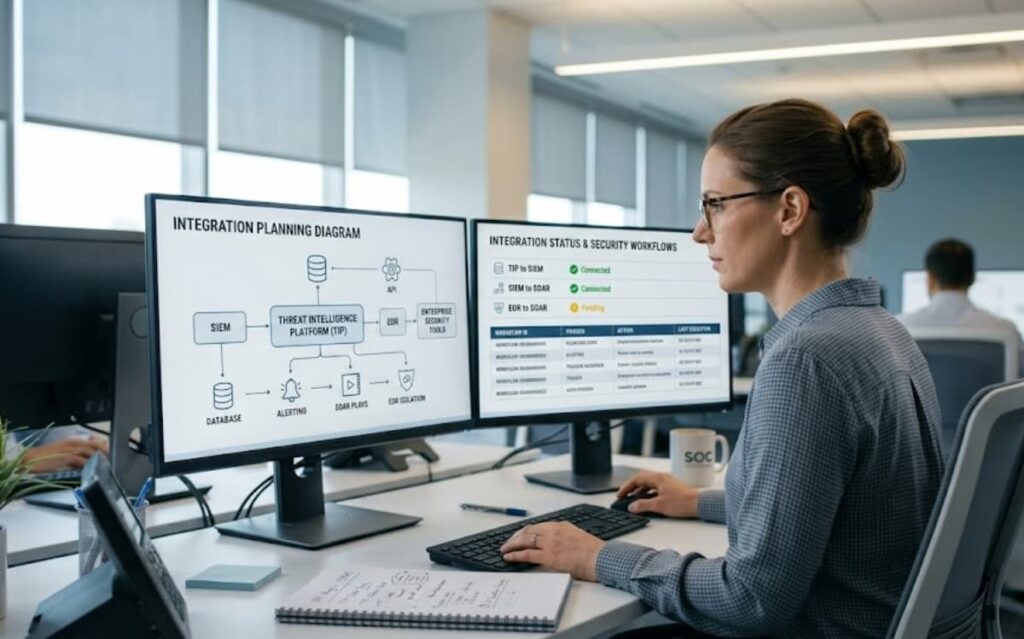
A TIP should fit into the tools an organization already uses.
That sounds obvious, yet it is one of the most common issues we find during product evaluations.
Some platforms look impressive during a demonstration but require significant manual work after deployment. Others support the right integrations from the beginning, making adoption much smoother.
The difference can have a real impact on daily operations.
Which Integrations Should Every Organization Expect?
Most security teams already rely on several technologies.
A TIP should connect with them instead of working on its own.
Key integrations often include:
- SIEM platforms
- SOAR platforms
- EDR solutions
- API support for custom workflows
When these systems exchange information automatically, analysts spend less time moving data between tools. Investigations become more consistent because everyone is working from the same intelligence.
What Problems Happen When Integrations Are Limited?
Poor integration creates extra work.
Analysts may need to copy indicators from one platform to another, repeat the same searches across different tools, or investigate the same alert more than once.
Those small tasks add up quickly.
A TIP should strengthen the security stack that is already in place, helping analysts work faster while making better use of existing technologies. These practical TIP benefits become much more noticeable once intelligence moves smoothly across connected security tools.
How Much Automation Should A TIP Really Provide?
Source: Adam Goss
Automation can save time, but it should never take control away from the people making security decisions.
A good TIP removes repetitive work so analysts can focus on investigating real threats. That is where we usually see the biggest benefit. Analysts spend less time on routine tasks and more time understanding what is happening inside the environment.
Which Security Tasks Are Worth Automating?
Many SOC tasks follow the same process every day. Automating those activities helps teams move faster and keeps investigations more consistent.
Common examples include:
- Alert enrichment
- IOC lookups
- Threat correlation
- Ticket creation
- Threat feed updates
- Response playbook triggers
These tasks do not disappear. They simply require less manual effort.
Which Vendor Evaluation Criteria Should You Prioritize?

Choosing a TIP is a long term investment. Looking only at features or pricing can make different platforms seem very similar.
Once the platform becomes part of daily operations, though, other factors become much more important.
“Cybersecurity risk management is the process of identifying, analyzing, evaluating, and addressing cybersecurity risks to organizational operations, organizational assets, individuals, other organizations, and the Nation.” – National Institute of Standards and Technology (NIST)
What Should You Evaluate Beyond Product Features?
Product demonstrations usually highlight dashboards and advanced capabilities.
Daily operations tell a different story.
Look closely at areas such as:
- Deployment options
- Platform scalability
- Reporting capabilities
- Ease of use
- Workflow customization
A platform with fewer features may still be the better choice if analysts can learn it quickly and use it every day without adding unnecessary steps.
How Do You Compare TIP Vendors Objectively?
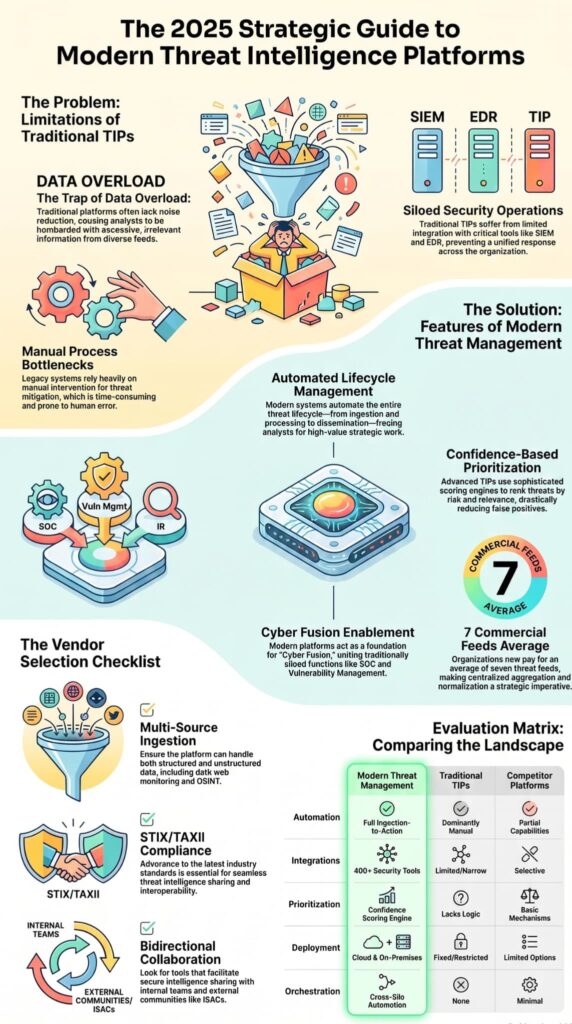
Comparing vendors can become difficult once every sales presentation starts sounding the same.
A structured evaluation helps.
Instead of relying on marketing claims, compare each platform using the same practical criteria. This makes it easier to identify strengths, weaknesses, and how well each solution supports real security operations.
Choosing a threat intelligence platform becomes much more straightforward when every vendor is evaluated against the same operational requirements rather than marketing claims.
Which Questions Belong In Every Vendor Evaluation?
We usually recommend asking questions that focus on daily operations instead of feature counts.
Examples include:
- How current is the threat intelligence?
- How often are feeds updated?
- Does it support API integrations?
- How well does it fit existing workflows?
- What implementation support is available?
- Can the vendor provide customer examples?
These questions often reveal far more than a feature checklist.
Good answers should explain how the platform performs in real environments, not only what it can do in theory.
Why Is A Proof Of Concept Worth The Effort?
A proof of concept gives organizations a chance to test the platform before making a long term commitment.
During a pilot, security teams can see how the TIP works with existing tools, how analysts use it during investigations, and whether it improves daily workflows.
“Threat-informed defense is a continuous process in which defenders and adversaries are constantly learning and evolving. Cyber threat intelligence means knowing the adversary and their tactics, techniques, and procedures, while defensive measures focus on prevention, detection, and mitigation tailored to known threats.” – Center for Threat-Informed Defense (MITRE)
A successful proof of concept should answer practical questions, not marketing ones.
| Evaluation Area | What To Look For |
| Integration | Works with current security tools |
| Intelligence Quality | Accurate and current threat data |
| Analyst Experience | Easy to learn and investigate |
| Workflow Fit | Supports existing SOC processes |
| Performance | Improves investigation speed |
FAQs
What should I prioritize when choosing a TIP vendor solution?
When choosing a TIP vendor solution, prioritize how well the platform supports your organization’s security objectives and operational needs. Review the vendor evaluation criteria, including platform scalability, API integration, security tool integration, deployment options, and technical support. A structured vendor comparison helps your team identify a solution that fits current workflows while supporting future growth.
How can I compare threat intelligence platform vendors effectively?
Compare each threat intelligence platform vendor using consistent and measurable criteria. Assess vendor due diligence, proof of concept results, customer references, service-level agreements, and the product roadmap. This approach makes TIP vendor selection more objective, supports informed purchasing decisions, and reduces the risk of choosing a platform that does not meet long-term operational requirements.
What should I review before starting TIP implementation?
Before TIP implementation, review your organization’s security requirements, existing security tools, and operational workflows. Confirm support for SIEM integration, SOAR integration, EDR integration, and intelligence platform integration. You should also evaluate implementation support, training services, and custom workflows to ensure a smoother deployment process and encourage successful user adoption.
How do deployment options affect a TIP purchasing decision?
Deployment options affect security, compliance, performance, and operational flexibility. Organizations can choose a cloud-based TIP, on-premises TIP, or hybrid deployment based on their infrastructure and business requirements. Evaluate compliance support, data normalization, continuous monitoring, and platform scalability to determine which deployment model best supports your long-term security strategy.
Why is total cost important when selecting a TIP vendor?
The purchase price represents only one part of the investment. A complete cost analysis should include licensing, implementation, maintenance, training, and ongoing support costs to estimate the total cost of ownership. Reviewing these expenses helps organizations calculate the expected return on investment and make more informed cybersecurity procurement decisions.
Choosing the Right TIP Vendor Solution in Fullerton
Picking the right Threat Intelligence Platform isn’t just about features. It should fit the way your security team already works, connect with your existing tools, and help analysts make better decisions without adding extra complexity. A good TIP makes daily operations smoother. That’s what matters most.
If you’re comparing TIP vendors in Fullerton, MSSP Security can help you choose with confidence. Our vendor neutral consulting helps reduce tool sprawl, improve security integration, and build a security stack that fits your operational goals. Backed by more than 15 years of experience and over 48,000 completed projects, we provide practical support from vendor evaluation to implementation planning.
References
- https://csrc.nist.gov/pubs/sp/800/37/r2/final
- https://ctid.mitre.org/our-mission/