


Threat intelligence sharing collaboration helps organizations detect and respond to cyber threats faster by exchanging actionable intelligence with trusted partners.
Sharing indicators of compromise, attacker tactics, and incident insights improves visibility, strengthens collective cyber defense, and supports informed security decisions.
In our experience at MSSP Security, integrating shared intelligence into daily security operations enhances detection without adding unnecessary complexity.
Keep reading to learn how threat intelligence sharing collaboration works, the technologies that support it, and the best practices for implementing it effectively.
What Should You Know About Threat Intelligence Sharing Collaboration?
Understanding the core principles of threat intelligence sharing collaboration helps organizations make better security decisions. Here are the key takeaways:
- Threat intelligence sharing collaboration improves collective cyber defense by enabling organizations to share actionable intelligence, identify threats sooner, and support faster incident response.
- Successful threat intelligence sharing collaboration relies on trusted partnerships, secure information exchange, governance, and standards such as STIX and TAXII to ensure intelligence remains reliable and usable.
- Organizations that embed threat intelligence sharing collaboration into everyday security operations strengthen threat detection, improve response efficiency, and build long-term cyber resilience.
What Is Threat Intelligence Sharing Collaboration?
Threat intelligence sharing collaboration is the practice of exchanging cyber threat information between organizations, trusted partners, and security communities to strengthen collective cyber defense.
Rather than relying only on internal security data, participants share actionable threat intelligence that helps identify threats earlier, validate suspicious activity, and improve incident response.
“Organizations that share cyber threat information can improve their own security postures as well as those of other organizations.” – National Institute of Standards and Technology (NIST)
This reinforces why collaborative intelligence exchange is valuable beyond individual security teams, as shared knowledge helps organizations improve visibility and strengthen defenses across broader communities.
Common intelligence shared includes:
- Indicators of compromise (IOCs), such as malicious IP addresses, domains, and file hashes
- Attacker tactics, techniques, and procedures (TTPs)
- Malware analysis, phishing indicators, and vulnerability intelligence
- Incident findings that help organizations prepare for similar attacks
Unlike one-way threat feeds, threat intelligence sharing collaboration is a continuous exchange where organizations both contribute and consume intelligence. Standards such as STIX and TAXII make this information easier to share across security platforms.
From our experience at MSSP Security, organizations gain the most value when intelligence is validated, enriched with context, and integrated into daily security operations.
As consultants helping MSSPs evaluate and audit security products, we’ve found that focusing on relevant, high-quality intelligence leads to faster investigations, better detection, and more effective collaboration than simply collecting larger volumes of threat data.
Why Organizations Need Cyber Threat Intelligence Sharing?
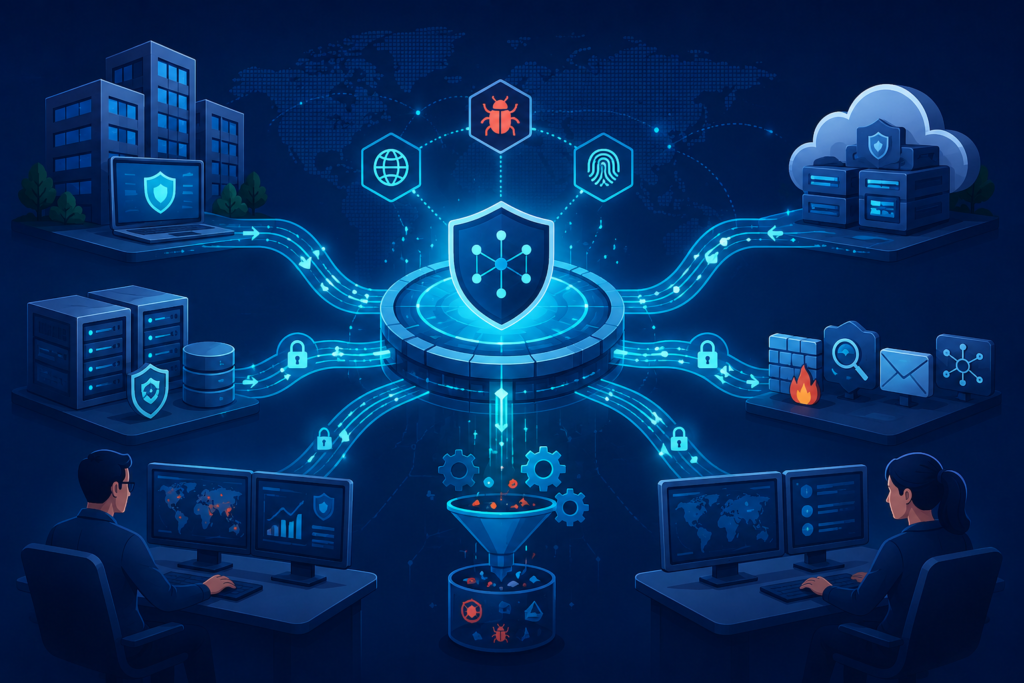
Cybercriminals often reuse the same phishing campaigns, malware, infrastructure, and attacker tactics, techniques, and procedures (TTPs) across multiple targets.
For that reason, cyber threat intelligence sharing plays a critical role in helping organizations identify threats earlier and strengthen threat intelligence sharing collaboration.
Instead of relying only on internal monitoring, organizations can use shared indicators of compromise (IOCs) and verified threat intelligence to improve detection, prioritize investigations, and support an intelligence-led defense.
“By exchanging cyber-threat information within a sharing community, organizations can leverage the collective knowledge, experience, and capabilities of that sharing community to gain a more complete understanding of the threats the organization may face.” – National Institute of Standards and Technology (NIST)
This supports the idea that collaboration provides broader visibility than isolated security monitoring and helps organizations make more informed defensive decisions.
Key benefits include:
- Earlier detection of emerging threats through actionable threat intelligence
- Better visibility with shared indicators of compromise (IOCs) and attacker TTPs
- Faster incident response and more informed security decisions
- Stronger collaboration across trusted security communities
From our experience at MSSP Security, successful intelligence sharing depends on choosing the right tools and processes.
As consultants helping MSSPs evaluate and audit security products, we’ve found that organizations achieve better results when threat intelligence is validated, integrated into daily security operations, and used to support practical detection and response rather than simply increasing the volume of threat data.
What Types of Threat Intelligence Should Organizations Share?
Effective threat intelligence sharing collaboration focuses on sharing actionable threat intelligence that helps organizations detect, investigate, and respond to cyber threats.
Instead of exchanging every security event, organizations prioritize information that strengthens collective cyber defense and improves threat intelligence exchange across trusted partners.
Common types of shared intelligence include:
- Indicators of compromise (IOCs), such as malicious IP addresses, domains, URLs, and file hashes
- Attacker tactics, techniques, and procedures (TTPs) mapped to the MITRE ATT&CK framework
- Malware, phishing, ransomware, and vulnerability intelligence
- Incident findings that improve future detection and response
While IOCs help security teams identify known threats, TTP sharing provides context about attacker behavior, supporting better threat hunting, detection engineering, and shared detections.
Organizations can also improve analysis by visualizing threat actor ttps tip, allowing security teams to better understand attack patterns, adversary behavior, and potential defensive gaps.
Many organizations exchange this intelligence through a threat intelligence platform using standards such as STIX and TAXII for secure, automated sharing.
From our experience at MSSP Security, organizations achieve the best results when intelligence is accurate, contextual, and integrated into daily operations.
As consultants helping MSSPs evaluate and audit security products, we’ve found that high-quality intelligence consistently delivers more value than simply increasing the volume of threat data.
What Are the Key Benefits of Collaborative Threat Intelligence?
Threat intelligence sharing collaboration helps organizations move beyond isolated security data by combining internal insights with cyber threat intelligence sharing from trusted partners.
This broader visibility allows security teams to detect threats earlier, improve decision-making, and strengthen collective cyber defense before attacks spread.
Key benefits include:
- Faster detection through shared indicators of compromise (IOCs) and real-time intelligence sharing
- Better context with TTP sharing and MITRE ATT&CK mapping
- Stronger threat hunting, detection engineering, and shared detections
- Faster investigations and coordinated incident response
Shared intelligence also improves indicator correlation and alert enrichment, helping analysts focus on meaningful threats instead of isolated alerts or duplicate indicators.
By using enriched intelligence and adversary context, security teams can focus on improving threat hunting tip through better investigation workflows, stronger detection logic, and more accurate identification of attacker behavior.
From our experience at MSSP Security, organizations see the greatest value when threat intelligence sharing collaboration is integrated into everyday security operations.
As consultants helping MSSPs evaluate and audit security products, we’ve found that selecting solutions with strong intelligence-sharing capabilities enables teams to consume actionable threat intelligence more efficiently, improve response times, and strengthen long-term cyber resilience without adding unnecessary operational complexity.
What Are the Common Threat Intelligence Sharing Models?
Organizations adopt different threat intelligence sharing collaboration models based on their security goals, industry, and compliance requirements. Each model supports cyber threat intelligence sharing while balancing collaboration, trust, and data protection to strengthen collective cyber defense.
Common sharing models include:
- Information sharing communities for industry and sector-wide collaboration
- Trusted sharing networks that enable secure intelligence exchange between verified partners
- Private sharing groups connecting business units, subsidiaries, and supply chain partners
- Cross-organizational sharing to improve visibility into emerging threats
These models allow organizations to exchange shared threat indicators, incident intelligence, adversary behavior, and vulnerability intelligence while protecting sensitive information through role-based sharing, access-controlled sharing, and clear governance policies.
From our experience at MSSP Security, choosing the right sharing model is just as important as selecting the right technology.
As consultants helping MSSPs evaluate and audit security products, we’ve found that organizations achieve stronger shared situational awareness and more effective threat intelligence sharing collaboration when their intelligence-sharing tools align with operational workflows, security requirements, and trusted partner relationships rather than relying on a single collaboration model.
What Technologies Enable Threat Intelligence Exchange?
Effective threat intelligence sharing collaboration relies on technologies that help organizations collect, standardize, and distribute actionable threat intelligence across security environments.
A structured threat intelligence exchange ensures intelligence is easy to integrate, helping security teams respond faster and make better-informed decisions.
Key technologies include:
- Threat intelligence platforms (TIPs) that centralize intelligence from threat feeds, OSINT, and internal investigations
- STIX and the TAXII protocol for sharing machine-readable threat data
- Threat feed integration, automated intelligence ingestion, and indicator correlation
- Alert enrichment and automated workflows that improve detection and incident response
Understanding how each technology supports threat intelligence sharing collaboration helps organizations evaluate security solutions more effectively and select platforms that align with operational requirements.
| Technology | Primary Function | Contribution to Threat Intelligence Sharing Collaboration |
| Threat Intelligence Platform (TIP) | Collects, organizes, enriches, and distributes threat intelligence | Centralizes intelligence sources and improves visibility across security operations |
| STIX (Structured Threat Information eXpression) | Standardizes machine-readable threat data formats | Enables consistent representation and sharing of threat intelligence |
| TAXII Protocol | Automates exchange of STIX-formatted intelligence | Improves interoperability and supports secure automated intelligence sharing |
| Threat Feed Integration | Connects external intelligence sources with security tools | Provides continuous access to updated threat information |
| Automated Intelligence Ingestion | Imports and processes intelligence automatically | Reduces manual effort and accelerates threat detection workflows |
| Indicator Correlation & Alert Enrichment | Adds context to security alerts | Helps analysts prioritize meaningful threats and reduce investigation time |
These technologies reduce manual effort while improving interoperability between security tools and supporting real-time intelligence sharing.
Organizations can gain additional visibility and operational improvements by understanding Threat Intelligence Platform (TIP) Benefits, especially when selecting platforms that support automated intelligence workflows, data enrichment, and integration across existing security tools.
From our experience at MSSP Security, technology delivers the greatest value when it fits existing security operations. As consultants helping MSSPs evaluate and audit security products, we’ve found that organizations achieve stronger threat intelligence sharing collaboration by selecting platforms that integrate seamlessly with their workflows.
Combining automation with analyst expertise enables faster investigations, more accurate detection, and better long-term security outcomes.
What Are the Best Practices for Secure Intelligence Sharing?
Credit: AI and Technology Law
Effective threat intelligence sharing collaboration requires organizations to share intelligence that is accurate, trusted, and protected. Instead of focusing on data volume, successful programs prioritize actionable threat intelligence supported by strong governance and consistent validation to improve cyber threat intelligence sharing.
Key best practices include:
- Validate shared threat indicators and indicators of compromise (IOCs) through source validation and intelligence quality control
- Define intelligence sharing policy, data handling rules, and sharing policy governance
- Protect sensitive information using role-based sharing, access-controlled sharing, and secure information exchange
- Improve efficiency with automated sharing workflows, threat feed integration, indicator correlation, and alert enrichment
From our experience at MSSP Security, effective collaboration depends on selecting technologies that support both governance and daily operations.
As consultants helping MSSPs evaluate and audit security products, we’ve found that organizations achieve stronger threat intelligence sharing collaboration when automation works alongside experienced analysts, improving detection accuracy, protecting sensitive intelligence, and strengthening long-term intelligence-led defense.
What Challenges Can Limit Threat Intelligence Sharing Collaboration?

Threat intelligence sharing collaboration can significantly improve security, but its success depends on trust, governance, and technology working together. Without these foundations, cyber threat intelligence sharing may produce inconsistent or low-value intelligence instead of actionable threat intelligence.
Common challenges include:
- Maintaining trust through source validation, reputation scoring, and intelligence quality control
- Protecting sensitive information with role-based sharing, access-controlled sharing, and sharing policy governance
- Integrating security tools using STIX, the TAXII protocol, and machine-readable threat data
- Reducing analyst workload with indicator correlation, alert enrichment, and duplicate indicator suppression
From our experience at MSSP Security, organizations often overcome these challenges by selecting technologies that align with existing security operations.
As consultants helping MSSPs evaluate and audit security products, we’ve found that the right platforms, combined with clear governance and analyst oversight, strengthen threat intelligence sharing collaboration, improve shared situational awareness, and support a more effective intelligence-led defense against evolving cyber threats.
How Do We Support Effective Threat Intelligence Sharing?
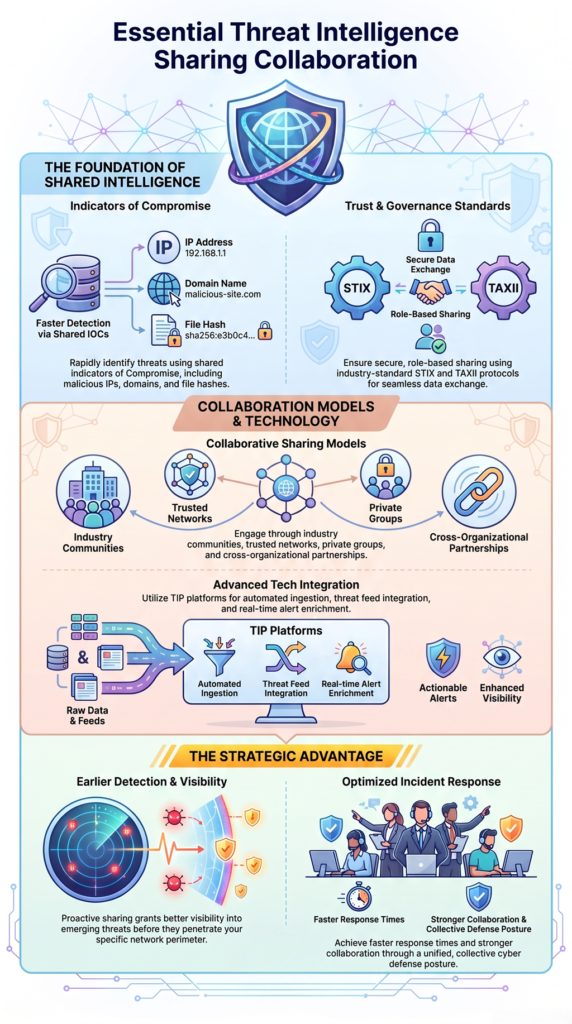
At MSSP Security, we believe threat intelligence sharing collaboration works best when it is integrated into an organization’s broader security strategy.
Effective collaboration requires more than technology. It depends on trusted processes, reliable data, and actionable threat intelligence that security teams can apply quickly.
We help organizations improve cyber threat intelligence sharing by evaluating existing workflows, reviewing intelligence sources, and identifying gaps in threat intelligence exchange. Our approach focuses on selecting and auditing security products that align with operational needs rather than applying a one-size-fits-all solution.
Key areas we support include:
- Threat feed integration and intelligence workflow improvements
- Shared threat indicators validation and data quality checks
- STIX sharing, TAXII protocol, and automated intelligence ingestion
- Governance practices such as intelligence sharing policy and secure information exchange
From our experience helping MSSPs evaluate security solutions, organizations gain the most value when technology supports analyst expertise. Combining the right tools, processes, and validation methods helps improve security operations collaboration, accelerate response, and strengthen long-term intelligence-led defense.
FAQ
What is threat intelligence sharing collaboration?
Threat intelligence sharing collaboration enables organizations to exchange cyber threat intelligence, improve visibility, strengthen collective cyber defense, and respond faster to emerging threats through trusted collaboration.
What information should organizations share?
Organizations should share actionable threat intelligence, including shared threat indicators, IOCs, TTPs, malware insights, phishing indicators, vulnerabilities, and incident data to improve detection.
How do STIX and TAXII improve threat intelligence exchange?
STIX sharing and the TAXII protocol standardize threat intelligence exchange, automate threat data exchange, improve interoperability, and support efficient intelligence integration.
How can organizations securely share threat intelligence?
Secure threat intelligence sharing collaboration requires governance, access-controlled sharing, role-based sharing, secure information exchange, and validation processes to protect sensitive intelligence.
What are the biggest challenges in collaborative threat intelligence?
Challenges in collaborative threat intelligence include trust, data quality, confidentiality, platform integration, and managing intelligence volumes through source validation and governance.
How does MSSP Security help organizations improve threat intelligence sharing?
At MSSP Security, we help MSSPs evaluate and audit security products, improve threat intelligence sharing collaboration, strengthen threat feed integration, and support intelligence-led defense.
How Can Threat Intelligence Sharing Collaboration Strengthen Cyber Defense?
Threat intelligence sharing collaboration helps organizations improve cybersecurity by combining internal insights with cyber threat intelligence sharing from trusted sources. Access to actionable threat intelligence, shared threat indicators, and adversary insights supports faster detection and response.
At MSSP Security, we help MSSPs evaluate and audit security products to improve intelligence workflows, tool selection, and integration.
Through vendor-neutral consulting, organizations can strengthen shared situational awareness and build a more effective intelligence-led defense.
References
- https://csrc.nist.gov/pubs/sp/800/150/final
- https://www.nist.gov/publications/cyber-threat-intelligence-and-information-sharing