

Your MSSP’s value isn’t just measured in blocked threats, but in the absence of your client’s panic. A strong client communication protocols mssp is what ensures that. It’s the difference between a partner they rely on and a vendor they tolerate.
We’ve watched relationships shatter over a poorly delivered alert, and we’ve seen others solidify into unbreakable trust because the message was clear, calm, and controlled. This is how you build the latter. Keep reading to transform your communication from an afterthought into your strongest security layer.
What You Need to Remember
Before diving into tools, channels, or incident playbooks, it’s important to understand the core ideas that shape effective MSSP communication.
- A documented communication strategy aligns your team and the client, preventing confusion before an incident even occurs.
- Designated points of contact and secure, reliable channels are non-negotiable foundations for daily and crisis talks.
- Proactive expectation management through regular, plain-language updates builds more trust than any post-incident report.
Your MSSP Client Communication Strategy: The Blueprint Before the Storm
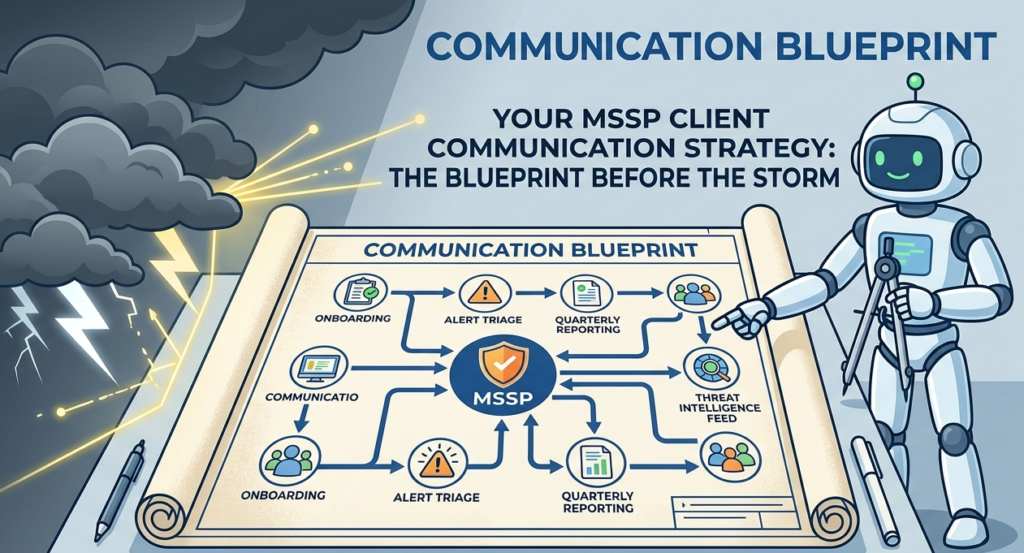
We learned this the hard way, early on. You can have the sharpest tools, the brightest analysts, but if you can’t talk to the client in a way they understand, it all crumbles. A communication strategy isn’t a section in a contract. It’s the operating manual for your partnership.
“A persistent governance risk in outsourcing cybersecurity operations is reduced visibility and a gap between external execution and internal accountability.” – ResearchGate
It answers the “who, when, and how” for every type of conversation, from a routine patch update to a full-scale breach. Without it, you’re just reacting. With it, you’re leading.
The strategy starts with a simple, uncomfortable question: “What does your client actually need to know?” Not what your SIEM can spit out, but what keeps their CEO up at night. Is it operational downtime? Data exposure? Regulatory fines? Your communication cadence and content must map to their business risks, not your technical curiosities.
We sit down at the very start and define this together. It’s the first step in building a shared language.
Establishing Communication Channels Your MSSP and Client Will Actually Use
Credits: Pratham Gupta
Communication channels are about guarantee, not convenience. Email is great for paper trails, terrible for urgency. A text might get seen, but it lacks context. Your channel strategy must be layered.
We establish three primary lanes, each with a strict purpose. This prevents the “alert fatigue” where everything feels like an emergency, or worse, the critical alert that gets buried in a busy inbox.
For daily operational chatter, a secure ticketing portal or messaging app works. It’s asynchronous, trackable. For scheduled strategic reviews, it’s video calls. The face-to-face matter, even digitally, for building rapport. But for critical incident notification, you need a channel that screams.
We use a dedicated, secure messaging platform with mandatory read receipts, backed by an automated voice call. The protocol dictates that if the message isn’t acknowledged in five minutes, the phone tree activates. It seems excessive, until the night it isn’t.
The Incident Notification Communication Process: No Surprises, Ever
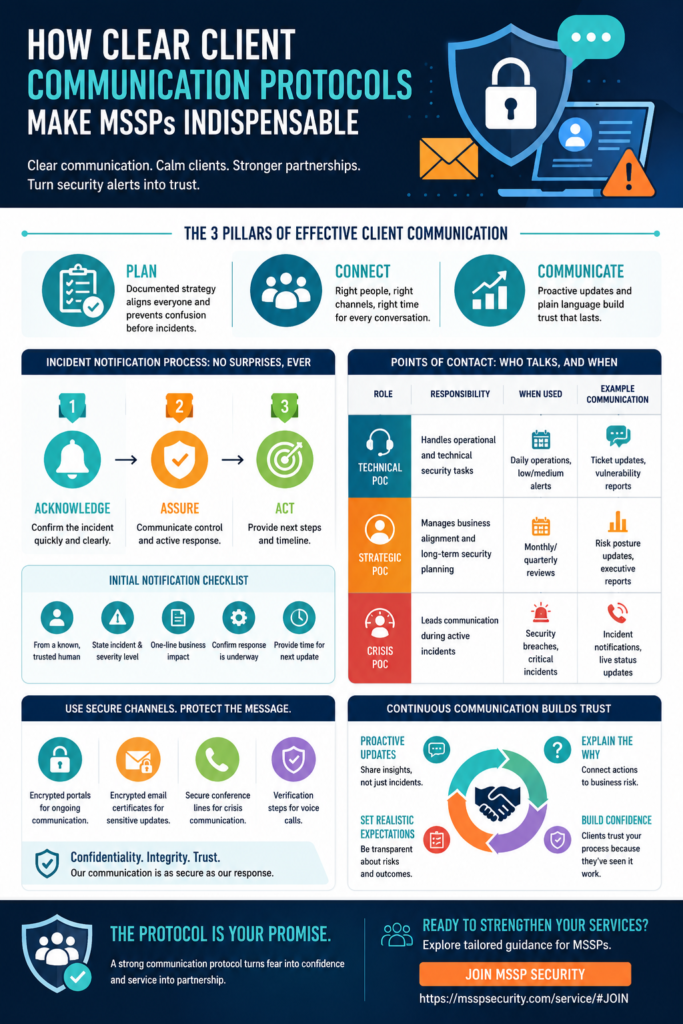
This is the heartbeat of the protocol. When something bad happens, the client’s first notification should never be a surprise. It should be a expected, calm confirmation of a plan in motion. Our process is built on a simple mantra: Acknowledge, Assure, Act.
The moment our SOC confirms an incident meeting pre-defined thresholds, the notification engine fires. Not from a robot, but from the assigned client lead. The message follows a strict template we’ve pre-approved with the client. It looks something like: “[Client Name], this is [Name] from MSSP Security.
We have declared a [Severity Level] security incident involving [Brief, Non-Technical Description]. Our team is actively containing the issue. You do not need to take action at this moment. We will have our first update call in 30 minutes at [Dial-in Link].”
This does three things immediately: it names the problem, it shows control, and it sets the next touchpoint. The fear of the unknown is the worst part, and this kills it.
Initial Notification Checklist:
- Message originates from a known, trusted human name.
- States incident declaration and severity level.
- Provides a one-line, business-impact description.
- Confirms active response is underway.
- Gives exact time for next update.
Communication During a Security Crisis: Clarity Over Speed
The first alert is just the opening note. The crisis communication that follows is a symphony, and you’re the conductor. Speed is important, but clarity is king. After that initial blast, the protocol shifts to a regular, predictable cadence. Even if there’s no new news, you communicate that. Silence breeds panic.
We move to a dedicated, secure conference bridge for the duration. Every 60 to 90 minutes, the client lead or a technical spokesperson provides a bulleted update: what we’ve done, what we’re doing, what we’re seeing. We tell them what they can share with their own teams. We provide them drafted internal statements.
Our job is to be the calm in their storm, to give them the words when theirs are failing. This isn’t about being heroes, it’s about being a pillar. We’ve been on calls where our steady cadence of updates was the only thing that kept a client’s leadership team from making a disastrous, public overreaction.
Defining Points of Contact: Who Talks, and When
A single point of contact is a single point of failure. Your strategy needs a matrix. We define and socialize a clear roster with our clients, so everyone knows their role. It typically breaks down into three tiers.
| Role | Primary Responsibility | When They Are Used | Example Communication |
| Technical Point of Contact | Handles operational and technical security tasks | Daily operations, low/medium alerts | Ticket updates, vulnerability reports |
| Strategic Point of Contact | Manages business alignment and long-term security planning | Monthly/quarterly reviews | Risk posture updates, executive reports |
| Crisis Point of Contact | Leads communication during active incidents | Security breaches, critical incidents | Incident notifications, live status updates |
The Technical Point of Contact handles the day-to-day. They’re discussing tickets, vulnerability scans, and low-severity alerts. The Strategic Point of Contact, often a vCISO or senior advisor, handles the monthly business reviews, risk discussions, and contract talks. Then there’s the Crisis Point of Contact.
This is a senior member of our team, available 24/7, whose only role during an incident is client communication. They are not troubleshooting the firewall. They are translating the technical battle into a business narrative for the client’s leadership. This separation is critical. It ensures the message is clear and the client feels prioritized.
Secure Communication Methods That Protect the Message
You can’t shout secrets in a crowded room. Discussing an active breach over standard email or consumer-grade chat is a recipe for disaster. The method must be as secure as the advice. We insist on using encrypted channels for all security-sensitive communication. This isn’t just about confidentiality, it’s about integrity.
The client needs to know without a doubt that the message “all clear” is genuinely from us, not from an impersonator.
For most ongoing communication, we use a client-specific channel within our secure portal, which offers end-to-end encryption. For crisis communication, we maintain pre-provisioned, encrypted email certificates and secure conference lines that don’t require public dial-ins. We also agree on code words or verification steps for voice calls in extreme scenarios.
It sounds like spycraft, but in a social engineering world, verifying “who’s on the other line” is a basic control. We provide simple guides to the clients on using these tools, turning a potential technical hurdle into a demonstration of our thoroughness.
Managing Client Expectations Through Continuous Communication
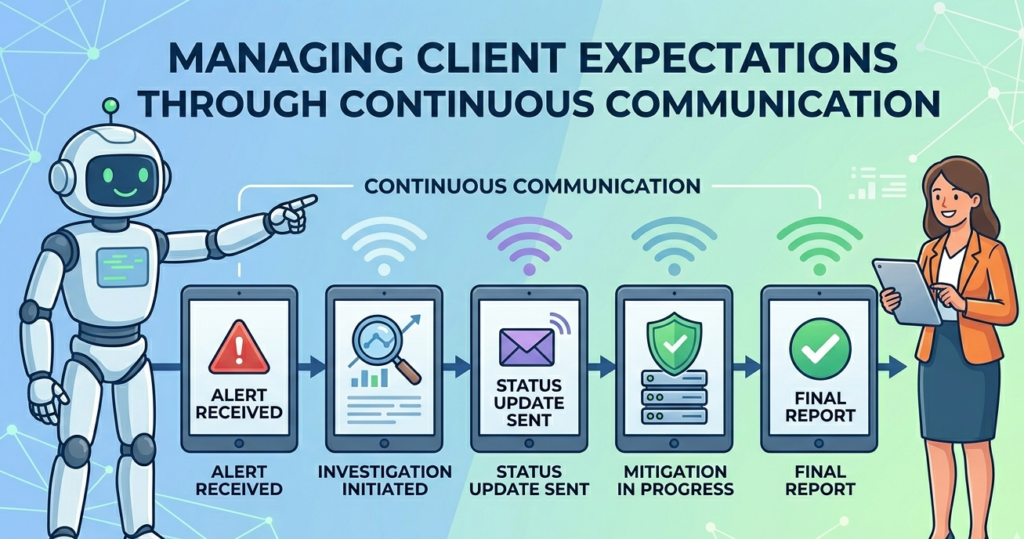
Managing client trust is built in the quiet moments between the storms. If the only time a client hears from you is when something is wrong, you are, by definition, a bearer of bad news. Proactive, expectation-setting communication changes that entire dynamic.
It’s the monthly review where you show the landscape of attempts blocked. It’s the quarterly briefing where you explain how their risk profile is changing and why you’re adjusting a control.
“In technology outsourcing, client communication quality directly drives trust development, coordination effectiveness, and long-term ecosystem relationship stability.” – ResearchGate
We make it a point to explain the “why” behind our actions. “We’re implementing this new detection rule because we’re seeing this specific threat target your industry.” This transforms you from a cost center into a strategic advisor.
You’re also setting realistic expectations: “No system is 100% secure, but here is our mean time to detect and respond, and here’s how we’re improving it.”
This honesty, delivered consistently, means that when an incident does occur, the client isn’t blindsided. They understand it’s a risk they accepted, and they have confidence in your documented process to handle it. They’ve seen the protocol work in drills. They believe in it.
FAQ
How important is communication in MSSP services?
Communication is critical in MSSPs because it directly impacts client trust, incident response clarity, and overall service perception beyond just technical performance.
What is the biggest mistake MSSPs make in client communication?
The most common mistake is over-technical, unclear, or delayed incident updates that increase client panic instead of reducing it.
Why do MSSPs need structured communication protocols?
Structured protocols ensure every incident, update, and interaction follows a consistent, predictable system that reduces confusion and improves response coordination.
How does communication improve client trust in cybersecurity services?
Consistent, transparent, and proactive communication reassures clients that threats are being managed effectively, even when they cannot see the technical actions directly.
The Protocol Is Your Promise
Ready to turn your communication protocol into a real operational advantage? We help MSSPs strengthen operations through expert consulting, vendor-neutral tool selection, and stack optimization that reduces complexity and improves visibility.
With 15+ years of experience and 48K+ projects delivered, we support you from needs analysis to PoC and final recommendations. Explore tailored guidance and take the next step in building a more resilient security service by joining our program here today securely now platform: Join MSSP Security
References
- https://www.researchgate.net/publication/405355873_Outsourcing_Cybersecurity_Governance_Risks_of_Managed_Security_Service_Provider_MSSP_Dependence_in_Healthcare_Organizations?__cf_chl_tk=GvDhNwfV24cIBN9Xd_.6NgJcVQJbVj9u7l0KK3DE8aY-1780496843-1.0.1.1-9adGX22vbUXFNrHoqiQ9uvoPjoFp3TT3Kg79I20DDKo
- https://www.researchgate.net/publication/404303038_Beyond_code_How_client_communication_defines_success_in_software_outsourcing
Related Articles
- https://msspsecurity.com/mssp-client-communication-strategy/
- https://msspsecurity.com/establishing-communication-channels-mssp/
- https://msspsecurity.com/incident-notification-communication-process/
- https://msspsecurity.com/communication-during-security-crisis/
- https://msspsecurity.com/defining-points-contact-mssp/
- https://msspsecurity.com/secure-communication-methods-mssp/
- https://msspsecurity.com/managing-client-expectations-communication/