

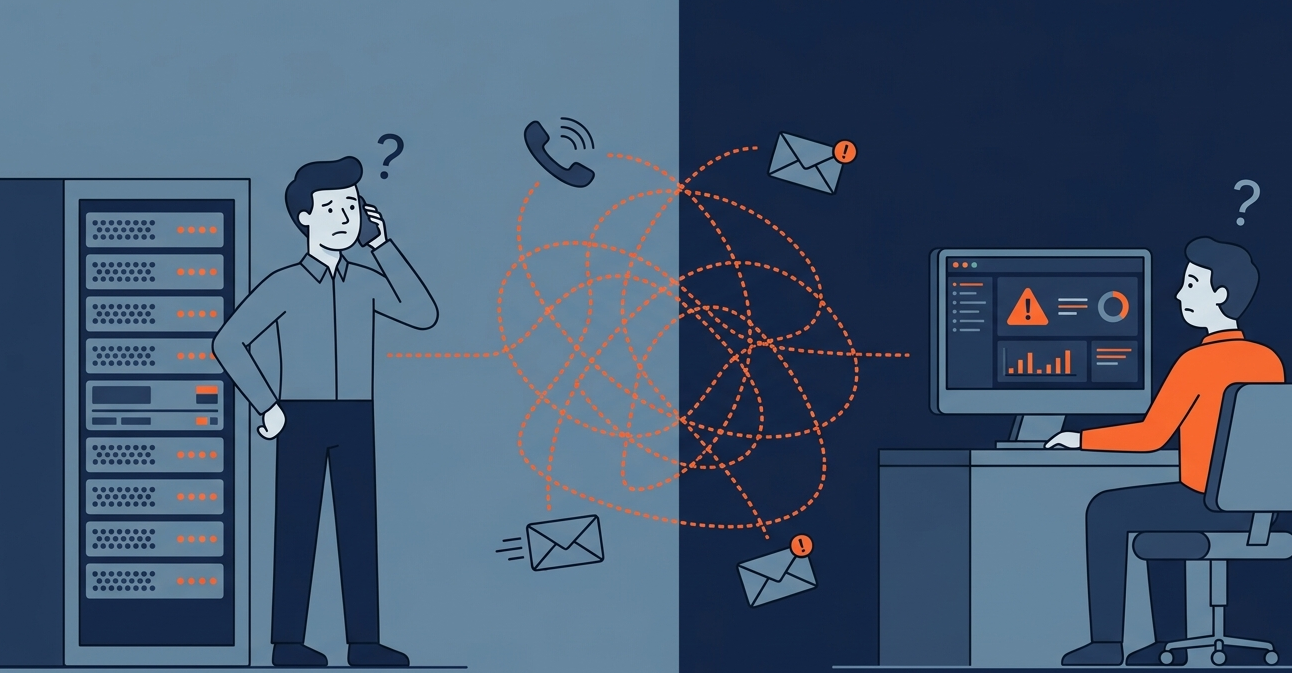
When you partner with MSSP Security,, you’re buying more than software. You’re buying a team. But if your people don’t know who to call on that team during a crisis, the best tools won’t help. Minutes matter. That’s why defining your main contacts is crucial. It stops the frantic search for the right person. It creates a direct line for action.
This clear path for communication is what turns a vendor relationship into a reliable partnership. The technology monitors the threats; the people you talk to manage the response. Keep reading to know defining points contact MSSP
What You Need to Know
Before we dive deeper, here are the key lessons that can help improve communication and accountability with your MSSP.
- You must name the single person accountable for your account’s strategic security health.
- You require a dedicated, 24/7 technical team for urgent threats, not a general support line.
- Clear rules for daily operational chatter prevent minor issues from becoming major problems.
Why Do Defined Points of Contact Matter in an MSSP Partnership?
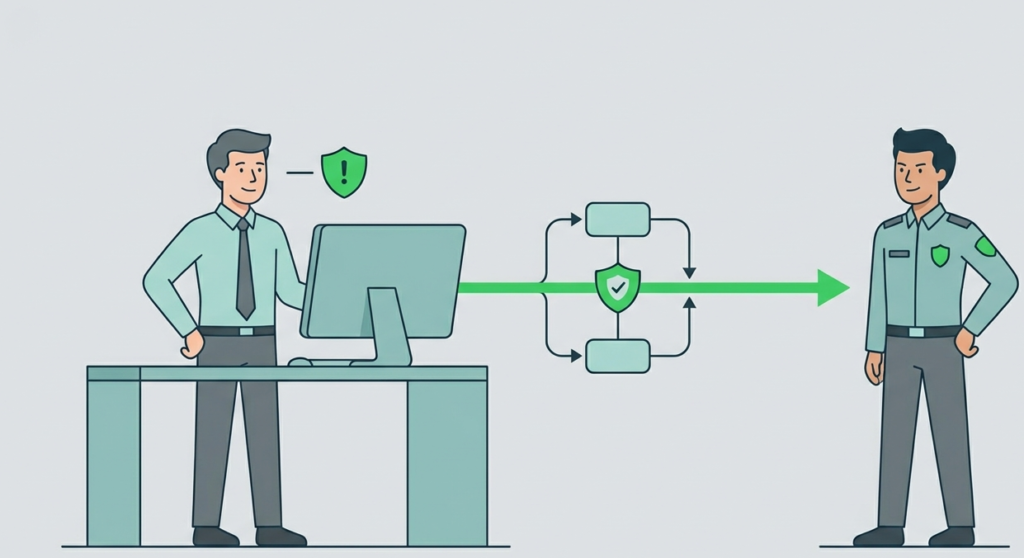
I remember sitting in a client’s war room, the air thick with that particular strain of panic that only a live breach can produce. The technical lead was on the phone, his voice climbing, “I need your incident commander, now!” The voice on the other end was polite, professional, and utterly useless.
“Sir, I’ve created a ticket, priority high. The on-call engineer will be notified.” Notified. Not responding. That gap, between a ticket number and a human being with authority to act, felt wider than any firewall.
“Independent empirical studies have noted that communication disconnects between dedicated technical groups and organizational stakeholders are a persistent bottleneck in cyber readiness, emphasizing that ‘establishing constant and streamlined communication’ is vital to filling critical gaps in incident response.” – Aldabjan et al., 2024 / SciTePress
It was the moment I understood that establishing strict client communication protocols with your MSSP isn’t just about administrative setup. An MSSP isn’t a magic box you plug in. It’s a chain of human decisions, and every link needs a name, a face, and a direct line.
The contract had service level agreements (SLAs), sure. It promised 24/7 monitoring and response. But it never specified who responds, how they escalate to whom on our side, and where the casual, daily coordination happens. We were connected to a service, but not to people.
Who Should Serve as Your Strategic Point of Contact?
Credits: Reformed Forum
This is not your sales representative. That relationship often fades after the ink dries. The strategic point of contact is someone who understands your business objectives, your risk tolerance, and the narrative of your security posture over quarters and years, not just days. They are your guide and your advocate inside the MSSP.
Without this defined person, your security strategy becomes reactive and fragmented. You’ll get monthly reports, but no one to explain what the trends mean for your upcoming merger. You’ll have tools, but no one to advise if they’re still the right fit for your new cloud infrastructure. The relationship defaults to a transactional, ticket-based interaction, leaving long-term risk unaddressed.
At MSSP Security, we assign a dedicated Client Security Principal to every account. This person’s job is to know your environment and your goals.
What this role must own:
- Quarterly business reviews (QBRs) that tie security metrics to business goals.
- Translating board-level risk concerns into actionable security plans.
- Advocating for your needs within the MSSP’s own resource planning.
A vague contact here means your security has no true north. It drifts.
What Responsibilities Should a Strategic Contact Own?
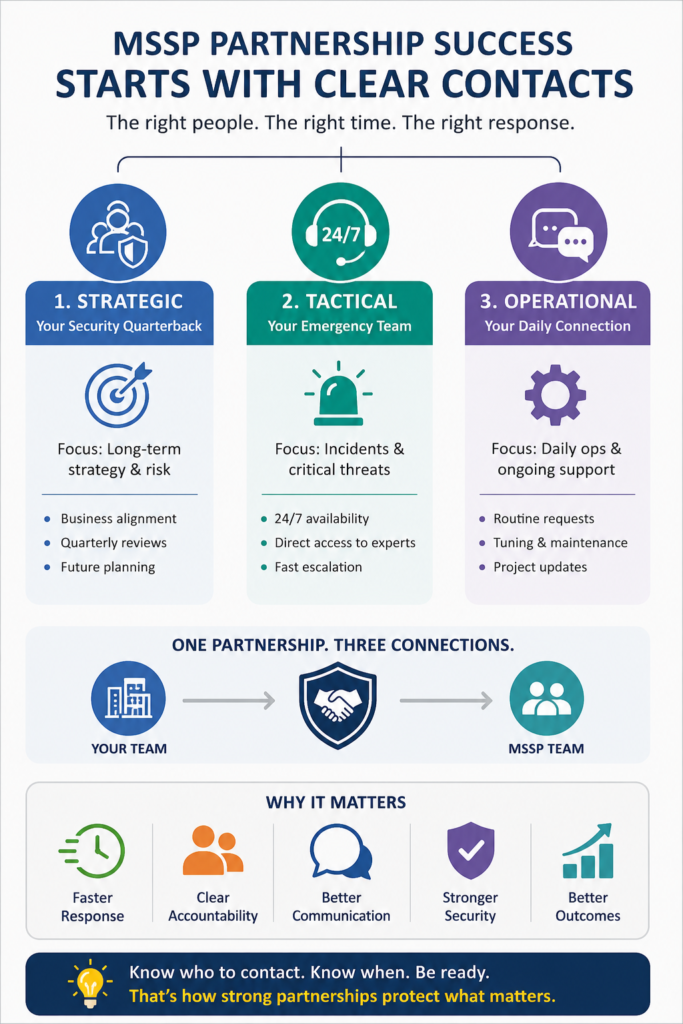
When your SIEM lights up with a critical alert at midnight on a holiday, you cannot be searching for a phone number or debating which email alias to use. The tactical point of contact is a dedicated, staffed channel for urgent security incidents. This is your direct line to the Security Operations Center (SOC) analysts and incident responders who will act.
This is often the most dangerously undefined area. Many contracts point to a generic support desk. But a support desk handles password resets and software installs. You need a team trained in cyber kill chain analysis, one that speaks the language of indicators of compromise (IOCs) and tactical response playbooks.
Without a predetermined incident notification and communication process, valuable remediation windows shrink. The difference is the difference between containing a threat in minutes and reading about your data on a leak site tomorrow.
We operate a separate, secured hotline and portal exclusively for critical security incidents. It bypasses all general support queues. When you call, you are speaking immediately to a Tier 2 or Tier 3 SOC analyst who already has your environment context on screen. They aren’t logging a ticket; they are initiating a documented response procedure, with you on the call.
The channel must guarantee:
- Immediate human response, not automated call routing.
- Access to senior analysts with decision-making authority.
- A unified, real-time incident war room for joint response.
Confusion at this point multiplies the damage of an attack. Clarity here is your best insurance.
Who Handles Critical Security Incidents at Any Hour?
Not everything is a five-alarm fire. Most of security is maintenance, tuning, and coordination. The operational point of contact is the agreed-upon channel for this daily rhythm, scheduling vulnerability scans, discussing false positives, coordinating system updates, or sharing new project plans that affect the security perimeter.
If you use the strategic channel for this, you overwhelm your quarterback with noise. If you use the tactical channel, you dilute its urgency and risk a real alert being missed. This operational layer needs its own home, a shared space like a dedicated messaging channel (e.g., Slack, Teams) or a designated operations email alias monitored by both teams.
“Organization D describes that some organizations should find out how to effectively integrate an external party… on the other extreme are the organizations that need the outsource partner to provide all the resources… According to Organization D, the latter case is the most difficult case to integrate… because people that are potentially not familiar with the organization, who don’t know who all the players are, they have to learn about it on the fly. These difficulties can delay the response to an incident.” – Academic Master’s Thesis from Aalto University (Finland)
The rules of engagement for this space are crucial. Define expected response times (e.g., 4 business hours), the types of requests that belong here, and who from each team is present.
This prevents minor issues from festering and builds the day-to-day muscle memory of partnership. It’s where the relationship between your sysadmins and our SOC engineers becomes seamless.
| Contact Point | Purpose | Channel Examples | Expected Response Time |
| Strategic | Long-term risk & business alignment | Scheduled QBRs, Executive calls | Defined per meeting agenda |
| Tactical | Active security incidents & critical threats | Dedicated hotline, Secure incident portal | Immediate (<5 mins) |
| Operational | Daily coordination, tuning, & maintenance | Shared chat channel, Designated ops email | Within 4 business hours |
What Makes an Effective Tactical Point of Contact?
Clearly defined contacts reduce confusion during both routine operations and emergencies. Knowing who owns each link eliminates internal friction and ensures smooth communication during a security crisis. Every request reaches the right person without delays.
Benefits include:
- Faster incident response.
- Better accountability.
- Improved communication.
- Fewer misunderstandings.
- Stronger collaboration between teams.
When everyone understands their role, security processes become more efficient and predictable.
How to Review Your MSSP Contact Structure?
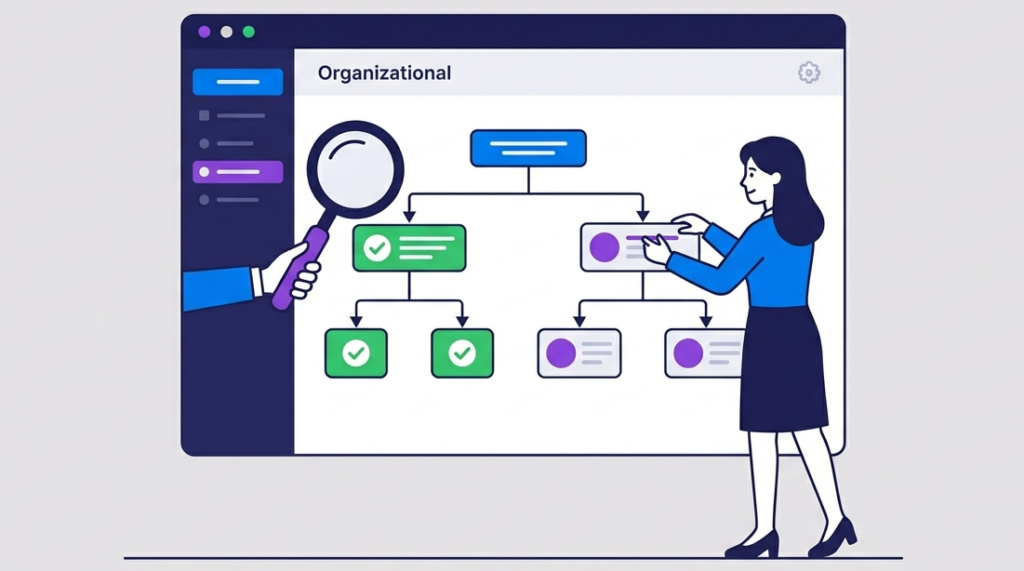
Many organizations establish contacts when signing a contract but never review them again. Team members change roles, companies grow, and communication needs evolve.
Review your contact structure at least once a year by asking:
- Are all contacts still active?
- Are emergency phone numbers current?
- Does everyone understand escalation procedures?
- Are communication channels working effectively?
Regular reviews help keep your MSSP partnership prepared for future challenges.
FAQ
What is a point of contact in an MSSP partnership?
A point of contact is a designated person or team responsible for communication between your organization and the MSSP. Different contacts may handle strategy, incident response, or daily operations.
Why are multiple points of contact necessary?
Different situations require different expertise. Strategic planning, emergency response, and routine operations have unique communication needs that should be handled separately.
How often should MSSP contact information be reviewed?
Most organizations should review contact information at least annually and whenever major staffing changes occur.
What happens if points of contact are not clearly defined?
Undefined contacts can cause delayed responses, communication failures, confusion during incidents, and increased security risks.
The Right Contact Can Make All the Difference
A clear contact list is one of the easiest ways to get more from your MSSP. It means the right people talk at the right time, whether you’re planning a new project or dealing with an active alert. Setting strategic, tactical, and operational contacts leads to faster action and better results. Good security needs strong processes and people, not just strong technology.
If your current tech stack isn’t delivering the clarity or integration you need for this kind of partnership, expert guidance can help. We provide vendor-neutral consulting to help MSSPs reduce tool sprawl, improve integration, and build a stack that actually supports their operations.
References
- https://www.scitepress.org/Papers/2024/124876/124876.pdf
- https://aaltodoc.aalto.fi/server/api/core/bitstreams/d45f93cb-1064-49f8-8f7b-76aae796b806/content#11#6