

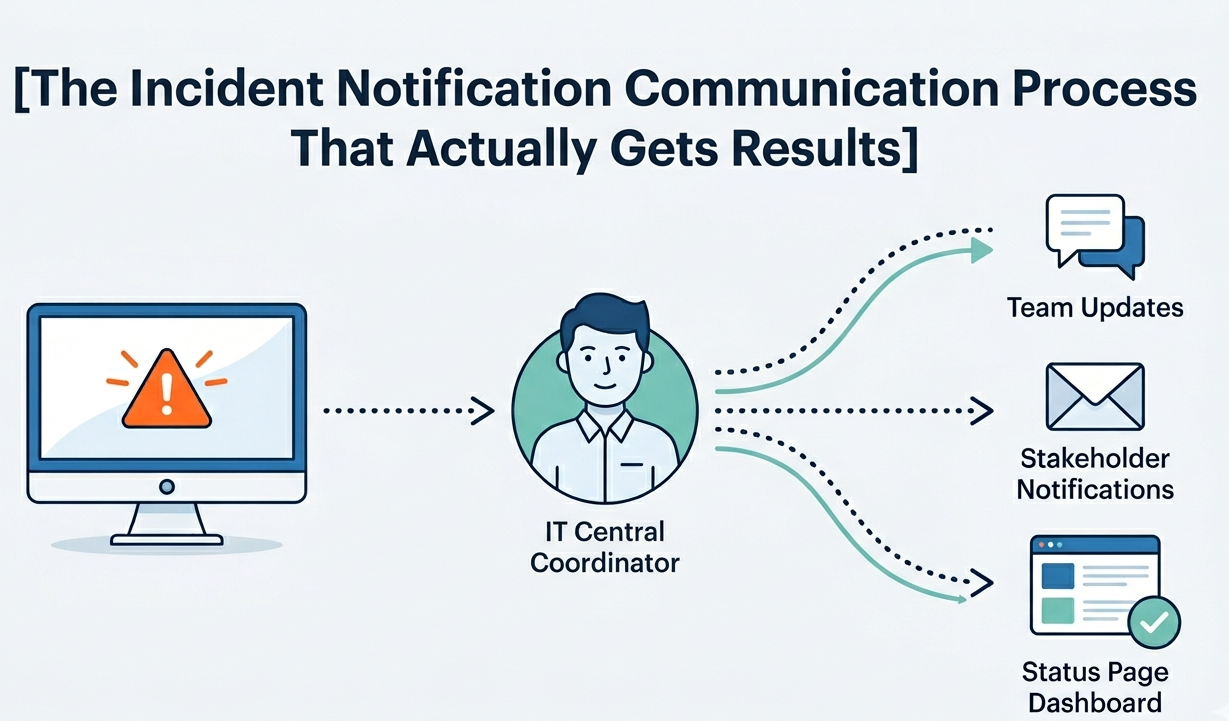
You hear the alert. Your heart jumps. There’s been an incident. Maybe it’s a data leak, a ransomware hit, or a suspicious login from halfway across the globe. The next ten minutes matter more than the next ten hours. What you do now, who you tell, and how you tell them defines the entire event.
The difference between a contained blip and a full-blown catastrophe often isn’t the firewall, it’s the communication. A solid incident notification communication process isn’t about paperwork, it’s about control. Keep reading to see how to build one that works when the screens are flashing red.
The Three Rules That Keep Incidents Under Control
These three principles help teams stay organized, keep stakeholders informed, and prevent confusion from making a bad situation worse
- A pre-defined notification checklist prevents panic and ensures critical first steps aren’t missed.
- Tailoring the message for each audience, technical team, executives, legal, maintains trust and enables action.
- Practicing the process through simulations exposes flaws and builds team confidence before a real crisis.
The Moment It All Goes Sideways
I remember the first major incident I witnessed. It wasn’t the code, or the malware signature, that failed. It was a human silence. Someone saw something weird, didn’t know who to tell, and figured it could wait. That hour of silence cost more than any software license ever could.
It taught me that an incident response plan without a watertight communication process is like a fire station without an alarm. It’s just a building full of hoses. The process starts before the incident, it’s a set of understood pathways burned into muscle memory. When the heat is on, you don’t think, you act.
You need a map for the first chaotic minutes. A simple, unbreakable checklist.
Initial Notification Checklist
- Confirm the incident is real (no false alarms).
- Activate the primary response team via pre-set channel (e.g., secure chat).
- Notify the Incident Commander immediately.
- Begin a dedicated, time-stamped log for all actions and decisions.
This list seems obvious, right. But under pressure, obvious things vanish. I’ve seen engineers start debugging a compromised server before telling anyone, a heroic instinct that just gives the threat more room to breathe. The first notification is inward, to your own team. It’s the muster point. Everything flows from there.
Timing Is Everything in Incident Communication
Credits: Quantum Safety
One of the biggest mistakes during a security incident is waiting too long to communicate. Teams often hesitate because they want perfect information before sending an update. In reality, stakeholders usually prefer a timely update with limited details over complete silence. Early communication creates trust and prevents rumors from filling the information gap.
“Timely disclosure, message consistency, and proactive stakeholder engagement are essential for effective incident management.” – JRACR
A simple message acknowledging the situation, outlining what is currently known, and explaining the next update timeline can significantly reduce uncertainty. The goal is not to have every answer immediately. The goal is to demonstrate awareness, control, and active management of the situation from the very beginning.
Speaking in Tongues: One Incident, Many Audiences
Once the team is scrambling, you have to look outward. This is where most processes fall apart. You send a frantic, technical deep-dive to the CEO and watch their eyes glaze over with panic.
Or you send a vague “we’re investigating something” to your legal counsel, who then assumes the worst. The message must fit the listener. It’s not one notification, it’s several, crafted for purpose.
For the technical response team, your communication is a firehose of data. IP addresses, affected hostnames, log snippets, mitigation steps attempted. It’s raw and rapid, usually in a secure chat room. For executive leadership, you need the “so what.”
Impact on business operations, potential customer effect, estimated time to resolution, and what you need from them (usually budget or authority). Legal needs to know about data disclosure, regulatory implications, and the paper trail. Customers, if they must be told, need clear, actionable advice on their risk and your support.
Crafting these parallel messages simultaneously is impossible on the fly. That’s why you need templates. Not to sound robotic, but to ensure the crucial points, the liability points, the operational points, are never forgotten in the rush. We learned this the hard way at MSSP Security when refining our client communication protocols.
Early on, we’d be so focused on containment that a crucial regulatory notification clock would almost run out. Now, part of our process is triggering those template drafts with the initial alert, so they’re ready for review within the first 30 minutes.
Incident Communication Matrix
Not every stakeholder needs the same information during an incident. A structured communication matrix helps teams deliver the right message to the right audience at the right time, reducing confusion while ensuring critical decisions can be made quickly.
The table below outlines a practical framework for managing communications across key stakeholder groups.
| Audience | Primary Concern | Information Needed | Recommended Update Frequency |
| Technical Response Team | Containment and remediation | Indicators of compromise, affected systems, mitigation actions, technical findings | Continuous or real-time |
| Executive Leadership | Business impact and risk | Operational disruption, financial impact, customer impact, recovery timeline | Every 30–60 minutes |
| Legal and Compliance | Regulatory obligations and liability | Data exposure details, compliance requirements, documentation records | As significant findings emerge |
| Customers and Partners | Personal or business risk | Service impact, protective actions, support resources, status updates | Based on incident severity |
| Public Relations Team | Reputation management | Approved messaging, stakeholder concerns, media inquiries | As communication milestones occur |
The Practice That Feels Like Play
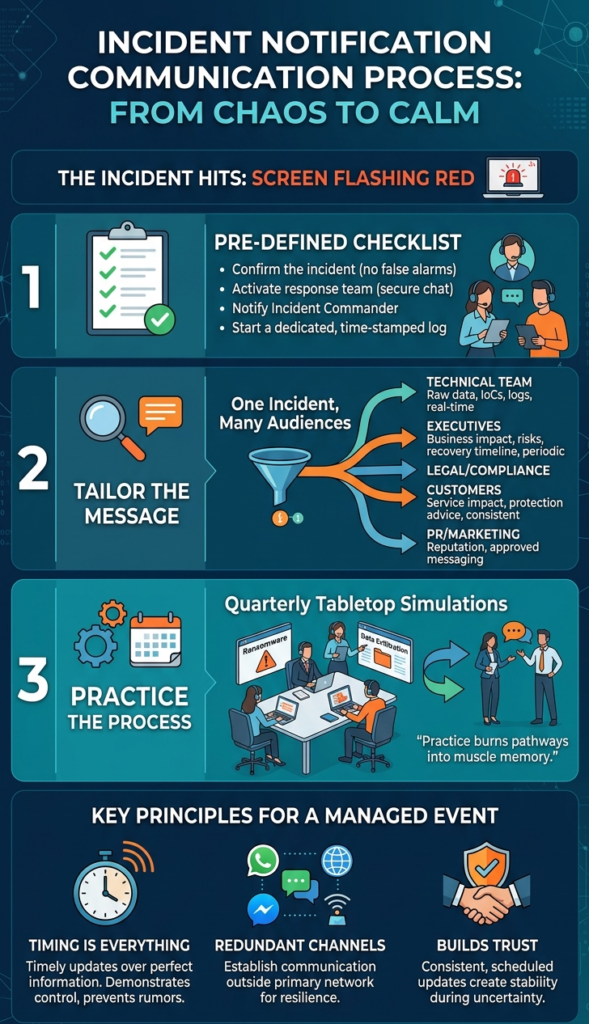
A process in a binder is a fiction. A process you’ve practiced is a capability. We run tabletop simulations quarterly, each one a different scenario. A ransomware attack on a client’s billing system. A privileged insider exfiltrating data. A DDoS attack taking a customer portal offline. The goal isn’t to solve the technical puzzle, it’s to stress-test the communication lines.
You see who instinctively reaches for the checklist. You hear the awkward pauses when someone has to draft the “hypothetical” executive update. You discover that the number you have for the lead forensics analyst is out of date. These simulations feel awkward, even silly, until they don’t.
“Being prepared, being organized, and following incident response best practices are factors that help incident responders cooperate effectively.” – SEI.MCU.EDU
Until the day a real alert pops for a client, and you hear the team lead say, “This is like the Q3 tabletop. Comms team, start draft A for internal, draft C for client execs. I’ll confirm scope.” That’s the sound of a machine working.
The rhythm of practice builds a cadence for real response. It moves communication from a reactive, after-the-fact task to a proactive, guiding function. This proactive alignment is exactly what transforms a standard workflow into a resilient client communication strategy, allowing you to steer the response rather than chase the incident.
Tools Are Just Talkative Paperweights
People get obsessed with the platform. The shiny notification system with all the bells and whistles. It’s just a tool. If you haven’t defined who gets what message and when, the tool will just automate the confusion. The process dictates the tool, not the other way around. That said, the right tool can make a good process frictionless.
You need a central, secure, and accessible log. A place where every observation, every decision, every outgoing message is recorded with a timestamp. This isn’t for blame, it’s for clarity. In the fog of war, people forget what was said. The log is the single source of truth.
You also need reliable, redundant notification channels. If your secure chat is hosted in the same environment under attack, you’re already lost. Taking a deliberate approach to establishing communication channels outside your primary network is non-negotiable for secure command control.
At MSSP Security, we view our communication tools as critical infrastructure. They’re tested more than anything else. Because we’ve seen what happens when they fail.
You get a team of smart people standing around, wondering what to do next, while a threat actor is having the time of their life. The tool’s job is to vanish, to become an invisible conduit for the plan you already made.
Building Trust Through Consistent Updates
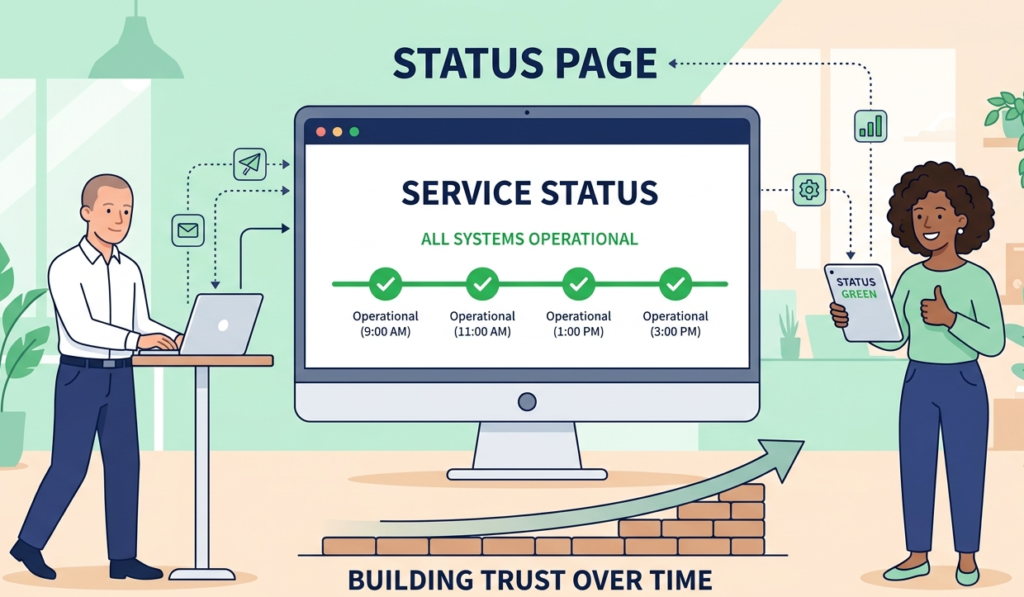
Communication during an incident should never be a one-time event. Stakeholders become more confident when they receive regular updates, even if there is little new information to report. Consistency shows that the response team remains engaged and transparent throughout the investigation.
Scheduled updates also reduce interruptions because executives, customers, and partners know when to expect new information. This allows technical teams to focus on containment and recovery rather than answering repeated status requests.
A predictable communication rhythm creates stability during uncertainty and helps everyone involved make better decisions based on accurate, current information rather than assumptions.
FAQ
How quickly should an incident be reported internally?
The initial internal notification should happen as soon as a potential incident is identified. Teams should avoid waiting for complete confirmation or full technical details before alerting the appropriate response personnel. Early notification allows investigation, containment, and decision-making to begin immediately while additional information is gathered.
Who should be notified first during a security incident?
The first notifications typically go to the incident response team and the designated Incident Commander. Once the response process is activated, communications can expand to executive leadership, legal teams, compliance personnel, customers, partners, or regulators depending on the severity and nature of the incident.
How often should stakeholders receive incident updates?
Update frequency depends on the audience and incident severity. Technical teams may require continuous communication, while executives often benefit from structured updates every 30–60 minutes during active response. The key is maintaining a predictable cadence so stakeholders remain informed without overwhelming responders.
Why are incident communication templates important?
Templates help teams communicate quickly and consistently during high-pressure situations. They ensure critical information is included, reduce the risk of omissions, support regulatory compliance requirements, and allow responders to focus on containment and recovery rather than drafting messages from scratch during a crisis.
From Chaos to Calm: The Outcome of Clarity
A strong incident notification communication process does more than improve response times, it strengthens trust, accountability, and resilience across your organization. When communication flows smoothly, teams stay focused, stakeholders remain informed, and decisions are made with confidence rather than panic.
If you’re looking to refine your incident response strategy, MSSP Security provides expert consulting to help MSSPs optimize operations, reduce tool sprawl, improve visibility, and build processes that support long-term success.
References
- https://www.jracr.com/index.php/jracr/article/view/564
- https://www.sei.cmu.edu/library/communication-among-incident-responders-a-study/