

Your most sensitive data is only as secure as the weakest channel used to discuss it. We’ve watched companies encrypt their databases while sharing credentials over standard email, or use a secure portal for tickets but leak incident details on a public Slack channel. The tools your Managed Security Services Provider (MSSP) uses are built for secrecy, but the human process around them often isn’t.
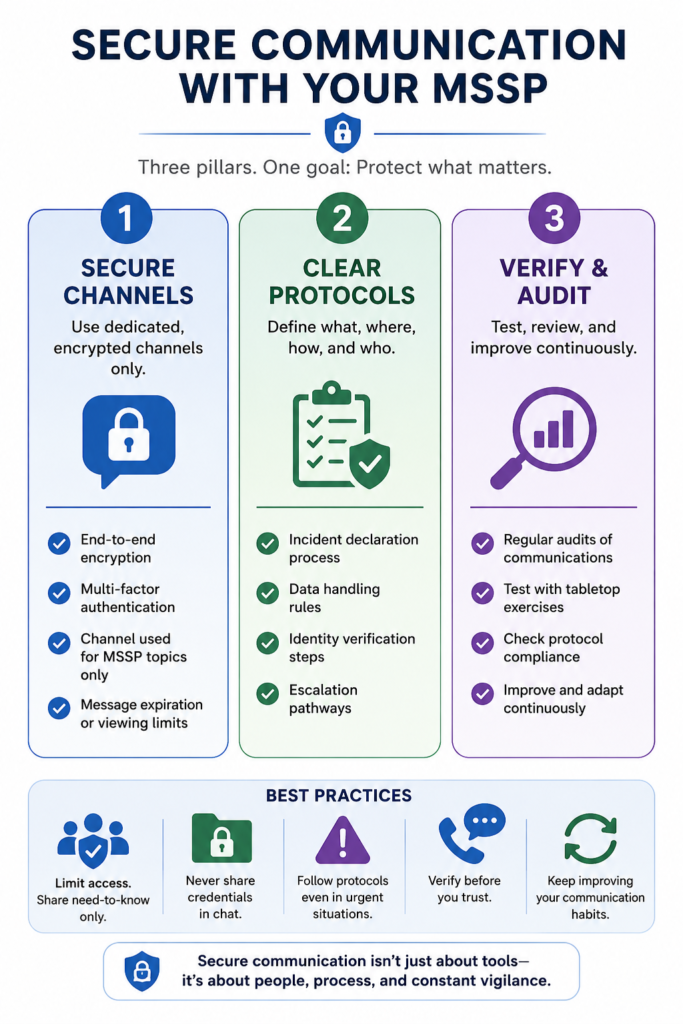
At MSSP Security, we’ve seen firsthand how communication failures can undermine even the strongest cybersecurity programs. True security requires three intertwined methods working together: fortified channels, ironclad protocols, and continuous verification. Keep reading to understand how secure communication methods MSSP.
What Secure MSSP Communication Really Comes Down To
Before diving deeper, remember that secure communication methods MSSP are not defined by encryption alone.
- You must use dedicated, encrypted channels separate from all other business communication.
- Every interaction needs a clear protocol dictating what to share, where, and how.
- Security is a habit, reinforced by regular audits and testing of your communication flows.
Why Secure Communication Matters More Than Most Teams Realize
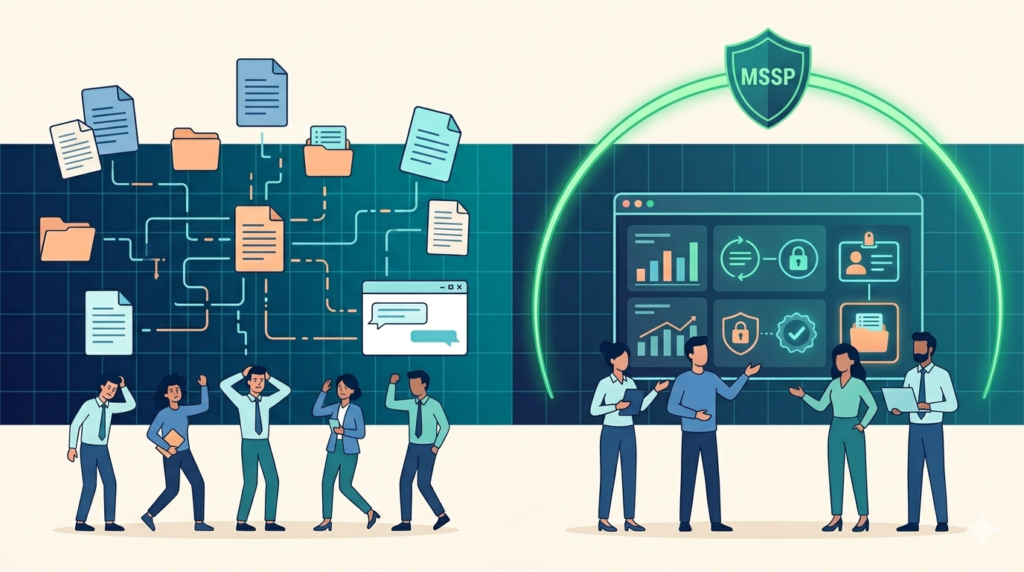
I once had to deliver the worst kind of news. A client’s internal chat logs, detailing their initial panic and response to a breach, had been leaked. The irony was corrosive. They’d hired a top-tier MSSP for protection, but the post-incident discussion about the attack, the very metadata of their response, was what got exposed.
It wasn’t a failure of their firewall or their endpoint detection. It was a failure of method. They used a convenient, company-wide channel for speed, not a secured, isolated one for safety.
That moment cemented a rule for us: secure communication during security crisis events isn’t a feature, it’s the foundational protocol of the entire partnership. Without it, you’re building a vault and leaving the blueprints on a park bench.
The relationship with your MSSP is unique. You are sharing network diagrams, vulnerability reports, incident evidence, and sometimes credentials. This isn’t typical vendor correspondence. It’s the crown jewels of your operational intelligence. Treating it like any other business chat is a profound, and common, mistake.
At MSSP Security, we start every engagement by defining not just what we will protect, but how we will talk about protecting it. The channel is as critical as the content.
How Should Organizations Choose Secure Communication Channels?
Credits: IronEdge Group
This is where most teams think they have it covered. “We use email.” But standard email is like a postcard. It passes through countless systems, and while transit encryption helps, the copies sitting in ‘Sent’ folders are often vulnerable. The same goes for mainstream collaboration platforms unless specifically configured for isolated, encrypted workspaces.
The channel must be purpose-built or rigorously configured for confidential exchange. It should offer end-to-end encryption, meaning only the sender and the intended recipient can decrypt the message. Even the provider shouldn’t have the key.
Platforms like Signal for direct messaging or dedicated, on-premise portals fit this bill. More importantly, these channels must be isolated. They should be used exclusively for MSSP communication. No mixing in birthday party planning or lunch orders.
We provide clients with access to our secure, isolated collaboration environment from day one. It’s a walled garden. Nothing in or out mixes with general traffic. This isolation is the first, most physical barrier against accidental exposure or credential harvesting from other, less secure parts of your digital life.
Your channel checklist must include:
- End-to-end encryption for data at rest and in transit.
- Access controlled by multi-factor authentication (MFA).
- A clear, written policy that this channel is for MSSP use only.
- The ability to set message expiration or enforce viewing limits.
A shared Google Doc or a default Teams channel doesn’t cut it. The channel itself is a statement of intent.
What Communication Protocols Should Every MSSP Partnership Have?
A secure channel is useless if the protocol for using it is loose. A protocol answers the questions: What type of information goes where? Who initiates contact for what? How do we verify identity in a crisis? Without this, you have a locked door, but everyone shouts the password across the street.
The most critical protocol is for incident response. It must define the exact method for declaring a Severity 1 event. Is it a call to a specific number? A keyword in a specific portal? This protocol must bypass all normal ticketing queues.
Another protocol governs data sharing. Sending a sensitive file? The protocol should mandate it is encrypted before being placed in the channel, with the passphrase sent via a separate, pre-agreed method (like a brief phone call). This “out-of-band” verification for the most sensitive items adds a crucial layer.
At our firm, we co-author a structured document detailing specific client communication protocols with each partner. It’s a living guide. It specifies that all incident alerts go through the secure portal, triggering an immediate SMS to the response team. .
Core protocols to define:
- Incident Declaration: The single, unambiguous action that triggers high-priority response.
- Data Classification & Handling: What constitutes “Restricted” data and the exact steps for sharing it.
- Verification Procedures: How to confirm identities during sensitive or urgent exchanges.
- Escalation Paths: When and how to move a discussion from an operational to a strategic channel.
Protocols turn a secure tool into a secure system.
Why Are Verification and Communication Audits Essential?
Security isn’t a state you achieve, it’s a behavior you maintain. The final method is the practice of regularly checking your own work. Are the protocols being followed? Is the isolated channel actually being used for everything, or are people slipping back to email for “quick questions”? You have to look.
“The gap between an event’s occurrence and official notification is often used by those impacted by that event to verify what is happening before taking action… This pause is the amount of time it takes to verify what has happened before messages are received and before reaction can begin… Getting a message seen and getting a message believed seem to be the two issues that designers must overcome. This is important because even if these processes of verification and attention are improved by even a few seconds, this faster response can save lives.” – Peer-reviewed academic chapter from IGI Global (2023)
This means scheduled audits. Every quarter, someone should review a sample of communications with the MSSP. Are sensitive attachments being encrypted pre-upload? Are incident discussions staying in the secure war room? It also means testing.
Conduct a table-top exercise where you simulate a breach and deliberately use the defined protocols. You’ll find the gaps in the calm of a simulation, not the chaos of a real event.
We build this into our service. Part of our quarterly review isn’t just about threat metrics, it’s about process health. We’ll ask, “Did any credentials get shared outside the vault this quarter?” We’ll suggest a communication drill.
| Communication Method | Its Primary Role | Key Action for the Client | Common Pitfall to Avoid |
| Secure, Isolated Channels | Provides the encrypted “room” for conversation. | Enforce exclusive use for all MSSP topics. | Letting general business chat bleed into the secure space. |
| Formalized Protocols | Defines the “rules of engagement” for the room. | Regularly drill the incident declaration process. | Having protocols that are documented but never practiced or reviewed. |
| Verification & Audit | Ensures the room and rules are used correctly. | Schedule quarterly reviews of communication logs. | Assuming that because a tool is in place, it is being used properly. |
What Communication Mistakes Create Security Gaps?
Even organizations with mature cybersecurity programs can undermine their defenses through poor communication habits. The problem isn’t always the technology. More often, it’s the shortcuts people take when speed feels more important than security.
One common mistake is using personal messaging apps or standard email to discuss security incidents. Employees may believe they’re helping move things along faster, but they’re actually creating additional attack surfaces and leaving sensitive information outside approved environments.
“MSS platform is a complex environment where different stakeholders, including authorized MSSP personnel and customers’ own users, have access to the same platform but with different types of rights and tasks… Sharing such data among these large entities is believed to improve their effectiveness and efficiency at tackling cybercrimes, via improved analytics and insights. However, MSS platform customers currently are not able or not willing to share data among themselves because of multiple reasons, including privacy and confidentiality concerns, even when they are using the same MSS platform.” – IEEE Conference on Communications and Network Security (CNS)
Another frequent issue is oversharing information. Not everyone involved in a project needs access to incident reports, credentials, or vulnerability details. Following the principle of least privilege applies to communication just as much as it applies to system access.
Common communication mistakes include:
- Sharing credentials through chat messages.
- Discussing incidents in public or company-wide channels.
- Using personal devices without proper security controls.
- Failing to verify identities during urgent requests.
- Bypassing established communication procedures for convenience
Building a Security-First Communication Culture

Technology and protocols are only effective when people consistently follow them. That’s why creating a security-first culture is just as important as implementing secure communication tools.
Leadership plays a critical role in setting expectations. When executives and managers follow communication protocols themselves, employees are more likely to take them seriously. Security becomes part of daily operations rather than a task reserved for incident response situations.
Training is equally important. Employees should understand not only what the rules are but why they exist. When teams see how communication failures have contributed to real-world breaches, they become more invested in following secure practices.
Regular communication drills can help reinforce these habits. By practicing response procedures during simulated incidents, organizations can identify weaknesses and build confidence before an actual emergency occurs.
A strong communication culture includes:
- Ongoing security awareness training.
- Explicitly defining points of contact to handle designated escalation paths.
- Routine incident-response exercises.
- Leadership support for security policies.
- Continuous improvement based on audit findings.
The strongest secure communication methods MSSP partnerships depend on people, processes, and technology working together. When secure communication becomes part of organizational culture, protecting sensitive information becomes second nature.
FAQ
What are secure communication methods in MSSP services?
Secure communication methods MSSP use include encrypted messaging platforms, secure client portals, multi-factor authentication (MFA), identity verification procedures, and documented communication protocols. These measures help protect sensitive security information from unauthorized access or accidental exposure.
Why should MSSP communication be separated from regular business communication?
Security-related discussions often involve incident details, vulnerability reports, credentials, and network information. Using dedicated communication channels reduces the risk of sensitive information being mixed with everyday conversations and helps maintain stronger access controls.
How can organizations verify they are communicating with the right person during a security incident?
Organizations should establish identity verification procedures before an incident occurs. This may include code words, approved contact lists, callback verification, multi-factor authentication, or secure portal confirmations to ensure communications are legitimate.
How often should secure communication processes be tested and reviewed?
Communication processes should be reviewed at least quarterly. Organizations should conduct audits, tabletop exercises, and incident-response simulations to ensure channels, protocols, and verification methods remain effective and are being followed correctly.
Making Secure Dialogue Second Nature
When communicating with your MSSP, security must be seamless, not cumbersome. Deliberate channel design, clear protocols, and regular practice ensure critical intelligence stays protected. Convenience tools leave trails, but encrypted, isolated rails secure your posture. Don’t let a single leak undermine your entire investment.
We offer expert consulting to help MSSPs optimize tech stacks, streamline operations, and boost visibility. Ready to elevate your security and align your tools with operational maturity? Join us today.
References
- https://www.igi-global.com/viewtitlesample.aspx?id=309887&ptid=306207&t=more+than+milling:+the+pause+to+verify+during+crisis+events#1#1
- https://ieeexplore.ieee.org/document/6047128/citations?tabFilter=papers#citations