

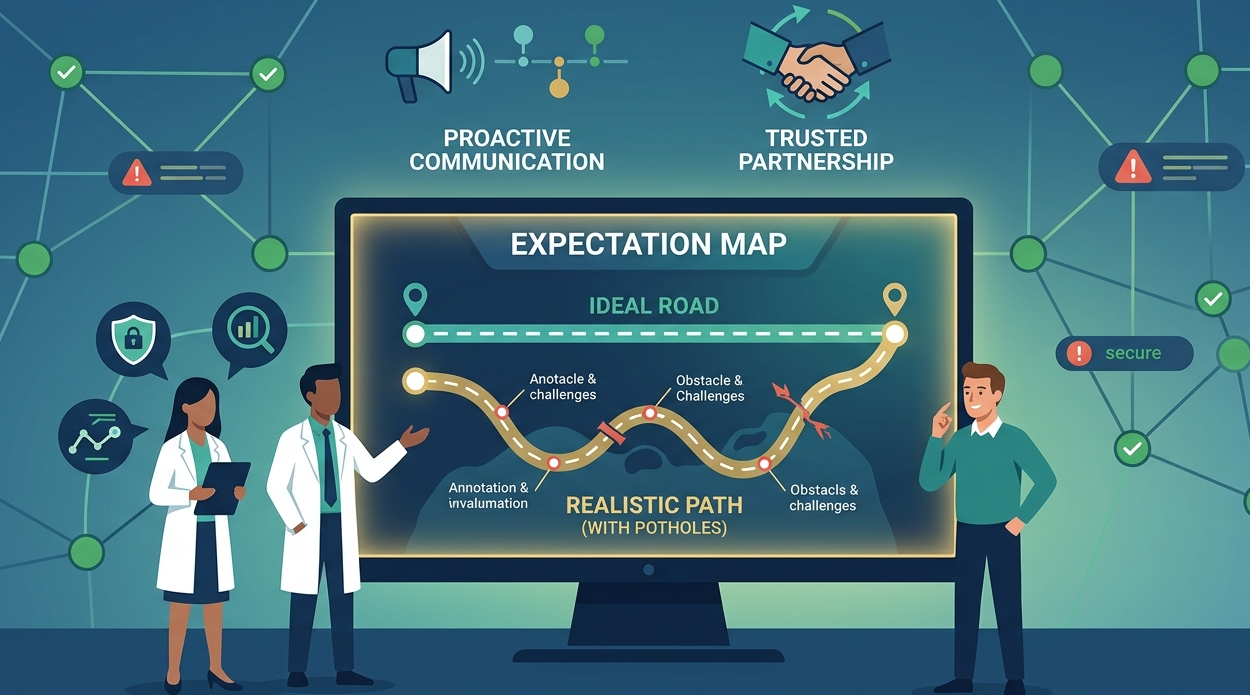
You keep clients by telling them the truth, even when it’s uncomfortable. That’s the core of managing expectations. At MSSP Security, we’ve learned that strong client relationships are rarely built on perfect results. They’re built on honest communication, realistic commitments, and consistent follow-through.
If you can master that single skill, you’ll transform frustrated customers into loyal partners. Let’s talk about how to do it, and why it’s the only thing that really works. Keep reading to see how managing client expectations communication.
What You’ll Discover in This Guide
Before we dive into the strategies, it’s important to understand one simple truth: clients don’t expect everything to go perfectly.
- Proactive, honest communication prevents small issues from becoming relationship-ending crises.
- Setting clear, documented expectations from the start aligns your goals and prevents misunderstandings.
- Regular, structured check-ins build trust and turn clients into collaborative partners.
Why Managing Expectations Starts Before Problems Appear
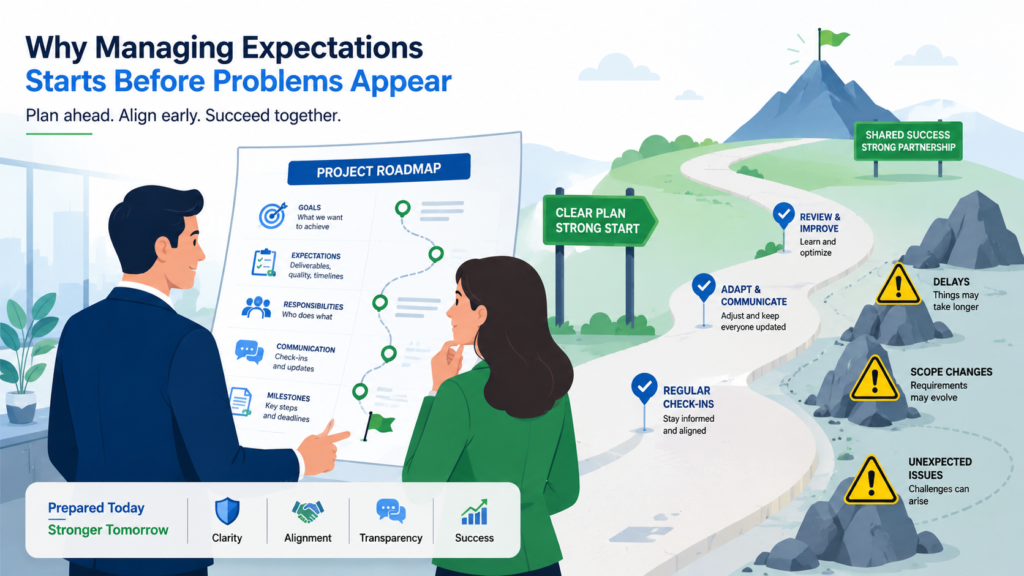
We still remember one of the earliest lessons that shaped our approach to client communication.. It wasn’t about a massive failure, some catastrophic breach. The security dashboard was green, the reports were clean. The issue was a single, unflagged anomaly that their internal team spotted before we did. They weren’t angry about the anomaly, those happen. They were furious about the silence.
The gap between what they expected, total, omniscient oversight, and what we were actually providing created a vacuum, and that vacuum filled with distrust. We hadn’t managed expectations, we’d avoided a crucial conversation. That lesson, learned the hard way, reshaped everything we do at MSSP Security.
Managing expectations isn’t a soft skill, it’s the technical foundation of client retention. You can have the best tools, the sharpest analysts, but if your client feels surprised or left in the dark, none of it matters. The relationship crumbles. So how do you build it right? You start before the contract ink is dry.
How Should Businesses Set Expectations During Client Onboarding?
The sprint to onboard a new client is where most of the future problems are either created or prevented. Everyone’s excited, eager to see value. That energy is good, but it’s dangerous if it leads to vagueness.
We make a simple pact during onboarding. We show them our playbook, literally. We walk through our standard operating procedures for alerts, escalation paths, and reporting windows.
We explain what “24/7 monitoring” really means: it’s not a person staring at their network every second, it’s automated systems pinging human analysts based on priority. We also detail the specific secure communication methods used to relay these critical alerts safely. That’s a technical detail, but sharing it is an act of trust.
We also define what success looks like, together. It’s not us dictating terms. We ask: “What keeps you up at night?” The answer isn’t always “compliance.” Sometimes it’s “I don’t want to get a frantic call from the CFO on a Sunday.” That’s a measurable, human expectation we can build into our plan.
A critical part of this phase is the Service Level Agreement (SLA). But an SLA shouldn’t be a gotcha document buried in appendix C. We treat it as the core expectation-setting tool. We review key parts visually:
| Expectation Area | What We Commit To | What This Looks Like in Practice |
| Initial Response Time | Acknowledgement of a high-severity alert within 30 minutes. | An analyst is paged, investigates, and sends a “We’re on it” update via our portal and email. |
| Regular Reporting | A detailed threat landscape report delivered by the 5th of each month. | The report includes trends, mitigated incidents, and clear, jargon-light recommendations for your team. |
| Strategic Review | A quarterly business review (QBR) to align on goals. | A 60-minute video call reviewing past performance and adjusting priorities for the next quarter. |
This table isn’t just for them. It’s for us. It’s the benchmark we hold ourselves to. Putting it in plain language, early on, removes the “I thought you were going to…” conversations later.
Why Is Active Listening Essential for Client Communication?
Credits: She Means Business
Communication is not only about sharing information. It is also about understanding what your clients need, expect, and worry about. Many misunderstandings happen because businesses focus on explaining their perspective without fully listening to the client.
Practice active listening during meetings, calls, and email conversations. Ask clarifying questions, confirm your understanding, and encourage clients to share feedback. When clients feel heard, they are more likely to trust your recommendations and work collaboratively when challenges arise.
“Actively listening to clients’ concerns enables service providers to pinpoint underlying problems and tailor their responses to meet both the customers’ current needs and emotional requirements.” – International Journal of Research and Innovation in Social Science
Simple habits such as summarizing key discussion points, repeating agreed-upon action items, and addressing concerns promptly can prevent confusion before it becomes a problem. Effective managing client expectations communication depends as much on listening as it does on speaking.
Why it matters:
- Helps identify potential issues early.
- Builds stronger client relationships.
- Reduces misunderstandings and misaligned expectations.
- Creates a more collaborative and productive partnership.
How Does Proactive Communication Build Client Trust?
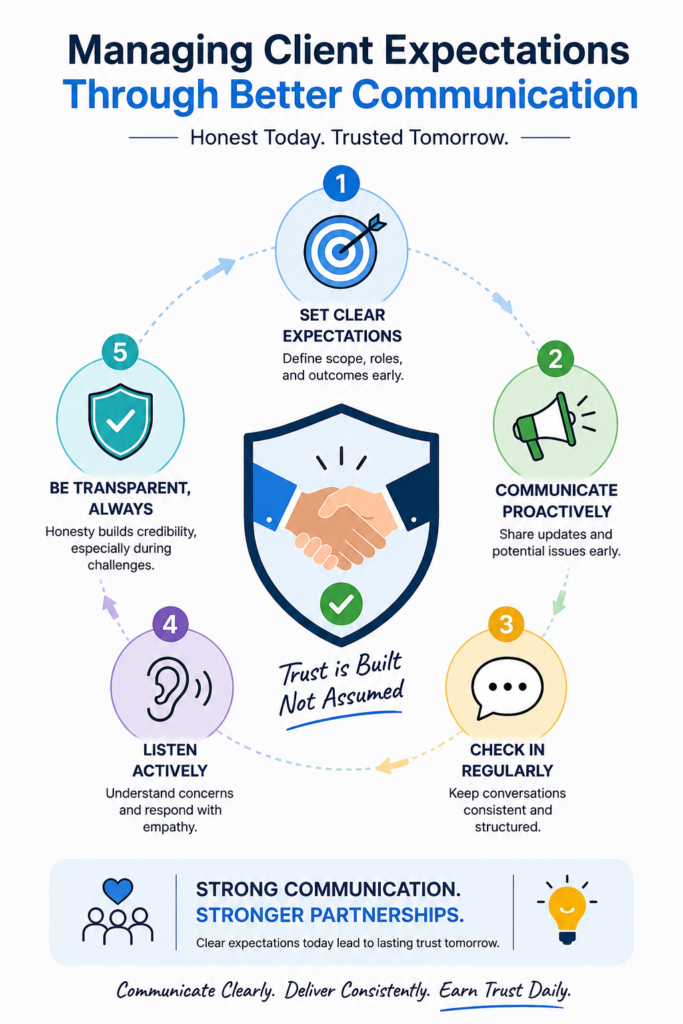
Once the foundation is set, you need a rhythm. Silence is the enemy. Establishing structured client communication protocols allows us to operate on a cadence of proactive updates, not reactive responses.
The monthly report is the cornerstone. But a PDF stuffed with graphs no one understands is worse than useless. We start each report with a simple, three-bullet executive summary:
- The most important thing we stopped this month.
- One thing your team did that improved your posture.
- One thing we’re watching for next month.
This tells a story they can grasp in thirty seconds. It shows we’re paying attention to their context, not just our own data feeds.
Then there’s the real-time communication. When an incident occurs, we have a protocol. The first update goes out the moment we confirm it’s a genuine threat, not when we have all the answers.
That message says: “We’ve confirmed a potential incident involving [X]. Our team is investigating. Next update in 30 minutes.” That initial contact, even without solutions, manages the expectation of uncertainty. It tells the client they’re in the loop, not outside waiting for news.
What Should You Do When Expectations and Reality Don’t Match?
Sometimes, despite the best plans, expectations falter. A critical alert slips past a defined response window. A report is delayed. The key isn’t to hide it, it’s to own it with radical transparency. We had a situation where a complex malware investigation took longer than our SLA promised.
Instead of hiding behind “complexity,” we reached out to the team’s designated stakeholders. Clear ownership matters, and defining points of contact ahead of time ensures we send messages directly to the right people. The delay is due to [brief technical reason]. We’ve escalated internally and will provide a full update by [new time].
“It is about how we respond to those situations, open and honest. Identify corrective actions, document and report… It is about professional response to outages.”– Core.ac.uk
We’ve logged this against our SLA for review.” This does a few things. It acknowledges the breach of expectation immediately. It provides a legitimate, non-excuse reason. It sets a new, clear expectation. And it shows we’re tracking our own performance.
This approach, we’ve found, almost always builds more trust than a perfect performance record with no explanation. It humanizes the operation. It shows that when the wheels wobble, our first instinct is to communicate, not conceal.
Another reality is scope creep. A client might ask, “While you’re in there, can you just check this other server?” It seems harmless. But saying “yes” to every ad-hoc request without adjusting timelines or resources is a fast track to missed expectations on the core work. We’ve learned to say, “We can absolutely look at that.
To do it properly, it will add about [X hours] to the timeline. Should we adjust the priority of the original task, or schedule this for next week?” This frames the conversation around trade-offs, not a simple yes/no. It keeps expectations realistic and managed.
How Can You Turn Satisfied Clients Into Long-Term Advocates?
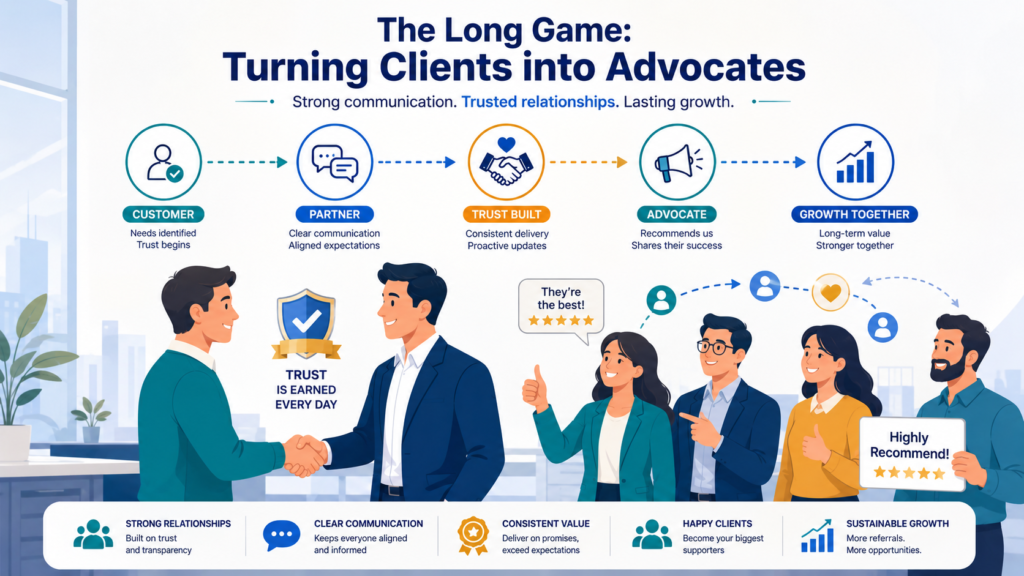
When you get this right, something shifts. The relationship moves from transactional to strategic. The client stops seeing you as a tool they use and starts seeing you as part of their team.
Their feedback becomes more constructive, because they believe you’ll act on it. They provide clearer context, because they trust you with it. They become, in the best sense, a collaborator.
We measure this not just by retention rates, but by the quality of our QBR conversations. Are they bringing ideas to the table? Are they sharing their business roadmap freely? That’s the signal. That’s when you know you’ve moved beyond managing expectations to building a shared mission.
The tools and tactics are important, the SLAs, the report formats, the communication protocols. But they’re just instruments. The music is the relationship itself. It’s built on the belief that this partner will tell you the truth, will warn you of the potholes, and will walk the road with you even when it gets steep.
FAQ
How does managing client expectations communication improve client retention?
Managing client expectations communication helps prevent misunderstandings, surprises, and frustration. When clients clearly understand what to expect regarding timelines, deliverables, and outcomes, they are more likely to trust your team and continue the partnership long term.
What is the biggest mistake businesses make when managing client expectations?
One of the most common mistakes is overpromising during the sales or onboarding process. Setting unrealistic expectations may win short-term approval, but it often leads to disappointment later. Clear and realistic communication is far more effective for building lasting trust.
How often should businesses communicate with clients?
The ideal frequency depends on the project, but regular and predictable communication is essential. Weekly updates, monthly reviews, and immediate notifications about significant changes help clients stay informed and confident in your work.
What should you do when a project encounters unexpected challenges?
Communicate the issue as soon as possible. Explain what happened, how it may affect the project, and the steps being taken to resolve it. Honest and proactive communication demonstrates accountability and often strengthens client trust, even during difficult situations.
Your Next Step Is Clear
Start with the one conversation you might be avoiding. Pull out your standard SLA or service description. Read it from your client’s perspective. Where is it vague? Where does it promise something your process can’t reliably deliver? Then, in your next check-in, clarify just one of those points. Be uncomfortably specific.
You’ll feel the difference immediately. The tension of the unsaid dissipates. What’s left is space for real work, and for a partnership that lasts. Ready to strengthen client relationships through better communication and operational clarity? Visit MSSP Security Consulting Services and discover how the right strategy can help you build lasting client trust.
References
- https://econpapers.repec.org/article/bcpjournl/v_3a8_3ay_3a2024_3ai_3a12_3ap_3a1560-1574.htm
- https://pdf.core.ac.uk/corefilesystem/pdf/10830/301349551.pdf?se=2026-06-10T16%3A24%3A49Z&sp=r&sv=2026-06-06&sr=b&rscd=inline%3B%20filename%3D%22301349551.pdf%22&rsct=application/pdf&sig=EwvZApX5FopjLfQMfdCwuSlm41hpffcTNjIm3kwG3VM%3D#5#2