


Threat intelligence integration actioning improves security outcomes by turning threat data into detection, response, and operational decisions. Many organizations collect feeds, indicators, and reports, yet analysts still deal with alert fatigue and slow investigations. The problem is rarely a lack of intelligence. It is the lack of action.
At MSSP Security, we have seen organizations invest heavily in threat data while gaining little operational value. This guide explains how to turn raw intelligence into measurable outcomes, improve analyst efficiency, and reduce unnecessary alerts. Keep reading to see what effective intelligence programs do differently.
Intelligence-to-Action Highlights
Threat intelligence only delivers value when it improves detection, response, and security decisions. The following insights summarize how organizations turn intelligence into measurable security outcomes.
- Threat intelligence integration improves detection quality through contextual intelligence and alert prioritization.
- High-fidelity intelligence supports faster incident response, automated response, and stronger analyst workflow.
- Effective programs measure outcomes such as false positive reduction, containment speed, and detection lift.
What Do Security Teams Gain From Threat Intelligence Integration?
Threat intelligence only matters when it helps analysts make better decisions. Many teams buy feeds, collect indicators, and add new tools, yet daily operations barely improve. We have reviewed several MSSP environments where large intelligence collections produced very little value because nobody connected the data to real investigations.
Better intelligence improves detection quality. Alerts gain context, analysts spend less time guessing, and response teams move faster when supported by effective operations & delivery mechanisms. That alone can reduce fatigue inside busy SOC environments.
Our consulting work often focuses on helping MSSPs review new products before deployment. In many cases, the strongest results come from removing poor feeds rather than adding more. Less noise. Better visibility.
Security teams often gain:
- Better alert quality
- Faster investigations
- Improved prioritization
- Stronger threat hunting
- Reduced analyst fatigue
One security manager told us that analysts finally trusted alerts after confidence scores were introduced. That surprised us a little, although it makes sense. Good intelligence supports people first. The technology follows.
How Does Integrating Threat Intel Into SIEM Improve Detection?
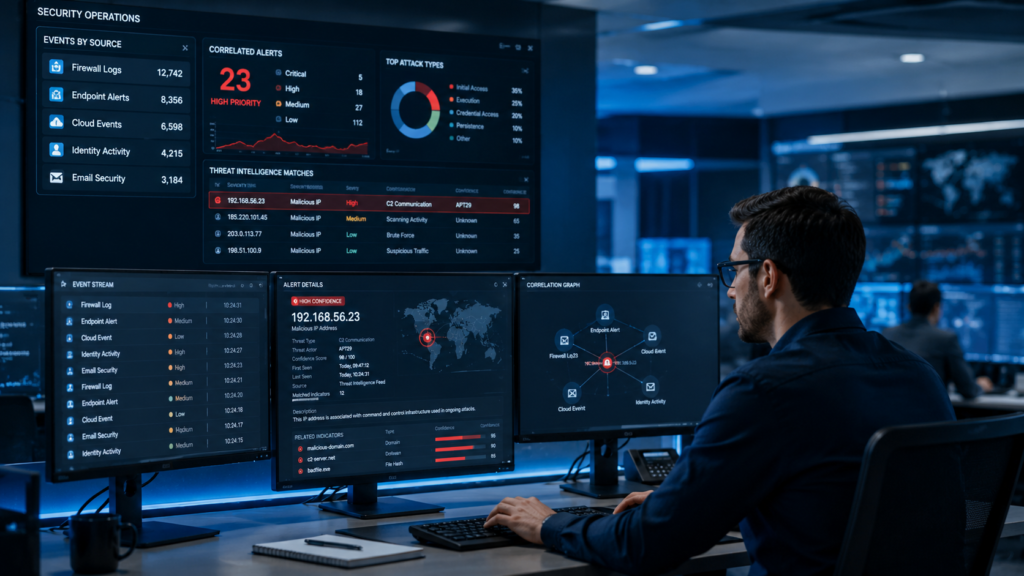
SIEM platforms become much more useful when intelligence feeds add context to events. Logs alone rarely tell the full story. A suspicious IP address may look harmless until intelligence identifies it as part of an active campaign.
We often help MSSPs evaluate products that promise large indicator volumes. Yet large numbers rarely equal better outcomes. Relevance matters more. After all, integrating threat intel into SIEM is about improving decisions, not collecting more data.
Common data sources include:
- Firewall logs
- Endpoint alerts
- Identity events
- Email activity
- Cloud monitoring
Thousands of indicators may enter a SIEM every day. Still, only a small portion usually creates valuable detections. We have seen environments where fewer than five percent of indicators generated useful alerts.
| Security Area | Intelligence Use | Outcome |
| Detection | IOC correlation | Faster alerts |
| Response | Context data | Quicker decisions |
| Hunting | Indicator enrichment | Better visibility |
| Automation | Risk scoring | Less noise |
The problem often is not volume. It is relevant. Teams that focus on trusted indicators usually see better detection results and fewer false positives.
How Should You Integrate Threat Intelligence Feeds Into SIEM?
Threat feeds usually enter SIEM platforms through APIs, TAXII connections, or built-in integrations. While integrating threat intelligence feeds SIEM environments may look simple at first, we often see problems appear after the feeds go live.
Different sources use different formats, confidence scores, and naming methods. Without proper normalization, analysts receive alerts that lack context or create confusion during investigations.
Important fields often include:
- Confidence scores
- Source reliability
- Expiration dates
- Threat category
- Severity ratings
During our consulting projects, we help MSSPs evaluate and audit new security products before deployment. In many environments, we find old indicators that remain active long after they lose value. Those stale indicators continue to trigger alerts, and eventually analysts stop trusting them. That problem becomes costly over time.
Several teams we have worked with introduced expiration policies and source scoring. The changes were simple, yet alert quality improved almost immediately. One MSSP reduced unnecessary alerts within weeks after removing outdated indicators.
Fresh intelligence supports better decisions. Organizations should regularly review their feeds and remove information that no longer provides value. Threat data only helps security operations when it stays current, reliable, and connected to business risk.
How Should Security Teams Action Threat Intelligence Alerts?
Not every alert deserves escalation. Effective alert prioritization and actioning threat intelligence alerts become critical because analysts face hundreds of decisions every day, and context matters.
The same indicator can carry different risk levels depending on the asset involved. A suspicious connection to a testing server may require monitoring. The same activity on a privileged system may require immediate action.
Effective triage considers:
- Asset value
- Confidence score
- Indicator age
- Business impact
- Threat relevance
We have seen security teams drown in alerts because every IOC received the same priority. Once risk scoring was introduced, investigation queues became manageable.
One manufacturing client combined asset value with intelligence confidence. Alert volume dropped, and analysts focused on the highest-risk activity.
Analysts trust intelligence when it improves their work. If feeds create noise, they ignore them. That happens more often than many organizations realize.
Operational intelligence should support decisions, not overwhelm people. A good alert explains why something matters and what action should happen next.
When Should Organizations Use a TIP Threat Intelligence Platform?
A threat intelligence platform helps teams manage large amounts of information through centralized intelligence workflows. Organizations using TIP threat intelligence platform capabilities can manage indicators from one location instead of moving data between separate tools. That saves time and reduces mistakes.
Our consulting work often involves helping MSSPs evaluate intelligence platforms before purchase. Some products offer countless features, but many teams only need a few capabilities that improve daily operations.
Useful platform functions include:
- Indicator management
- Duplicate removal
- Risk scoring
- Expiration policies
- Intelligence sharing
We have seen analysts spend hours reviewing duplicate indicators across multiple feeds. A centralized workflow removes that burden. Analysts can focus on investigations instead of administrative work.
One security team told us their biggest improvement was not better detection. It was having fewer duplicate alerts. That matters.
A TIP should support existing tools rather than create another isolated system. Intelligence needs to flow into SIEM, endpoint tools, and response workflows. Technology alone does not solve intelligence problems. Good processes still matter.
How Do You Operationalize Threat Intelligence in the SOC?
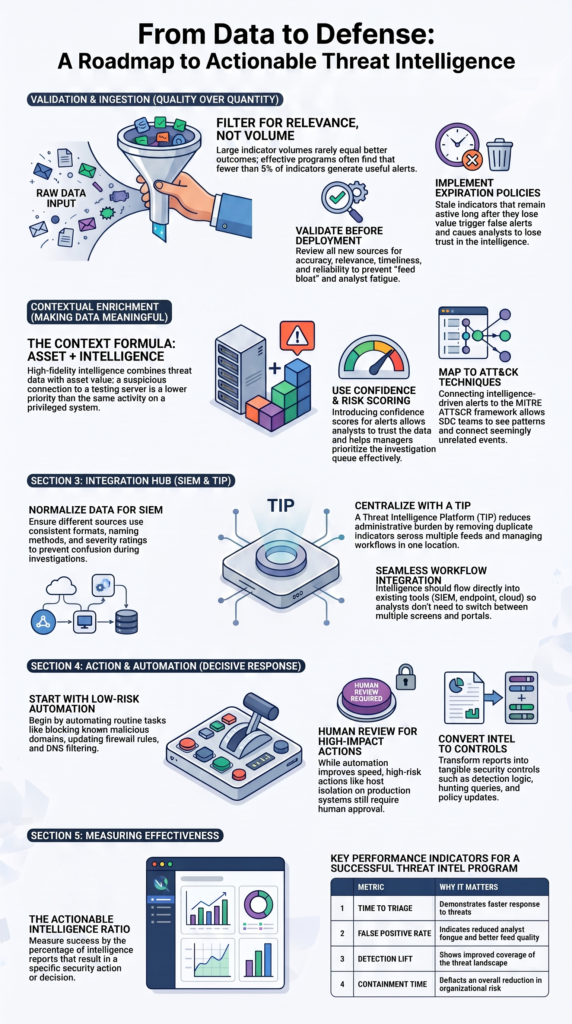
Operationalizing intelligence means using it every day. This day-to-day SOC process, often described as operationalizing threat intelligence SOC, helps security teams apply intelligence during investigations rather than treating it as a separate activity. Many organizations still produce monthly reports that never reach the SOC.
Effective teams apply intelligence to:
- Detection engineering
- Threat hunting
- Incident response
- Case management
- Alert prioritization
During one healthcare engagement, analysts began mapping intelligence-driven alerts to ATT&CK techniques. Patterns appeared quickly. Events that once seemed unrelated suddenly connected.
We noticed something interesting. Analysts trust intelligence when it repeatedly helps them solve problems. If alerts create noise, confidence disappears. Trust becomes a hidden metric.
SOC teams benefit when intelligence appears directly inside their workflows. They should not need multiple screens and separate portals to understand an alert.
Good operational programs collect information, enrich indicators, distribute intelligence, and measure outcomes. Each step supports the next.
And consistency matters. Small improvements repeated every day often deliver stronger results than large projects that never reach production.
When Does Automating Threat Intel Response Make Sense?
Automation offers major benefits, but only when applied carefully. Many organizations rush into automating threat intel response, and that usually creates problems.
We recommend starting with low-risk actions first. Common examples include:
- Blocking known domains
- Updating firewall rules
- Creating tickets
- DNS filtering
- Alert enrichment
One MSSP introduced automated domain blocking after several months of testing. The process reduced analyst workload without affecting operations.
Automatic host isolation carries more risk. Production systems may require approval before action occurs. Human review still plays an important role.
Move slowly. Our teams often advise clients to build confidence through small wins. When automation consistently produces good results, organizations can expand their workflows.
Response speed improves when analysts no longer perform repetitive tasks manually. That allows security teams to focus on investigations, threat hunting, and incident analysis.
The goal is not removing people. The goal is helping them spend time where they provide the most value.
How Can You Validate Threat Intelligence Sources?
Credits: IBM Technology
The quality of a threat feed directly affects the quality of security decisions, which is why validating threat intelligence sources remains essential. Poor sources create noise, while trusted intelligence helps analysts focus on real threats.
Many organizations still judge intelligence programs by the number of indicators they receive. In our experience, that approach rarely works. More data often creates more alerts, more investigation time, and more false positives.
Teams should review sources based on:
- Accuracy
- Relevance
- Timeliness
- Completeness
- Reliability
As part of our consulting work, we help MSSPs evaluate and audit new security products before deployment. During these reviews, we often find intelligence feeds that generate alerts but provide very little value. Those feeds usually stay active simply because nobody measures their performance.
Several teams we support review their sources every quarter. Low-performing feeds are removed, while new ones go through testing before entering production.
One analyst told us that an IP address means very little without context. We have seen that firsthand during product assessments. Confidence scores, expiration dates, and historical accuracy often reveal whether a source can be trusted.
A feed that works well for one industry may offer little value to another. Strong validation keeps intelligence programs focused on results instead of data collection.
How Should You Measure Threat Intelligence Effectiveness?
Successful intelligence programs measure outcomes. Organizations focused on measuring threat intelligence effectiveness often discover that indicator volume says very little about security performance.
Organizations often track:
- Detection lift
- False positives
- Time to triage
- Containment speed
- Intelligence-driven cases
We frequently ask MSSP teams a simple question: what changed because of the intelligence? The answer reveals whether the program is working.
| Metric | Why It Matters |
| Time to triage | Faster response |
| False positives | Less analyst fatigue |
| Detection lift | Better coverage |
| Containment time | Lower risk |
Research from RSA Conference
“Intelligence effectiveness metrics focus on whether threat intelligence actually enhances detection and response capabilities… Key metrics include: Actionable Intelligence Ratio: The percentage of intelligence reports that result in specific security actions or decisions, indicating the practical utility of CTI analysis.” – RSA Conference Blog
One client discovered that removing poor feeds improved productivity more than adding new ones. That result surprised their leadership team.
Metrics should support business goals. Analysts need measures that reflect daily operations, not dashboard numbers that nobody uses. Keep it practical.
Security leaders want to understand risk reduction, faster response, and operational improvements. Those outcomes demonstrate value far better than large indicator counts.
How Do You Convert Intelligence Into Actionable Security Controls?
Threat intelligence creates value when it becomes action. Reports alone do not stop attacks, which is why converting intel actionable security controls remains essential for security teams.
Security teams often convert intelligence into:
- Blocking rules
- Detection logic
- Hunting queries
- Policy updates
- Correlation rules
We regularly help MSSPs evaluate products that claim advanced intelligence features. The first question we ask is simple: what security control changes because of this information?
Good intelligence supports:
- Firewalls
- Endpoint tools
- Identity systems
- Cloud controls
- Security monitoring
As highlighted by arXiv.org
“This integrated resource enables organisations to connect threat intelligence directly to actionable controls and measurable outcomes.” – arXiv.org (Cornell University) / Perdana University
One customer discovered that intelligence reports were being read but never used. Once the team created detection rules from those findings, results improved quickly.
Intelligence should support prevention and detection. It should not remain inside presentations or monthly reports. And small actions matter.
A single high-confidence detection rule can provide more value than hundreds of unused indicators. Security outcomes depend on implementation.
What Makes an Effective IOC Management Enrichment Process?
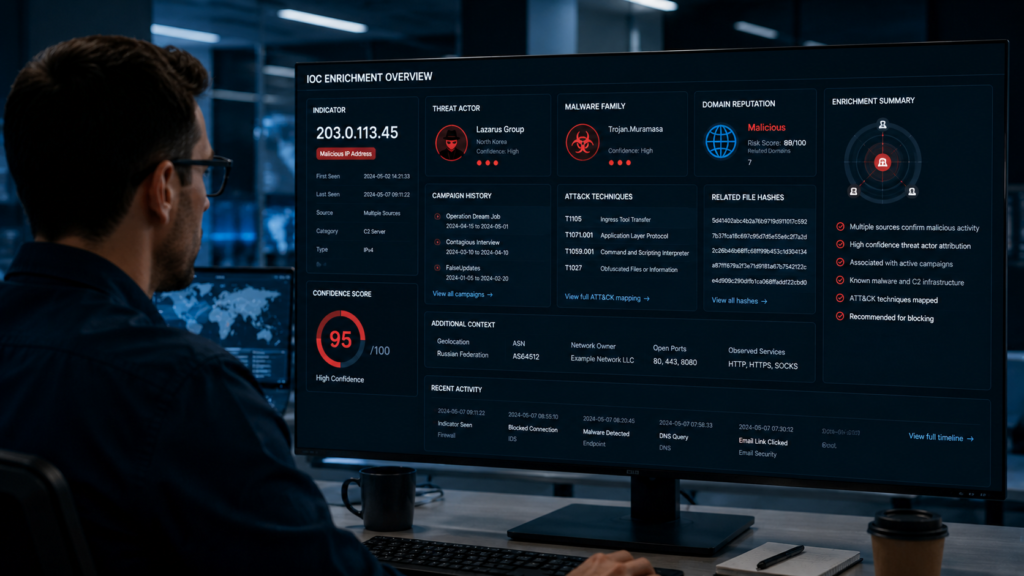
The IOC management enrichment process helps security teams add context to raw indicators. An IP address, domain, or file hash alone rarely tells the full story. Enrichment provides the details analysts need to understand risk and make better decisions.
Many organizations still collect indicators without adding context. Indicators may sit in separate tools while analysts manually search for related information. That process takes time and often leads to inconsistent results.
During several product assessments, we found that teams with strong enrichment workflows produced better results than those with larger indicator collections. One client reduced investigation time after adding source reputation and asset context to their indicators.
An effective process helps teams:
- Improve threat hunting
- Reduce investigation time
- Add context to alerts
- Support ATT&CK mapping
- Increase detection accuracy
The goal is not collecting more indicators. It is turning indicators into useful intelligence.
Analysts work more efficiently when they understand why an IOC matters. Context such as confidence scores, threat history, asset value, and campaign information helps explain attacker behavior and supports faster decisions.
Successful enrichment programs rely on consistent processes, trusted sources, and regular reviews to keep intelligence relevant and actionable.
How Can You Communicate Threat Intel Insights to Clients?
Most clients do not want thousands of indicators. They want clear answers and practical guidance. Effective communicating threat intel insights client practices help security reports explain what happened and why it matters.
Executive reporting should answer:
- What changed
- What happened
- What actions occurred
- What risk remains
A report may include:
- Seventeen domains blocked
- Two phishing attempts detected
- No confirmed compromise
- One active campaign observed
In our consulting work, we often help MSSPs review new security products and reporting workflows. We have seen technical reports filled with indicators, yet executives still leave meetings with unanswered questions. That usually means the message was too technical.
Business leaders care about impact, risk, and response. They want to know whether security improved and what actions the team took. One client told us that a simple one-page summary helped their leadership team understand threats for the first time.
Keep the message clear. Technical findings should support business decisions, not overwhelm them. The strongest reports connect intelligence to outcomes and show clients how security efforts reduce risk.
FAQ
How does threat intelligence integration improve security operations?
Threat intelligence integration helps security teams connect external intelligence with internal security data. This process gives analysts more context during investigations and supports faster decisions.
It also improves the security operations workflow by identifying malicious IPs, malicious domains, and compromise indicators. As a result, teams can prioritize important alerts and reduce the time spent investigating low-risk events.
Why do SIEM threat feeds create false positive alerts?
SIEM threat feeds can create false positives when indicators are outdated, duplicated, or poorly validated. Weak source reliability and missing confidence scoring often lead to unnecessary alerts.
Organizations can reduce these problems by reviewing feed quality, removing expired indicators, and validating intelligence sources regularly. These steps improve security analytics and help analysts trust the alerts they receive.
How does IOC enrichment support threat hunting activities?
IOC enrichment adds useful context to file hashes, malicious domains, and other indicators. Security teams can use domain reputation, malware analysis, and threat actor profiles to understand suspicious activity.
This information supports threat hunting, ATT&CK mapping, and TTP analysis. Enriched indicators help analysts identify attack patterns and investigate incidents more accurately.
How does automated response improve incident response workflows?
Automated response reduces the time required to complete routine security tasks. SOC automation and orchestration can update blocking rules, improve DNS filtering, and support firewall integration.
Some organizations also use SOAR integration to assist with alert triage and case management. Automation allows analysts to focus on investigations, detection engineering, and high-priority incidents.
Which metrics measure the success of a CTI program?
A CTI program should measure results instead of counting indicators. Useful measurement metrics include response time, false positive reduction, alert prioritization, and detection accuracy.
Organizations may also track threat feed ingestion, IOC expiration, and operational intelligence outcomes. These metrics help security teams determine whether actionable intelligence improves incident response and overall security performance.
Turn Intelligence Into Action
Threat intelligence only works when it supports real decisions and helps teams respond faster. Large feeds often create more noise, which makes it harder to spot what matters. The real value comes from useful intelligence that improves detection, reduces manual work, and strengthens daily security operations.
Organizations see better results when intelligence becomes part of practical workflows. For expert guidance on improving visibility and operational outcomes, explore MSSP Security.
References
- https://www.rsaconference.com/Library/blog/measuring-the-effectiveness-of-cyber-threat-intelligence-key-performance-indicators
- https://arxiv.org/abs/2603.12455
Related Articles
- https://msspsecurity.com/operations-delivery-mechanisms/
- https://msspsecurity.com/integrating-threat-intel-siem/
- https://msspsecurity.com/integrating-threat-intelligence-feeds-siem/
- https://msspsecurity.com/actioning-threat-intelligence-alerts/
- https://msspsecurity.com/using-tip-threat-intelligence-platform/
- https://msspsecurity.com/operationalizing-threat-intelligence-soc/
- https://msspsecurity.com/automating-threat-intel-response/
- https://msspsecurity.com/validating-threat-intelligence-sources/
- https://msspsecurity.com/measuring-threat-intelligence-effectiveness/
- https://msspsecurity.com/converting-intel-actionable-security-controls/
- https://msspsecurity.com/ioc-management-enrichment-process/
- https://msspsecurity.com/communicating-threat-intel-insights-client/