


IOC management enrichment process helps security teams turn raw indicators into useful intelligence. An IP address, file hash, or domain alone rarely provides enough information to make a confident decision. Context such as reputation data, historical activity, and internal evidence helps analysts investigate faster and reduce unnecessary work.
At MSSP Security, we often see organizations struggle with too many indicators and not enough context. Security teams that combine intelligence with operational data often make better decisions and respond more efficiently. Keep reading to see how enrichment workflows strengthen SOC operations and improve threat intelligence programs.
From Indicators to Intelligence
Raw indicators create noise without context. Enrichment adds the intelligence, confidence, and prioritization that help analysts investigate faster and make better decisions.
- Raw indicators create noise without threat context.
- IOC enrichment improves confidence scoring, triage, and threat hunting.
- Automation and enrichment workflows reduce repetitive analyst work while improving consistency.
What Security Teams Gain From IOC Enrichment

Raw indicators create noise. An IP address by itself doesn’t say much. Neither does a hash or a domain. Security teams still need context before making a decision.
Over the years, we have worked with MSSPs that collect thousands of indicators every day. The problem wasn’t gathering data. The real problem was deciding which indicators deserved attention. Most teams already had enough information. They lacked context.
IOC enrichment fills that gap. It adds reputation data, historical activity, previous sightings, and internal evidence. That extra information helps analysts move faster and spend less time on repetitive searches.
Several consulting projects showed us the same pattern. Analysts often spent more time opening browser tabs than investigating incidents. That slows everything down.
Teams usually gain:
- Better triage
- Fewer false positives
- Faster investigations
- Stronger threat hunting
- Less analyst fatigue
One thing surprised us. Small enrichment improvements often reduce analyst workload more than adding another threat feed. Without context, indicators become noise. With context, they become evidence.
Why Does IOC Enrichment Matter?
An observable only tells part of the story. A suspicious IP address might be harmless. A malicious hash may have appeared months ago. Analysts need more information before acting.
We often see MSSPs receive alerts that contain only a SHA-256 hash or a domain name. That forces analysts to leave their case tools and perform manual searches. Minutes disappear quickly. Get context.
Enrichment usually adds:
- Reputation scores
- Historical sightings
- Ownership details
- DNS records
- Confidence ratings
- Related indicators
The difference can be dramatic. A single domain becomes much more useful when several malicious sightings appear alongside internal detections.
Many raw indicators fail because they arrive without evidence. A hash alone doesn’t explain risk. An IP address alone doesn’t explain intent.
During one audit engagement, our team found analysts repeatedly checking the same indicators across several cases. They already had answers. The information simply wasn’t stored or reused.
And that creates unnecessary work.
Organizations that enrich indicators early can prioritize alerts faster and reduce investigation delays. Most teams don’t need more indicators. They need better ones.
How Does the IOC Management Enrichment Process Work?
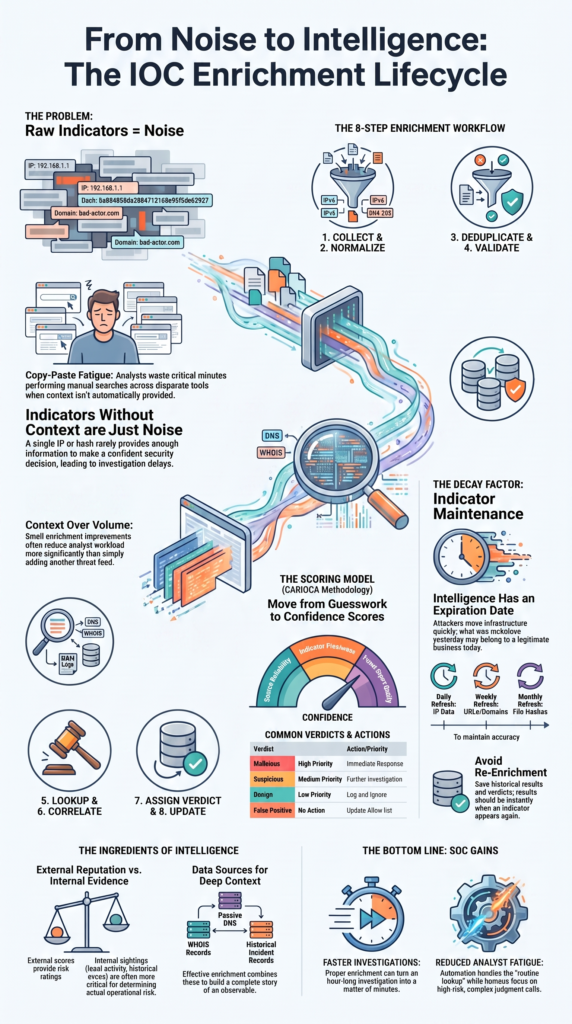
The enrichment process follows a predictable path. Different tools may use different names, but the overall flow stays similar.
Most workflows include:
- Collect indicators.
- Normalize data.
- Remove duplicates.
- Validate indicators.
- Run lookups.
- Correlate evidence.
- Assign verdicts.
- Update records.
Our consulting work with MSSPs often focuses on these workflows. Many organizations buy new tools before reviewing existing enrichment steps. That’s usually where problems begin. Building effective workflows often starts with validating threat intelligence sources so analysts can trust the indicators entering the enrichment process.
Validation matters. Known assets can be skipped. Trusted domains may belong on allow lists. Previously processed indicators often don’t need another lookup.
Verdicts also help teams move quickly. Common verdicts include:
- Malicious
- Suspicious
- Benign
- Unknown
- False positive
Analysts can prioritize cases based on confidence scores instead of guesswork. One SOC we reviewed had several enrichment tools but no scoring system. Every alert looked equally important. That created long queues and frustrated analysts.
The process itself isn’t complicated. The difficult part is building rules that reduce unnecessary work while keeping valuable indicators visible.
Which Data Sources Improve Enrichment?
No single source gives complete intelligence. Most organizations combine several sources to build confidence.
Internal evidence often matters more than external reputation scores. We’ve seen indicators marked as malicious that never appeared anywhere inside the environment. At the same time, some unknown indicators generated several internal detections.
That changes priorities.
| Source | Purpose |
| Reputation data | Risk scoring |
| Passive DNS | Domain history |
| WHOIS records | Ownership |
| Internal logs | Local activity |
| Historical cases | Previous sightings |
Internal data may include:
- SIEM logs
- Endpoint alerts
- Detection history
- Incident records
- Network activity
Multiple sources improve confidence. One reputation score may not justify action. Several sources pointing in the same direction often do.
A consulting engagement with an MSSP showed this clearly. An IP address received a poor reputation score, yet no customer environment had ever communicated with it. The team avoided unnecessary work by looking at internal evidence first. And that’s important.
The strongest indicators usually combine external intelligence with local observations. Neither source tells the whole story by itself.
Why Does IOC Data Decay Over Time?
Indicators do not stay useful forever. Domains expire. IP addresses change owners. Attackers move infrastructure quickly.
Some indicators disappear within days. IP addresses and URLs usually lose value first. Malware hashes often remain useful longer because the underlying file does not change.
Common short-lived indicators:
- IP addresses
- URLs
- Temporary domains
Longer-lasting indicators:
- SHA-256 hashes
- Malware samples
- Behavioral indicators
One analyst told us that hashes live forever while IP addresses fade quickly. That statement reflects what many security teams experience. Still, every environment differs.
Several MSSPs we advised kept old indicators active for months. The result was increased noise and unnecessary investigations. Retiring stale indicators improved alert quality.
Refresh schedules often depend on risk:
- IP addresses: daily
- Domains: weekly
- URLs: weekly
- Hashes: monthly
Old indicators can become harmless. A malicious address today may belong to a legitimate business later. That happens more often than people expect.
Regular reviews help organizations avoid outdated intelligence while keeping useful indicators available for future investigations.
How Can SOC Teams Avoid Re-Enrichment?
Repeated enrichment wastes time. The same indicator often appears in several alerts, cases, or investigations. Without tracking previous results, analysts end up performing identical lookups again and again.
We have seen this problem during MSSP assessments. One malware hash appeared across multiple customer environments over several weeks. Each analyst enriched it separately because the previous results were never saved.
That adds unnecessary work. Good enrichment programs keep historical results. Teams can store verdicts, confidence scores, timestamps, and supporting evidence for future investigations.
Helpful practices include:
- Allow lists
- Previous verdicts
- Lifecycle tracking
- Historical enrichment
- Reuse policies
Allow lists also reduce noise. Trusted domains, approved infrastructure, and known internal assets can bypass enrichment rules.
One customer reduced analyst workload after adding simple tracking states for processed indicators. The change was small, but the impact was noticeable. And consistency matters.
When analysts reuse trusted enrichment data, investigations move faster. Teams spend less time searching and more time understanding the threat itself. Historical context also supports actioning threat intelligence alerts because analysts can make decisions using previous verdicts and trusted evidence instead of repeating the same investigation.
How Does Automation Improve IOC Enrichment?
Automation removes repetitive tasks. Analysts should investigate threats, not spend hours copying indicators between tools.
Many MSSPs we support focus on this area first. Before selecting new products, we review which enrichment activities still require manual work. The results are often surprising.
Automation commonly handles:
- Reputation checks
- Indicator scoring
- Threat lookups
- Observable tagging
- Case updates
Several teams reduced investigation times after automating routine enrichment steps. Analysts received additional context immediately instead of performing multiple searches. Strong threat intelligence integration and actioning processes help organizations move intelligence directly into operational workflows instead of leaving analysts.
Still, automation cannot solve everything. Human review remains necessary when results conflict or when high-risk investigations require additional analysis. Complex incidents often involve judgment calls that software cannot make.
One SOC manager told us that automation reduced repetitive work but increased the quality of analyst decisions. That observation matched what we have seen elsewhere.
The goal is not full automation. The goal is removing unnecessary effort. Organizations usually benefit most when analysts focus on difficult investigations while automated workflows handle routine enrichment tasks.
Why Do IOC Feeds Fail in Practice?
More indicators do not always improve security. Large collections of low-quality indicators can overwhelm analysts and create alert fatigue.
We frequently review environments that import every available threat feed. The intention is good, but the outcome is often disappointing.
Common problems include:
- Duplicate entries
- Old indicators
- Missing context
- Low confidence
- Excessive noise
Blind ingestion causes many of these issues. Indicators enter production systems without validation, scoring, or filtering.
Several MSSPs have told us that large feed volumes increased workload instead of improving detection quality. Analysts spent more time cleaning data than investigating incidents. That gets old fast.
Confidence thresholds help reduce noise. Teams can score indicators before allowing them into production environments.
One engineer described manual enrichment as copy-and-paste fatigue. Many analysts recognize that experience immediately.
Effective programs focus on quality over volume. A small set of trusted indicators often produces better results than thousands of unknown entries. The number of indicators matters less than the confidence behind them.
How Should Organizations Score and Prioritize IOCs?
Credits: SOCDemystified
Not every indicator deserves the same response. Prioritization helps analysts focus on threats that present the greatest risk.
Several factors influence confidence:
| Factor | Example |
| Confidence | High or low |
| Severity | Critical or low |
| Reputation | Malicious score |
| Sightings | Present or absent |
High-priority indicators often include:
- Multiple sightings
- Internal detections
- Strong context
- Malicious reputation
Lower-priority indicators may include:
- Trusted assets
- Expired domains
- Unknown observables
We often recommend that MSSPs build scoring models before deploying additional products. One assessment revealed hundreds of critical alerts with identical severity levels. Analysts struggled because every alert appeared urgent. Organizations that combine internal evidence with external intelligence usually achieve more reliable results.
Research from Springer’s International Journal of Information Security shows
“In this work, a methodology named comprehensive assessment and rating of IoCs via CADE algorithm (CARIOCA) is proposed, which aims to analyze data contained in the CTI platform to select a subset of indicators of compromise (IoCs) considered most relevant for protection systems. Through CARIOCA, IoCs evaluation based on three level scoring is proposed, considering sources’ reliability, IoCs freshness, and CTI reports quality using a new algorithm… By combining three scores, CARIOCA can comprehensively assess IoCs relevance.” – Springer’s International Journal of Information Security
How Does Maintenance Enrichment Work?
New indicators need immediate attention. Existing indicators require periodic reviews. Threat intelligence changes constantly. Domains expire, infrastructure changes ownership, and reputation scores shift over time.
Maintenance activities often include:
- Reputation updates
- Feed refreshes
- Error checks
- Status reviews
- Indicator retirement
Several organizations overlook this stage. They enrich indicators once and assume the information remains accurate forever.
That rarely happens.
During one review, our team found old indicators still marked as malicious years after their original activity ended. Analysts continued investigating alerts that no longer represented risk.
Refresh schedules vary depending on the indicator type. IP addresses usually require frequent checks. File hashes often need fewer updates.
Organizations should review:
- IP addresses daily
- URLs weekly
- Domains weekly
- Hashes monthly
Regular maintenance improves confidence while reducing unnecessary investigations. And stale intelligence creates problems.
Keeping enrichment current allows security teams to make decisions using information that reflects today’s threat environment rather than last year’s activity.
What Does a Real IOC Enrichment Example Look Like?
Imagine a suspicious file hash appears during an investigation. The indicator enters the enrichment process automatically.
Several actions occur:
- Reputation lookup.
- Threat correlation.
- Historical searches.
- Behavioral analysis.
- Confidence scoring.
- Case updates.
The final verdict may indicate malicious activity if multiple sources support the finding.
We’ve observed this process during several MSSP engagements. One customer repeatedly encountered the same malware hash across different incidents. Previous enrichment data allowed analysts to respond immediately. That saved time.
Historical reuse offers several benefits:
- Faster investigations
- Lower workload
- Better consistency
- Reduced duplication
Analysts no longer repeat the same searches. Existing evidence becomes available the moment the indicator appears. One investigation that previously required an hour took only minutes because enrichment data already existed.
The process itself is straightforward. The value comes from preserving knowledge and making it available when indicators return. Teams that reuse intelligence often investigate incidents faster and with greater confidence.
As noted by Google Threat Intelligence
“A typical integration journey begins with manual IOC enrichment, using scripts to look up indicators like IPs, domains, and file hashes. This can evolve into automated enrichment that is typically leveraged in integrations with SIEM’s…” – Google Threat Intelligence
How Can MSSPs Build Better IOC Enrichment Workflows?

Managed security providers need enrichment workflows that can grow with their environments. Large SOC teams process thousands of indicators every day, and analysts cannot review each one manually.
In our consulting work, we help MSSPs evaluate security products, review existing workflows, and identify gaps before new tools are introduced. We have seen many teams invest in technology while their processes still need attention.
Several elements appear in the strongest programs:
- New indicator workflows
- Maintenance cycles
- Confidence scoring
- Allow lists
- Retention policies
- Lifecycle tracking
One lesson appears repeatedly. Many organizations buy new products before fixing the process behind enrichment. In our experience, that usually creates more work instead of better results.
Useful metrics often include:
- Success rates
- False positives
- Processing speed
- Analyst time savings
- Indicator freshness
During several assessments, we found that separating maintenance enrichment from initial enrichment improved efficiency. Analysts avoided repeated work while keeping intelligence current.
Good enrichment programs focus on context, prioritization, and operational value. The goal is not collecting every indicator. It is helping analysts spend time on threats that truly matter.
FAQ
How can IOC scoring reduce false positives during incident triage?
IOC scoring helps analysts identify which indicators of compromise require immediate attention. Confidence scoring, reputation scoring, and threat context help separate real threats from false positives.
During incident triage, analysts can prioritize alerts based on risk and available evidence. This process improves analyst workflow, supports better case management, and reduces time spent investigating low-priority indicators.
How do passive DNS and WHOIS lookup improve IOC enrichment?
Passive DNS and WHOIS lookup provide valuable threat context during IOC enrichment. These sources help analysts review domain reputation, ownership details, and historical activity.
A domain name may appear harmless at first, but a sighting search can reveal suspicious behavior. Using passive DNS, WHOIS lookup, and reputation lookup together improves indicator validation and helps analysts make better decisions.
When should security teams use automated enrichment or manual enrichment?
Automated enrichment works best for repetitive tasks such as threat lookup, alert enrichment, and observable tagging. Manual enrichment is useful when analysts need deeper investigation or additional context.
Many organizations combine both methods in the same enrichment workflow. Automated enrichment improves speed, while manual enrichment supports malware analysis, incident response, and threat hunting activities.
Why is indicator normalization important in an enrichment pipeline?
Indicator normalization helps an enrichment pipeline process data in a consistent format. An IPv4 address, IPv6 address, email indicator, registry path, or malware hash may appear differently across data sources.
Indicator normalization, deduplication, and indicator correlation reduce errors and improve observable enrichment. This process supports effective IOC management and allows enrichment engines to produce more reliable results.
How do enrichment maintenance and indicator lifecycle management support security operations?
Enrichment maintenance keeps indicators accurate as threat intelligence changes over time. The indicator lifecycle includes processed state tracking, observable updated records, and regular enrichment refresh activities.
Teams may use allow lists, deny lists, or skip enrichment rules to reduce unnecessary work. Effective IOC lifecycle management improves enrichment accuracy and helps security teams maintain reliable threat intelligence data.
Make Enrichment Work for Security Teams
IOC enrichment becomes valuable when it helps teams focus on the indicators that matter most. Large volumes of data can create more noise and slow investigations. Better context, confidence scoring, and ongoing review help analysts reduce repetitive work and improve security decisions.
Organizations that build practical enrichment workflows often gain better visibility and faster investigations. To improve threat intelligence programs and reduce alert fatigue, see how MSSP Security can support your security operations strategy.
References
- https://link.springer.com/article/10.1007/s10207-025-01006-2
- https://github.com/VirusTotal/gti-dev-kit