


Converting intel into actionable security controls helps organizations reduce risk by turning threat intelligence into detections, response actions, and security improvements. Threat data alone does not stop attacks. Security controls do. According to IBM research, compromised credentials remain one of the most common attack methods affecting organizations today.
At MSSP Security, we have seen organizations improve their security posture only after intelligence begins influencing detection rules, investigations, and mitigation decisions. Preventive, detective, and corrective actions help security teams respond faster and reduce exposure. Keep reading to see how organizations turn threat intelligence into practical controls.
From Intel to Action: Security Control Essentials
Threat intelligence creates value only when it drives detections, response actions, and measurable security controls that reduce real-world risk.
- How to transform threat intelligence into actionable intelligence and measurable controls.
- Why behavioral detections outperform traditional IOC blocking.
- How intelligence-led security improves risk mitigation, detection engineering, and incident response.
Why Do Most Threat Feeds Fail Security Teams?

Threat feeds often promise visibility. But visibility alone doesn’t stop attacks.
Many security teams collect thousands of indicators every day. IP addresses, domains, file hashes, and URLs arrive nonstop. Yet most of those indicators never affect the environment. Some are old. Others have low confidence. Quite a few never touched the organization in the first place.
We’ve seen this during product assessments for MSSPs. One client imported several large feeds into their SIEM. Alert counts climbed fast. Analysts became buried in noise, and investigations slowed down. The extra data didn’t improve protection. That’s the problem.
Analysts rarely struggle because they lack information. They struggle because they have too much of it. Large IOC lists often create duplicate alerts, expired indicators, and false positives.
Teams should first ask a few questions:
- Is the asset exposed?
- Does the threat matter?
- Are controls already active?
- Can we act on it?
If intelligence cannot change a detection rule, response playbook, firewall policy, or endpoint setting, it remains data instead of actionable intelligence.
How Does the Intelligence-to-Control Pipeline Work?
Credits: SANS Digital Forensics and Incident Response
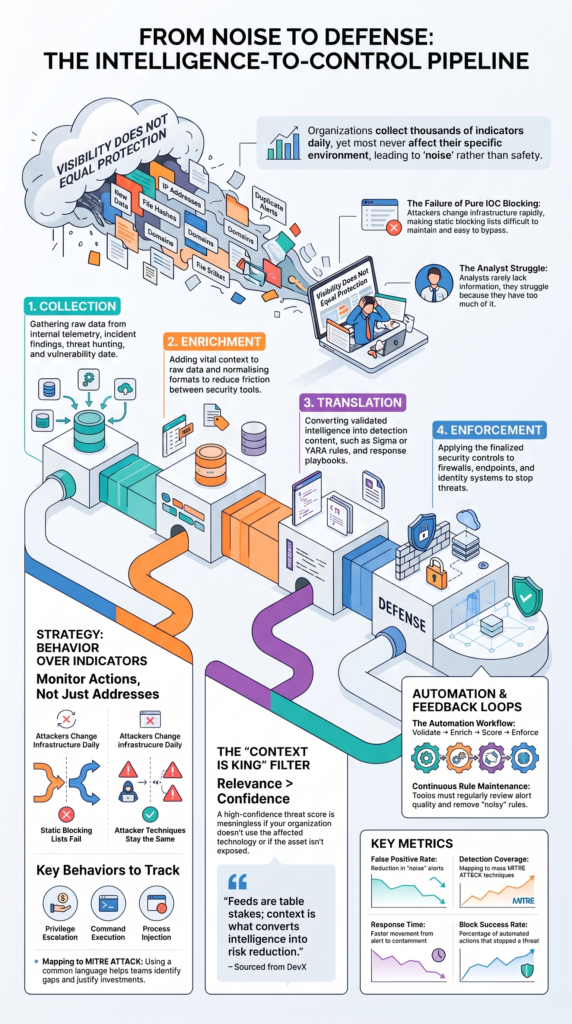
Good intelligence programs follow a clear process. Information enters, gets reviewed, and eventually becomes a security control.
In our consulting work, we often see organizations skip the middle steps. They collect intelligence but never enrich or validate it. That usually creates confusion.
A better process looks like this:
| Stage | Purpose |
| Collection | Gather data |
| Enrichment | Add context |
| Translation | Create rules |
| Enforcement | Apply controls |
Several sources can feed this pipeline:
- Internal telemetry.
- Incident findings.
- Threat hunting.
- Vulnerability data.
- Security investigations.
Now the important part.
Normalization matters more than many teams realize. Different formats create friction between tools. Organizations that focus on integrating threat intel SIEM workflows often reduce manual work and improve how analysts move intelligence into detection and response processes.
When data is standardized, analysts spend less time cleaning information and more time investigating real threats. We’ve watched security teams cut investigation time after improving their enrichment process. The difference wasn’t a new product. It was cleaner data and better context.
Small change. Big payoff. Intelligence becomes useful when it moves from raw information into something defenders can use every day.
Why Is Behavioral Detection Better Than IOC Blocking?
Indicators change quickly. Attack behavior usually doesn’t. Attackers replace domains, servers, and malware files all the time. A malicious IP address that works today may disappear tomorrow. That makes pure IOC blocking difficult to maintain.
We’ve seen this during security reviews with managed security providers. One organization blocked thousands of indicators every week. Yet the same attack methods continued to appear. The infrastructure changed, but the behavior stayed the same.
Behavioral detections last longer.
Teams gain more value when they monitor actions such as:
- Credential abuse.
- Privilege escalation.
- Command execution.
- Lateral movement.
- Process injection.
Those activities often appear across multiple attacks. Different threat groups may use different tools, but the underlying techniques remain similar.
Many organizations discover that high alert counts do not equal good visibility. In our experience, fewer high-quality detections usually outperform thousands of indicator matches. Effective threat intelligence integration and actioning helps security teams prioritize attacker behavior and focus on controls that deliver measurable results.
That’s worth remembering. Behavior-based detection helps security teams stay focused on attacker actions instead of chasing short-lived indicators.
How Should Teams Map Intelligence to MITRE ATT&CK?
MITRE ATT&CK gives defenders a common language. Security teams can connect intelligence to specific attacker techniques instead of working with isolated alerts.
We regularly use ATT&CK during product audits and detection reviews. It helps teams understand what an attacker is trying to do and where controls may be missing.
Several techniques often appear during investigations:
- T1078 Valid Accounts.
- T1059 Command Execution.
- T1055 Process Injection.
Once techniques are identified, teams can build controls around them.
Detection sources may include:
- Endpoint logs.
- Authentication events.
- PowerShell activity.
- Network traffic.
- Identity systems.
One customer discovered they had strong endpoint coverage but almost no visibility into account misuse. Mapping detections to ATT&CK exposed the gap quickly. And gaps matter.
The framework also improves communication. Analysts, engineers, and leadership can discuss the same attack behaviors using the same language. That reduces confusion and makes security investments easier to justify. Good mapping turns intelligence into practical defense.
How Can Sigma, YARA, and Detection Rules Create Controls?
Detection rules turn intelligence into action. Security teams often struggle because valuable intelligence stays inside reports. It never reaches the tools that analysts use every day. That’s where detection content becomes important.
Sigma rules help security teams create portable detections. A single behavior can often be used across different logging platforms.
Common uses include:
- Log correlation.
- Threat monitoring.
- Event analysis.
- Behavioral alerts.
Malware analysis and network monitoring rules also help identify suspicious activity. A PowerShell attack, for example, can become a detection rule, an alert, and a response action.
We’ve helped MSSPs evaluate products that generated thousands of alerts but very few meaningful detections. The strongest platforms supported flexible rule creation and easier tuning. Rules need maintenance.
A detection that worked last year may no longer fit today’s environment. Teams should review alert quality regularly and remove rules that create unnecessary noise.
Good intelligence produces good detections. Good detections improve response. Everything else becomes easier.
Why Does Context Matter More Than Confidence Scores?
High-confidence intelligence can still be irrelevant. An indicator may receive a strong confidence rating, but that does not mean it affects every organization. Context determines whether a threat matters.
Our teams often ask several questions during assessments:
- Do we use the technology?
- Is the asset exposed?
- Are controls already active?
- Does the risk affect operations?
One company may treat an indicator as critical. Another may safely ignore it because the affected system does not exist in their environment.
Context comes from several places:
- Asset inventories.
- Internal incidents.
- Vulnerability data.
- Threat sightings.
- Exposure reviews.
We’ve seen organizations chase highly rated threats while overlooking risks already present inside their own networks. That happens more often than people expect.
As highlighted by DevX
“The uncomfortable truth is that feeds are table stakes; context inside your environment is what converts intelligence into risk reduction.” – DevX
Look closer. Security teams gain better results when they combine intelligence with business context. Risk becomes easier to understand, and response decisions become more accurate. Relevant intelligence always beats large amounts of intelligence.
How Can MISP and Automation Improve Actionable Intelligence?
Centralized intelligence helps teams stay organized. Many organizations collect indicators from several sources. Without validation, those indicators quickly become difficult to manage. Shared platforms and review processes help reduce that problem.
We’ve seen MSSPs improve their operations after separating raw observables from verified indicators. Analysts spent less time reviewing noise and more time investigating real threats.
Several features improve quality:
- Warning lists.
- Indicator scoring.
- Community sightings.
- Validation workflows.
Sightings matter because they confirm activity. An indicator that appears repeatedly across different organizations often deserves more attention. Automation can help, but it also creates risk.
Common problems include:
- Missing approvals.
- Weak scoring.
- Poor validation.
- Bad blocklists.
One mistake can spread across multiple tools very quickly.
Good workflows usually follow four steps:
- Validate.
- Enrich.
- Score.
- Enforce.
Organizations that invest in automating threat intel response often reduce repetitive analyst work while maintaining consistent validation and enforcement processes. Automation works best when humans still review important decisions. Fast action is helpful, but accurate action matters more.
Insights from the Official MISP Project
“Massive rise in user capabilities… Lessons learned: Context is king – Enables better decision making… Intelligence and situational awareness are natural by-products of context.” – MISP Project
How Do Feedback Loops Improve Security Controls?

Security controls should not stay the same for years. Attack methods change, environments grow, and business needs shift over time. A detection rule that worked six months ago may no longer provide useful results.
During product audits for MSSPs, we often review older detection content. In several cases, our team found alerts that had been creating noise for months without anyone checking their value. Once those rules were reviewed, analysts immediately saw the difference.
Teams often measure performance using metrics such as:
- False positives
- Detection coverage
- Response time
- Block success rates
Rules deserve another look when:
- Alert noise increases
- Confidence levels fall
- Systems change
- Risks evolve
We recently worked with an MSSP that removed several outdated alerts after a product review. Those alerts had generated hundreds of cases every month. After the cleanup, investigations became faster and analysts spent more time on real threats.
Short review cycles help security teams stay effective. Feedback allows organizations to tune detections, improve response processes, and strengthen controls. The strongest security programs learn from their own results and continue improving over time.
FAQ
How can small teams build an intelligence-led security program?
Small teams can build intelligence-led security programs by focusing on their most important assets and highest risks. Actionable intelligence helps teams prioritize threats and improve daily security operations. Instead of monitoring every threat, teams should focus on the risks that affect their environment. This approach supports threat prioritization and helps teams apply security controls more effectively.
What can reduce false positives during threat monitoring?
False positive reduction starts with better context and data quality. Teams can use log enrichment, telemetry correlation, and SIEM correlation to understand whether threat indicators affect their environment. Indicator scoring and alert prioritization also help analysts focus on real risks. These practices reduce unnecessary alerts and improve the accuracy of threat monitoring activities.
How does vulnerability management support threat-driven defense?
Vulnerability management supports threat-driven defense by helping organizations identify and fix important weaknesses first. Exploit intelligence and exposure management show which vulnerabilities attackers are actively using.
Patch prioritization helps security teams focus on the highest risks. Organizations can also apply compensating controls and control hardening to reduce their attack surface and improve risk-based security.
Why is MITRE ATT&CK useful for control mapping?
MITRE ATT&CK helps organizations understand adversary behavior and common attack techniques. Security teams use TTP analysis and kill chain analysis to connect threats with existing security controls. This process improves control mapping, detection engineering, and control validation. It also helps teams strengthen preventive controls, detective controls, and corrective controls across their environment.
How do security automation and SOAR workflows improve response?
Security automation and SOAR workflow processes help organizations respond to threats faster. Automated response playbooks can support incident response, incident containment, and threat hunting activities.
Security orchestration also improves response acceleration by reducing manual tasks. When combined with intelligence sharing and data normalization, automation strengthens cyber resilience and improves overall security posture.
Turn Intelligence Into Stronger Defense
Threat intelligence only works when it changes how teams detect threats and respond to risk. Reports and dashboards may provide visibility, but they do not improve security on their own. Teams that focus on better detections, stronger controls, and measurable results spend less time chasing alerts and more time improving protection.
Organizations build stronger defenses when intelligence supports daily operations and security decisions. If you’re ready to improve detection programs and strengthen long term resilience, learn how MSSP Security can help support actionable security controls.
References
- https://www.devx.com/cybersecurity/6-real-world-threat-intelligence-examples-and-best-practices/
- https://www.misp-project.org/misp-training/handout/b.2-turning-data-into-actionable-intelligence_handout.pdf