

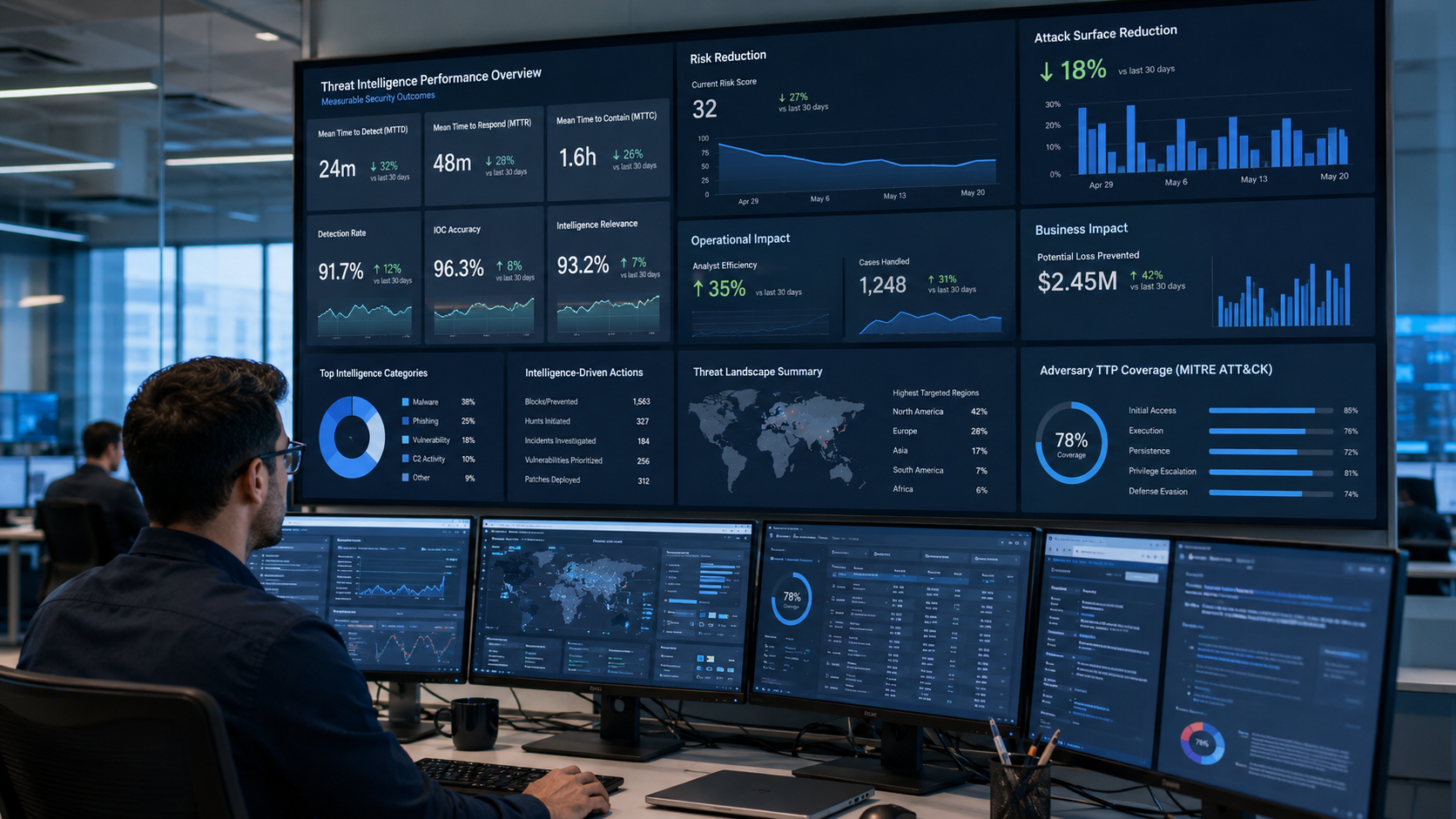
Measuring threat intelligence effectiveness focuses on whether intelligence reduces risk, improves detection, and helps security teams make faster decisions. At MSSP Security, we have seen that operational results, response improvements, and reduced exposure provide stronger evidence than indicator counts alone.
Effective measurement connects intelligence to business decisions, security outcomes, and daily operations. Teams that track meaningful metrics can better justify investments and demonstrate value to leadership. Keep reading to see which CTI metrics matter most and how to measure them.
CTI Value at a Glance
Threat intelligence proves its value when it improves decisions, reduces risk, and speeds security operations. The metrics below summarize the operational, tactical, and business outcomes that matter most.
- Measure threat intelligence through outcomes, not indicator volume.
- Connect CTI metrics to SOC efficiency, risk reduction, and business impact.
- Build a measurement framework that supports analysts, security leaders, and executives.
What Should Security Leaders Measure First?
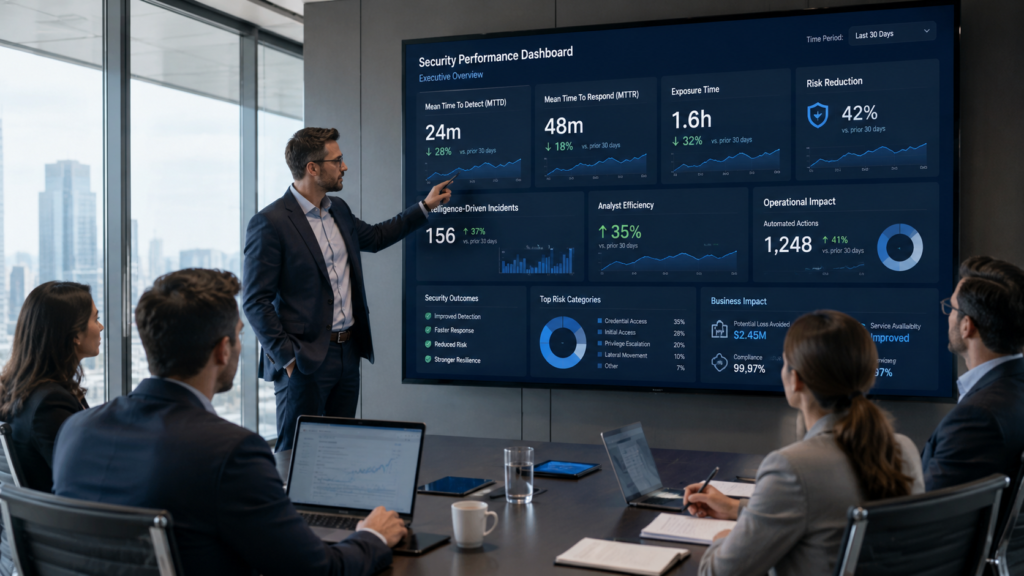
Security leaders should measure outcomes before activity. Many security programs still report the number of feeds, reports, or indicators collected each month. But those numbers don’t explain whether analysts detected threats faster or reduced exposure. That’s the problem.
In our consulting work, we often review intelligence programs that produce large amounts of data but very little action. Executives don’t ask how many indicators entered a platform. They ask whether risk dropped and whether analysts worked faster.
Teams should focus on a few practical measurements:
- Intelligence-driven incidents.
- Detection improvements.
- Faster investigations.
- Reduced exposure time.
- Decisions influenced by CTI.
And those metrics are easier to explain.
A security manager can show that intelligence reduces investigation time by twenty minutes. They can show that a vulnerability was patched because of an intelligence report. Those outcomes make sense to leadership.
We have seen MSSPs improve client reporting after removing large indicator counts from dashboards. Clients cared more about actions than collections. Most people do.
Key early metrics
| Metric | Why it matters |
| MTTD | Faster detection |
| MTTR | Faster response |
| Risk reduction | Business value |
| CTI actions | Operational impact |
| Exposure time | Lower risk |
Measure results first.
Why Is Measuring CTI Effectiveness So Difficult?
Successful intelligence often prevents incidents. And prevention is hard to prove. A blocked command-and-control connection may never become an incident. A prioritized vulnerability might never be exploited. Leadership sees fewer events while analysts see reduced exposure. Those viewpoints don’t always match.
We’ve reviewed several MSSP environments where strong intelligence stopped attacks early, yet monthly reports showed little activity. The security team felt successful. Management saw fewer incidents and wondered whether intelligence was necessary. That’s where measurement gaps appear.
Several factors contribute:
- Prevention leaves little evidence.
- Executives want financial value.
- Analysts need operational proof.
- Reports replace outcomes.
Still, organizations continue investing in CTI because intelligence supports better decisions. The challenge isn’t collecting data. It’s connecting that data to actions.
One consulting engagement showed this clearly. An intelligence report led to early patching of exposed systems. Months later, a campaign targeted the same weakness. The client avoided disruption, but proving the connection required documentation.
Security teams should therefore measure near misses, exposure windows, and intelligence-driven actions. Those measurements help explain what never happened and why that matters.
Which Metrics Matter at the Operational Level?
Operational metrics measure speed, quality, and usefulness. Analysts need intelligence that arrives quickly and produces reliable results. Delayed information often loses value. Poor-quality indicators create noise. Both problems reduce effectiveness.
Our teams frequently audit MSSP workflows to identify delays between intelligence collection and security controls. In many environments, integrating threat intelligence feeds into SIEM platforms helps reduce these delays by improving visibility and accelerating detection workflows.
Sometimes high-confidence indicators sit in queues for hours before deployment. By then, the opportunity may already be gone.
Important operational metrics include:
- Time to publish.
- IOC accuracy.
- Source reliability.
- False positive rates.
- Signal quality.
- Analyst efficiency.
Quality matters more than volume. One useful indicator can outperform thousands of noisy ones.
We also encourage teams to track operational delays:
- Review bottlenecks.
- Validation time.
- Correlation delays.
- Approval workflows.
- Enforcement delays.
And those delays often surprise security teams.
In one assessment, intelligence reached the platform within minutes, yet internal approvals delayed action by several hours. The problem wasn’t the feed. It was the process.
Good intelligence moves quickly. Better processes help it move faster. Operational measurements allow MSSPs to evaluate new products, audit workflows, and improve service delivery. That’s often where the biggest gains appear.
How Do Tactical Metrics Improve Security Operations?
Tactical metrics show whether intelligence improves detection and response. Threat intelligence becomes useful only after security teams apply it. Data sitting inside a platform doesn’t protect anyone. Action does.
Many MSSPs we support compare incidents with and without intelligence involvement. The differences can be substantial.
Analysts often investigate faster because context already exists before triage begins. Effective programs frequently depend on operationalizing threat intelligence within the SOC. So that intelligence directly supports investigations, detections, and response decisions.
Important tactical measurements include:
- Mean time to detect.
- Mean time to respond.
- Mean time to contain.
- Dwell time reduction.
- Detection improvements.
One thing stands out. Context saves time.
Analysts don’t need to start from zero when intelligence provides adversary behavior, known indicators, or attack patterns. Investigations become shorter and decisions become easier.
Another useful measurement is the IoC hit rate. This shows how often indicators generate meaningful detections.
Teams should track:
- Detection hits.
- Threat hunts.
- Investigation triggers.
- Detection rules.
- Response actions.
Sometimes the hit rate is low. That doesn’t always mean intelligence failed. Poor telemetry, weak visibility, or outdated data can also affect results. We often remind MSSPs to measure operations, not only intelligence. Both sides influence outcomes.
How Can Executives Measure Business Value?
Executives care about risk, costs, and decisions. Most leaders never review indicators, enrichment data, or detection rules. They want to know whether security investments reduced exposure and improved resilience. That’s the language they understand.
During our consulting engagements, we often help MSSPs translate technical metrics into business outcomes. The strongest reports connect intelligence to actions that leadership already tracks.
Intelligence should support:
- Vulnerability decisions.
- Budget planning.
- Risk reduction.
- Third-party reviews.
- Incident preparation.
- Security investments.
And those decisions have measurable value.
A CISO may never ask about indicator accuracy. But reduced exposure windows, faster containment, and lower operational risk immediately make sense. That’s why strategic metrics matter.
Teams can measure:
- Attack surface reduction.
- Remediation speed.
- Security investments.
- Risk exposure.
- Intelligence-driven decisions.
Short reports work.
One MSSP we supported reduced executive reporting from twenty pages to four. Leadership engagement improved because the information focused on business outcomes rather than technical details. The goal isn’t more reporting. It’s better reporting.
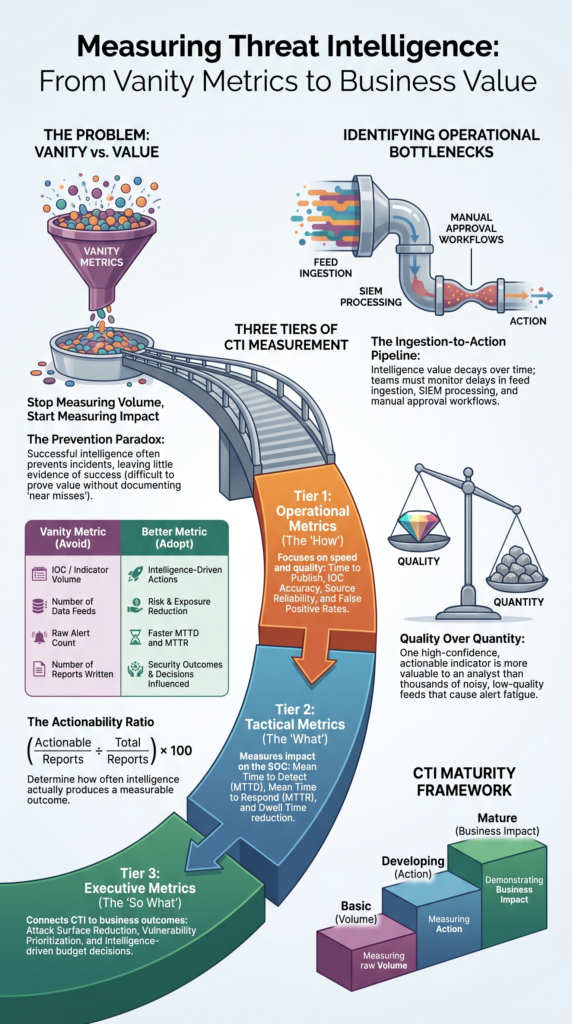
Why Do Vanity Metrics Fail Leadership Teams?
Large numbers often create confusion. Security teams sometimes report millions of indicators, dozens of feeds, or hundreds of alerts. Those figures look impressive, but they rarely explain whether security improved.
We’ve audited environments where several intelligence feeds produced almost identical indicators. The volume increased. The value did not.
| Vanity Metric | Better Metric |
| IOC volume | Actions taken |
| Feed count | Risk reduction |
| Alerts | Faster response |
| Reports | Security outcomes |
Several issues affect volume metrics:
- Duplicate indicators.
- Expired data.
- Feed overlap.
- Low-quality sources.
- Limited coverage.
And that’s common. Analysts often spend time processing data that never produces a detection or investigation. More information doesn’t always mean better intelligence.
Research from Sensors Journal (MDPI AG)
“Incomplete or inaccurate data can lead to flawed threat assessments and ineffective security measures. Additionally, information overload, or the volume of data related to cybersecurity threats, can be overwhelming, creating difficulties for organizations in identifying and prioritizing the most relevant threats.” – Sensors Journal
Instead, teams should track:
- Actionability rates.
- Detection improvements.
- Hunt success.
- Mitigation results.
- Intelligence usage.
We usually tell MSSPs to ask one question during product reviews: “What decisions changed?”. If nothing changed, the metric probably doesn’t matter. Simple measurements often provide the strongest evidence.
How Should Teams Measure Actionability?
Credits: BSidesLV
Actionability shows whether intelligence leads to action. Reports that nobody reads have little value. Indicators that never trigger detections don’t help analysts. Intelligence should influence decisions, investigations, or defensive actions.
One useful measurement is the actionability ratio:
Actionable Reports ÷ Total Reports × 100
This metric shows how often intelligence produces measurable outcomes. Organizations that focus on threat intelligence integration and actioning often find it easier to connect intelligence outputs with investigations, detections, and response activities.
Actions may include:
- Blocking activity.
- Threat hunts.
- Investigations.
- Detection rules.
- Executive briefings.
- Response playbooks.
We’ve seen some MSSPs focus heavily on report production while clients struggled to identify useful actions. After reviewing workflows, teams shifted toward shorter reports with clear recommendations. The results improved quickly.
Another useful measurement is tracking completed actions:
- Patching systems.
- Escalating cases.
- Deploying detections.
- Investigating alerts.
- Containing threats.
Actionability also helps product evaluations. When our teams audit intelligence platforms, we examine whether the information leads to operational decisions. Features matter, but outcomes matter more.
Security teams need decisions, not another dashboard. That lesson appears again and again.
How Does Latency Affect CTI Effectiveness?
Threat intelligence loses value over time. An indicator received today may become useless tomorrow. Fast-moving attacks leave little room for delays, which is why latency matters.
In several assessments, we found that high-confidence intelligence reached security teams quickly but waited inside approval queues for hours. The information was good. The process was slow. Ingestion-to-action latency measures the delay between receiving intelligence and deploying controls.
Common delays include:
- Feed ingestion.
- Manual approvals.
- SIEM processing.
- Enrichment workflows.
- Response execution.
And every delay reduces value.
A detection delivered six hours late may only explain what happened rather than prevent what happens next. That’s frustrating for analysts who know the threat already moved.
Teams should monitor:
- Source freshness.
- Response speed.
- Correlation delays.
- Deployment times.
- Processing bottlenecks.
We’ve helped MSSPs identify product configurations that added unnecessary delays. In some cases, small workflow changes improved response times more than new tools did.
Speed matters. Threat actors move quickly, and intelligence programs must move with them. The best intelligence arrives early enough to support action, not after the incident is over.
Why Must Telemetry and Threat Hunting Be Measured?
Intelligence depends on visibility. Threat intelligence cannot compensate for missing logs, broken agents, or incomplete telemetry. When data disappears, intelligence results become unreliable.
We often find telemetry problems during MSSP assessments. Analysts blame intelligence quality, but the real issue is visibility.
Several problems appear when telemetry fails:
- Missing endpoint data.
- Lost logs.
- Reduced detections.
- Incomplete context.
- Blind spots.
Check visibility first.
Critical data sources include:
- Endpoint sensors.
- Cloud logs.
- Network monitoring.
- Authentication logs.
- Security telemetry.
Threat hunting also validates intelligence effectiveness. Hunts driven by intelligence often uncover hidden activity that automated alerts miss.
As highlighted by arXiv e-prints (Cornell University)
“We present a mathematical model that translates complex threat intelligence into an actionable, unified metric similar to a stock market index, that executives can understand and interact with while teams can act upon… This allows for dynamic, context-aware evaluation of an organization’s security posture, moving beyond static compliance-based assessments.” – arXiv e-prints
Teams can measure:
- Hunt campaigns.
- Detection rules.
- Threat discoveries.
- Adversary behavior.
- Investigation outcomes.
One hunting exercise uncovered dormant persistence mechanisms that existing alerts missed. The resulting detection rules continued providing value long after the investigation ended.
How Can Organizations Build a CTI Measurement Framework?
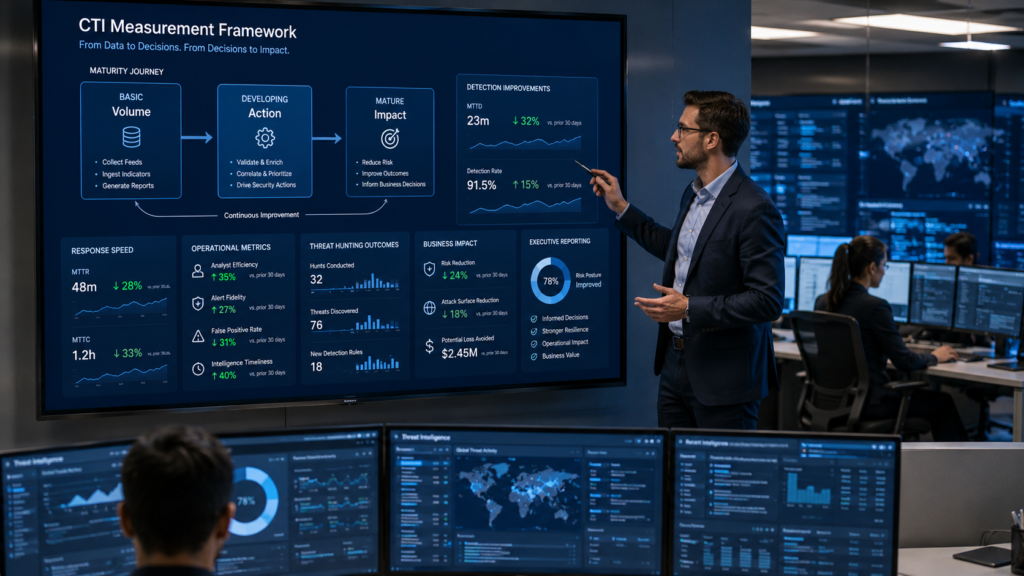
Mature programs measure impact. Security teams often begin by counting feeds, reports, and indicators. Over time, the focus should shift toward actions, outcomes, and business value.
| Stage | Focus |
| Basic | Volume |
| Developing | Action |
| Mature | Impact |
Executive dashboards should include:
- Detection improvements.
- Risk reduction.
- Response speed.
- Hunting outcomes.
- Business decisions.
- Exposure reduction.
At MSSP Security, we help service providers evaluate products, audit security programs, and measure intelligence outcomes. Our work focuses on practical improvements rather than large dashboards.
We’ve found that organizations achieve stronger results when operational, tactical, and executive metrics appear together. Separate reports often create confusion. Combined reporting creates context.
Threat intelligence succeeds when it reduces risk, speeds decisions, and improves security outcomes. Teams that focus on actionability, operational value, and measurable results move beyond vanity metrics.
As threats change, measurement should change too. Organizations should regularly review intelligence quality, validate security outcomes, and connect CTI to business performance.
Security programs that emphasize actionable intelligence and measurable impact consistently build stronger defensive operations.
FAQ
How can small security teams measure threat intelligence effectiveness?
Small security teams can begin measuring threat intelligence effectiveness by tracking results that affect daily operations. Useful threat intelligence metrics include mean time to detect, mean time to respond, and overall risk reduction.
Teams can also measure analyst productivity, incident prioritization, and operational impact. These measurements help organizations understand whether intelligence improves security outcomes and supports better decisions.
Which threat intelligence KPI helps reduce unnecessary alerts?
The false positive rate is an important threat intelligence KPI because it shows how often alerts are incorrect. Teams should also measure the true positive rate, false negative rate, and alert fidelity.
Strong intelligence accuracy and effective threat feed validation improve detection quality. Monitoring these security intelligence metrics helps reduce alert fatigue and allows analysts to focus on real threats.
Why does intelligence timeliness affect security outcomes?
Intelligence timeliness determines whether security teams receive information early enough to take action. Delayed intelligence often reduces intelligence relevance and limits actionable intelligence.
Organizations can measure source freshness, detection rate, and remediation speed to evaluate performance. Timely intelligence supports proactive defense, improves incident response, and helps reduce operational risk across security operations.
How does threat hunting improve CTI effectiveness?
Threat hunting helps organizations evaluate CTI effectiveness by identifying threats that automated tools may miss. Hunting activities improve threat context, support adversary TTPs analysis, and strengthen MITRE ATT&CK alignment.
Teams can measure campaign tracking, TTP visibility, and detection engineering results. These activities improve intelligence-driven security and provide valuable information for future investigations and defensive actions.
What makes a threat intelligence source reliable?
A reliable intelligence source provides accurate, relevant, and current information. Organizations evaluate source reliability by reviewing source credibility, source coverage, and intelligence accuracy.
Threat feed quality also depends on indicator validation, IOC correlation, and source freshness. Reliable intelligence improves vulnerability prioritization, supports attack surface reduction, and strengthens long-term security outcome measurement.
Measure What Improves Security
Threat intelligence only matters when it helps teams make better decisions and reduce risk. Metrics that focus on accuracy, relevance, and operational impact give security teams a clearer view of what works. As threats change, organizations need to keep measuring outcomes and connect intelligence directly to security performance.
Teams that focus on actionable intelligence often build stronger defenses and improve visibility across daily operations. See how MSSP Security can help turn intelligence insights into measurable security results.
References
- https://pmc.ncbi.nlm.nih.gov/articles/PMC10459806/
- https://ui.adsabs.harvard.edu/abs/2024arXiv240619374A/abstract