

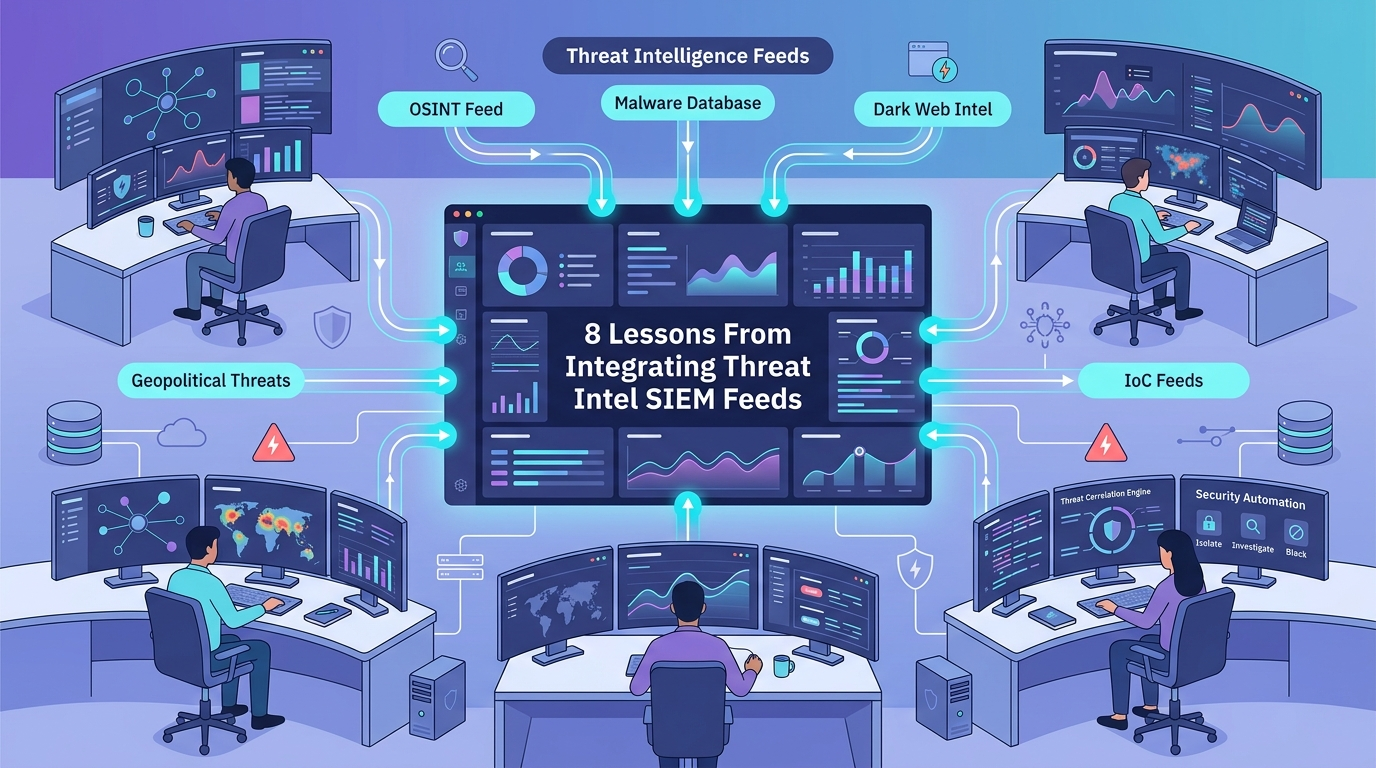
Integrating threat intel SIEM feeds the wrong way creates alert fatigue fast. These lessons help teams avoid common failures.
A three-tier setup is often the most sustainable architecture: external threat feeds, a Threat Intelligence Platform (TIP) to normalize the data, and your SIEM to handle correlation. This is a widely recommended way to reduce false positives and control ingestion load. Plugging raw feeds straight into your SIEM can overwhelm analysts and increase storage, parsing, and correlation overhead. It can quickly become an operational bottleneck. To learn how to build a pipeline that turns raw data into real defensive action, keep reading.
Threat Intel SIEM Wins You Can Apply Fast
Building a sustainable threat intelligence workflow in your SIEM comes down to filtering noise, prioritizing meaningful signals, and focusing on detections that stay useful over time.
- A TIP is highly recommended in larger environments for filtering and scoring data before it hits your SIEM, preventing alert fatigue.
- Use retroactive, scheduled searches alongside real-time matching to balance detection speed with system performance.
- Focus on behavioral indicators and attacker TTPs over ephemeral IPs and hashes for more durable, effective detection rules.
Why Raw Threat Feeds Break Your SIEM
Many MSSPs run into a common problem: believing more threat data means better security. The reality is brutal. Unfiltered feeds from sources like Abuse.ch flood SIEMs with ephemeral IPs and file hashes that change frequently, grinding performance to a halt. This “ingest tax” costs real money and burns out analysts who face hundreds of useless “critical” alerts, especially during SIEM EDR investigation workflows where analysts already struggle with alert overload. The system loses all trust.
As highlighted by ScienceDirect
“Merely generating SIEM alerts for suspicious activity did not increase the rate at which security analysts responded to events. In fact, it could be argued that too many SIEM alerts had an adverse effect on analyst response rates” –ScienceDirect
The goal is to reduce noise and improve signal quality. We help clients stop dumping raw, low-confidence indicators and duplicates straight into their SIEM. Hash-based detection is less durable than behavior-based detection. Now, the focus has to be on curating data first, filtering the noise to find the underlying attack behaviors that actually matter.
The Recommended Architecture: Inserting a Middleman
You don’t pipe a river into your house; you filter it first. This is why our recommended architecture forces a middleman between raw feeds and your SIEM: a Threat Intelligence Platform (TIP). We’ve seen tools like MISP or Anomali do the dirty work your SIEM shouldn’t handle, aggregating feeds, deduplicating entries, and scoring each indicator.
| Layer | Role | Example Technologies |
| Threat Sources | Collects raw intelligence | OSINT feeds, ISACs, Commercial vendors |
| Threat Intelligence Platform (TIP) | Normalizes, scores, and filters | MISP, OpenCIT, Anomali |
| SIEM Engine | Correlates and generates alerts | Microsoft Sentinel, Splunk, Elastic |
A good TIP filters based on confidence scores, letting you push only high-value indicators to the SIEM. This prevents storage bloat and turns a chaotic firehose into a manageable stream for correlation. Many teams also pair this approach with integrating SOAR SIEM EDR pipelines to automate enrichment and reduce manual triage pressure. It’s the practical fix we implement for MSSPs drowning in data.
Real-Time vs. Retroactive Matching: A Performance Choice
The clean data is in your SIEM, so how do you use it? We advise MSSPs to consider two paths. Real-time correlation checks every incoming log instantly against threat lists, giving immediate alerts but risking severe performance lag. Retroactive matching runs scheduled searches through past logs, saving processing power but delaying detection.
| Detection Method | Advantage | Risk |
| Real-Time Correlation | Immediate alerts | High CPU/Memory usage |
| Retroactive Matching | Lower processing overhead | Delayed detection |
| Hybrid Model | Balanced visibility | Requires careful orchestration |
In reality, you need both. Our audits often find teams using real-time only for their highest-confidence, critical indicators. For broader intelligence and hunting, they switch to retroactive searches. This hybrid approach is the fix we implement to stop production environments from buckling under the load.
How STIX and TAXII Standardize the Exchange
Credits: Cyber Security Entertainment
For feeds and platforms to communicate, they need a shared language. This is where STIX and TAXII come in. STIX provides the vocabulary, structuring threat details into a machine-readable format that describes not just an IP, but the actor, malware, and its tactics. TAXII is the delivery system, a standard protocol for securely moving that STIX data from a provider to your systems.
The real world isn’t ideal. In our audits, we find many vendors still use proprietary APIs or CSV files. These are simpler to set up but lose the crucial context of a full STIX object. The trend, however, is moving toward this standardization. We help MSSPs prioritize and select products that support STIX/TAXII, because this common framework is what makes a modern, automated threat intelligence pipeline work without constant manual integration headaches.
Managing the Lifecycle: From Ingestion to Expiration
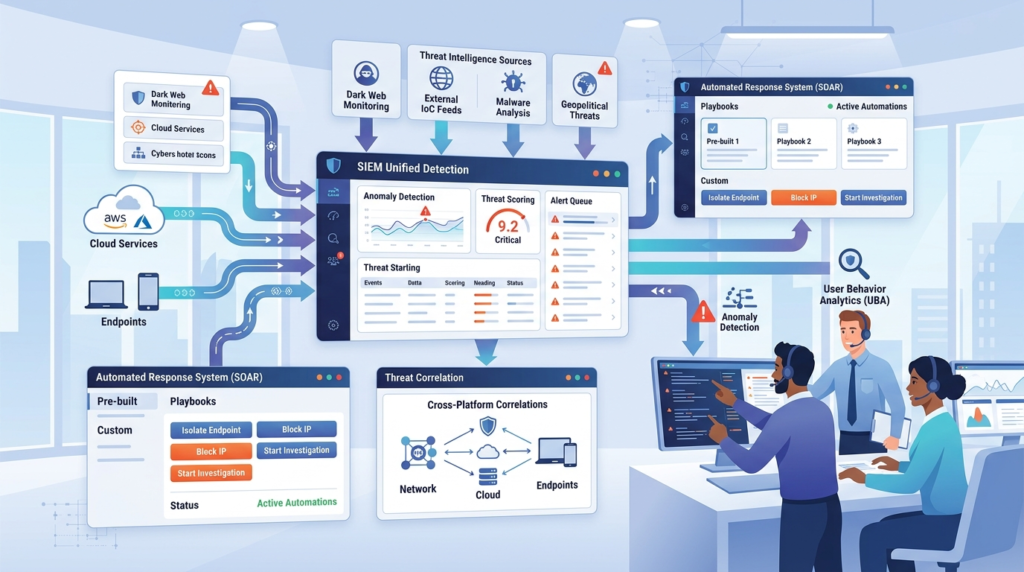
Indicator lifespan varies by source, type, and relevance, so expiration policies should be based on confidence and recency. If you don’t manage it, old data will flood your system with false positives. We enforce a five-phase lifecycle for our MSSP clients: Ingestion, Normalization, Enrichment, Scoring, and Expiration.
- Ingestion: TAXII/API pull from sources.
- Normalization: Map src_ip, dest, ip_address to unified intel_ip.
- Enrichment: Tag with actor, confidence score, kill-chain phase.
- Scoring: Apply threshold (e.g., confidence > 75% for alerts).
- Expiration: Automated aging-out (Example TTLs for IP indicators may range from days to weeks, depending on confidence and relevance).
The last step, automated expiration, is essential. Without it, stale indicators poison your active lookup tables. We use confidence scoring as a primary filter; only high-scoring data triggers alerts, while lower-confidence intel is reserved for analyst hunting, which keeps the main alert queue clean and operational.
Shifting From Atomic Indicators to Behavioral Intelligence
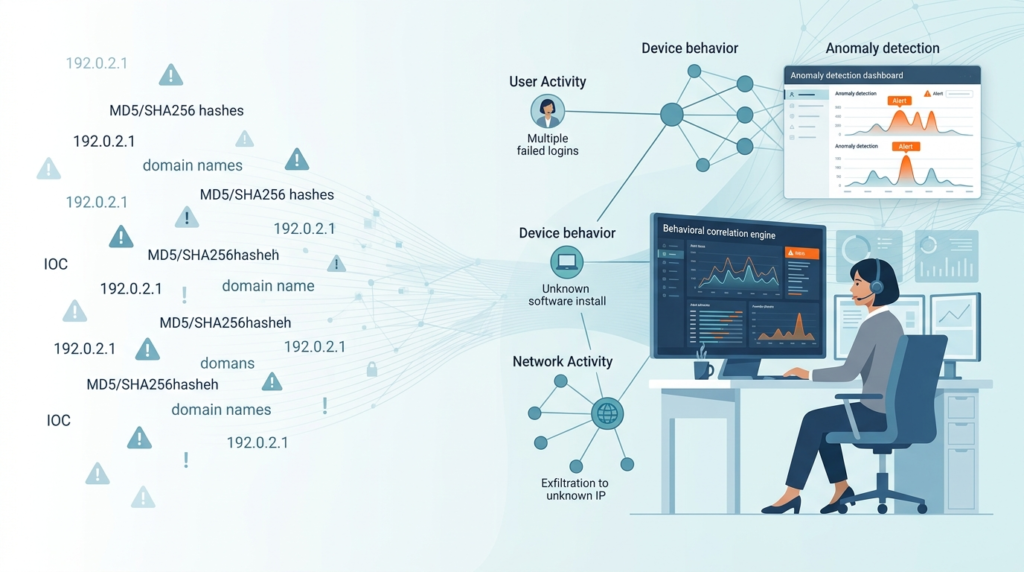
Focusing on single IPs and hashes is a short-term game; attackers change them constantly. A smarter approach is using intelligence to understand their behaviors, which is where frameworks like MITRE ATT&CK come in.
Research from Computers & Security shows
“High detection rate for C2 and Impact techniques, and partial detection for Collection and Ex-filtration tactics owing to gaps in correlation and telemetry depth.” –Computers & Security
Instead of a rule that alerts on a specific malicious IP, we help build rules for behaviors like unexpected PowerShell execution from a non-admin context followed by an outbound HTTP request. This shifts detection from chasing ephemeral indicators to finding persistent operational patterns, which are much harder for an attacker to change.
Monitor for the behaviors intelligence reports highlight: DNS beaconing with regular, timed queries, lateral movement like a service account authenticating across multiple systems, or privilege escalation where a user account spawns SYSTEM-level processes. Tuning your SIEM to find these patterns moves your security from reactive to proactive.
Advanced Edge Cases That Break Production Integrations
Even with a perfect architecture, things break in production. One common failure is parsing; your SIEM might look for a field like ‘DestinationIP’, but if the firewall log buries that IP in an unstructured Syslog string, the match fails silently. We’ve seen this happen.
Some platforms impose rule, ingestion, or parsing limits that require tuning or workaround design. This forces you to combine logic or script external filters. The ‘plug-and-play’ dream meets these software constraints, which we help MSSPs design around from the start.
Building a Strategy That Lasts
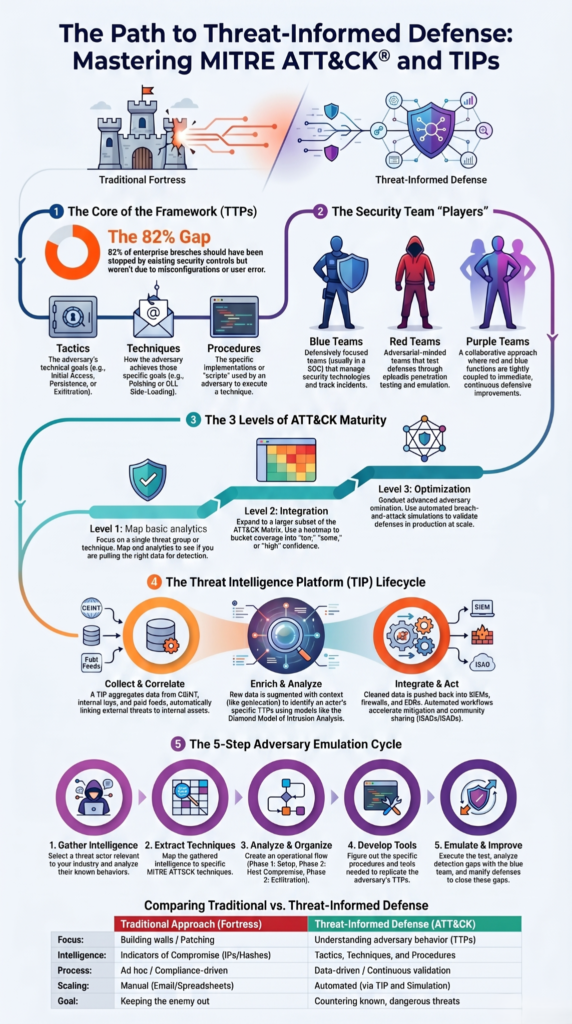
Start by defining what’s relevant. A financial client needs different intelligence than a healthcare provider, so we prune feeds on that basis. A TIP becomes increasingly valuable as feed volume and correlation complexity grow: it’s a necessity for enforcing strict confidence scoring and automated expiration policies. This is also why many organizations move toward managed SIEM service benefits that help maintain tuning, lifecycle management, and operational stability at scale.
The strategy builds detection rules around attacker behaviors, not just atomic indicators, and mixes real-time with retroactive matching to maintain performance. Success is measured by quality, not quantity. The mean time to detect should drop, and the false-positive rate must plummet.
This is how you integrate threat intelligence without breaking your SIEM. It’s a disciplined architecture that understands more data is only better if you have a robust system to handle it, which is the foundation we build for our MSSP partners.
FAQs
How does integrating threat intel SIEM improve daily security monitoring?
Integrating threat intel SIEM processes adds contextual intelligence to event logs and internal telemetry. This approach helps analysts identify suspicious activity faster, improve alert triage accuracy, reduce false positives, and strengthen proactive defense strategies across security operations.
Why do threat intel feeds create excessive false positives?
Threat intel feeds often generate false positives when they contain outdated compromise indicators or low-confidence external threat data. Proper IOC correlation, enrichment rules, and behavioral analytics help security teams improve detection quality and reduce unnecessary alerts.
What improves threat feed ingestion performance in large SIEM environments?
Feed normalization, data parsing, and structured threat data correlation improve threat feed ingestion performance in large environments. Combining scheduled searches with real-time detection also prevents log management systems and security analytics workflows from becoming overloaded.
How does indicator enrichment support faster incident investigation?
Indicator enrichment connects malicious IP detection, URL reputation, file hash matching, and domain reputation analysis with relevant security context. This process helps analysts accelerate incident investigation, improve threat analysis, and strengthen incident response decisions.
Why are adversary TTPs more effective than basic IOC matching?
Adversary TTPs provide stronger long-term detection value because attackers frequently rotate malware indicators and compromise indicators. Behavioral analytics, MITRE ATT&CK mapping, and attack pattern analysis help teams improve threat hunting and intelligence-driven security operations.
The Sustainable Integration Blueprint
Integrating threat intelligence into your SIEM is less about collecting more feeds and more about building a system that can process, prioritize, and act on meaningful signals. A sustainable approach starts with clean data, smart filtering, and lifecycle management that keeps detections relevant instead of noisy. If your team is evaluating how to reduce tool sprawl, improve SIEM visibility, or optimize your security stack for long-term performance, MSSP Security consulting services can help you streamline integrations, assess vendors, and build a detection strategy aligned with your operational goals.
References
- https://www.sciencedirect.com/science/article/abs/pii/S016740482030095X
- https://www.sciencedirect.com/science/article/abs/pii/S0167404825003918?dgcid=rss_sd_all