

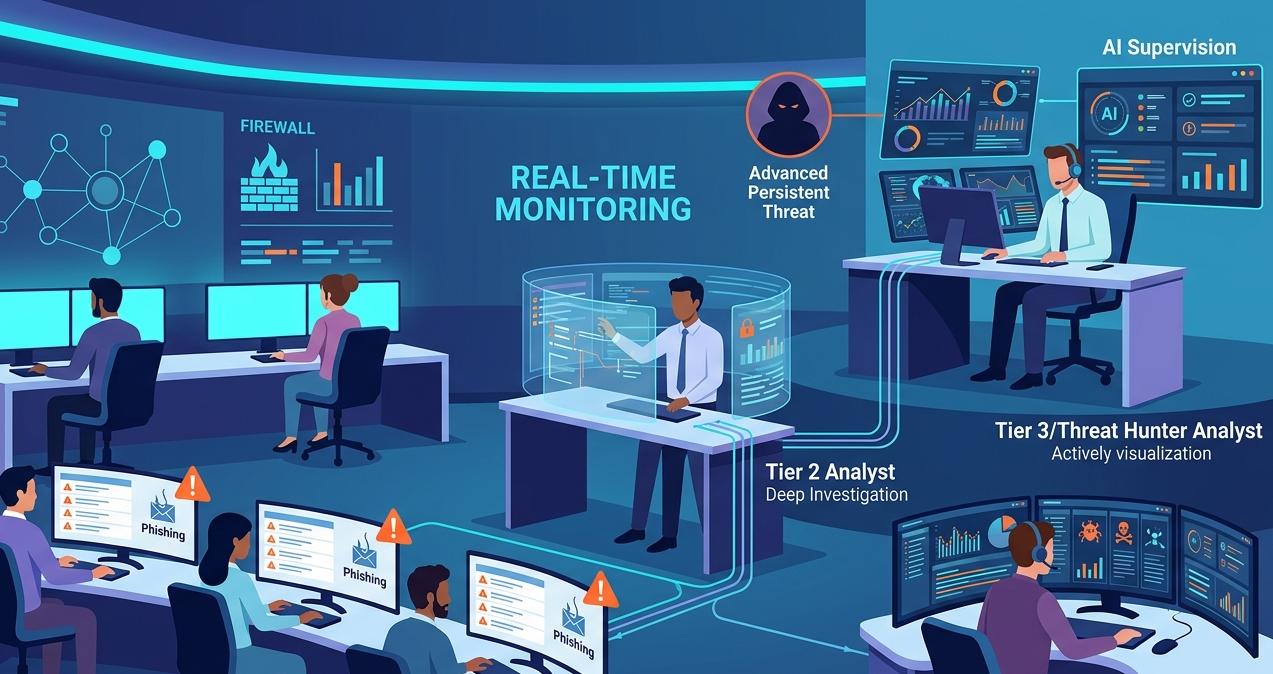
Security Analyst Roles Expertise is best understood through how Security Operations Centers (SOC) function in real time. In MSSP Security environments, we don’t just observe threats, we continuously monitor, analyze, and respond to them across multiple clients and systems.
Every analyst role, from Tier 1 to Tier 3, contributes to a layered defense system where speed and accuracy matter. This breakdown follows real operational workflows, not just theory, showing how SOC teams actually function day to day.
What You’ll Actually Notice in SOC Work
Before going into roles and responsibilities, it’s important to understand the pattern behind SOC operations. In MSSP Security settings, we often experience how everything connects into one workflow where detection and response never stop.
- SOC analysts continuously monitor and triage security alerts
- Tiered roles (1, 2, 3) define depth of investigation and escalation
- MSSP environments accelerate real-world cybersecurity skill development
SOC Analyst Daily Activities
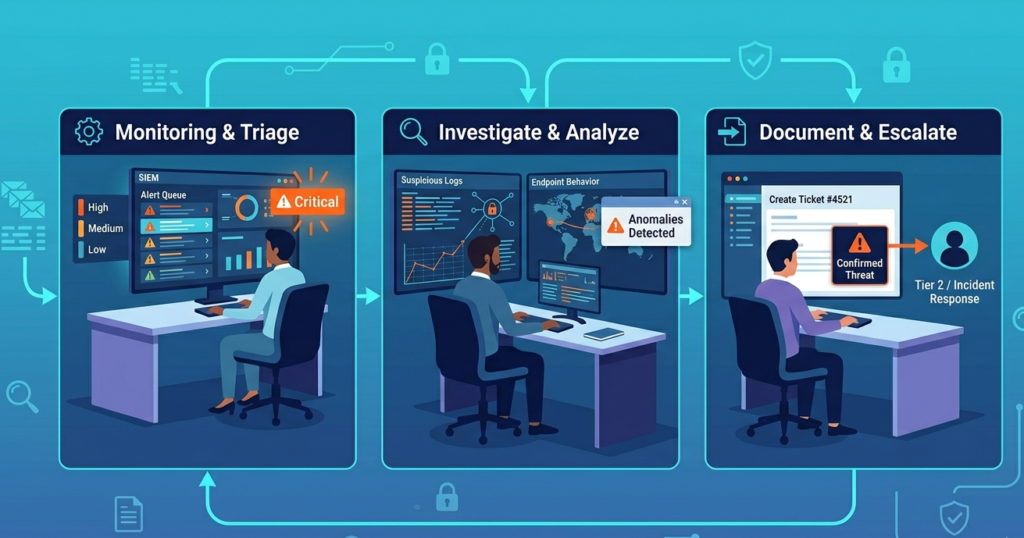
SOC analysts spend most of their time working inside security dashboards and incident queues. In MSSP Security operations, we often rotate between alert review, investigation, and escalation tasks depending on severity.
Daily activities include:
- Monitoring SIEM alerts and security dashboards
- Investigating suspicious logs and anomalies
- Prioritizing and triaging incidents
- Escalating confirmed threats
- Documenting findings in ticketing systems
- Coordinating with response and engineering teams
The work is continuous, structured, and highly time-sensitive.
Roles Within Security Operations Center
A SOC is not a single role but a structured system of responsibilities. Each function supports the others in a layered defense model.
“L1 analysts are upgrading from alert processors into AI supervisors and context analysts, the people who coach, validate, and direct AI systems operating at a scale no human team ever could” – Medium
Common SOC roles include:
- SOC Analyst (Tier 1–2 monitoring and investigation)
- Threat Hunter (proactive threat discovery)
- Security Engineer (tooling and detection systems)
- Incident Responder (containment and recovery)
- SOC Manager (coordination and operations oversight)
In MSSP Security environments, these roles often overlap depending on workload and client needs.
SOC Analyst Tier 1 2 3 Responsibilities
SOC analyst tier roles are divided into tiers based on complexity and technical depth.
| Tier | Focus | Responsibilities |
| Tier 1 | Monitoring | Alert triage, initial investigation |
| Tier 2 | Analysis | Deep investigation, correlation |
| Tier 3 | Advanced Security | Threat hunting, forensic analysis |
Tier 1 filters noise, Tier 2 validates incidents, and Tier 3 handles advanced attacks and intelligence-driven analysis.
Skills Needed Security Analyst
Credits: Cyber with Ben
A strong security analyst combines technical knowledge with structured thinking and attention to detail.
Core skills include:
- Networking fundamentals (TCP/IP, DNS, HTTP)
- SIEM tools and log correlation
- Malware behavior analysis
- Incident documentation and reporting
- Critical thinking under pressure
- Understanding attack patterns
In MSSP Security environments, these skills develop faster due to exposure to multiple systems and real incidents.
Threat Hunter Role Description
Threat hunters actively search for hidden threats instead of waiting for alerts. In MSSP Security operations, this role focuses on identifying advanced persistent threats that bypass detection systems.
Key responsibilities:
- Hypothesis-based threat investigation
- Behavioral anomaly detection
- Endpoint and network analysis
- Identifying stealthy attack patterns
Threat hunting is proactive, analytical, and deeply investigative.
Security Engineer SOC Responsibilities
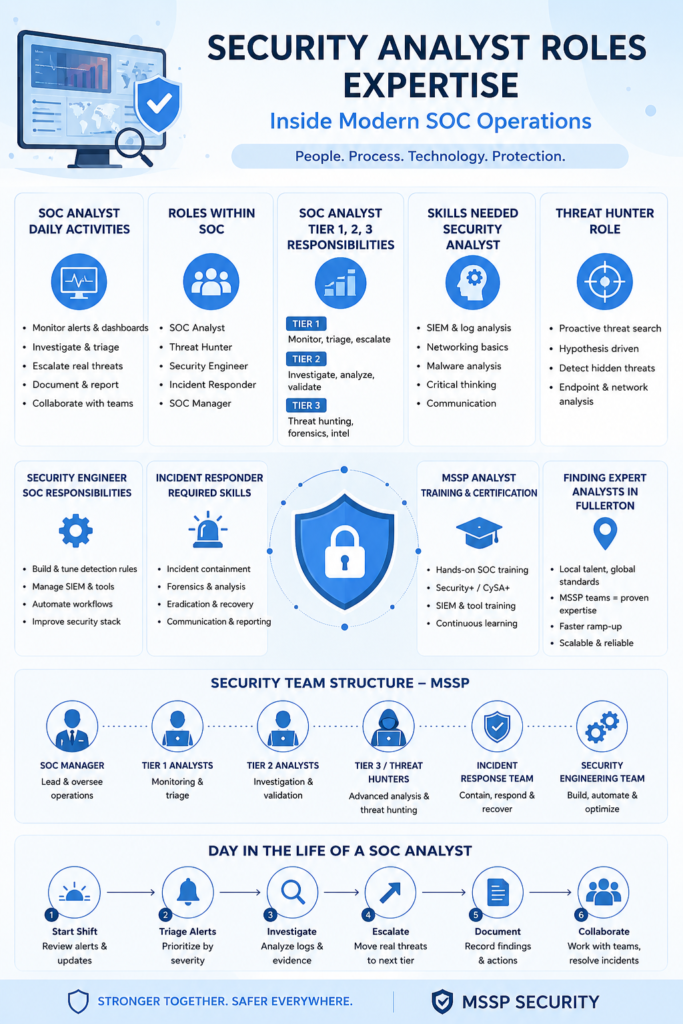
Security engineers build and maintain the SOC infrastructure. They ensure detection systems and security tools function effectively.
Responsibilities include:
- Managing SIEM configurations
- Creating and tuning detection rules
- Automating security workflows
- Supporting SOC analysts with tools
- Maintaining security architecture
They ensure the SOC operates efficiently at scale.
Incident Responder Required Skills
Incident responders focus on containing attacks and restoring systems after a breach.
Required skills:
- Digital forensic investigation
- Malware containment and analysis
- System isolation techniques
- Incident coordination and communication
- Root cause analysis
Speed and accuracy are critical in minimizing damage during incidents.
MSSP Analyst Training Certification
MSSP Security environments are structured to accelerate analyst development through hands-on experience.
Common training pathways include:
- Security+ foundational certification
- CySA+ or equivalent analyst certification
- SIEM tool training (log analysis and correlation)
- Live incident response simulations
- Continuous on-the-job learning
We often see MSSP environments helping analysts progress faster due to real-world exposure.
Finding Expert Security Analysts in Fullerton
Organizations searching for expert security analysts in areas like Fullerton often prioritize MSSP Security teams because they offer structured training, multi-client experience, and scalable expertise.
Instead of hiring isolated talent, MSSP models provide:
- Pre-trained SOC teams
- Tiered expertise structure
- Faster incident response readiness
- Continuous skill development
This makes MSSP-based teams a practical choice for enterprise security needs.
Security Team Structure MSSP
MSSP Security teams are organized to handle multiple clients efficiently while maintaining high security standards.
“The tiered structure of SOC teams enhances incident management by ensuring that incidents are addressed by the appropriate level of expertise… allowing for efficient handling of incidents while optimizing resource use”. – Scribd
Typical structure:
- SOC Manager
- Tier 1 Analysts (monitoring and triage)
- Tier 2 Analysts (investigation and validation)
- Tier 3 Engineers / Threat Hunters
- Incident Response Team
- Security Engineering Team
This layered model ensures coverage, scalability, and fast response.
Day in Life SOC Analyst
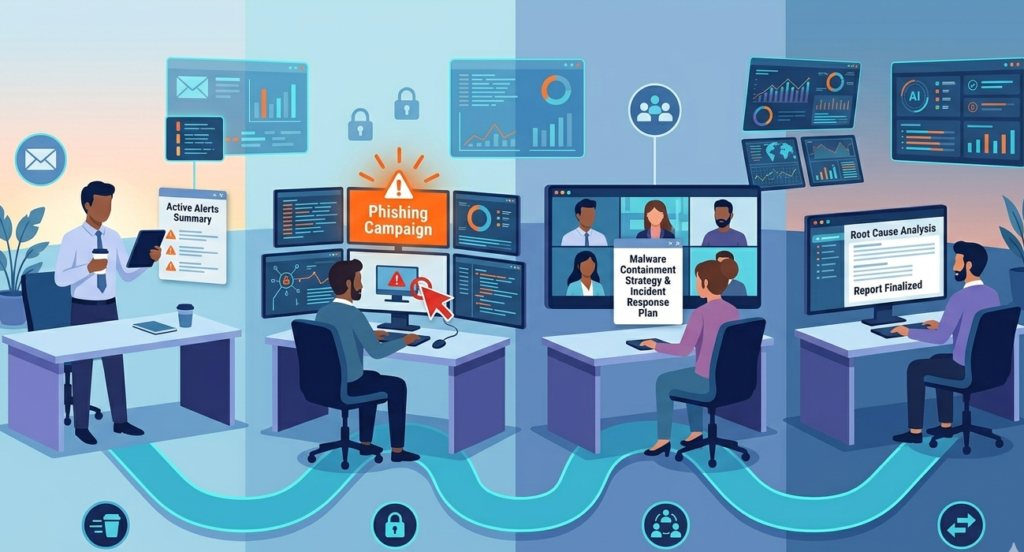
A SOC analyst’s day in MSSP Security environments is dynamic and unpredictable. One shift may focus on phishing investigations, while another deals with malware detection or endpoint compromise.
Typical flow:
- Start shift reviewing active alerts
- Prioritize incidents by severity
- Investigate logs and security events
- Escalate confirmed threats
- Document and report findings
- Coordinate with engineers or response teams
It’s structured work, but no two days feel exactly the same.
FAQ
What does a SOC analyst do daily?
They monitor alerts, investigate suspicious activity, and escalate confirmed threats while documenting incidents.
How are SOC Tier 1, 2, and 3 roles different?
Tier 1 handles monitoring, Tier 2 focuses on deeper analysis, and Tier 3 performs advanced threat hunting and forensics.
What skills are most important for security analysts?
Networking, SIEM tools, log analysis, malware understanding, and strong analytical thinking are essential.
Why is MSSP Security experience valuable?
Because it provides real-world exposure to multiple environments, accelerating hands-on cybersecurity expertise.
Security Analyst Roles Expertise in Modern SOC Environments
Modern SOC environments rely on a structured hierarchy of Security Analyst roles to combat evolving cyber threats. Tier 1 handles initial triage, Tier 2 focuses on deep investigation, and Tier 3 manages advanced hunting.
In MSSP operations, analysts gain rapid expertise through diverse client exposure and streamlined toolstacks. We help MSSPs optimize these environments, reducing sprawl and improving visibility through 15 years of proven consulting experience. Elevate your SOC efficiency, Join Our Expert Program.
References
- https://medium.com/@tahirhussain8098/cyber-security-soc-organizational-hierarchy-and-event-id-mapping-b5930b68b175
- https://www.scribd.com/document/874975327/Key-Roles-of-SOC-Analyst
Related Articles
- https://msspsecurity.com/soc-analyst-daily-activities/
- https://msspsecurity.com/roles-within-security-operations-center/
- https://msspsecurity.com/soc-analyst-tier-1-2-3-responsibilities/
- https://msspsecurity.com/skills-needed-security-analyst/
- https://msspsecurity.com/threat-hunter-role-description/
- https://msspsecurity.com/security-engineer-soc-responsibilities/
- https://msspsecurity.com/incident-responder-required-skills/
- https://msspsecurity.com/mssp-analyst-training-certification/
- https://msspsecurity.com/finding-expert-security-analysts-in-fullerton/
- https://msspsecurity.com/security-team-structure-mssp/
- https://msspsecurity.com/day-in-life-soc-analyst/