

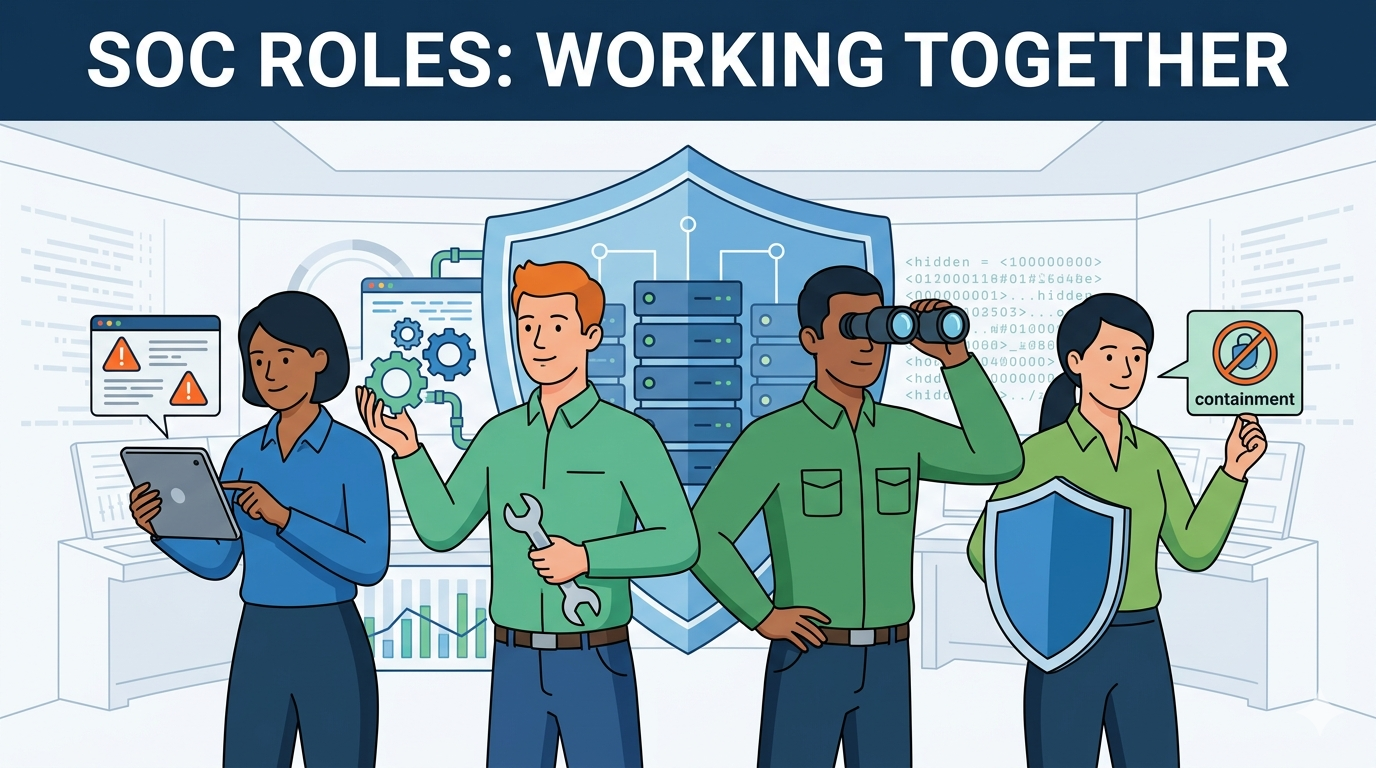
A Security Operations Center (SOC) is not a single job, it is a coordinated system of roles working together to detect, analyze, and respond to cyber threats. Roles within Security Operations Center define how efficiently security incidents are handled from first detection to final resolution.
In MSSP Security operations, we work across multiple client environments, so clear role separation helps maintain speed and accuracy. Each role has a specific responsibility, but all contribute to one goal: protecting systems from evolving threats. Keep reading.
What You Should Remember: SOC Roles in Action
A Security Operations Center only works well when every role understands its function and connects smoothly with others. Here are the key points from how SOC teams operate in real environments:
- A SOC is a collaborative system, not a single job, each role supports the next in the detection-to-response cycle.
- SOC analysts act as the first filter, handling alerts, removing noise, and escalating real threats.
- Security engineers build and maintain the technical backbone (SIEMs, automation, integrations) that keeps monitoring effective.
How SOC Roles Work Together in Practice
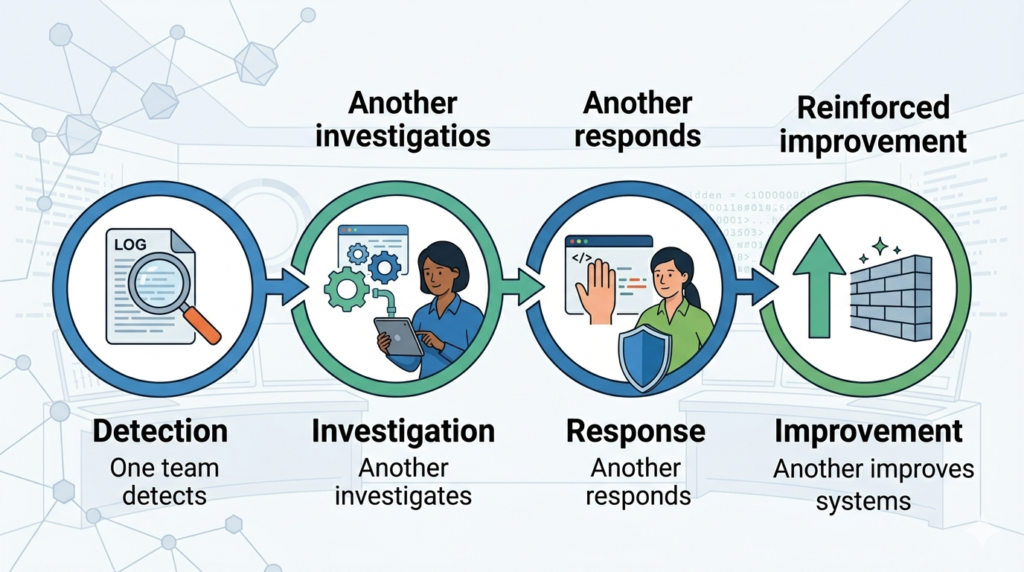
SOC teams operate like a continuous cycle of detection and response. Instead of working in isolation, each role feeds information into the next stage of analysis or action. In MSSP Security environments, this collaboration becomes even more important because we manage multiple organizations at once.
“Instead of treating threat detection, threat prediction, and threat response as independent functions… they can be unified into a continuous feedback-driven intelligence cycle that evolves in parallel with attacker strategies” – The Pinnacle International Journals
Main idea of SOC collaboration:
- One team detects
- Another investigates
- Another responds
- Another improves systems
This flow ensures threats are not only handled but also understood and prevented in the future.
SOC Analyst: The First Line of Defense
Analysts are the first layer of defense, utilizing their security analyst roles expertise to turn raw data into meaningful security actions.
Standard soc analyst daily activities
- Monitoring SIEM dashboards
- Investigating alerts
- Reducing false positives
- Escalating confirmed threats
- Documenting incidents
Analysts are the first layer of defense, turning raw data into meaningful security actions.
Security Engineer: Building the SOC Foundation
Credits: Cyber with Ben
Security engineers maintain and optimize the tools that SOC teams rely on. Without them, detection systems would be unstable or inefficient.
Key responsibilities:
- Configuring SIEM platforms
- Integrating security tools
- Automating detection rules
- Improving system performance
In MSSP Security environments, engineers ensure that systems work across different client infrastructures without interruption.
Threat Hunter: Searching for Hidden Attacks
Threat hunters focus on discovering advanced threats that bypass traditional detection systems. Their work is proactive rather than reactive.
Typical activities:
- Building threat hypotheses
- Analyzing unusual patterns
- Investigating long-term attack behavior
- Identifying stealthy intrusions
Research notes: “Proactive threat hunting enhances detection of advanced persistent threats that evade automated systems” (https://www.sciencedirect.com/science/article/pii/S016740482030215X).
In MSSP Security, threat hunting strengthens visibility across multiple environments.
Incident Responder: Managing Security Breaches
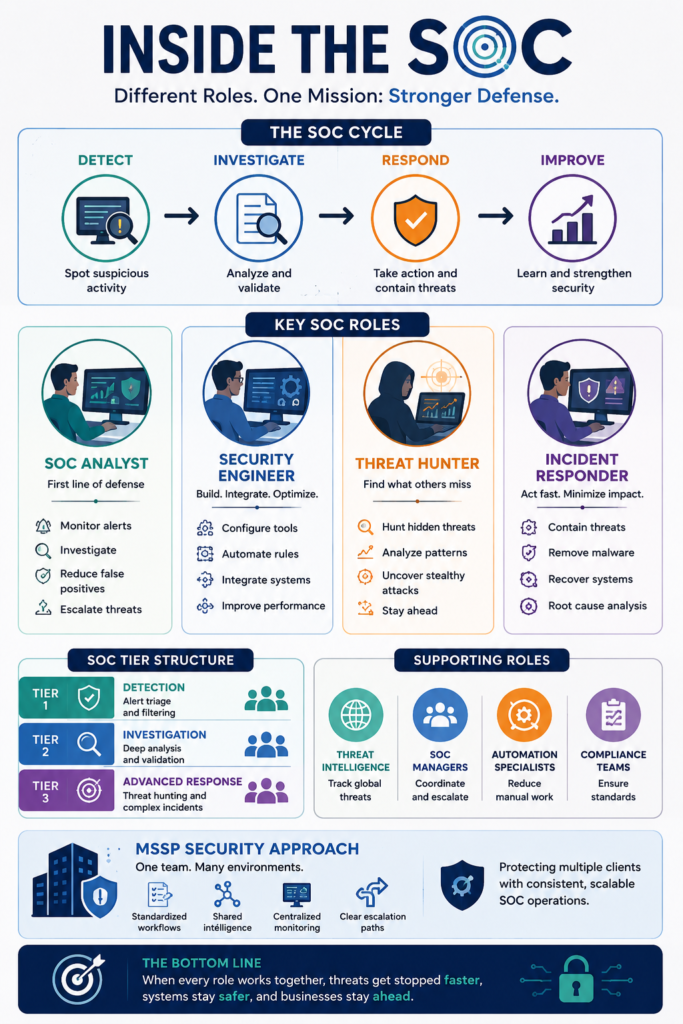
Incident responders take action when a threat is confirmed. Their goal is containment, recovery, and damage reduction.
“Effective Incident Response (IR) is essential for mitigating cyberattacks, safeguarding critical infrastructure, and ensuring the continued functionality of software systems under attack” – ResearchGate
Key tasks:
- Containing active threats
- Removing malicious activity
- Recovering affected systems
- Coordinating response communication
- Performing root cause analysis
In MSSP Security operations, responders often handle incidents across different clients simultaneously, requiring strong prioritization skills.
SOC Tier Structure: How Work Is Divided
SOC roles are often organized into tiers based on complexity.
| Tier | Focus | Responsibility |
| Tier 1 | Detection | Alert triage and filtering |
| Tier 2 | Investigation | Deep analysis and validation |
| Tier 3 | Advanced response | Threat hunting and complex incidents |
Understanding specific soc analyst tier 1 2 3 responsibilities allows MSSP Security teams to handle large-scale monitoring efficiently while maintaining accuracy.
Supporting Roles That Keep SOC Running
Beyond core roles, SOC operations rely on additional supporting functions that improve efficiency and intelligence sharing.
- Threat intelligence analysts (track global threats)
- SOC managers (coordinate operations and escalation)
- Automation specialists (reduce manual workload)
- Compliance teams (ensure security standards)
Each role strengthens the overall security ecosystem by improving coordination and decision-making.
How MSSP Security Organizes SOC Roles
In MSSP Security operations, roles are designed to support multi-client environments. Instead of focusing on a single organization, teams handle diverse infrastructures simultaneously.
We rely on:
- Standardized workflows
- Shared intelligence systems
- Centralized monitoring platforms
- Clear escalation paths
This structure ensures consistency while still adapting to each client’s unique security needs.
FAQ
What are the main roles in a SOC?
The main roles include SOC analysts, security engineers, threat hunters, and incident responders. Each role has a specific function in detecting, investigating, and responding to cyber threats.
Why are SOC roles divided into tiers?
Tiers help manage workload and complexity. Entry-level analysts handle basic alerts, while senior teams focus on advanced investigations and threat hunting.
How does MSSP Security change SOC roles?
MSSP Security allows teams to manage multiple clients at once. This requires stronger coordination, standardized processes, and scalable monitoring systems.
Can one person handle multiple SOC roles?
In small environments, yes, but in professional SOCs, roles are specialized to improve efficiency, accuracy, and response speed.
Why SOC Roles Define Strong Cybersecurity
The strength of a robust cybersecurity defense lies in the synergy of specialized SOC roles. Analysts monitor traffic, engineers maintain infrastructure, hunters proactively seek hidden vulnerabilities, and responders neutralize active threats. In a unified MSSP structure, these functions work in concert to maximize visibility and resilience across diverse environments.
By streamlining operations and optimizing tool stacks through expert consulting, you can reduce sprawl and enhance service quality. To strengthen your security operations, explore further insights.
References
- https://aimjournals.com/index.php/ijctisn/article/download/473/412
- https://www.researchgate.net/publication/388911046_Enhancing_Cybersecurity_Resilience_through_Improved_Technical_Measures_in_Incident_Response_Strategies