

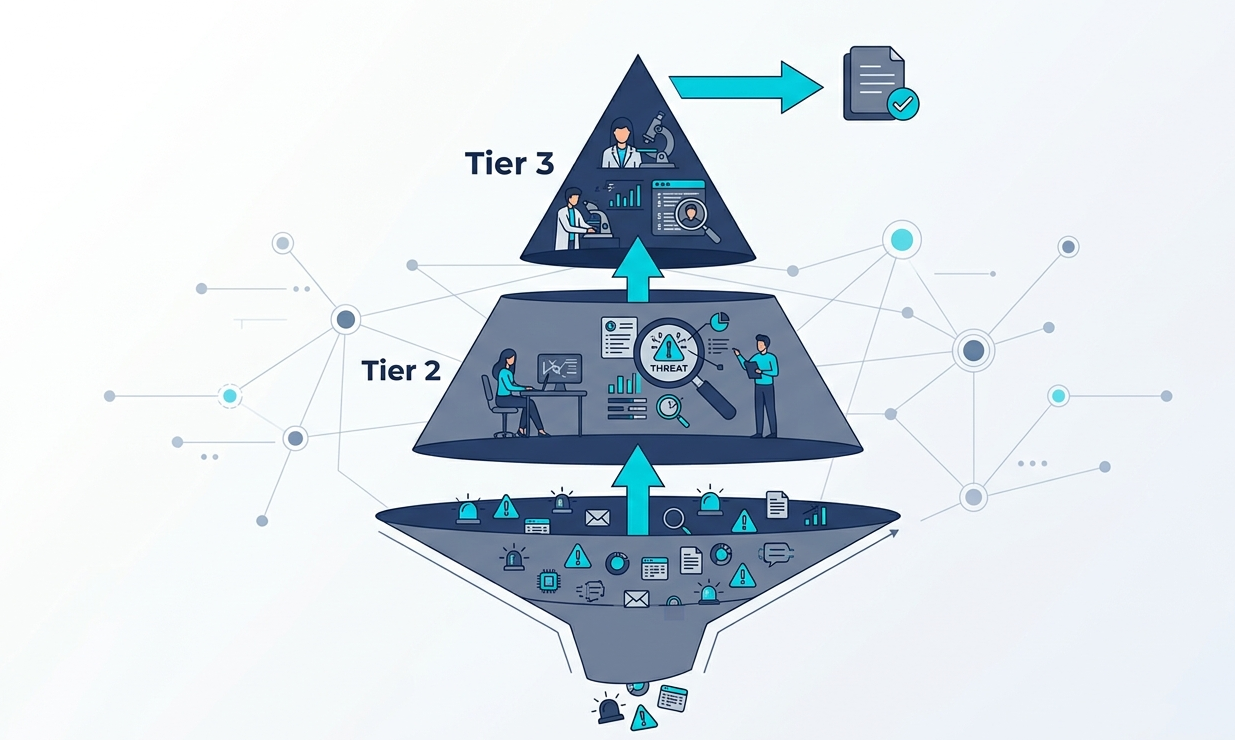
In real SOC environments, cybersecurity work is never handled as a single flat process. In our day-to-day operations at MSSP Security, we rely on a structured layered model where soc analyst Tier 1 2 3 responsibilities work together as one coordinated defense system.
From what we’ve seen across multiple client environments, this structure helps us manage high alert volumes without losing clarity. Every alert moves through a clear path, starting from detection, going through investigation, and ending in advanced response when needed. Keep reading.
What Matters Most in SOC Tier Structure
Here’s a simple breakdown of how the SOC tier system actually supports real security operations.
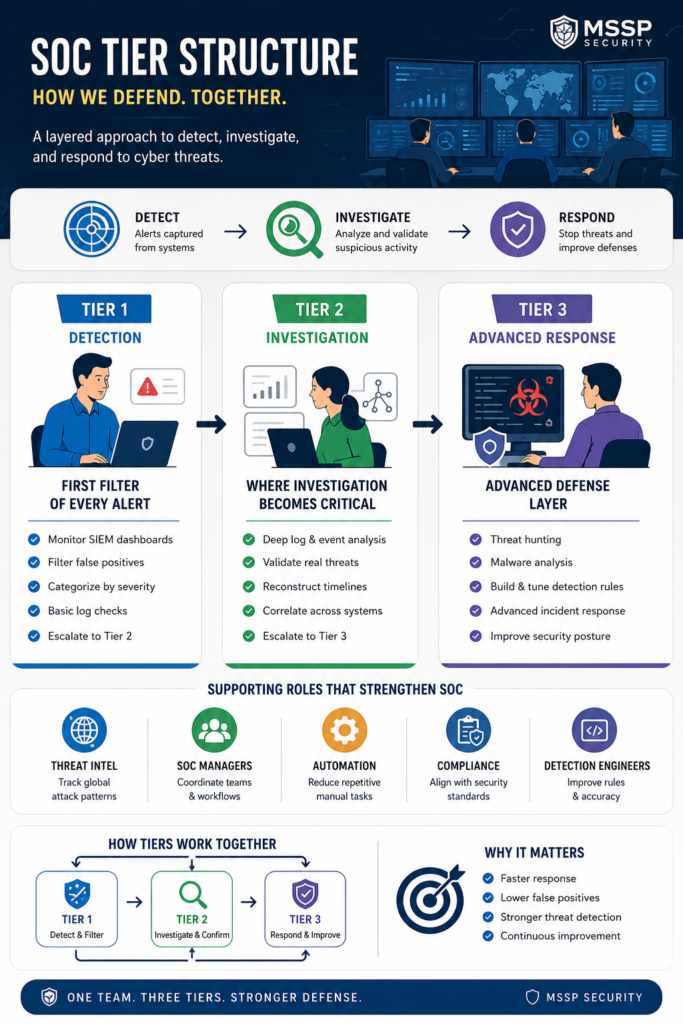
- Tier 1 acts as the first checkpoint for all security alerts
- Tier 2 focuses on validating and investigating suspicious activity
- Tier 3 handles complex threats and strengthens detection systems
Tier 1 SOC Analyst: First Filter of Every Alert
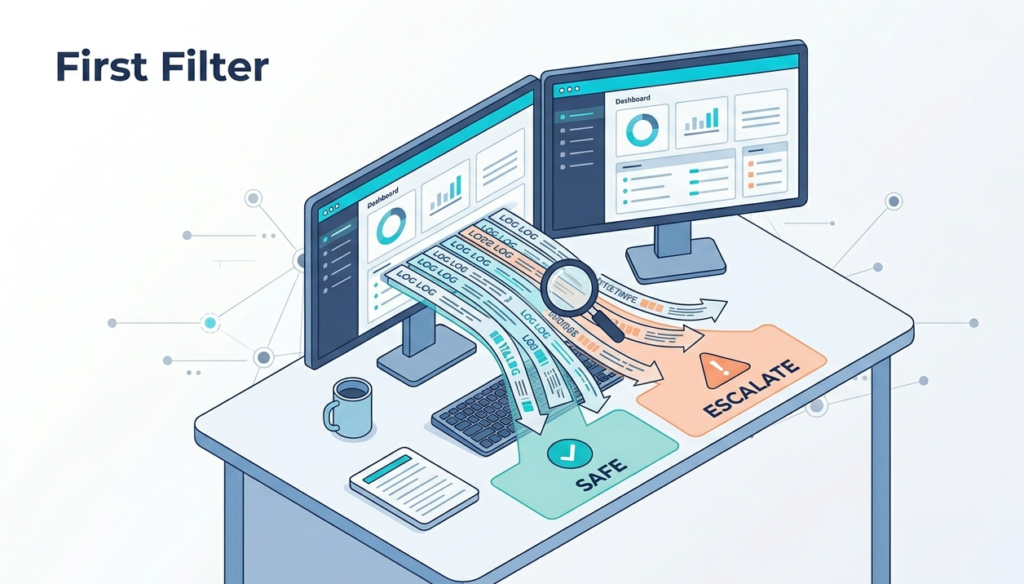
Tier 1 is where everything begins. In our MSSP Security operations, this is the most alert-heavy layer because soc analyst daily activities involve managing continuous incoming data from monitoring systems.
“Tier 1 analysts perform alert monitoring and initial triage… Challenges in SOC operations are most evident at Tier 1, where analysts often face an overwhelming number of alerts and a high prevalence of false positives” – NDSS Symposium
At this stage, speed and accuracy matter more than deep analysis. The main goal is to separate harmless noise from potentially real threats.
Responsibilities:
- Monitoring SIEM dashboards
- Filtering false positives
- Categorizing alerts based on severity
- Performing basic log checks
- Escalating suspicious activity to Tier 2
From our experience, most alerts never turn into real incidents, but Tier 1 ensures nothing important gets missed in the process.
Tier 2 SOC Analyst: Where Investigation Becomes Critical
Tier 2 is where the real investigative work begins. Instead of simply reacting to alerts, the security analyst roles at this level focus on connecting data points and analyzing behavior across systems and timeframes. In MSSP Security operations, Tier 2 often works across multiple client environments, which makes correlation skills extremely important.
“Tier 2 analysts perform deeper forensic investigations and root-cause analysis on validated incidents… reconstructing attack timelines and correlating activity across systems” – IEEE Xplore
In MSSP Security operations, Tier 2 often works across multiple client environments, which makes correlation skills extremely important.
Responsibilities:
- Deep log and event analysis
- Validating whether incidents are real threats
- Reconstructing attack timelines
- Correlating activity across systems
- Escalating complex cases to Tier 3
At this stage, we’re no longer just seeing alerts, we’re building the story behind them.
SOC Tier Structure Overview
Credits: InfoSec Pandey
| Tier | Focus | Main Role | Outcome |
| Tier 1 | Detection | Alert filtering | Identify possible threats |
| Tier 2 | Investigation | Deep analysis | Confirm incidents |
| Tier 3 | Advanced response | Threat hunting | Stop complex attacks |
This structure helps us maintain consistency in MSSP Security, especially when coordinating the various roles within security operations center across multiple organizations with different security environments.
Tier 3 SOC Analyst: Advanced Defense Layer
Tier 3 is the most specialized level in SOC operations. This is where we handle advanced threats that often bypass standard detection systems, including persistent and stealthy attacks.
In our MSSP Security workflow, Tier 3 also plays a big role in improving the system itself, not just responding to threats.
Responsibilities:
- Threat hunting and proactive detection
- Malware behavior analysis
- Creating and refining detection rules
- Supporting advanced incident response
- Providing security improvement recommendations
This layer ensures the SOC doesn’t just react, it evolves.
Supporting Roles That Keep SOC Operations Stable
Around 30% of SOC effectiveness comes from supporting functions that strengthen daily operations in MSSP Security:
- Threat intelligence analysts tracking global attack patterns
- SOC managers coordinating escalation and workflows
- Automation engineers reducing repetitive manual tasks
- Compliance teams aligning with security standards
- Detection engineers improving SIEM rules and accuracy
These roles help keep the entire system stable, especially in high-volume MSSP environments.
How We Coordinate Tier Collaboration in MSSP Security
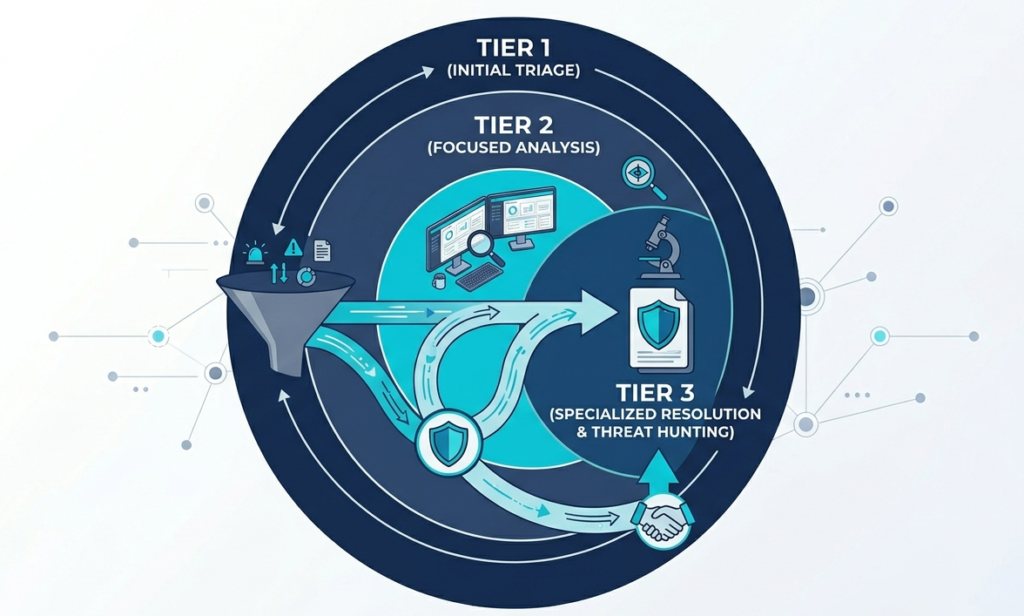
In MSSP Security operations, we don’t treat SOC tiers as separate silos. Instead, we design workflows where Tier 1, Tier 2, and Tier 3 function as one continuous system.
From our experience, shared dashboards and standardized alert formats make a huge difference in reducing confusion during escalation. We also rely heavily on consistent communication between tiers, especially when handling incidents across multiple clients.
This structure helps us maintain speed without sacrificing accuracy, even when threat activity increases.
FAQ
Why are SOC roles divided into tiers?
Cybersecurity alerts vary in complexity, so tiering helps separate basic monitoring from deep investigation and advanced threat response.
What does a Tier 1 SOC analyst do daily?
They monitor alerts, filter false positives, and escalate suspicious activities for further investigation.
How is Tier 2 different from Tier 1?
Tier 2 focuses on analyzing incidents in detail, while Tier 1 focuses on identifying and categorizing alerts.
Why is Tier 3 important in a SOC?
Tier 3 handles advanced threats and improves detection systems to prevent future attacks.
Why SOC Layers Decide Security Success
The effectiveness of a modern defense depends on a structured tier system. Tier 1 manages high-volume alert triage, Tier 2 provides deep technical investigation, and Tier 3 handles advanced threat hunting and complex incident response.
At MSSP Security, aligning these layers ensures resources are used strategically, preventing burnout while maintaining rapid response times. By optimizing your tools and tiered workflows, you can enhance operational maturity. To strengthen your security operations, explore further insights.
References
- https://www.ndss-symposium.org/wp-content/uploads/wosoc26-04.pdf
- https://ieeexplore.ieee.org/iel8/6287639/11323511/11478241.pdf