

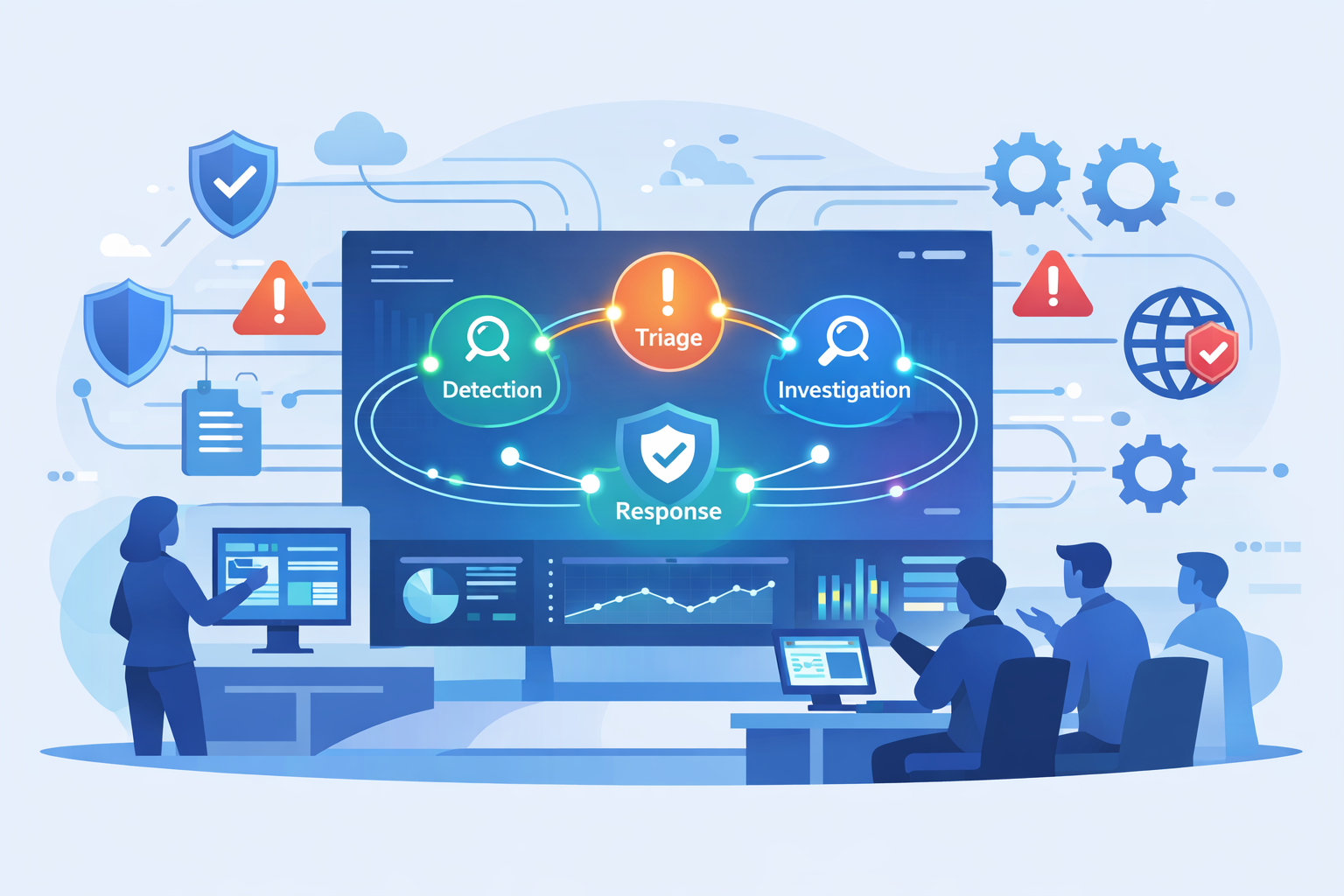
Operations & delivery mechanisms in an MSSP SOC define how threats move from detection to resolution. In our experience advising MSSPs, structure matters more than tool count. Modern SOCs handle thousands of alerts daily, and weak triage quickly turns into wasted analyst hours and rising costs.
The strongest teams rely on clear workflows backed by automation and human judgment, then refine them over time. As the managed security space keeps growing, disciplined delivery becomes a core differentiator. Below, we walk through how these mechanisms actually work in practice and where mature SOCs keep improving, keep reading.
Operations & Delivery Mechanisms Snapshot
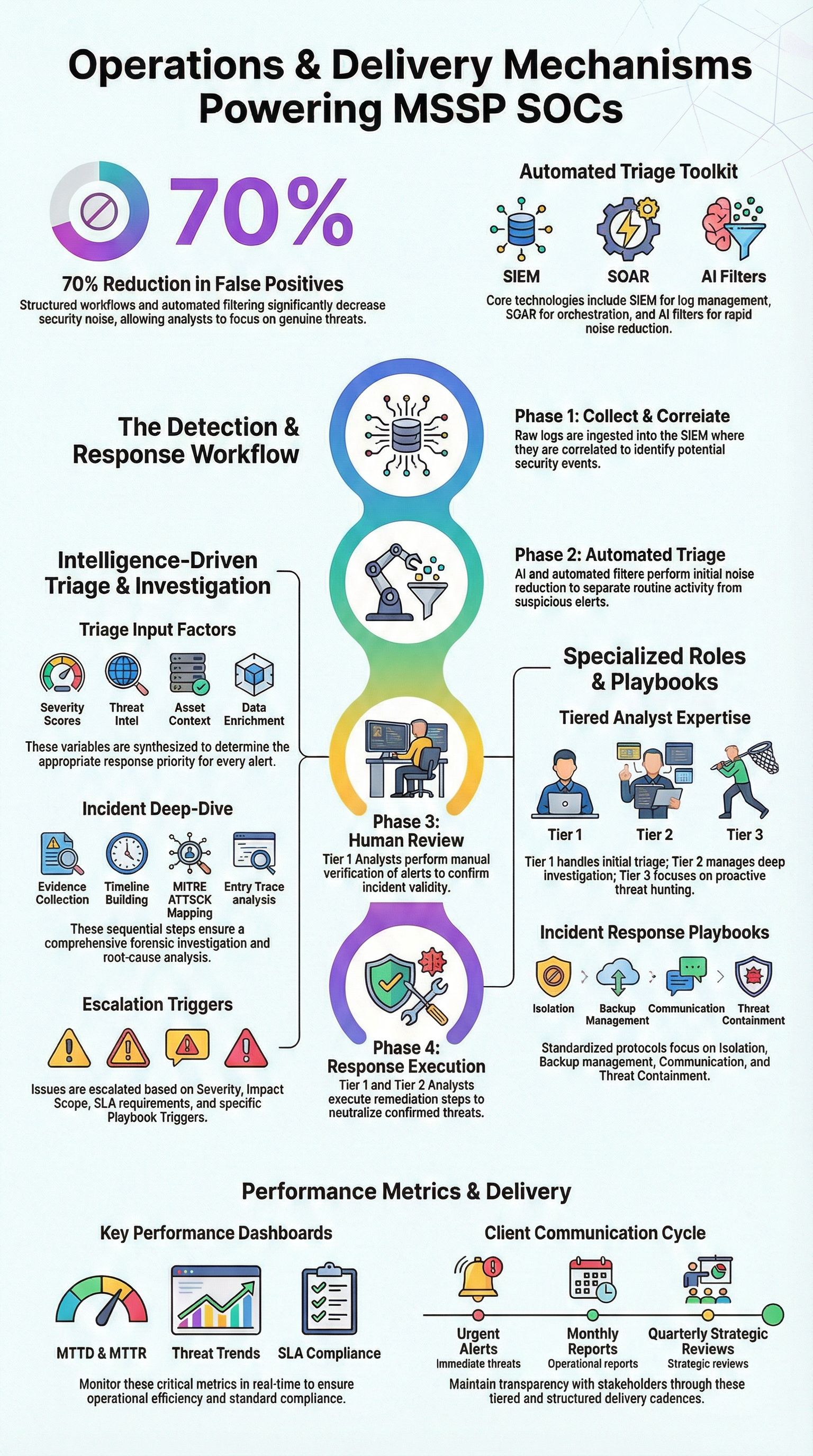
- A structured MSSP SOC workflow reduces false positives by up to 70% and improves MTTD metrics and MTTR improvement.
- Automation through SIEM monitoring and SOAR automation drives operational efficiency across multi-tenant environments.
- Clear escalation procedures, playbooks, and reporting dashboards ensure SLA compliance and client transparency.
Inside an MSSP SOC Workflow
An MSSP SOC runs on a loop that never really pauses, especially when viewed through an inside MSSP SOC workflow lens. Logs pour in from everywhere, servers, firewalls, endpoints, into a central SIEM.
| Stage | Primary Goal | Who Owns It | Tooling Involved |
| Collect & Correlate | Centralize logs and link events | SOC Platform | SIEM, log collectors |
| Automated Triage | Reduce alert noise early | Automation layer | SIEM rules, SOAR, AI filters |
| Human Review | Validate severity and context | Tier 1 Analysts | Investigation console |
| Response Execution | Contain or remediate threats | Tier 1–2 Analysts | SOAR, EDR, IR playbooks |
In audits we’ve done, teams weren’t short on tools; they were buried in alerts, most of them harmless. The SOCs that hold up well build workflows that cut noise early and keep analysts focused on what matters.
In practice, the flow is simple but disciplined. The strongest teams we’ve reviewed stick to a few grounded stages:
- Collect and correlate: Pull logs into the SIEM and connect the dots across systems.
- Triage with tech: Use automation and light AI to filter known patterns fast.
- Human judgment: Analysts step in, weigh context, and validate severity.
- Take action: Response kicks off, sometimes automated, sometimes guided.
From what we’ve seen while advising MSSPs on tool selection, the balance between automation and human review makes or breaks outcomes.
Alert Triage Prioritization Process

This is the moment where signals finally rise above the noise, where alert triage prioritization determines what deserves attention first. Every alert gets a quick score before a human even looks at it.
Severity matters, but context matters more. In the reviews we run, we often see teams miss that second piece. A risky IP might not mean much if it hits a lab box, but it’s a different story if it touches a public-facing system.
When MSSPs get this right, triage becomes structured instead of chaotic. The process usually blends a few simple inputs:
- Severity scoring: How dangerous is the underlying vulnerability?
- Threat intel checks: Is the IP or domain already flagged as malicious?
- Asset context: Is the target critical, exposed, or low risk?
- Basic enrichment: Add ownership, location, and recent activity.
The goal is practical: give Tier 1 analysts a fair starting point. We’ve seen queues shrink from hundreds of raw alerts to a smaller, enriched set. From there, analysts validate the findings, pull a bit more intel, and decide whether to escalate or close with confidence.
Incident Investigation Analysis Steps
Credits: SC Media – A CRA Resource
Once an alert turns into a confirmed incident, the pace shifts and teams move into structured incident investigation steps. The work becomes careful and deliberate. In many SOCs we’ve assessed, the best teams treat this stage like field work, not just dashboard watching.
Before anything else, they preserve evidence. Logs are secured, memory snapshots taken, and access tightened so nothing gets overwritten. From there, the investigation follows a steady rhythm.
Across the MSSPs we’ve advised, the strongest workflows stick to a few core moves:
- Collect evidence: Pull data from logs, endpoints, and network tools.
- Build a timeline: Lay out events to see how the attack unfolded.
- Map techniques: Align activity with frameworks like MITRE ATT&CK.
- Trace the entry point: Identify how access was first gained.
In our audits, speed usually comes from clarity, not rushing. As noted in this resource,
“The goal of incident response is to limit the damage from a cyber incident, understand what happened and permanently resolve the situation, get business operations back to normal as quickly as possible, and prevent the same issue from occurring again.” – Arctic Wolf
When teams know their steps and tools are well-integrated, decisions happen faster. That reduces dwell time and limits damage, which is why investigation maturity often tells us more than tool count ever could.
Incident Escalation Procedures Guide
Escalation works best when it feels routine, not dramatic, especially when incident escalation procedures are clearly defined. The strongest SOCs we’ve reviewed don’t rely on gut calls; they lean on clear triggers.
An alert moves from Tier 1 to Tier 2 based on defined thresholds, and leadership gets looped in only when criteria are met. In our consulting work, unclear rules are one of the fastest ways escalation turns messy.
Most mature MSSPs anchor escalation to a few grounded factors:
- Severity level: How damaging the incident could become.
- Scope of impact: One endpoint or multiple business systems.
- SLA obligations: What response times the contract demands.
- Playbook triggers: Events like ransomware or data exfiltration.
We’ve seen ransomware cases where escalation fired instantly, and containment steps launched without debate. Machines were isolated, stakeholders notified, and roles were already understood.
That kind of clarity usually comes from well-tested playbooks and tooling that supports them. When escalation paths are mapped early, often during tool selection and audits, the response feels coordinated, and confusion has little room to grow.
Security Response Playbook Examples
Playbooks are where preparation turns into speed, and a solid security response playbook keeps decisions consistent under pressure. Instead of deciding from scratch during an incident, teams follow steps they’ve already mapped out.
In many MSSPs we’ve worked with, playbooks act like muscle memory. They don’t remove judgment, but they cut hesitation when minutes matter.
Most providers keep a library built around common threats, ransomware, phishing waves, brute-force attempts. During audits, we often look for practical depth, not just documentation. A solid ransomware playbook, for example, usually includes:
- Isolation steps: How to quickly remove infected endpoints from the network.
- Backup checks: Where clean restore points live and how to protect them.
- Communication paths: Clear templates for updating client leadership.
- Containment flow: Who owns each action as the situation unfolds.
We’ve seen the biggest gains when MSSPs treat playbooks as living tools. Regular drills expose gaps fast, especially when new tools enter the stack. After real incidents, strong teams revisit what worked and what didn’t. That feedback loop, often guided during product reviews, keeps playbooks sharp and usable when pressure is high.
MSSP Remediation Guidance Explained
Finding a vulnerability is only the midpoint, and clear remediation guidance determines what happens next. What matters next is whether it actually gets fixed. In many environments we’ve reviewed, discovery gets attention, but remediation drifts. That’s why strong MSSPs start by ranking issues clearly.
Scores like CVSS show impact, while EPSS hints at real-world likelihood. Together, they help teams focus effort where it counts. When we help evaluate remediation workflows, the most effective ones stay simple and repeatable.
The guidance usually lands in three practical steps:
- Patch: Apply vendor fixes or updates as soon as testing allows.
- Harden: Adjust configurations using proven baselines, often mapped to OWASP-style controls.
- Verify: Confirm the fix worked and watch for signs of regression.
From what we’ve seen, the difference is follow-through. Mature providers track remediation speed against SLAs and revisit slow patterns during reviews. That visibility helps clients understand risk in real terms, not just ticket counts.
Good remediation isn’t about closing alerts quickly, it’s about reducing the chance the same weakness shows up again during the next audit cycle.
Security Analyst Roles Expertise
Not every analyst plays the same role inside a SOC, and clearly defined security analyst roles keep operations balanced. The strongest teams we’ve evaluated divide responsibilities so speed doesn’t come at the cost of depth. During our assessments, clear tiering almost always correlates with smoother workflows and fewer handoff gaps.
At the entry layer, Tier 1 analysts keep things moving. They handle first-pass triage, close obvious false positives, and stop queues from piling up. In several MSSPs we’ve worked with, this layer protects higher tiers from burnout by filtering early noise.
As cases grow more complex, ownership shifts:
- Tier 2 analysts: Run deeper investigations, trace attacker movement, and analyze suspicious artifacts.
- Tier 3 specialists: Step in for advanced threats, guide threat hunting, and refine detection strategy.
- Cross-tier collaboration: Share findings so lessons feed back into tooling and playbooks.
We often see the biggest value when tier definitions align with tooling maturity. When MSSPs select and audit products with role clarity in mind, analysts spend less time fighting platforms and more time applying expertise. That balance creates a natural growth path while ensuring serious incidents land with the right level of skill.
MSSP Reporting Dashboard Features

Dashboards sit at the intersection of visibility and accountability, where strong reporting dashboard features drive clarity. Clients want proof their security investment is working, while analysts need fast context to do their jobs well. In many MSSPs we’ve evaluated, reporting quality often reveals more about maturity than the tool stack itself.
From the client side, clarity matters more than volume. The most useful dashboards we’ve reviewed keep metrics focused and easy to read:
- MTTD (Mean Time to Detect): How quickly threats are identified.
- MTTR (Mean Time to Respond): How fast incidents are contained.
- Threat trends: The types of attacks showing up most often.
- SLA tracking: Whether response commitments are being met.
On the operations side, depth becomes critical. Analysts need the ability to pivot from a summary view into a single alert and see the full trail, timeline, evidence, enrichment data. Industry guidance on unified MSSP dashboards notes that,
“One of the biggest operational challenges for MSSPs is managing visibility across multiple clients. Without a unified dashboard, analysts must switch between client views, increasing the risk of missed insights and slower remediation. A scalable, interactive dashboard provides a single pane of glass to monitor, compare, and act across clients.” – Indusface
We’ve seen trust grow when both layers exist together. When MSSPs choose and tune reporting tools thoughtfully, dashboards stop being vanity charts and start telling a story clients can actually act on.
Client Communication Protocols MSSP
Communication is part of the security workflow, not an afterthought, and defined client communication protocols set expectations early. The most effective MSSPs we’ve worked with lock this down during onboarding. Expectations are set early, who gets notified, how often updates happen, and what situations justify an immediate call.
In our consulting work, unclear communication paths often cause more friction than the incident itself. Once protocols are defined, they tend to follow a steady cadence.
Most mature providers build around a few consistent touchpoints:
- Monthly reporting: A clear summary of metrics, alerts, and resolved cases.
- Quarterly reviews: Time to step back, discuss trends, and adjust strategy.
- Urgent notifications: Direct outreach when a high-impact incident appears.
- Defined contacts: Named roles on both sides to avoid confusion.
We’ve seen real incidents where these structures made a visible difference. Teams didn’t waste time figuring out who to call or what to share.
When MSSPs align communication workflows with tooling and reporting during audits, updates feel structured rather than reactive. That consistency builds confidence and keeps conversations focused, even when pressure is high.
Threat Intelligence Integration Actioning
Threat intelligence only earns its value when it’s operational, and effective threat intelligence integration makes that possible. Lists of bad IPs or malware hashes sound useful, but in many environments we’ve assessed, they sit disconnected from daily workflows.
The difference shows up fast during audits, intel that lives in a spreadsheet rarely changes outcomes. In stronger MSSP setups, intelligence feeds are wired directly into the stack. The goal is simple: make context appear exactly when it’s needed.
We usually see a few practical integrations:
- SIEM enrichment: Alerts get auto-checked against known malicious indicators.
- Network enforcement: Firewalls or gateways block traffic as feeds update.
- Analyst context: Investigation views include attacker patterns and TTP notes.
- Feedback loops: Findings from incidents feed back into detection rules.
From what we’ve seen while helping MSSPs evaluate tools, integration depth matters more than feed count. A smaller set of well-connected sources often outperforms dozens of passive ones. When intelligence flows into detections and controls automatically, analysts spend less time searching for context and more time acting on it.
FAQ
What makes an effective MSSP SOC workflow today?
An effective MSSP SOC workflow balances structure with speed. Strong workflows combine SIEM monitoring, log correlation, and SOAR automation. Their handle alerts across a multi-tenant environment. Clear stages, from detection to containment. Its help reduce false positives and improve MTTD metrics and MTTR improvement.
The best teams also use continuous monitoring and regular performance benchmarking. Their keep operations efficient as threat volume grows.
How does the alert triage process reduce alert fatigue?
A solid alert triage process relies on severity prioritization and context. AI-driven triage, IOC lookup, and IP reputation checks help filter noise early. Tier 1 triage handles obvious cases, while deeper issues move to higher levels.
This layered approach supports false positive reduction and alert fatigue mitigation. Especially in 24/7 monitoring environments processing EDR alerts and IDS signatures.
What are the key incident investigation steps teams follow?
Most incident investigation steps begin with evidence collection and root cause analysis. Analysts rebuild timelines using forensic artifacts and event timeline reconstruction. Many teams map activity to the MITRE ATT&CK framework to support TTP mapping and threat actor profiling.
Why do escalation procedures and playbooks matter?
Clear escalation procedures help incidents move smoothly from Tier 1 triage to Tier 2 analysis or threat hunting. Automated playbooks standardize phishing response, ransomware playbook execution, and brute force detection. This consistency improves incident containment and supports SLA compliance across client SLAs.
How do reporting dashboards improve client transparency?
Strong reporting dashboard features provide real-time dashboards and clear KPI tracking. Metrics such as threat severity trends and remediation timelines show progress in plain terms. Dashboard drill-downs support executive summaries and compliance reporting, while quarterly reviews reinforce client communication protocols.
Operations & Delivery Mechanisms That Drive Real Outcomes
Operations & Delivery Mechanisms in an MSSP SOC bring structure to detection, response, and continuous improvement. From our experience advising MSSPs, clarity beats tool volume every time. Strong workflows align escalation, remediation, and reporting into something measurable and repeatable.
If you’re refining your SOC model, the next step is practical: evaluate maturity, simplify your stack, and work with a partner focused on outcomes. Explore how MSSP Security can strengthen your SOC operations.
References
- https://arcticwolf.com/resources/blog/why-you-need-incident-response-as-part-of-your-cybersecurity-strategy/
- https://www.indusface.com/blog/mssp-client-reporting-dashboards/