

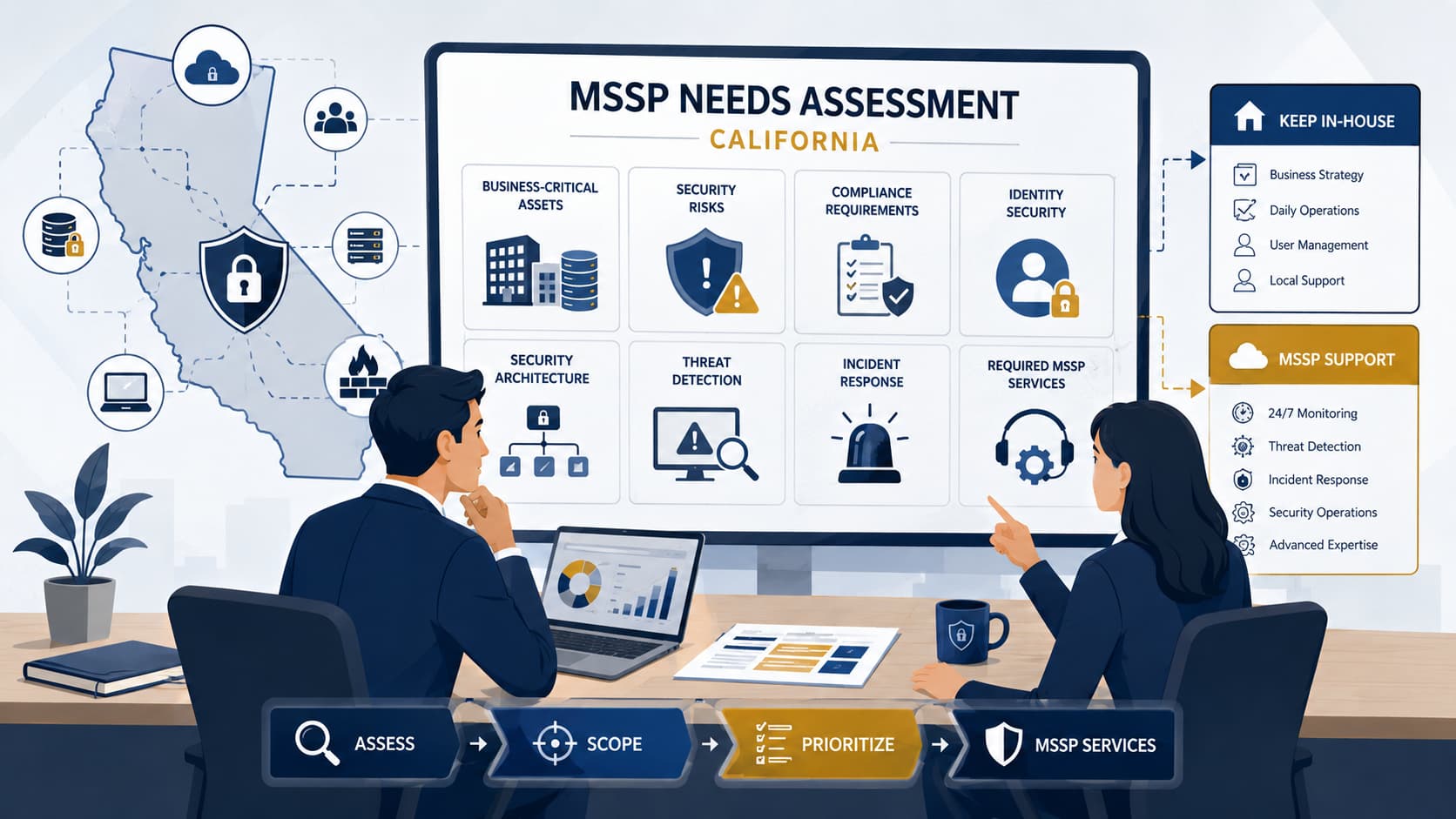
An MSSP needs assessment shows a California organization which security services it needs, what should stay in-house, and where outside support makes sense.
Effective MSSP scoping evaluates business risks, existing security controls, and regulatory requirements, ensuring services match actual operational needs rather than a rigid vendor catalog.
The assessment can also identify security gaps, overlapping responsibilities, and areas where internal teams need extra support. MSSP Security can help turn these findings into a practical service scope.
It’s a clear way to define MSSP responsibilities before signing a contract. Keep reading to learn how to scope MSSP needs effectively.
MSSP Scoping: What California Organizations Should Get Right
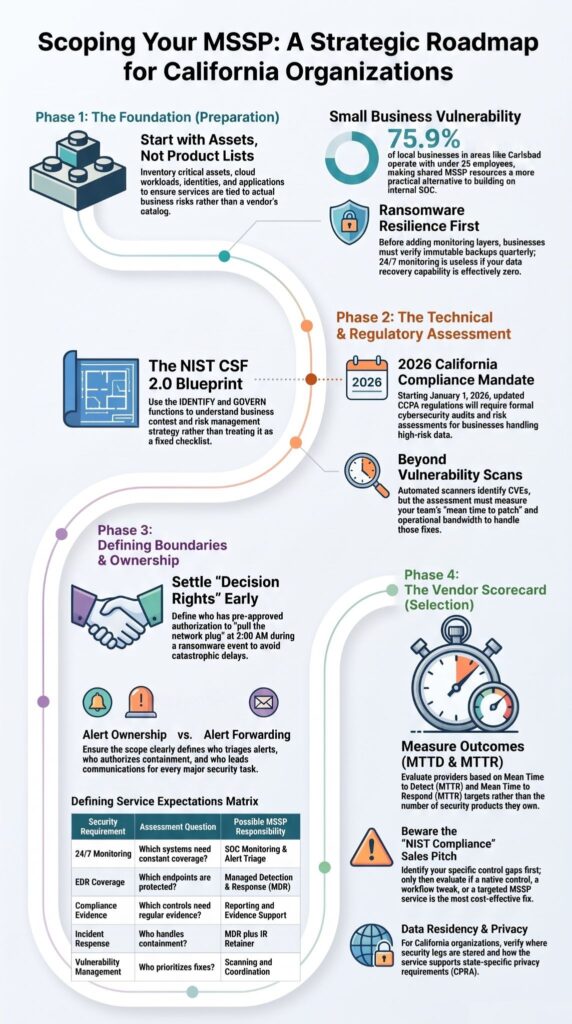
When we walk California leadership teams through an MSSP scoping engagement, our primary goal is simple: bridge the gap between abstract compliance mandates and practical daily operations before a single contract is signed.
- Define the real security needs. Start with critical assets, data, identities, applications, current controls, compliance requirements, and security gaps. This keeps MSSP services tied to actual business risks rather than a vendor’s product list.
- Set clear service boundaries. Document what the MSSP will monitor, manage, and respond to, including SIEM, EDR, vulnerability management, incident response, SLAs, MTTD, MTTR, escalation rules, and exclusions. Ownership should be clear for every major security task.
- Turn the assessment into a roadmap. Use the findings to set remediation priorities, KPIs, responsibilities, budget needs, and RFP requirements. The final scope should give leadership a practical basis for selecting services that fit the organization without unnecessary complexity.
MSSP Needs Assessment Consultant California
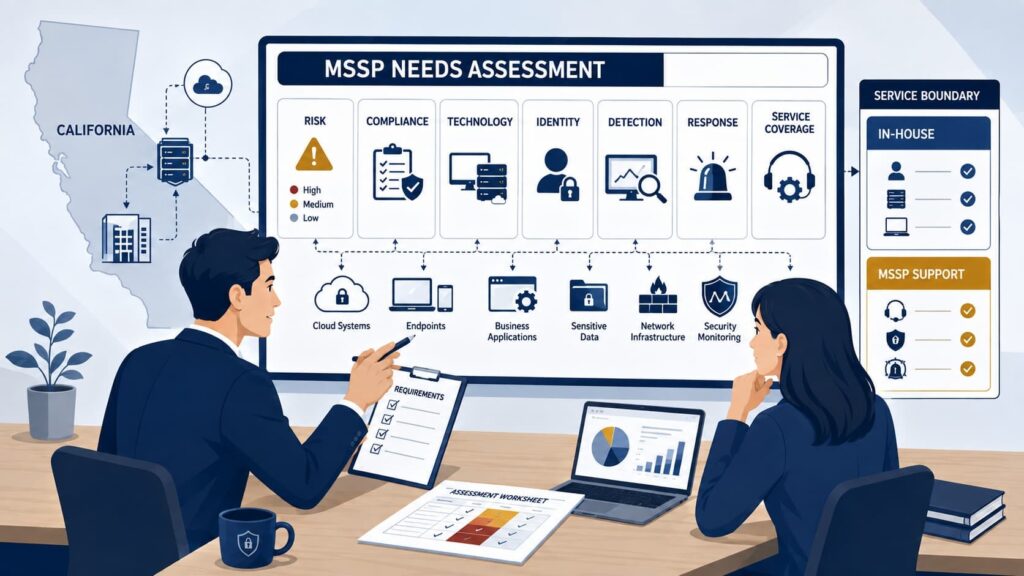
A California MSSP needs assessment consultant should show what security tools and services a client needs, where the gaps are, and what the MSSP should handle. We start by reviewing the current environment before looking at new products.
That usually includes an asset inventory, data flows, identity controls, and a basic risk review. It gives us a clearer picture of what the client has and where support is needed. In our field assessments, we rarely treat headcount as the deciding factor.
A 500-endpoint company with a solid IT team might only need us to handle overnight alert triage, whereas a 40-person firm with zero dedicated security staff requires a fully managed SOC, automated EDR containment, and complete policy enforcement.
NIST CSF 2.0, released in 2024, can also help organize security needs across different types of organizations. We use it as a guide, not as a fixed checklist.
As noted by National Institute of Standards and Technology (NIST):
“The IDENTIFY and GOVERN functions help an organization to understand its business context, resources, and risk management strategy, which are the foundation for an effective security program.” – National Institute of Standards and Technology (NIST)
Beyond technical controls, a thorough assessment evaluates cyber insurance mandates, contractual obligations, privacy requirements, internal staffing constraints, and incident response plans all of which dictate optimal MSSP service alignment.
When we review a new product, we also check whether it fits the client’s needs instead of relying on a vendor’s feature list. A practical assessment normally examines:
- Asset inventory, cloud accounts, endpoints, applications, and critical data
- Identity controls, MFA, Entra ID, Conditional Access, and privileged access
- SIEM scope, log ingestion, EDR coverage, and alert ownership
- Vulnerability management, penetration testing, and remediation
- Incident response, tabletop exercises, and forensic readiness
Compliance mapping may include CPRA, HIPAA, PCI DSS, SOC 2 Type II, CMMC Level 2, or CJIS. The final work should include a requirements matrix, gap analysis, security roadmap, and clear ownership for each MSSP service. We’ve seen proposals that look strong but leave key questions unanswered.
- Who reviews alerts?
- Who declares the incident, authorizes containment, performs containment, leads communications, preserves evidence, and closes the incident?
- Who owns the product?
Those answers should be clear before the contract is signed.
Cybersecurity Requirements Analysis Service California
A cybersecurity requirements analysis turns legal, contract, and business needs into clear security requirements an MSSP can price and track.
As of January 1, 2026, California’s updated CCPA regulations mandate formal cybersecurity audits and risk assessments for businesses handling high-risk data processing or meeting specific revenue thresholds.
For a California organization that is subject to the CCPA/CPRA, these requirements may affect data flows, access controls, retention, privacy reviews, and vendor oversight.
In our work with MSSPs, we’ve found it helps to split requirements into three groups: legal rules, customer or contract needs, and optional security frameworks.
We routinely see vendor proposals push expensive tooling suites under the banner of ‘NIST compliance.’ In our practice, we use NIST CSF 2.0 strictly as an architectural blueprint: we pinpoint your exact control gap first, and only then evaluate whether an existing native control, a workflow tweak, or a targeted MSSP service satisfies the requirement.
A useful requirements matrix might look like this:
| Security requirement | Assessment question | Possible MSSP responsibility |
| 24/7 monitoring | Which systems need constant coverage? | SOC monitoring and alert triage |
| EDR coverage | Which endpoints are protected and reporting? | Managed detection and response (MDR) |
| Identity security | Are admin accounts being monitored? | Identity monitoring |
| Compliance evidence | Which controls need regular evidence? | Reporting and evidence support |
| Incident response | Who handles escalation and containment? | MDR plus IR retainer |
| Vulnerability management | Who tracks and prioritizes fixes? | Scanning and coordination |
The matrix doesn’t need hundreds of rows. It needs to answer a few basic questions. What is required? Who owns it? How will it be checked? What falls outside the MSSP’s scope? We’ve seen these answers change from one client to another.
Regulatory requirements vary significantly by industry: California healthcare entities must align with HIPAA Security Rule safeguards and state privacy laws, while defense contractors handling CUI may require CMMC Level 2 compliance based on specific federal flow-down terms.
But compliance alone doesn’t mean security operations should be outsourced. We first identify the control that must be met.
Then we help the MSSP decide whether its staff, an existing product, a new product, or outside support makes the most sense. That keeps product selection tied to an actual need, not a vendor sales pitch.
Scoping Managed Security Services California
Scoping managed security services means defining exactly which assets, data, controls, response actions, and service levels belong inside the engagement.
The first step is identifying critical assets rather than starting with a vendor catalog. For a California mid-market company, that might mean production cloud workloads, Microsoft 365 identities, financial systems, customer databases, laptops, firewalls, and business-critical SaaS applications.
A realistic scope should document 24/7 monitoring, SIEM use cases, log ingestion, EDR coverage, cloud security posture, identity monitoring, threat hunting, vulnerability management, and escalation procedures.
It should also identify systems that cannot provide reliable logs or fall outside the MSSP’s operational authority. Incomplete telemetry, restricted administrative access, or unclear cloud ownership can dramatically expand or delay an MSSP engagement scope.
A Microsoft-heavy organization might rely on Microsoft Sentinel, Microsoft Defender, Entra ID, Conditional Access, and identity governance, while another organization may operate across multiple cloud platforms and security products.
During active incident responses, the biggest failure point is rarely the tool it is ambiguous authority.
We force clients to settle critical decision rights during scoping: when a server shows signs of ransomware at 2:00 AM, does our SOC have pre-approved authorization to pull the network plug, or are we waiting on your on-call engineer to pick up the phone?
A complete scope should define:
- In-scope and excluded assets
- Log sources and retention expectations
- Alert severity and escalation rules
- Define MTTD and MTTR formulas, severity classes, clock start/stop rules, exclusions, customer dependencies, and service credits
- Security SLAs and reporting cadence
- Data-location, cross-border transfer, privacy, confidentiality, and customer-contract requirements
- Incident response responsibilities
- Third-party and SaaS limitations
These boundaries also matter for regulated environments. If an MSSP touches sensitive security data or CUI, its systems and personnel may affect the organization’s assessment boundary.
The result should be a service definition that can move directly into an RFP, statement of work, and SLA without requiring the buyer to guess what “managed security” means.
Security Assessment Expert California
A security assessment expert provides the evidence needed to decide what an organization should fix, monitor, test, or outsource. A useful security assessment combines risk assessment, technical validation, architecture review, and compliance gap analysis.
Automated vulnerability scanners spit out thousands of raw CVEs, but they cannot tell you if your team actually has the operational bandwidth to patch them.
When we evaluate an environment, we look past raw scan output to audit your true remediation pipeline measuring mean time to patch and alert velocity before recommending an outsourced MDR model.
For example, a 100-person organization might have strong endpoint protection but weak identity governance and no defined incident response process. Another company could have excellent identity controls while lacking reliable log ingestion from critical applications.
The assessment should therefore examine the relationship between controls. Security architecture, network segmentation, firewall rules, IDS/IPS tuning, cloud configuration, identity governance, backup and recovery, and endpoint detection all affect how an MSSP can operate. Penetration testing also needs clear boundaries.
Scope can include external systems, internal networks, applications, cloud environments, social engineering, or selected business processes. Penetration testing scope and budget should be driven by asset criticality, threat modeling, system exposure, and regulatory mandates not headcount alone.
A practical assessment can produce:
- Risk-ranked findings
- Control framework mappings
- Technical evidence
- Compliance gaps
- Architecture recommendations
- Remediation priorities
- MSSP service requirements
Importantly, assessment work should not stop at identifying vulnerabilities. Each material finding should connect to an owner, target date, business impact, and remediation path.
That creates a more useful handoff into managed security services because the MSSP receives a defined operating environment instead of inheriting an undocumented security program.
Outsourced Security Needs Evaluation Guide
An outsourced security needs evaluation should connect business risk, security maturity, compliance requirements, and operating capacity before an organization decides what to outsource.
We generally start by separating risk ownership from security operations. Leadership owns business risk, while an MSSP might own continuous monitoring, alert triage, threat hunting, vulnerability management, or defined incident response tasks.
A useful evaluation also measures what already exists. An organization may already have Microsoft Defender, Entra ID, endpoint protection, firewall monitoring, backup systems, and internal IT expertise.
Replacing these controls without understanding their effectiveness can create unnecessary cost and operational disruption. The evaluation should also identify where existing capabilities stop.
While an unstaffed after-hours environment creates a compelling case for outsourced 24/7 monitoring, an organization with an agile internal SOC team may only require co-managed or escalated incident support.
The same principle applies to compliance. SOC 2 Type II, ISO 27001, PCI DSS, HIPAA security, CMMC Level 2, and CJIS compliance create different evidence and control expectations. A requirements analysis should map overlapping controls instead of building separate security programs for every framework.
A practical evaluation follows this sequence:
- Define business objectives, risk tolerance, and critical operations.
- Inventory systems, identities, applications, endpoints, and sensitive data.
- Map applicable regulatory and contractual requirements.
- Assess current controls, staffing, tooling, and security maturity.
- Identify gaps and rank them by business impact.
- Decide which functions belong internally and which can be outsourced.
- Define KPIs, SLAs, reporting requirements, and escalation rules.
- Convert the results into an RFP and MSSP evaluation scorecard.
This approach also helps control the security budget. A smaller organization might prioritize continuous monitoring, EDR, backups, vulnerability management, and an incident response retainer instead of buying every available managed service.
Of course, price should not become the only comparison point. Two proposals with similar monthly fees can deliver very different coverage if one includes identity monitoring, cloud telemetry, threat hunting, and defined response actions while the other mainly provides alert forwarding.
The final evaluation should make those differences measurable. That gives leadership a defensible basis for selecting services and deciding what remains under internal control.
What should an MSSP evaluation scorecard measure?
An MSSP evaluation scorecard should measure operational outcomes rather than the number of security products a provider can demonstrate. MTTD metrics, MTTR targets, analyst coverage, escalation quality, reporting, integration support, and incident ownership are stronger evaluation criteria than generic claims about advanced technology.
For a California organization, the scorecard can include:
- Coverage of critical assets and data
- 24/7 monitoring availability
- EDR and identity telemetry coverage
- SIEM ingestion and retention
- Threat hunting capabilities
- Incident response escalation
- Vulnerability management workflow
- Compliance reporting
- Data residency and privacy practices
- Security SLAs and service credits
- Onboarding and offboarding procedures
The organization should also ask what happens when a tool fails, a log source stops reporting, or an alert requires action outside the MSSP’s authority. That level of detail turns vendor evaluation into requirements analysis.
It also reduces the chance that an organization pays for services that sound sophisticated but do not address its highest-priority risks.
Small Business MSSP Assessment California
A small business MSSP assessment should focus on the few controls that materially reduce risk while keeping the service model affordable and manageable.
Small businesses make up a vital portion of California’s economy as illustrated by Carlsbad’s 2022 economic data showing that 75.9% of local businesses operate with under 25 employees.
For organizations of this scale, shared MSSP resources offer a far more practical security posture than building an internal SOC. For a small business, the starting point is usually straightforward.
Review MFA, EDR, email security, patching, backups, administrative access, endpoint coverage, firewall configuration, and basic logging. We also recommend checking whether the business can recover from ransomware before adding layers of monitoring.
In our recovery work with mid-market clients, we have seen multimillion-dollar detection stacks rendered useless because nobody verified immutable backup restores.
We tell every small business we audit: 24/7 monitoring is critical, but if your air-gapped backups are not tested quarterly, your ransomware resilience is effectively zero.
Compliance triage comes next. A medical practice may need HIPAA security controls, a payment business may require PCI DSS, and a defense supplier may need CMMC Level 2 preparation. California privacy obligations can also influence how consumer data is collected, stored, accessed, and shared.
As highlighted by Wilson, C., et al.:
“It also appears that SMEs are unaware of the protective guidance provided by the UK government. Despite the significant progress made in understanding the barriers to SME cybersecurity adoption and engagement preferences, recent literature reviews indicate that most previous research has adopted a one-size-fits-all approach to SME cybersecurity. This approach fails to consider contextual factors such as varying resource access, regulatory awareness, and cybersecurity knowledge levels. This leads to recommendations that may not align with the specific requirements of SMEs and thus yield less effective outcomes.” – Wilson, C., et al.
A small-business scope might include:
- 24/7 monitoring for critical endpoints and infrastructure
- EDR or MDR coverage
- Basic vulnerability scanning
- Patch and remediation coordination
- Identity and privileged-account monitoring
- Backup and recovery validation
- Incident response support
- Security awareness training and phishing simulations
The key is proportionality. A 20-person company does not necessarily need the same SIEM architecture, threat-hunting schedule, or reporting package as a multinational enterprise.
That said, smaller organizations should not confuse a smaller scope with weak security. Strong MFA, reliable backups, endpoint detection, controlled administrative access, and a clear incident escalation path can provide substantial protection when consistently maintained.
When does a small business need 24/7 monitoring?
A small business should consider 24/7 monitoring when critical systems remain exposed outside business hours and no qualified person can reliably investigate high-priority alerts.
The decision depends on business impact, exposure, regulatory obligations, cyber insurance requirements, and internal response capacity. Headcount alone should not determine the answer.
For example, an organization processing sensitive customer information might prioritize after-hours detection because a compromised administrator account could create immediate business and privacy consequences.
A lighter model can also work. Existing alerts from Microsoft Defender, Entra ID, firewalls, and cloud platforms can provide useful detection when a full SIEM deployment is not justified.
The assessment should answer three operational questions: Which alerts matter, who receives them, and what happens next? Without those answers, even a sophisticated monitoring platform can produce alert fatigue instead of useful security operations.
Initial MSSP Consultation Planning California
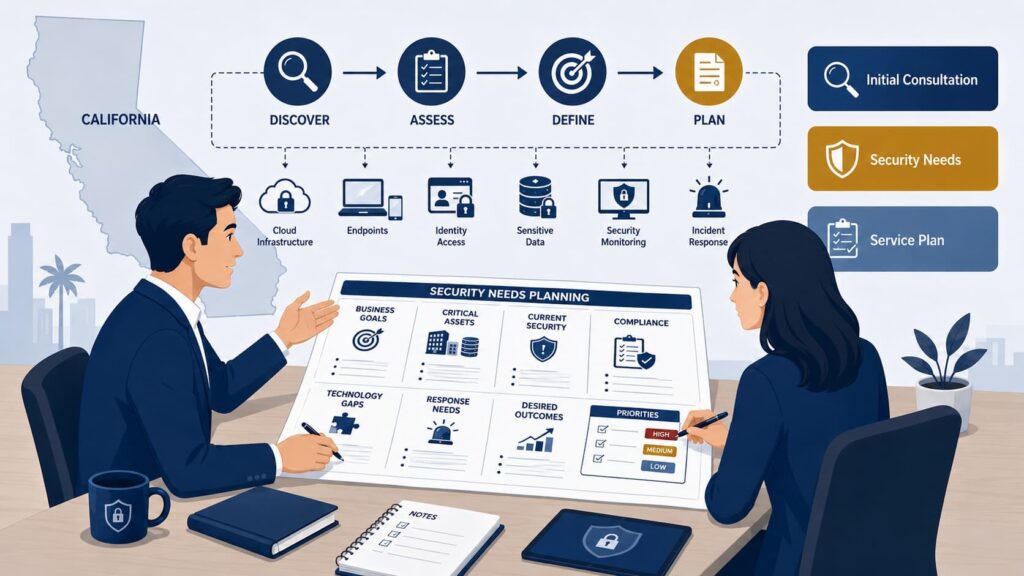
Initial MSSP consultation planning should prepare the organization to obtain comparable proposals, technical answers, and realistic service boundaries from potential providers.
Before the first meeting, we recommend preparing a concise environment summary covering users, endpoints, offices, cloud platforms, critical applications, identity architecture, existing security tools, and known pain points.
The organization should also document known compliance drivers. CPRA, HIPAA, CMMC, PCI DSS, SOC 2 Type II, ISO 27001, CJIS, customer contracts, and cyber insurance requirements can each influence scope.
The technical conversation should then move toward evidence. Ask which logs are available, how long they are retained, whether EDR telemetry is complete, how identity events are monitored, and which cloud services can be integrated.
Microsoft environments deserve particular attention. Entra ID, Conditional Access, Microsoft Defender, Intune, identity governance, and cloud security controls can already provide significant telemetry.
The MSSP should explain how it will use those capabilities rather than automatically replacing them. A first consultation should cover:
- Current security architecture
- Critical assets and data flows
- Existing security tooling
- Internal staffing and responsibilities
- Regulatory and contractual requirements
- Desired monitoring coverage
- Incident escalation procedures
- MTTD and MTTR expectations
- Data residency requirements
- Reporting and governance needs
A serious provider should also explain exclusions. Endpoint reimaging, legal notification, physical security, application remediation, forensic investigations, and certain infrastructure changes may remain with the customer or another specialist.
The consultation should finish with concrete next steps rather than a generic maturity score. A technical scoping workshop, sample report, architecture review, tabletop exercise, or limited pilot can reveal whether the proposed service fits the environment.
What should California organizations ask during the first MSSP meeting?
The first MSSP meeting should determine whether the provider understands the organization’s environment, responsibilities, risks, and measurable service outcomes. Questions should be specific enough to expose assumptions.
When we assist clients in vetting MSSP vendors, we advise them to look past slick slide decks and press sales reps on operational specifics: Ask them to show you their exact Tier-1 vs. Tier-3 escalation playbook, demand proof of how quickly their SOC analyst triages a critical Entra ID anomaly, and verify whether their SLA clock stops while waiting on your response.
Useful questions include:
- What assets are included at the base service level?
- Which log sources are required?
- How is EDR coverage measured?
- How are identity threats investigated?
- What are the MTTD and MTTR targets?
- Who can authorize containment?
- What happens during a ransomware event?
- How are vulnerability findings prioritized?
- Where are security logs stored and processed?
- How does the service support applicable California privacy requirements?
- What evidence can the MSSP provide for audits?
- Which responsibilities remain with our internal team?
These questions help distinguish a defined security operating model from a collection of technology features.
A good RFP should carry the same precision forward. It should specify assets, services, exclusions, data handling, integrations, reporting, SLAs, escalation, and pricing assumptions.
Strategic Scoping & Risk Management for Effective Pen Testing
Credits: Cyber connect
Remember, you don’t want to be under or over scoped. Make sure to clearly define the assessment goals and the pen testing scope for each engagement. A good rule of thumb is to define the scope according to specific business risks. Fine-tune the pen testing boundaries for specific engagements to work with your budget and needs.
FAQ
What should a California company prepare before an MSSP needs assessment?
A California company should prepare an asset inventory, current security documentation, known risks, and business requirements. A risk assessment can help identify security priorities before defining managed security services. Organizations should also document data flows, third-party risks, security maturity, and applicable compliance obligations.
How does compliance mapping help with security scoping?
Compliance mapping connects business and regulatory requirements to specific security controls. It can address CPRA audit requirements, NIST CSF, ISO 27001, SOC 2 Type II, HIPAA security, PCI DSS, and CJIS compliance. This approach helps organizations identify required controls and avoid including unnecessary services in their security scope.
What should an MSSP security architecture review include?
An MSSP security architecture review should examine identity governance, network segmentation, firewall rules, cloud security posture, log ingestion, and endpoint coverage. The review should also address SIEM scoping, EDR coverage, Zero Trust controls, and security operations. These areas help define which systems require protection, monitoring, integration, or improvement.
How can a business compare MSSP options before signing a contract?
A business should use an MSSP evaluation process that compares security maturity, service coverage, response capabilities, and measurable outcomes. Key areas include security SLAs, MTTD metrics, MTTR targets, 24/7 monitoring, alert triage, vulnerability management, and incident response retainer terms. An RFP template can help providers respond to consistent requirements.
What should small and mid-market businesses prioritize for California cybersecurity?
Small and mid-market businesses should prioritize controls that reduce their most important security risks. These may include asset inventory, continuous monitoring, backup and recovery, vulnerability management, security awareness training, phishing simulations, incident response, and security documentation. A security roadmap can connect these priorities with remediation planning, security KPIs, security governance, and the available security budget.
MSSP Needs Assessment Scoping California: Building the Right Security Roadmap
When security gaps appear, it’s easy to buy more tools before identifying what actually needs fixing. A proper MSSP needs assessment connects security priorities to business risk, compliance needs, and available resources.
From there, MSSP Security can help turn findings into a practical roadmap with clear priorities, ownership, and service needs. With needs analysis, vendor shortlisting, PoC support, and stack optimization, the focus stays on coverage that fits your organization not a sales package.
Start with the risks that matter most, measure progress, and expand security capabilities as your needs change.
References
- https://nvlpubs.nist.gov/nistpubs/CSWP/NIST.CSWP.29.pdf
- https://rke.abertay.ac.uk/ws/portalfiles/portal/84460006/Wilson_OneSizeDoesNotFitAll_Published_2025.pdf
Related Articles
- https://msspsecurity.com/mssp-needs-assessment-consultant-california/
- https://msspsecurity.com/cybersecurity-requirements-analysis-service-california/
- https://msspsecurity.com/scoping-managed-security-services-california/
- https://msspsecurity.com/security-assessment-expert-california/
- https://msspsecurity.com/outsourced-security-needs-evaluation-guide/
- https://msspsecurity.com/small-business-mssp-assessment-california/
- https://msspsecurity.com/initial-mssp-consultation-planning-california/
- https://msspsecurity.com/evaluation-selection-and-onboarding-consulting/