

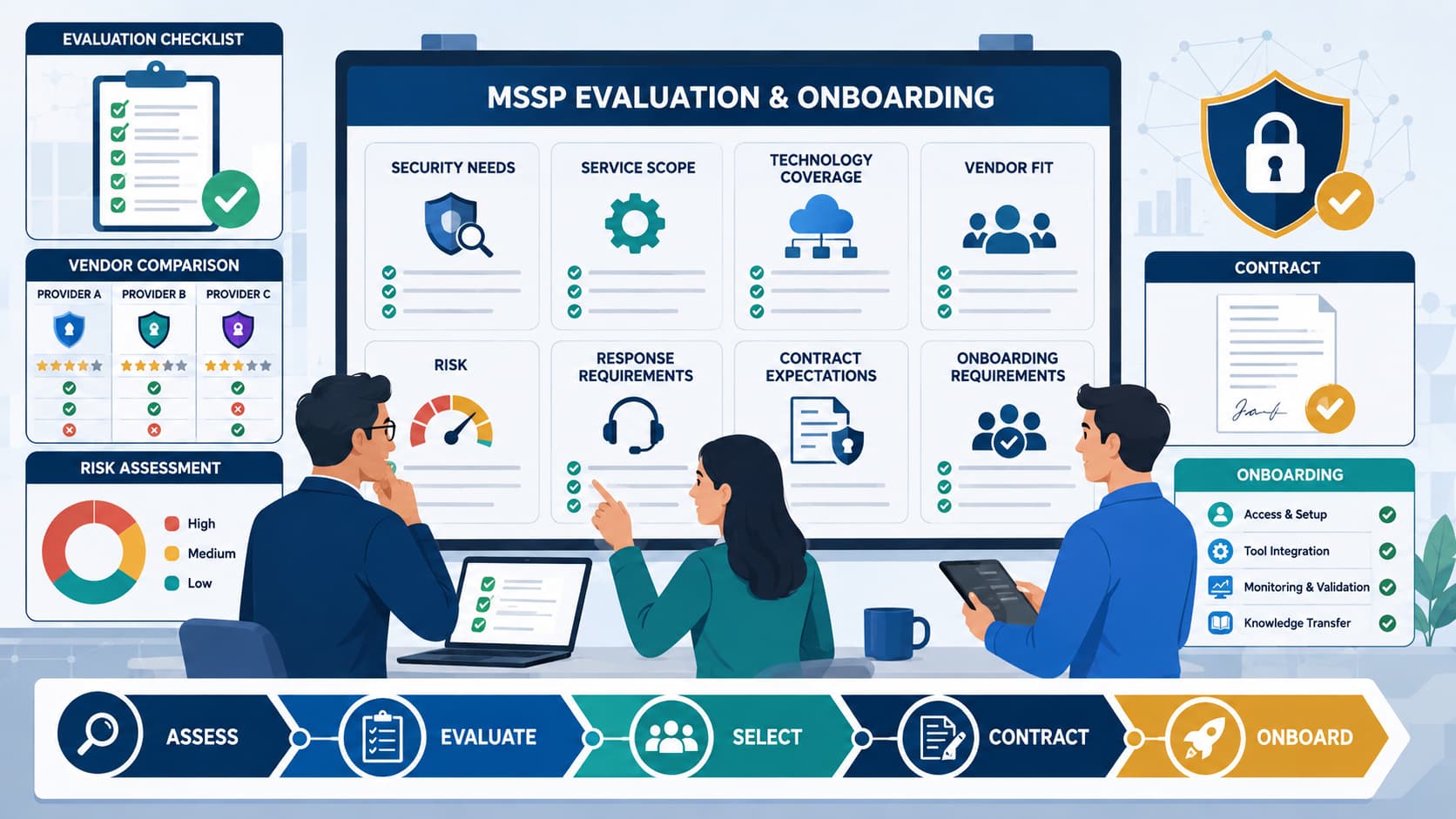
Choose an MSSP based on business risk, security maturity, required services, technology coverage, response needs, and measurable outcomes not a vendor list. MSSP Security can support firms that need security assessments, managed services, and onboarding tied to risk.
Start by identifying critical assets, security gaps, compliance obligations, telemetry sources, and decision owners. Strong engagements rely on evidence, clear requirements, and defined responsibilities.
Scope the work, review current controls, set service expectations, and plan the transition before operations begin. Get these details right early, then keep reading to see how the MSSP evaluation, selection, and onboarding process works.
Quick Reads: MSSP Evaluation Essentials
A strong MSSP decision starts with clear security needs, evidence-based vendor checks, defined contract terms, and a structured onboarding plan.
- Define the need first: document business risks, security maturity, required coverage, service boundaries, response targets, compliance obligations, and measurable outcomes before reviewing MSSP vendors.
- Evaluate with proof: use an RFP, weighted score matrix, PoC, customer references, due diligence, and SLA checks to test detection, response, integration, reporting, and operational fit.
- Plan onboarding before signing: Set requirements for documentation, access, telemetry, SOC workflows, incident response, reporting, governance, and handover before services begin.
MSSP Needs Assessment Scoping California
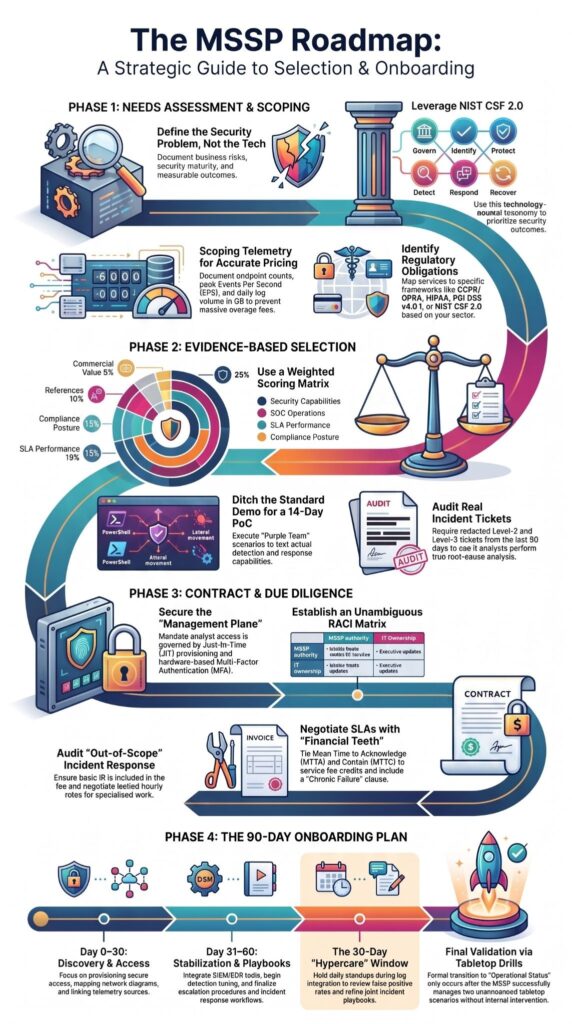
An MSSP needs to define business risk, critical assets, data types, technology coverage, regulatory requirements, service boundaries, and measurable security goals before vendors submit bids. A clear needs assessment also gives vendors enough context to price the required services consistently.
MSSP Security first defines the security problem apart from the tech used to fix it. It then reviews critical assets, applicable regulations, staffing capacity, existing controls, telemetry coverage, and current monitoring responsibilities.
This creates clear service requirements that vendors can price consistently. California organizations should identify the laws, regulations, contractual requirements, and voluntary frameworks that apply to their business, data, sector, and payment environment.
These may include the CCPA, as amended by the CPRA, HIPAA, PCI DSS v4.0.1, NIST CSF 2.0, and sector-specific requirements, where applicable.
NIST CSF 2.0 provides a technology-neutral taxonomy of cybersecurity outcomes that organizations can use to assess, prioritize, and communicate risk.
It does not prescribe a specific product architecture. When scoping telemetry, record endpoint and server counts, peak EPS, daily log volume in GB, retention periods, and major cloud sources.
In my experience negotiating MSSP contracts, vendors love to gloss over log volume thresholds during discovery, only to hit you with massive bandwidth and storage overage fees three months after go-live.
Where possible, negotiate fixed pricing tiers for SaaS and cloud log sources such as AWS CloudTrail and Azure AD, with documented EPS, storage, retention, and overage thresholds.
Key scope areas include:
- Business drivers such as 24/7 monitoring, ransomware defense, compliance, staffing gaps, cyber-insurance requirements, or reduced incident-response time
- Technical coverage across endpoint, network, identity, cloud, and application telemetry Service boundaries for monitoring, threat hunting, vulnerability management, and incident response
- KPIs such as MTTD, MTTR, coverage, false-positive rates, escalation time, and reporting frequency, with current baselines and target values
Organizations should also establish their current security baseline to determine whether they need monitoring, remediation, strategic guidance, or a broader managed security function.
Security Maturity Evaluation Service California
A security maturity evaluation reviews people, processes, technology, governance, controls, telemetry, incident readiness, and third-party dependencies. It then turns the results into a clear cybersecurity roadmap.
NIST CSF 2.0 can structure risk outcomes; CIS Controls can provide prioritized safeguards; and ISO/IEC 27001 can support an information-security management-system assessment.
The assessor should state whether NIST CSF 2.0 is used for cybersecurity outcomes, CIS Controls for prioritized safeguards, and ISO/IEC 27001 for the information-security management system. But the review should focus on real security results.
Research from International Journal of Information and Communication Technology Research shows:
“One of the acceptable strategies in security is the maturity model. Provides a standard way to assess process maturity along with business process improvement.” – International Journal of Information and Communication Technology Research
NIST CSF 2.0 uses six Functions: Govern, Identify, Protect, Detect, Respond, and Recover. A strong review combines document review, stakeholder interviews, technical validation, control testing, telemetry checks, and evidence sampling.
Questionnaires alone can produce polished scores without showing whether an organization can detect lateral movement or respond to compromised identities.
The assessment should examine governance policies, access management, vulnerability management, incident response, security awareness, threat intelligence, telemetry coverage, and reporting.
During security maturity audits, we frequently uncover critical visibility gaps between what clients assume they monitor and what actually hits their SIEM.
Across dozens of cloud assessments using the MITRE ATT&CK framework, we regularly find that while core endpoint logs are ingested, in our assessments, we have observed material gaps in non-interactive cloud-identity telemetry, including service-account events that do not reach the SOC.
A true maturity review validates telemetry pipelines through simulated adversary techniques, not just questionnaire checkboxes.
A useful assessment should produce:
- Governance: ownership, policies, and risk gaps
- Technology: SIEM, EDR, IAM, and cloud coverage
- Operations: SOC procedures, staffing, and escalation
- Compliance: framework mappings and audit gaps
- Response: playbooks, exercises, and readiness
- Risk: prioritized threats and business impact
The final report should link maturity findings to risk, budget, and risk appetite. This creates a clear MSSP evaluation roadmap.
MSSP Gap Analysis Report
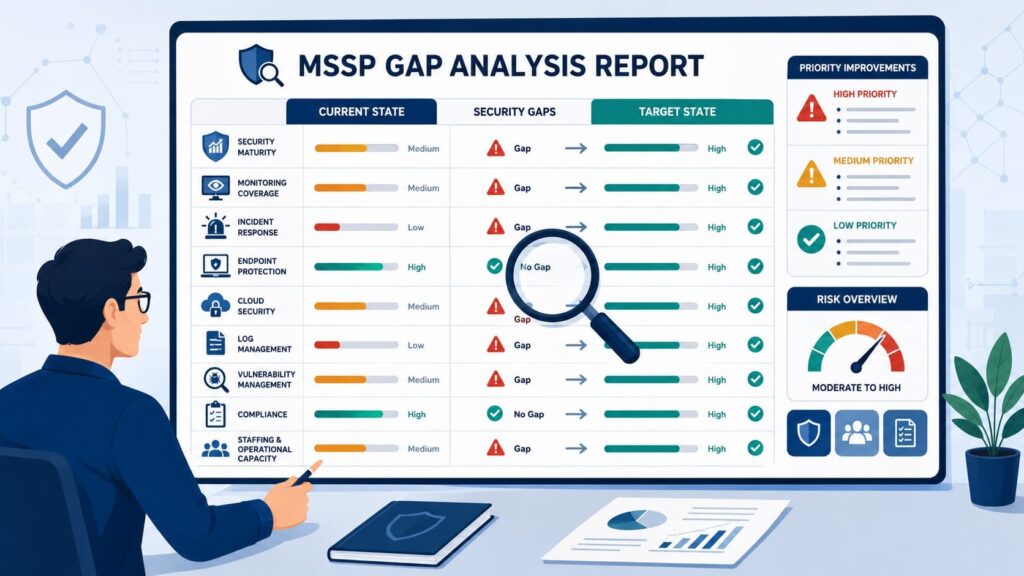
A practical gap analysis should connect each technical gap to affected assets, business impact, compliance exposure, remediation cost, and residual risk.
Instead of simply noting missing EDR coverage on legacy servers, identify the affected assets, applicable control requirement, business exposure, insurance implications, and estimated remediation effort.
Linking every control failure directly to compliance penalties, insurance void clauses, and targeted remediation costs gives executive leadership the exact business case needed to approve MSSP funding.
It should also show if the cause is policy, process, tech, staff, or unclear roles. For example, a missing cloud identity log is a technology gap. A log without a detection rule is a detection engineering gap, while an alert without an escalation path is an operational gap.
Each requires a different response. NIST CSF 2.0 gives a useful structure because it sets security goals, not set tech. This allows organizations to establish a common language while accounting for their architecture and risk tolerance.
A practical gap report should prioritize findings by business risk:
- Critical: Direct exposure, active control failure, or major compliance blocker
- High: Significant detection, response, identity, or resilience weakness
- Medium: Control improvement with manageable residual risk
- Low: Documentation, optimization, or efficiency improvement
Each finding should connect to a remediation action, owner, target date, dependency, estimated effort, and expected risk reduction. The report should also document effort, dependencies, ownership, and audit implications.
This turns review findings into clear MSSP buying needs. It also helps stop open gaps from moving into the new deal.
Defining MSSP Service Requirements
Clear service requirements should define the services, coverage, response authority, performance targets, reporting outputs, and expected security outcomes an MSSP must deliver.
For organizations that require continuous detection and response, define the expected monitoring coverage, threat-hunting frequency, escalation model, and after-hours response requirements.
Require the MSSP to perform weekly hypothesis-driven threat hunts mapped to the MITRE ATT&CK matrix and to integrate real-time vulnerability scanning that prioritizes CVEs based on active exploitation (EPSS scores) rather than raw CVSS metrics alone.
If an MSSP only alerts you on static firewall hits and standard EDR detections, you are paying for an automated tool, not a managed defense service. Vendors should show how they will run these services and give proof of their skills.
Insights from Technical Performance Metrics of a Security Operations Center indicate:
“The absence of adequate technical performance metrics makes it challenging to accurately evaluate the tangible impact of a SOC on overall cyber defense capabilities” – Technical Performance Metrics of a Security Operations Center
Roles also need to be clear. An MSP may manage networks and devices, while an MSSP handles security monitoring, SIEM and EDR operations, and incident response. When a ransomware outbreak happens at 2:00 AM, ambiguity kills response time.
Your contract must establish an unambiguous RACI matrix for incident containment: the MSSP must hold automated or pre-approved authority to isolate compromised hosts within 15 minutes of detection, while your internal IT team retains ownership of domain controller resets and executive stakeholder updates.
We’ve seen containment stalled for hours simply because an MSSP analyst was waiting on a client approval email that nobody was awake to read.
Key requirements typically include:
- Detection: SIEM, EDR, network, identity, cloud, and threat intelligence coverage
- Response: Escalation, notification, containment, and investigation procedures
- Operations: Staffing, expertise, coverage, maintenance, and change management
- Reporting: Dashboards, executive reports, trends, and audit evidence
- Compliance: Required controls and supporting evidence
- Performance: MTTD, MTTR, coverage, uptime, ticket response, and SLA remedies
NIST CSF 2.0 supports goals for security without forcing set tech. However, vendors must also demonstrate compatibility with the organization’s cloud, identity, IT processes, and existing security tools.
Clear requirements help eliminate poor-fit providers and identify MSSPs capable of delivering the expected results.
MSSP Vendor Research California
Evaluating MSSPs in California requires reviewing how providers handle personal information, security data, and access to customer systems under applicable California privacy and contractual requirements.
Beyond reviewing certifications such as SOC 2 Type II or ISO 27001, organizations should examine the provider’s data-handling practices, service-provider obligations, subprocessors, data storage locations, analyst access, and incident-notification procedures.
Where healthcare, payment, or other regulated data is involved, the evaluation should also confirm applicable sector-specific requirements and whether the provider’s data-storage and processing arrangements meet the organization’s contractual and compliance obligations.
A practical approach to vendor research is to start with a broad market scan, then apply clear filters based on the required security services.
Important criteria include SOC hours, analyst staffing, escalation procedures, subcontractors, threat intelligence, incident response capabilities, and experience with the organization’s existing technology.
Customer references can reveal details that proposals often miss, including communication quality, reporting, onboarding, and SLA management.
A vendor scoring matrix can help keep evaluations consistent:
| Criterion | Weight |
| Security capabilities | 25% |
| SOC operations | 20% |
| SLA performance | 15% |
| Compliance posture | 15% |
| Integration fit | 10% |
| References | 10% |
| Commercial value | 5% |
An MSSP may get high-level access to key data. So due diligence should also check the provider’s own controls.
Useful proof may include SOC 2 Type II, ISO 27001, pen-test data, access controls, past incidents, plans for outages, and subprocessor data. The best firms should show how they work during real incidents, not just say what they sell.
Writing an Effective MSSP RFP
An effective MSSP RFP gives every vendor the same questions, evidence requirements, and scope to price.
It should explain the organization’s goals, current environment, required services, mandatory controls, evaluation method, commercial terms, and procurement schedule. If requirements are still taking shape, an RFI can help narrow the field first.
Vendors should show what they can actually do rather than simply checking “yes” on a questionnaire. In your RFP, replace yes/no questionnaires with mandatory submission of real, redacted Level-2 and Level-3 incident escalation tickets from the past 90 days.
Inspect these artifacts to evaluate whether the analyst performed genuine threat hunting and root-cause analysis or simply copy-pasted raw SIEM logs into a ticket.
Additionally, requiring a live 30-minute interview with the actual Tier-2 SOC lead who will handle your account sales engineers rarely reflects the daily operational quality of the analysts monitoring your network.
The RFP should give enough data for fair pricing. Include asset and endpoint counts, log volume, cloud systems, key apps, retention periods, and hours. If forensic investigations may require additional work, those expectations should be defined upfront.
A practical RFP usually covers:
- Business objectives and current environment
- Technical and operational requirements
- Compliance and evidence requirements
- SOC operations and incident response
- SLAs and reporting
- Pricing assumptions
- Evaluation criteria, timeline, and submission instructions
- Score each proposal before the group talks.
This can limit bias and keep a clear evaluation record. Price is important, but it should not compensate for weak detection, poor SLAs, limited response authority, or unacceptable third-party risk. The RFP ultimately establishes the foundation for managing the MSSP relationship.
MSSP Proof of Concept (PoC) Management
An MSSP proof of concept lets a firm test detection, response, integration, reports, and service fit before a long-term deal. Success criteria should be agreed upon before any telemetry is connected.
A controlled PoC can run for 7 to 14 days, depending on scope, using selected endpoint, network, identity, cloud, and firewall data. Scenario-based testing is more useful than a product demonstration.
Never evaluate an MSSP using scripted, vendor-provided demos. During a 14-day PoC, we execute controlled purple-team scenarios such as encoded PowerShell execution via certutil, pass-the-hash lateral movement, and anomalous multi-region Entra ID sign-ins.
Grade the provider on three strict metrics: Mean Time to Detect (MTTD), Alert-to-Noise Ratio, and the quality of their analyst notes.
If their team routes raw, unvalidated SIEM alerts directly to your inbox without investigative enrichment, they are functioning as a glorified notification service, not a managed SOC
The goal is not to simulate an uncontrolled attack. It is to determine whether the MSSP can detect, investigate, communicate, and respond according to the agreed operating model.
Key measures should include:
- Detection coverage for defined scenarios
- Time to detect and escalate
- Analyst investigation quality
- Severity classification accuracy
- Incident report usefulness
- Telemetry completeness and integration reliability
The PoC should also check log retention, normalization, time sync, ticket use, API links, permissions, and data flow. Keep the trial focused. If it requires months of engineering work, it may be testing implementation effort rather than MSSP capability.
The final decision should be documented as a pass, conditional pass, or fail, with results informing SLAs, tuning requirements, onboarding milestones, and commercial terms.
MSSP Vendor Due Diligence Checklist
Credits: Sikich
MSSP vendor due diligence should look past certs. Check the provider’s security, resilience, legal setup, data use, high-level access, and exit plan. SOC 2 Type II, ISO 27001, penetration-testing results, business continuity plans, and incident response procedures can provide useful evidence, but they do not guarantee that an MSSP can meet specific service requirements.
When auditing an MSSP’s internal controls, evaluate their Privileged Access Management (PAM) architecture.
Mandate that analyst access to your EDR consoles, cloud environments, and firewalls is governed by Just-In-Time (JIT) provisioning and strict multi-factor authentication (MFA) tied to hardware security keys.
In supply-chain breaches, attackers frequently target the MSSP’s central management plane to pivot into client environments; if your provider cannot prove zero-standing-privilege for their SOC team, they represent a critical third-party vulnerability.
NIST SP 1326 can guide third-party checks. The steps are to find risks, set proof needs, check the supplier, record choices, and review them often.
Key areas include:
- Capability: Monitoring, detection, threat hunting, response, and integration
- Authority: Who can investigate, isolate systems, modify rules, or take response actions
- Data: Storage locations, access, retention, subprocessors, privacy, and deletion
- Exit: Data export, documentation, credential revocation, transition support, and termination terms
Due diligence should also cover governance, financial stability, ownership, staffing, subcontractors, breach notification, and regulatory obligations.
Record each risk as accepted, accepted with terms, or rejected. Exceptions need named owners and expiration dates. Reviews should continue after contract signing, with reassessment triggered by major technology changes, significant incidents, or material subcontractor changes.
MSSP Contract Negotiation Tips California
MSSP contract negotiation should focus on clear goals, enforceable SLAs, set pricing, liability, data protection, and exit rights. Buyers have stronger leverage when negotiations are based on evidence rather than assumptions.
A 90-day contract review can reveal service volumes, recurring problems, SLA performance, unused services, and actual unit costs before renewal. Like-for-like proposals from several vendors can also show whether pricing matches the agreed scope.
Carefully audit the line item for Incident Response (IR) hours in your contract. Many MSSPs include ‘basic incident response’ in their core fee, but reclassify memory forensics, malware reverse-engineering, and expert witness support as expensive, out-of-scope professional services.
Require a pre-negotiated, locked hourly rate for specialized forensic work and ensure that unused annual IR retainer hours roll over into proactive services, such as annual tabletop exercises or custom detection engineering.
Generic SLAs without financial teeth are useless. When negotiating response metrics, tie Mean Time to Acknowledge (MTTA) and Mean Time to Contain (MTTC) directly to Tier 1 through Tier 3 incident severities.
For Critical (Severity 1) alerts, mandate a 15-minute response window backed by monthly service fee credits if the SLA falls below 98% compliance. Crucially, insert a ‘Chronic SLA Failure’ clause that grants you immediate contract termination rights without penalty if the provider misses.
Severity 1 response times three times within a rolling quarter.
| Area | Define | Purpose |
| Detection | MTTD by severity | Measure performance |
| Response | Escalation and MTTR | Set expectations |
| Coverage | Assets and telemetry | Avoid scope gaps |
| Pricing | Escalation caps | Control costs |
| Exit | Data and transition support | Reduce switching risk |
Legal review should cover liability, indemnification, privacy, breach notification, insurance, subcontractors, intellectual property, and termination.
California organizations should also address applicable privacy and sector requirements. The goal is not the lowest price. It is lower risk at a fair total cost, based on the vendor score, PoC results, due diligence, and current security state.
MSSP Onboarding Project Planning
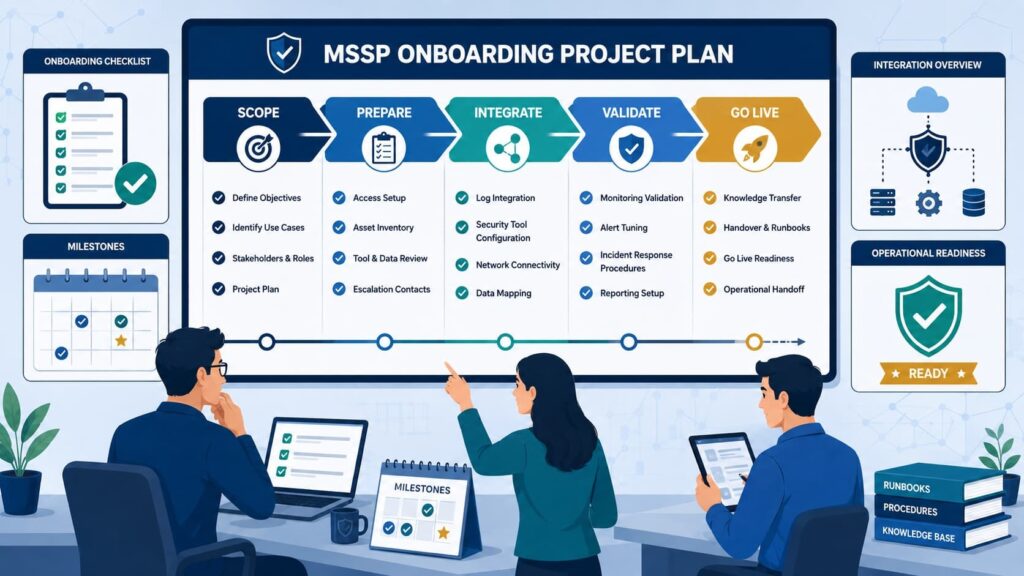
MSSP onboarding works best with clear project planning and defined steps for discovery, integration, setup, handover, and tuning. A 0/30/60/90-day plan gives both teams a practical roadmap, although complex or regulated environments may require more time.
Before onboarding begins, the organization should prepare network diagrams, asset inventories, administrator details, cloud accounts, security policies, existing contracts, critical applications, escalation contacts, and incident records.
The first phase focuses on discovery, access, and service boundaries. The MSSP checks the environment and sets secure access. It then links approved telemetry and records key dependencies.
The next phase focuses on stabilization, including SIEM, EDR, firewall, identity, cloud, ticketing, and reporting integrations. Detection tuning should begin while missing telemetry and control gaps are documented.
By day 60, playbooks, escalation procedures, SLA reporting, vulnerability management, and incident response workflows should be operational.
The final phase should focus on tuning. Review detection and false positives, check SLA results, run an incident response test, close key gaps, set reports, and make a 6–12-month plan.
The transition from deployment to live monitoring is where most MSSP relationships stumble. Plan for a mandatory 30-day ‘Hypercare’ tuning window immediately following log integration.
During this phase, your internal team and the MSSP SOC must hold daily standups to review false positive rates, adjust noisy EDR rules, and refine joint incident playbooks.
Services should only formally transition to operational status once the MSSP successfully runs two unannounced tabletop drill scenarios without internal intervention and assigns owners and deadlines for remaining gaps. This turns onboarding into an ongoing security program rather than a one-time deployment.
FAQ
What should be included in an MSSP evaluation before comparing providers?
An MSSP evaluation should define your security needs, current risks, and expected outcomes before you compare providers. Start with a security baseline assessment and security control validation, then document requirements for monitoring, incident response, compliance, and reporting. A vendor scoring matrix can help you compare providers consistently, while vendor due diligence can verify their capabilities and operational fit.
How can an organization improve its MSSP selection process?
A practical MSSP selection process starts with clear requirements rather than vendor claims. Use a cybersecurity RFP to request comparable information about threat detection capabilities, incident response procedures, security monitoring services, and SLA management. The security vendor comparison should also consider service coverage, escalation procedures, reporting standards, and how well each provider supports your cybersecurity strategy.
What should be checked during MSSP onboarding?
MSSP onboarding should clearly define responsibilities, required access, timelines, and communication procedures. An onboarding project plan should cover access provisioning, security documentation review, SOC onboarding, escalation contacts, and the security operations handover. Security transition management should also include testing and validation to reduce the risk of monitoring gaps or delayed incident management when services move to the provider.
How do you know whether an MSSP fits your security maturity?
A security maturity assessment can show whether an MSSP matches your current capabilities and future security needs. Review gaps in governance, monitoring, incident response, and security controls, then use a gap analysis report to prioritize improvements. The provider should offer services that address those gaps without introducing processes that your internal team cannot operate, monitor, or maintain effectively.
What should be reviewed before signing an MSSP contract?
Before signing, review MSSP contract terms against the specific services your organization requires. Check the security service agreement for service scope, response times, SLA management, reporting requirements, escalation procedures, data handling, and termination conditions. Contract negotiation should also define responsibilities during security incidents, service changes, and security breach response so both parties understand their obligations.
Evaluation, Selection & Onboarding: Choosing the Right MSSP
When evaluating an MSSP, broad promises are not enough. You need clear goals, defined owners, and proof that the provider can address your actual risks.
Start with your security baseline and gaps, then assess service needs, score vendors, run a PoC, complete due diligence, and negotiate contracts that protect your requirements.
MSSP Security can help with needs analysis, vendor shortlisting, PoC support, vendor-neutral product selection, auditing, and stack optimization. The goal is to turn security findings into practical services with clear reporting and measurable progress, giving you a stronger foundation for ongoing security operations.
References
- https://www.academia.edu/45111240/A_Novel_Maturity_Model_for_MSSP_Assessment
- https://www.sciencedirect.com/science/article/pii/S016740482300439X?via%3Dihub
Related Articles
- https://msspsecurity.com/mssp-needs-assessment-scoping-california/
- https://msspsecurity.com/security-maturity-evaluation-service-california/
- https://msspsecurity.com/mssp-gap-analysis-report/
- https://msspsecurity.com/defining-mssp-service-requirements/
- https://msspsecurity.com/mssp-vendor-research-california/
- https://msspsecurity.com/writing-an-effective-mssp-rfp/
- https://msspsecurity.com/mssp-proof-concept-(poc)-management/
- https://msspsecurity.com/mssp-vendor-due-diligence-checklist/
- https://msspsecurity.com/mssp-contract-negotiation-tips-california/
- https://msspsecurity.com/mssp-onboarding-project-planning/