

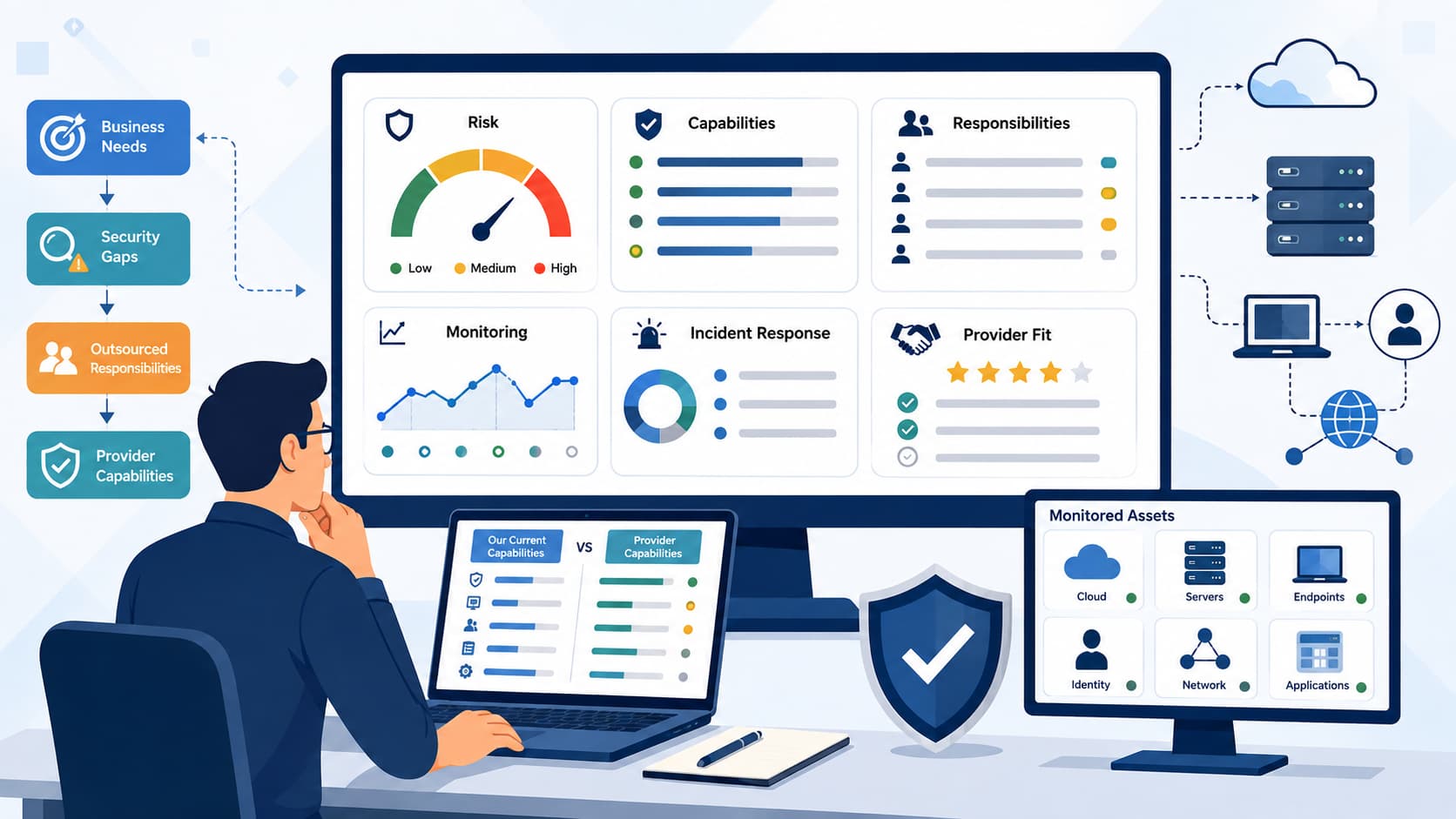
Outsourced cybersecurity evaluation is a financial and operational risk decision, not a vendor selection exercise.
Before contacting MSSPs, define the risks that require coverage, the security tasks the provider will own under a RACI model, and the evidence required to prove each capability works.
NIST CSF 2.0 provides a practical structure through Govern, Identify, Protect, Detect, Respond, and Recover. Use these functions to assess providers against the risks that matter to your environment, rather than relying on sales claims or feature lists.
Keep reading with MSSP Security to compare MSSPs on evidence, coverage, and accountability.
Outsourced Security Evaluation: 3 Key Points
A good evaluation should connect each business risk to a required security capability, an accountable owner, and evidence that the capability works.
- Define your needs: Identify key risks, security gaps, and which responsibilities should be outsourced.
- Test the provider: Check coverage, response, integrations, staffing, SLAs, and real-world performance.
- Protect your data: Compare total costs and ensure your security data, evidence, and exit rights remain protected.
What Should an Outsourced Security Evaluation Actually Determine?
An outsourced security evaluation should assign each security capability to a provider or internal owner, define the expected outcome, and specify how performance will be measured and audited.
As CISSP-certified practitioners who have led over 50 enterprise MSSP procurements, we treat security outsourcing as an operational capability rather than a bundle of software licenses.
This guide has been peer-reviewed by active CISOs to ensure alignment with current enterprise threat landscapes. That shift matters. A provider can offer strong products and still leave gaps in ownership, reporting, or day-to-day operations.
We evaluate four areas: risk coverage, who owns each security action, what evidence proves performance, and whether data and configurations remain portable.
The National Institute of Standards and Technology (NIST) emphasizes thorough supplier due diligence and ongoing cybersecurity supply chain risk management (C-SCRM).
Supplier due diligence should assess FOCI, technology and data provenance, operational resilience, foundational security controls, and the security practices of relevant supply-chain tiers.
In practice, we want clear answers:
- Does the provider cover our highest risks?
- Can it operate in our technology environment?
- Can we verify performance with evidence?
- Can we retain our data and configurations if the contract ends?
That keeps an MSSP evaluation tied to what the service can prove, not what a sales presentation promises.
How Do You Establish the Business and Risk Context?
Before we write MSSP RFP needs, we need to know what the business must keep safe. Document critical services, sensitive data, system dependencies, maximum tolerable downtime, available security staff, existing tools, and known control gaps.
A clear cybersecurity requirements process can help connect these business priorities to specific security controls and responsibilities.
In our evaluations, we’ve seen how easy it is to focus on endpoint counts and miss higher-risk systems. Ten privileged identity systems may deserve more attention than hundreds of standard endpoints.
For example, our Tier 1 systems might include identity, payments, production databases, and customer-facing applications. Tier 1 systems should receive 24/7 monitoring, defined critical-alert SLAs, and rapid escalation to incident responders.
We also account for cloud platforms, remote users, third parties, recovery needs, cyber insurance, and regulatory requirements. The provider’s role should fit the environment, not the other way around.
Classify assets by business impact, data sensitivity, privilege level, dependency, and downtime tolerance rather than endpoint count alone. Tier 1 systems, such as identity, payments, and production databases, require continuous monitoring and rapid response.
Tier 2 business applications can receive regular monitoring with defined response procedures, while Tier 3 supporting systems can follow baseline controls and periodic reviews.
Before selecting or auditing a product, we document past incidents, audit findings, recurring vulnerabilities, current contracts, and internal coverage hours. That gives us a better basis for judging whether an MSSP can cover the gaps we actually have.
As highlighted by BDO Indonesia:
“While activities may be outsourced, accountability increasingly remains with leadership” – BDO Indonesia
Which Security Functions Should You Outsource?
The right operating model assigns every security capability to an accountable owner before provider selection begins.
MSSP Security can support several models, from targeted MDR services to a fully managed SOC. The right model depends on our staff, risk level, tech stack, and control needs.
| Model | Provider typically handles | Customer retains |
| MDR | continuous monitoring, alert investigation, threat containment when authorized; customer retains business decisions and recovery | Business decisions and recovery |
| Managed SOC | Monitoring, triage, investigation, escalation | Governance and executive decisions |
| Co-managed | Shared security operations | Defined internal responsibilities |
| vCISO | Strategy, governance, and risk | Operational execution |
| IR retainer | Emergency investigation and containment | Day-to-day security |
A RACI model prevents responsibility gaps when security operations outsourcing begins.
How should responsibilities be assigned?
Each capability should have one Accountable owner, with Responsible, Consulted, and Informed roles defined for the specific action:
- Responsible: Performs the work.
- Accountable: Owns the result.
- Consulted: Provides expertise or approval.
- Informed: Receives status. The RACI matrix should cover key actions.
For each action such as endpoint isolation, account disablement, firewall changes, cloud changes, production shutdowns, and legal notices document who can approve, execute, review, and receive notification.
That level of detail matters because outsourcing a task does not automatically outsource business accountability.
How Can You Assess Your Current Security Maturity?
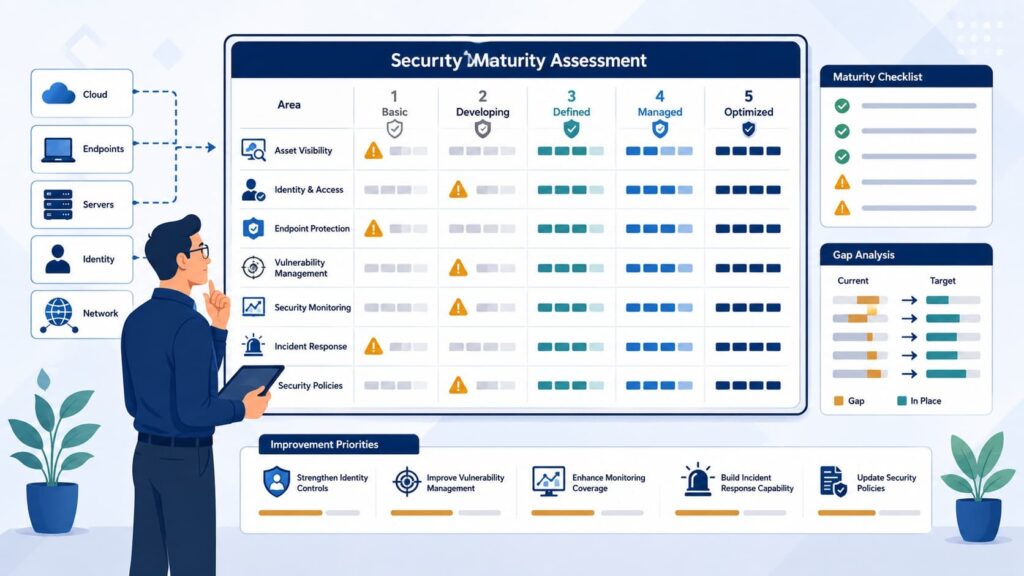
Score current maturity across governance, asset visibility, identity, endpoint security, vulnerability management, logging, detection, response, recovery, and supplier oversight before writing provider requirements.
We can use the six NIST CSF 2.0 Functions (Govern, Identify, Protect, Detect, Respond, Recover) to create a repeatable gap analysis. If using a 0–5 internal scale, define the meaning of every score and apply the same criteria across each security domain.
The assessment should examine governance, asset visibility, identity controls, endpoint protection, vulnerability management, logging, detection engineering, incident response, recovery, and supplier oversight.
It should also expose practical weaknesses. An organization may have EDR deployed across endpoints but lack analysts to review alerts, investigate detections, tune policies, and respond to confirmed threats.
Similarly, it may collect logs across the network but suffer from weak Security Information and Event Management (SIEM the central system that analyzes security alerts) practices. It may also have an incident plan that has not been tested.
The resulting gaps should become the foundation of the security service scope and RFP rather than being reverse-engineered around a provider’s preferred platform. Our practical rule: Buy the capability needed to close a measured gap, not another dashboard.
What Does “24/7 Security” Actually Mean?
A 24/7 SOC claim should identify analyst coverage by shift, alert-review responsibilities, escalation paths, threat-hunting frequency, and response authority. This distinction is central to MSSP evaluation.
A provider may collect telemetry around the clock while offering limited human investigation or customer-specific response.
When a provider claims 24/7 security, we should validate what that actually includes:
- 24/7 SOC: Confirm the number and seniority of analysts covering each shift, the escalation path for critical alerts, and the maximum escalation time.
- MDR: Confirm investigation and containment responsibilities.
- Threat hunting: Confirm how often threat hunting occurs, which data sources are covered, what methodology is used, and what evidence is delivered after each hunt.
- AI-powered detection: Confirm human review, escalation, and tuning.
- Proactive monitoring: Confirm customer-specific detection coverage.
Some users question if low-cost managed SOC services do more than send alerts. Those reports are anecdotal, but they point to a useful diligence question: What does the provider actually do that our existing EDR or SIEM cannot do alone?
We should ask who investigates critical alerts overnight, how analysts add business context, what evidence enters a case, and who can contain an attack.
A realistic demonstration should follow one detection from alert through triage, investigation, escalation, containment, reporting, and lessons learned. That is a stronger test than a polished portal tour.
How Do You Test Technical Coverage and Integrations?
Technical coverage is proven when required telemetry arrives within the agreed time, contains required fields, remains searchable for the contracted retention period, and supports an investigation. It must also reach the right tenant and workflow.
Clear security scoping helps define which integrations, data sources, retention requirements, and workflows the provider must support. A provider may list SIEM, EDR/XDR, identity, cloud, firewall, email, and vulnerability tools.
A configured connector is not sufficient; validate event completeness, required fields, timestamp accuracy, ingestion latency, and outage detection for each critical source.
Our technical validation should cover:
- Expected event types, mandatory fields, event volume, timestamp format, and acceptable ingestion delay
- Collection methods and transport
- Timestamp accuracy and normalization
- Log retention and searchability
- Failure detection and outage buffering
- Tenant attribution and administrative separation
- Native integrations versus APIs or custom development
- Additional ingestion, connector, and storage fees
NIST treats supplier needs and supplier checks as part of cybersecurity supply-chain risk management (C‑SCRM) under SP 800‑161 Rev. 1 and the 2026 SP 1326 due-diligence guide, which emphasize observable, testable controls.
The same principle applies to technical integration: requirements should be observable and testable. A useful acceptance test generates a known event, verifies its arrival, checks the required fields, finds it in the analyst interface, and confirms that the provider can investigate it.
What technical evidence should providers demonstrate?
Providers should show the architecture, data-flow path, collection method, storage location, retention period, encryption controls, subprocessors, and export method.
They should also show encryption, data sites, subprocessors, data hold rules, data deletion, disaster recovery, API access, and data export.
They should also explain how security telemetry, log collection, secure log forwarding, detection content, case records, and historical data remain accessible to us.
The difference between “supported” and “working” is small in a sales presentation but substantial during an incident. That is why technical evidence should be tested before approval.
How Should You Evaluate Provider Security and Staffing?
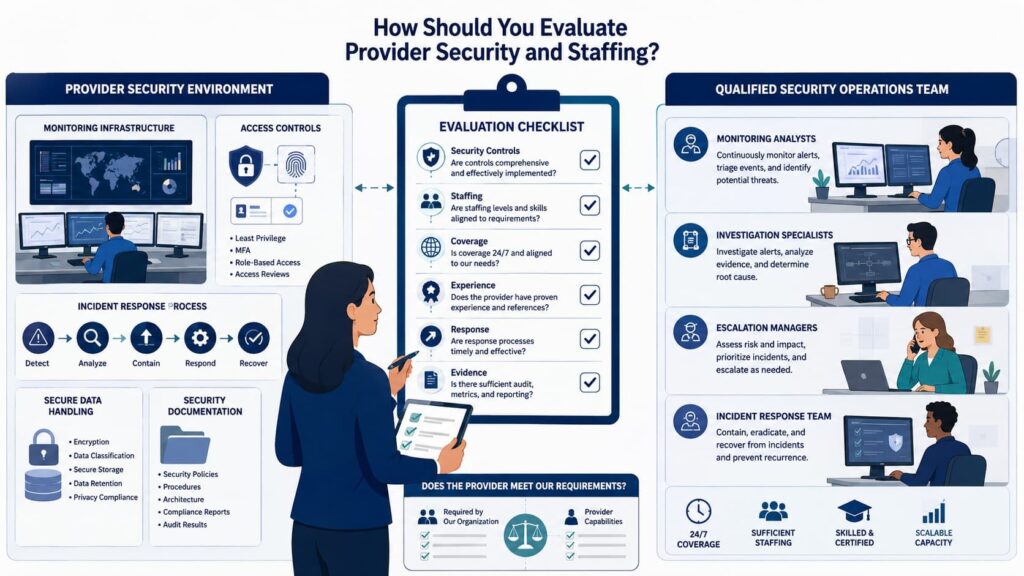
Treat the provider as a critical supplier. Request SOC 2 Type II or ISO 27001 evidence, then separately test resilience, privileged access, vulnerability management, secure development, MFA, penetration testing, and business continuity.
It should also check penetration testing, vulnerability management, secure development, MFA, privileged access, session logs, and business continuity. NIST supplier guidance supports evaluating provider resilience and foundational cybersecurity practices rather than accepting a certification as complete proof of security.
A certification shows that controls were assessed against a defined standard. It does not prove that a provider can detect our specific attack scenarios.
Evaluate staffing by analyst-to-alert workload, shift coverage, senior escalation capacity, turnover, training hours, and knowledge-transfer procedures.
In our direct security audits, we consistently observe that high turnover at Tier 1 desks severely degrades response quality. Evaluators should directly inspect analyst skill levels, tier-escalation pathways, shift handover logs, and ongoing training requirements.
We should also check how customer data and context stay in place when staff change. This is where outsourced cybersecurity can succeed or fail quietly.
A provider might have strong technology but limited analyst capacity, slow escalation, or excessive dependence on junior triage.
Before approval, verify:
- Analyst coverage: How many analysts monitor alerts during each shift, what seniority levels are available, and how is coverage maintained during nights, weekends, holidays, and absences?
- Senior escalation: How quickly can experienced analysts or incident responders become involved in a critical event?
- Threat hunting: What resources are dedicated to proactive threat hunting, and how often is it performed?
- Detection engineering: Who creates, tests, tunes, approves, and retires customer-specific detection rules, and what turnaround time applies to each change?
- Staff continuity: How does the provider manage analyst turnover, training, and knowledge transfer?
- Security screening: What background checks, security training, privileged-access requirements, and recurring reviews apply to personnel handling customer environments?
- Privileged access: How are privileged accounts controlled, monitored, and reviewed?
- Subprocessors: Which third parties have access to customer data or security operations, and how are they governed?
- Data residency and deletion: Where is customer data stored, and how is it securely deleted when it is no longer required?
The objective is not to demand perfect staffing. It is to determine whether staffing levels can realistically support the promised 24/7 security monitoring and incident response workload.
How Can You Prove a Provider Can Detect and Respond?
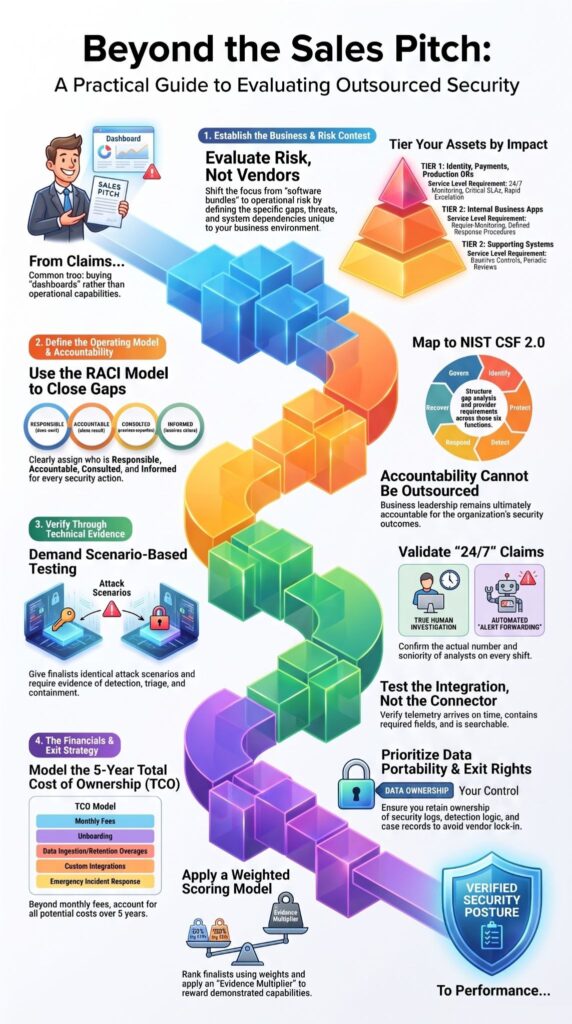
Give every finalist identical attack scenarios and require evidence of telemetry, detection, investigation, escalation, containment, and reporting. A security assessment expert can help evaluate whether those capabilities work under realistic attack conditions rather than relying only on documented claims.
This scenario-based cybersecurity vendor evaluation removes much of the ambiguity from marketing claims. Instead of asking whether a provider supports managed detection and response, we can watch how it handles a realistic attack.
Which scenarios should you test?
Use scenarios that cross multiple security domains:
- Stolen administrator credentials followed by cloud privilege escalation
- Ransomware activity on an endpoint
- Malicious mailbox forwarding
- Suspicious PowerShell or scripting activity
- Internet-facing application exploitation
- Firewall-rule manipulation followed by data exfiltration
- Compromised third-party account
- Critical vulnerability without an available patch
For every scenario, require evidence of telemetry arrival, detection time, triage decision, investigation steps, severity assignment, customer notification, containment action, recovery recommendation, and final reporting.
This includes telemetry, the detection trigger, triage, evidence collection, severity, customer notice, containment authority, portal workflow, and the final report.
A strong security operations center should also explain how the incident changes future detection logic. Detection engineering should continue after an alert is closed. Of course, a demonstration still has limits.
A scripted demo can hide operational weaknesses. That is why a paid proof-of-value can be useful before a multi-year agreement.
What should a proof-of-value require?
The proof-of-value should test each critical integration, required telemetry fields, priority detections, escalation times, portal workflows, reporting accuracy, collection-failure alerts, and at least one incident exercise.
These include integrations, telemetry, key detection cases, escalation, portal access, reports, collection-failure alerts, and an incident drill.
A provider should not receive full credit merely because a feature exists. We should award the highest score when the capability is demonstrated in our environment.
Which SLAs and KPIs Should an MSSP Contract Include?
An MSSP SLA should measure security actions such as analyst acknowledgment, investigation start, customer notification, containment, telemetry availability, and detection-tuning turnaround.
Good cybersecurity KPIs show how fast the provider finds, checks, reports, and contains threats.
| Metric | Define explicitly |
| Alert acknowledgment | Start and stop timestamps |
| Triage time | Severity and investigation threshold |
| Customer notification | Required communication point |
| Containment time | Meaningful containment action |
| Critical-alert SLA | Required compliance percentage |
| Telemetry availability | Source-level availability |
| False-positive rate | Measurement methodology |
| Detection tuning | Required turnaround |
| Report accuracy | Validation process |
As noted by UK National Cyber Security Centre (NCSC):
“Poorly chosen metrics can mask a vendor’s true security posture, giving a false sense of control. Incentive-driven metric gaming may reduce the effectiveness of outsourced SOC services” – UK National Cyber Security Centre (NCSC)
Define MTTD as the time from qualifying event availability to analyst-validated detection, and define MTTR separately for investigation start, containment, or recovery.
An automated email should not count as a meaningful response if no analyst has reviewed the event. The contract should define 24/7 and business-hour clocks.
It should also define severity, exclusions, customer delays, maintenance windows, evidence, report timing, service credits, and fixes.
A useful incident response SLA might distinguish acknowledgment, investigation start, customer notification, and verified containment rather than combining everything into one response-time number. That distinction gives both sides a measurable operating standard.
How Should You Compare Pricing, Contracts, and Exit Risk?
MSSP pricing should be compared using total cost of ownership across normal operations, expected growth, and incident scenarios.
Compare total cost across onboarding, recurring service, data ingestion, retention, integrations, incident response, growth, overages, and contract exit.
Managed security service costs can rise when these items cost extra: ingestion, retention, cloud connectors, custom integrations, threat hunting, vulnerability management, and emergency response.
What belongs in the total-cost model?
Our pricing workbook should include:
- Onboarding and implementation
- Licenses and data ingestion
- Storage and retention
- Custom integrations
- Detection-rule development
- Threat hunting
- Incident response and forensics
- Vulnerability management services
- After-hours work Cloud connectors
- Reporting and compliance services
- Exit and data-export costs
- Minimum commitments and overages
Community-reported MSSP pricing varies widely.Entry-level monitoring retainers typically start around $5,000/month. However, full Managed Detection and Response (MDR) for mid-market environments generally ranges from $5,000 to $25,000/month.
For example, during a 2025 evaluation for a 1,200-employee healthcare firm, baseline monitoring quotes were $8,000/month, but total cost of ownership (TCO) escalated to $18,000/month once enterprise cloud connectors and mandatory 24/7 custom incident response retainers were factored in.
These are not market benchmarks. They simply show why scope must be standardized before prices are compared. Model TCO over three or five years using projected users, endpoints, cloud accounts, log volume, sites, service expansion, incident response needs, and exit costs.
What should the contract protect?
The contract should clearly define:
- Data: Data terms should specify ownership, storage locations, retention duration, export format, export frequency, access rights, and deletion requirements.
- Security: Access controls, assurance requirements, and breach notification.
- Operations: Scope, approvals, SLAs, and responsibilities. Subprocessors: Disclosure and governance requirements.
- Evidence: Case records, logs, and configurations.
- Termination: Transition support and deletion certification.
NIST SP 800-161 Rev. 1 calls for supplier security needs, checks, monitoring, and contract controls as part of supply-chain risk management.
Data ownership deserves special attention. We should retain access to security logs, detection content, case records, configurations, asset information, and relevant historical evidence.
Vendor lock-in is a bigger risk when the provider controls our SIEM, firewall, identity workflows, and incident history.
Define exit requirements before signing, including transition duration, data-export format, configuration transfer, knowledge transfer, access revocation, and deletion evidence.
Contracts must explicitly stipulate 90-day transition support, raw log archive exports in non-proprietary formats (e.g., JSON or CSV), and certified cryptologic data sanitization (NIST SP 800-88 compliant) across all vendor storage environments upon contract end.
How Do You Score Finalists and Plan the Transition?
Use weighted scores, evidence scores, and clear acceptance rules before the managed security service goes live. A practical MSSP selection criteria model can give the greatest weight to risk fit and detection quality.
Score finalists using predefined weights: risk/service fit 20%, detection/response 20%, architecture/integrations 15%, security assurance 15%, operations 10%, reporting 5%, implementation 5%, and commercial value 10%.
Apply an evidence multiplier: 1.0 for demonstrated or independently verified capabilities, 0.8 for documented capabilities, 0.5 for limited claims, and 0 for missing evidence.
This method gives more credit to a tested capability than to a sales claim without proof.
What should transition acceptance require?
The onboarding process should move through discovery, implementation, stabilization, and acceptance.
We should verify asset and data-source inventories, existing detection rules, critical systems, escalation contacts, integrations, log parsing, ticket workflows, and portal roles.
SOC/MDR onboarding commonly takes 8–12 weeks for mid-sized environments, with larger or multi-cloud estates requiring additional months for integration, parsing, detection tuning, and workflow hardening.
These are anecdotal experiences rather than universal benchmarks, but they support a sensible procurement rule: never treat agent deployment as operational acceptance.
Acceptance should require:
- Verified telemetry
- Tested detections
- Working escalation
- Accurate reporting
- Alert-baseline development
- Detection tuning
- SLA measurement
- Incident exercises
- Knowledge transfer
Declare the service operational only after telemetry, detections, escalation, reporting, SLA measurement, and incident exercises pass their acceptance criteria.
What Are the Most Common Outsourced-Security Evaluation Mistakes?
The most common failures occur when organizations buy technology instead of capability or transfer tasks without creating measurable accountability. Our final security control assessment should test the full buying plan before approval.
- Scope should account for endpoints, identities, cloud accounts, applications, critical data, log sources, third parties, and required response coverage.
- 24/7 coverage has been operationally demonstrated.
- Detection and investigation are distinguished from alert forwarding.
- Containment authority is explicit.
- Cloud, identity, SaaS, and third-party visibility are included.
- Integration failures can be detected.
- Pricing includes retention, connectors, response, and overages.
- Provider security has been independently assessed.
- SLAs measure meaningful actions.
- Security data and detection content remain portable.
- Transition and exit procedures are contractually defined.
A recurring mistake is accepting a generic dashboard as evidence of service quality. A portal should show an actual incident with investigation notes, evidence, escalation timing, recommended actions, and customer responsibilities.
Another mistake is treating SOC 2 Type II or ISO 27001 as proof of operational effectiveness. These attestations show controls were designed and operated over an audit period, but they don’t guarantee detection/response quality for your scenarios validate with scenario testing and POVs.
Those certifications matter, but they answer a different question. The strongest evaluation connects assurance evidence with demonstrated behavior.
What should the final evaluation package contain?
The final package should contain a risk profile, maturity baseline, target-state requirements, capability/RACI matrix, technical requirements, assurance questionnaire, attack scenarios, SLA/KPI schedule, pricing model, scorecard, and transition/exit plan.
Together, these documents create a clear managed security RFP. They also make the plan easier to review with security, IT, finance, legal, privacy, and senior leaders.
A Capabilities-Based Approach to Security Requirements
credits: INCOSE RWG
When evaluating organizational cybersecurity, effective protection relies on a needs-driven, capabilities-based approach rather than treating security as an afterthought.
As detailed in the INCOSE RWG presentation by Dr. Beth Wilson, identifying security requirements begins with understanding potential losses and defining the precise capabilities needed to prevent them.
Crucially, security requirements designed to implement these protective capabilities must be treated as essential functional requirements rather than non-functional add-ons.
Aligning security evaluation directly with system requirements enables organizations to build robust defenses that safeguard critical assets and sustain long-term resilience.
FAQ
What should I check before comparing managed security service providers?
Start with a security needs assessment that identifies critical assets, major risks, existing controls, capability gaps, required coverage, and internal responsibilities. Identify the security capabilities your team already has and the areas where you need outside support. Then define your security service scope, coverage requirements, response expectations, reporting needs, and internal responsibilities before starting a cybersecurity vendor evaluation.
How can I tell if outsourced cybersecurity fits our security operations?
Map each security task to internal capacity, required expertise, coverage hours, response authority, and the provider role. Consider 24/7 security monitoring, security alert triage, incident response services, vulnerability management services, and cloud security monitoring. Define which activities the provider will manage and which activities your internal team will continue to handle.
What should an MSSP RFP include to get useful proposals?
Your MSSP RFP should define service scope, required data sources, coverage hours, response SLAs, escalation authority, evidence requirements, data ownership, pricing assumptions, and exit terms. Specify required coverage, escalation procedures, evidence requirements, service levels, and responsibilities so providers can submit comparable proposals.
How should I evaluate MSSP pricing beyond the monthly service fee?
Compare MSSP pricing with internal staffing, technology, onboarding, ingestion, retention, incident response, overage, and exit costs over the expected contract term. Calculate the cybersecurity total cost of ownership instead of comparing monthly fees alone. Also review service limits, additional charges, contract terms, and transition costs to estimate the full financial commitment.
What should I ask about security data before signing an outsourcing contract?
Ask who owns the security telemetry, how the provider handles log collection and secure log forwarding, how long security data is retained, and how you can export your data. Confirm security data portability, access controls, and exit procedures. These terms can reduce vendor lock-in and help you retain important security records when changing providers.
How Do You Know an Outsourced Security Provider Is Ready for Approval?
Choosing an outsourced security provider should start with evidence, not assumptions. Approve a provider only when critical detections, escalation paths, integrations, staffing coverage, SLA performance, pricing assumptions, and data-exit controls have been demonstrated or independently verified.
NIST CSF 2.0 can help structure the review, while clear roles and ongoing oversight keep your organization accountable. To strengthen secure development skills, MSSP Security provides hands-on training covering the OWASP Top 10, secure authentication, input validation, encryption, and safe dependency use.
References
- https://www.bdo.co.id/en-gb/insights/the-new-era-of-accountability-building-resilient-growth-through-strategic-outsourcing
- https://www.ncsc.gov.uk/blogs/could-your-choice-of-metrics-be-harming-your-soc