

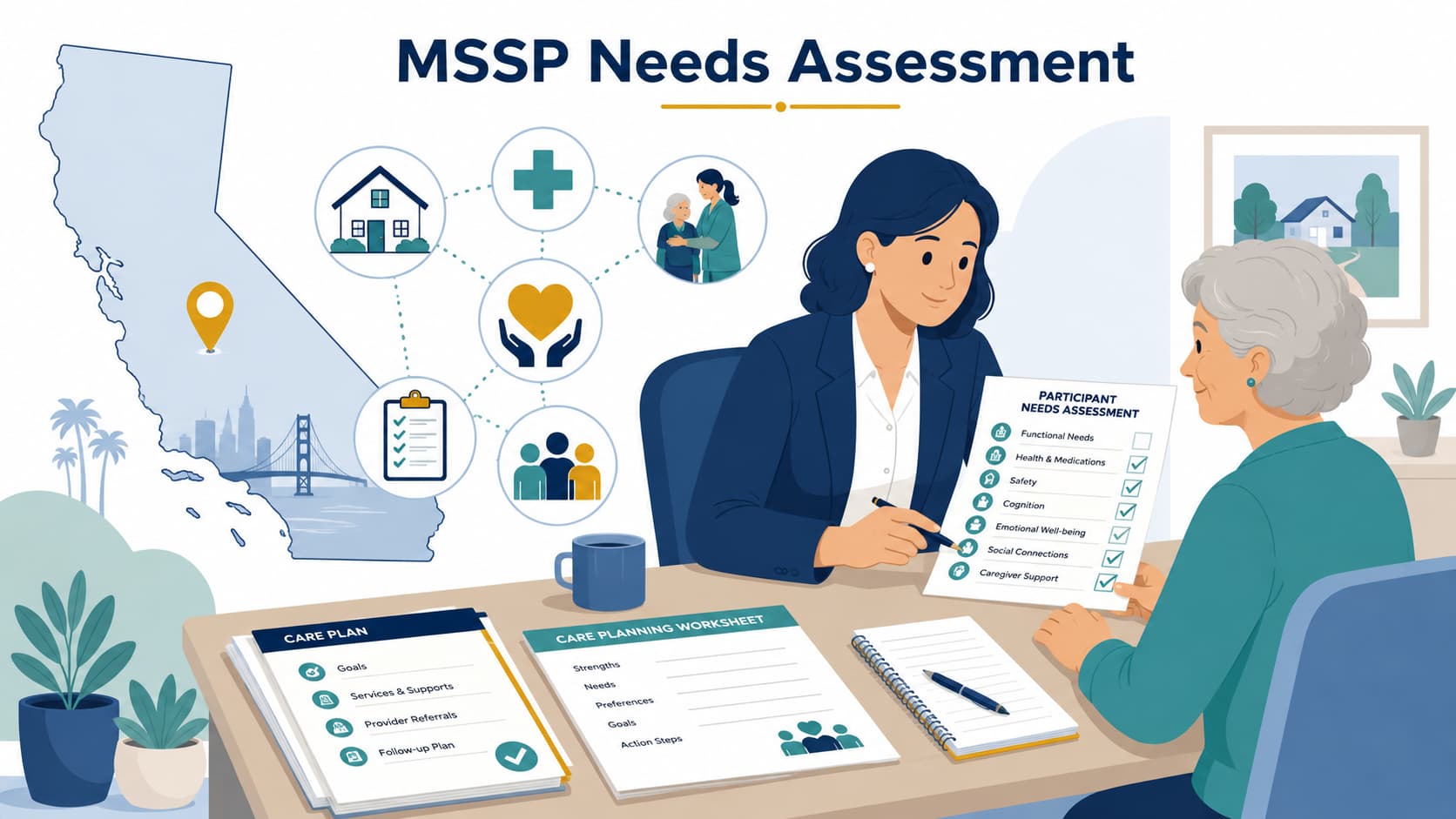
California’s Multipurpose Senior Services Program (MSSP) is a Home and Community-Based Services program that uses health, functional, psychosocial, cognitive, and safety information to identify participant needs and coordinate community-based services.
An MSSP needs assessment connects these findings with caregiver support, available resources, and an individualized care plan that fits daily life.
So, what does the California MSSP assessment process include? In this article, MSSP Security explains the key areas California MSSP sites should consider, from health and functional needs to safety, caregiver support, and follow-up. Keep reading to understand what to expect from the assessment process.
California MSSP Assessment: 3 Key Takeaways
A strong California MSSP needs assessment connects documented participant needs with current CDA guidance, individualized care planning, service coordination, and measurable workflow improvements.
- Assess the whole situation. Review health, functional ability, cognition, safety, psychosocial needs, caregiver support, and community resources together to understand what the participant actually needs.
- Connect findings to action. Each important need should lead to an appropriate service, responsible party, follow-up step, or monitoring process. Care plans should reflect documented needs rather than simply list available services.
- Keep workflows current and practical. California MSSP sites should review their assessment forms, documentation, reassessment practices, training, and care-planning processes against current CDA guidance, while prioritizing gaps that affect participant safety, compliance, and service coordination.
What Is an MSSP Needs Assessment in California?
A California MSSP needs assessment that reviews a participant’s health, functional ability, cognition, psychosocial circumstances, safety risks, caregiver support, and access to community resources.
These findings help the interdisciplinary team determine appropriate services, interventions, and follow-up actions while supporting documentation, reassessments, and care-plan updates.
According to the California Department of Aging (CDA), MSSP provides ongoing care management by connecting eligible participants with health and social services.
The CDA MSSP Site Manual addresses health status, social circumstances, functional ability, safety, cognitive status, medication considerations, and care planning.
These areas provide a practical framework for evaluating whether assessment tools support existing workflows or create unnecessary documentation and repetitive steps.
Research from UCLA Center for Health Policy Research shows:
“The findings from this needs assessment of the MSSP and CBAS programs in California underscore the importance of improving access to LTSS [Long-Term Services and Supports]. As the state of California continues to implement its Master Plan for Aging, it is imperative that potential gaps in access to home- and community-based care are identified and addressed.” – UCLA Center for Health Policy Research
For MSSP sites, this reinforces the importance of identifying unmet needs, service gaps, and available community resources. Independent consultants can also help evaluate new or existing tools against actual assessment and care-management workflows before broader adoption.
Who Qualifies for California MSSP Services?
California MSSP eligibility should be evaluated using current CDA and DHCS requirements. MSSP generally serves eligible individuals age 60 or older who meet applicable Medi-Cal, level-of-care, and service-area requirements. Sites should verify current eligibility rules with CDA and DHCS during program or compliance reviews.
DHCS describes MSSP as a 1915(c) Home and Community-Based Services waiver that helps eligible individuals remain in their homes and communities rather than requiring nursing facility placement. The current waiver period runs from July 1, 2019, through June 30, 2029.
Enrollment and participant-slot figures can vary by source and reporting period. Sites should identify the specific measure, fiscal year, and issuing agency rather than combining figures from different sources.
Eligibility determines whether someone can enter MSSP; the comprehensive needs assessment determines the scope of care. Assessment findings should translate documented functional limitations and other needs into appropriate services, referrals, care-plan interventions, and follow-up actions under applicable MSSP rules.
Depending on documented needs and program requirements, MSSP may coordinate or purchase services such as:
- Care management
- Respite and transportation
- Meal services
- Personal care and protective supervision
- Minor home repairs
- Adult day care
- Counseling and therapeutic services
When evaluating new products, sites should also assess whether tools support these workflows without adding unnecessary steps or disrupting daily care-management activities.
How Does an MSSP Needs Assessment Determine Care Needs?
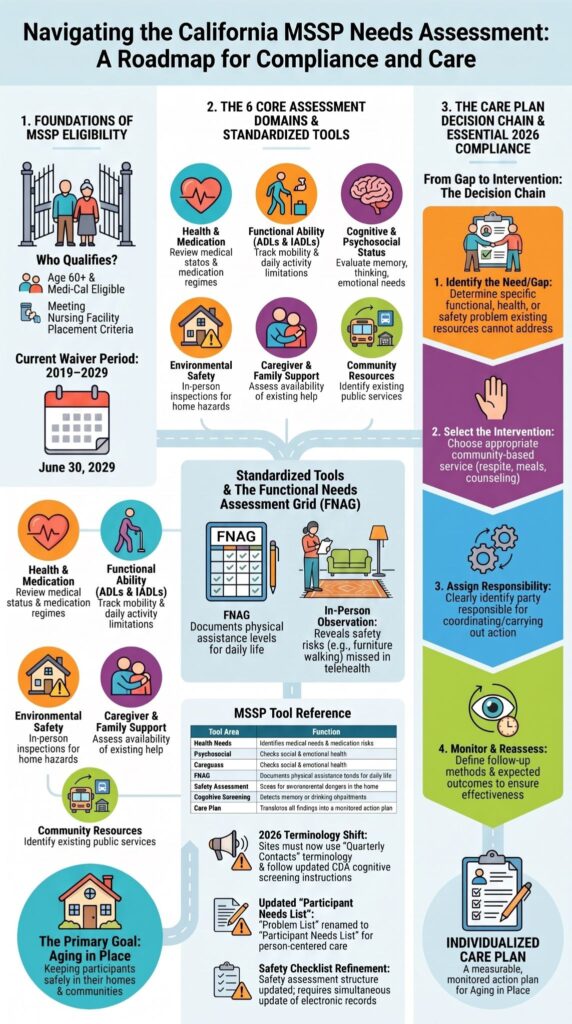
To build a compliant MSSP care plan, the interdisciplinary team should connect assessment findings directly to actionable interventions.
The decision chain is straightforward: assessment finding → identified gap → appropriate intervention or service → responsible party → follow-up or reassessment.
The process should:
- Review health and social circumstances.
- Check functional limitations and safety risks.
- Assess family support and community resources.
- Identify gaps where services are still needed.
- Determine which community services can address those gaps.
- Build and monitor an individualized care plan.
This approach connects the participant’s actual circumstances to specific services and follow-up actions. The assessment may involve social work case managers, nurse case managers, physicians, family members, caregivers, and community organizations so that health, functional, safety, and social needs are considered together.
Which Assessment Tools Does California MSSP Use?
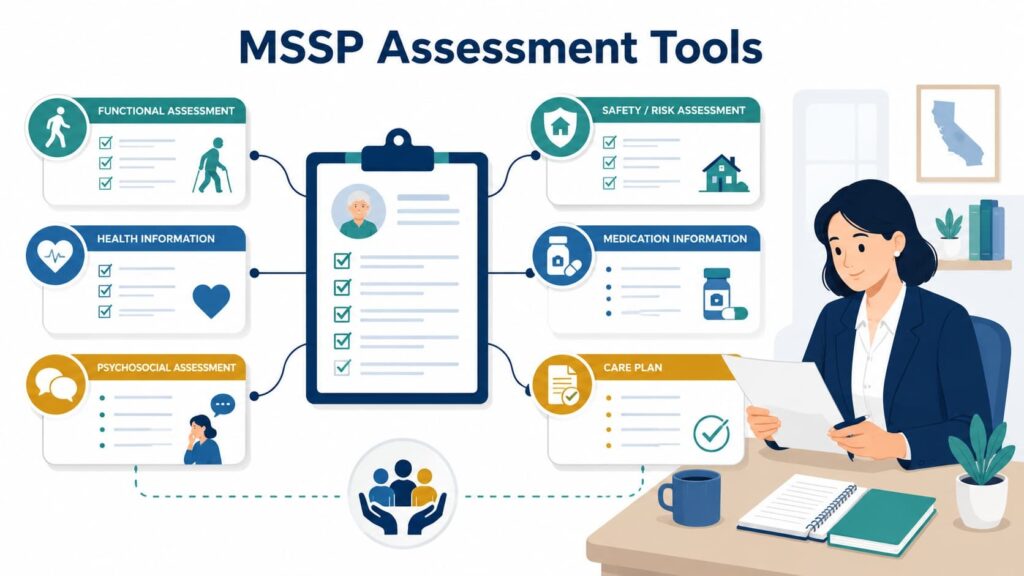
California MSSP sites use standardized assessment tools to evaluate participant health, cognitive function, safety risks, medication needs, and psychosocial circumstances. The CDA MSSP Site Manual includes 10 chapters and supporting guides, including the Functional Needs Assessment Grid (FNAG), reassessment forms, safety checklists, cognitive tools, medication logs, and Care Plan documents.
Here’s a quick look at these tools:
| Tool Area | What It Does |
| Health needs | Finds medical needs |
| Psychosocial needs | Checks social and emotional needs |
| Functional Needs Assessment Grid (FNAG) | Notes how much help someone needs |
| Safety assessment | Looks for dangers at home |
| Cognitive screening | Finds problems with memory or thinking |
| Medication review | Lists important medicines |
| Care plan | Turns all findings into a plan |
The FNAG documents functional limitations and the assistance needed for relevant daily activities. Sites should ensure staff use current CDA/DHCS guidance and update procedures when requirements change.
In-person assessment remains important when direct observation is needed. It can identify loose rugs, inaccessible rooms, nutritional concerns, medication difficulties, caregiver availability, and transportation or mobility problems that may be missed remotely.
For example, a participant may report walking independently, while an in-home assessment reveals reliance on furniture for balance.
That observation could change the documented functional need, safety intervention, or care-plan follow-up. Sites should document why a particular assessment method was used and follow current CDA requirements rather than outdated practices.
How Should an MSSP Consultant Evaluate Functional and Safety Needs?
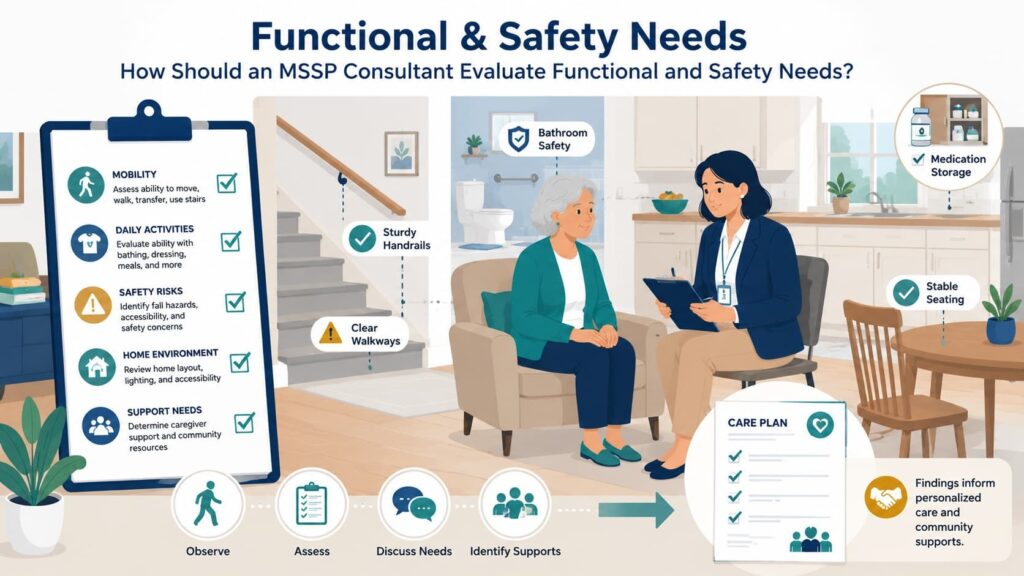
A California MSSP needs assessment consultant should organize findings across six core domains: health, functional ability, cognition, psychosocial needs, environmental safety, and available support.
The current CDA manual provides separate materials for functional needs and safety assessment, which helps interdisciplinary teams distinguish functional limitations from environmental hazards.
A practical review should consider:
- ADL and IADL limitations
- Mobility and assistance requirements
- Medication considerations
- Cognitive functioning
- Home safety concerns
- Caregiver and family support
- Transportation and nutrition
- Existing community resources
Assessment principle: Document the participant’s actual needs before recommending a service. The consultant should also examine whether staff consistently connect assessment findings to the care plan.
A well-completed form has limited value if important findings never influence service coordination, follow-up, or monitoring. In our experience, the strongest assessment workflows make the reasoning visible.
Staff should be able to explain what changed, why a service was selected, who coordinates it, and when the team will reassess the situation. That approach supports both participant-centered care and stronger operational consistency.
What Should a California MSSP Care Plan Include?
An MSSP care plan should connect each documented participant need with an intervention, responsible party, expected outcome, and monitoring or reassessment step.
The CDA describes individualized care planning as a collaborative process involving the participant and relevant professionals, family members, and other supports. Its current manual includes a dedicated Care Plan form and instructions.
As noted by Justice in Aging:
“MSSP is uniquely flexible in its ability to meet unmet needs through the purchase of individual services and is not limited to a set benefit package. MSSP social worker and registered nurse teams work with participants to create an individual care plan to address gaps that put participants at risk of institutional placement.” – Justice in Aging
How Do You Turn Assessment Findings Into Services?
A useful framework connects each finding to an action:
- Need: Identify the functional, health, psychosocial, or safety problem.
- Gap: Determine what existing resources cannot address.
- Intervention: Select an appropriate community-based service.
- Responsible party: Identify who coordinates or carries out the action.
- Monitoring: Define the follow-up method, evidence of follow-up, expected outcome, and reassessment point.
This structure helps prevent a common operational problem: documenting a need without documenting what happens next.
Of course, not every identified problem requires an MSSP-funded service. Existing family support, Medi-Cal services, local agencies, transportation programs, healthcare providers, and other community resources may already address part of the need. The consultant’s job is to help the team see the whole service picture clearly.
How Can Consultants Support MSSP Site Compliance?
Consultants can map four core MSSP workflows assessment, documentation, care planning, and reassessment to the current CDA Site Manual and identify gaps in forms, staff practices, training, and quality review.
The current Site Manual covers program operations, staffing, quality assurance, participant records, participant rights, information systems, service vendors, budgets, and equipment across 10 chapters, with extensive assessment and care-planning appendices.
A compliance-focused review can include:
- Reviewing assessment documentation.
- Comparing workflows with the current Site Manual.
- Checking use of current assessment materials.
- Reviewing reassessment practices.
- Evaluating care-plan documentation.
- Identifying training gaps.
- Reviewing participant-rights procedures.
- Tracking policy and manual revisions.
Examples include renaming ‘Problem List’ to ‘Participant Needs List’, clarifying reassessment timing and grace periods, integrating the CDA-approved cognitive screening tool into assessment workflows, and updating the Functional Needs Assessment Grid (FNAG).
For an MSSP site, that means an old internal checklist may no longer be enough. Our approach is to compare the workflow against the current state guidance first, then identify which changes require staff training, documentation updates, or process redesign.
What Changed in California MSSP Assessment Guidance in 2026?
The 2026 MSSP Site Manual revision clarified assessment terminology and procedures, making it useful for California sites to review existing workflows against the current guidance.
The California Department of Aging (CDA) updated several assessment-related materials, including reassessment terminology, cognitive screening guidance, the Functional Needs Assessment Grid, and safety assessment materials.
The changes affect how staff document participant contacts and complete assessment activities.
| 2026 update | Practical implication |
| Quarterly “contacts” terminology | Align internal language with current CDA terminology |
| In-home assessment guidance | Use the appropriate assessment method for each participant |
| Cognitive screening guidance | Follow current screening instructions |
| Safety checklist changes | Use the updated safety assessment structure |
| FNAG changes | Review current functional assessment instructions |
Outdated forms can create documentation and compliance risks when they no longer reflect current CDA requirements. Sites must update internal forms, staff policies, and electronic records simultaneously whenever CDA revises standard assessment terminology.
The CDA remains the primary state program authority, while DHCS administers the Medi-Cal waiver relationship.
Consultants should therefore distinguish state program guidance from general senior-care practices and avoid treating an outdated local procedure as current policy. That said, not every change requires a complete operational rebuild.
A structured gap review can identify which policies need revision and which workflows already meet current expectations.
How Do You Choose an MSSP Needs Assessment Consultant in California?
Choose a consultant with direct knowledge of California MSSP, interdisciplinary assessment, documentation, care planning, reassessment, and community-based service coordination.
A structured consultant selection process can help sites compare experience, assessment expertise, documentation practices, and familiarity with California MSSP requirements.
The strongest evidence is demonstrated California MSSP work, familiarity with the current Site Manual, and the ability to show how recommendations will affect assessment, care planning, documentation, and reassessment.
A consultant should understand how CDA, DHCS, local MSSP sites, case managers, healthcare providers, caregivers, and community organizations interact within the program. That practical knowledge is more useful than a generic senior-care consulting background.
A good selection process should examine:
- California MSSP program experience
- Familiarity with the current Site Manual
- Health and psychosocial assessment expertise
- Functional and safety assessment knowledge
- Documentation and compliance experience
- Care-plan workflow experience
- Community resource knowledge
- Interdisciplinary staff training ability
As senior-care compliance advisors, we prioritize current California program knowledge because MSSP site evaluations depend entirely on Department of Aging regulatory standards.
The consultant should be able to explain how recommendations connect to CDA guidance without turning the engagement into a generic compliance exercise.
A strong consultant also asks practical questions about staffing, forms, documentation systems, participant contacts, reassessments, referrals, and care-plan monitoring.
Those details show whether the consultant understands the workflow beyond the policy document.
What Should an MSSP Needs Assessment Deliver?
At minimum, the deliverable should distinguish participant-care findings, site workflow findings, compliance gaps, recommended actions, responsible parties, and implementation priorities. The assessment should not end with a list of observations.
A clear needs assessment scope can also define which participant-care areas, site workflows, documentation practices, and compliance issues the consultant will evaluate.
According to the CDA Site Manual, MSSP operations depend on structured assessment and care-planning processes, so consulting deliverables should connect findings to those processes.
Expected deliverables can include:
- Current-state assessment
- Functional and psychosocial findings
- Safety and environmental risk summary
- Service-gap analysis
- Documentation review
- Compliance findings
- Prioritized improvement roadmap
- Staff training recommendations
- Care-planning workflow improvements
The final report should separate required corrections from recommended improvements. This makes implementation easier for site administrators and interdisciplinary teams. A useful roadmap also assigns priorities.
A documentation issue affecting participant safety or required assessment procedures should receive faster attention than a minor formatting inconsistency.
What Makes an Assessment Report Useful?
A useful California MSSP assessment report translates documented findings into specific corrective actions, responsible parties, timelines, and measurable follow-up criteria.
For example, instead of stating that “assessment documentation needs improvement,” a consultant can identify the affected form, explain the documentation gap, assign responsibility for updating the workflow, and establish a review date.
That level of detail helps a site move from assessment to implementation without requiring another consulting engagement just to interpret the recommendations.
How Can California MSSP Sites Improve Assessment Workflows?
California MSSP sites can improve assessment consistency by combining current CDA guidance, standardized tools, interdisciplinary collaboration, and clear documentation practices.
An requirements analysis can help identify where existing assessment workflows, documentation, and internal procedures differ from applicable California requirements.
CDA program materials report statewide MSSP participation and site counts by reporting period. When using these figures, identify the fiscal year and CDA source rather than presenting a generalized current total.
That scale makes consistent assessment practices important across different local operating environments. A practical improvement process starts with the existing workflow:
- Audit the current assessment process.
- Compare forms and procedures with the current manual.
- Standardize interdisciplinary handoffs.
- Improve documentation quality.
- Track recurring service gaps.
- Review reassessment practices.
- Measure whether recommendations translate into appropriate services.
The California Department of Aging provides the state-level framework, while individual sites still need workable procedures that staff can follow consistently.
A process that looks excellent on paper but takes too long to complete may create new operational problems. We generally favor incremental workflow improvements over unnecessary redesign.
A site might only need updated forms, clearer handoff rules, better staff training, or a stronger quality-review process.
Of course, technology can support these improvements, but it should not replace professional judgment. Assessment information involves personal health, functional, social, and environmental circumstances, so staff need appropriate controls around access, documentation, and information sharing.
What Should You Ask Before Hiring an MSSP Needs Assessment Consultant?
The strongest consultant evaluation focuses on California-specific MSSP knowledge, measurable workflow improvements, and practical deliverables rather than a generic senior-care checklist.
The consultant should be prepared to explain the assessment methodology before the engagement begins. That includes what documents will be reviewed, which staff will participate, how findings will be validated, and what the final report will contain.
Potential questions include:
- Does the consultant understand the current MSSP waiver?
- Have they worked with California MSSP sites?
- Can they review assessment documentation?
- Do they understand functional and psychosocial workflows?
- Can they evaluate current CDA assessment tools?
- Can they train interdisciplinary staff?
- How will recommendations be measured?
- What deliverables will the engagement produce?
The answer should be specific. A consultant who promises a “complete assessment” without defining scope, documentation review, staff interviews, deliverables, and follow-up may leave important expectations unclear.
The CDA Site Manual should also be part of the conversation. A consultant should be comfortable identifying the relevant requirements and explaining how the site’s current workflow compares with them.
For administrators, this approach creates a cleaner basis for comparing consultants. Price still matters, but scope and demonstrated MSSP expertise often matter more because an inexpensive engagement that produces generic recommendations can cost more to implement later.
Defining the True Scope of an MSSP: Moving Beyond Standard IT
Credits: The TSP Advisory
The term MSSP is frequently misunderstood and oversimplified across the cybersecurity industry.
Unlike traditional MSPs that focus on day-to-day IT infrastructure management, an MSSP provides dedicated 24/7 threat monitoring, deep risk assessments, and advanced cyber defense strategies.
Understanding this core distinction is critical for businesses, especially SMBs to select the right security advisory partner and collaborate effectively to strengthen their overall posture.
FAQ
What does a California MSSP needs assessment include?
A California MSSP needs assessment reviews participant health, functional ability, cognition, psychosocial needs, safety, caregiver support, and available community resources. The findings help the interdisciplinary team identify service gaps and develop or update an individualized care plan.
How should a California MSSP site evaluate a needs assessment consultant?
Start an MSSP vendor evaluation by comparing security coverage, relevant experience, response capabilities, reporting, integrations, and contract terms. A managed security service provider consultant can establish clear MSSP selection criteria and support MSSP due diligence. Organizations can also use an MSSP RFP template to ask providers consistent questions and make a more informed comparison.
What should an MSSP assessment workflow include?
An MSSP onboarding checklist should cover access requirements, asset inventories, key contacts, escalation procedures, monitoring scope, log sources, security policies, and reporting expectations. It should also define MSSP SLA requirements and clarify who handles specific incidents. A detailed MSSP client onboarding process helps reduce delays and gives both teams clear responsibilities from the beginning.
When should an MSSP site schedule a comprehensive reassessment?
Sites should follow the current CDA MSSP Site Manual and applicable state guidance for reassessment timing and participant changes. The workflow should also account for significant changes in health, functional ability, safety, or other circumstances that may affect the care plan.
How much do MSSP services typically cost in California?
MSSP service costs vary because services are based on documented participant needs, available resources, applicable program rules, and the specific services coordinated or purchased. A site should verify current program and funding requirements before estimating costs.
What Should California MSSP Providers Take Away From a Needs Assessment?
A strong California MSSP needs assessment connects participant health, functional, cognitive, psychosocial, and safety findings to an individualized care plan, appropriate services, responsible parties, and follow-up. Before changing assessment processes, sites should review the current CDA MSSP Site Manual and align their approach with current requirements.
When outside support is needed, MSSP Security offers tailored MSSP consulting, including needs analysis, auditing, vendor-neutral recommendations, and practical decision support. With 15+ years of experience and 48K+ projects completed, its team can help turn assessment findings into practical improvements that strengthen operations and service quality.
References
- https://healthpolicy.ucla.edu/our-work/publications/multipurpose-senior-services-program-mssp-and-community-based-adult-services-cbas-needs-assessment?language=ko#1
- https://justiceinaging.org/multipurpose-senior-services-programs-to-help-older-adults/