

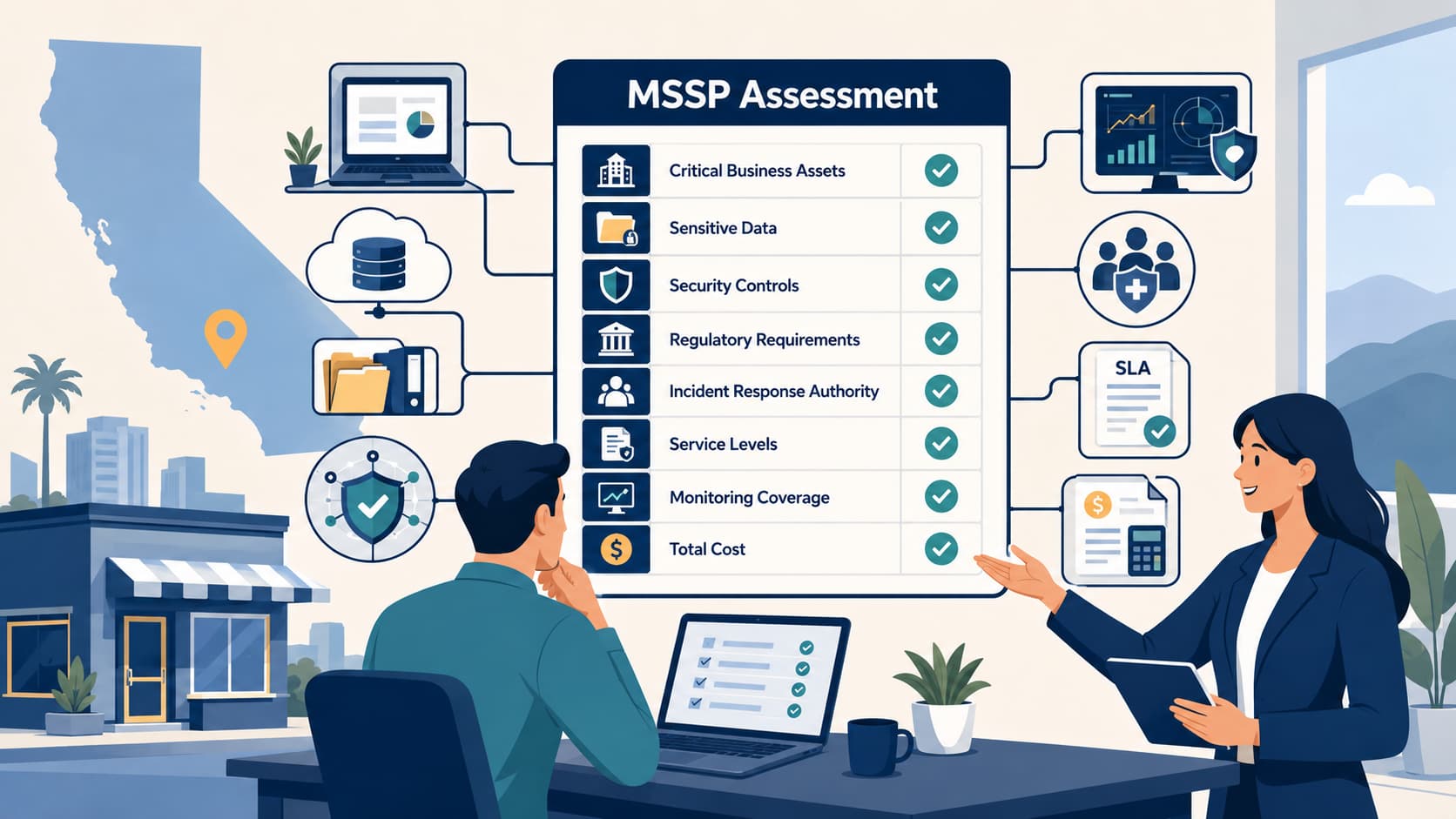
A California small business should assess an MSSP across eight areas: critical assets, sensitive data, security controls, regulatory duties, response authority, service levels, integrations, and total cost.
Small teams can face more exposure to phishing and social-engineering attacks, so a clear baseline helps before outsourcing security. MSSP Security can help businesses understand their security needs, reduce unnecessary tool spending, and make better-informed provider decisions.
Keep reading to learn how to assess your environment, define acceptable downtime and regulatory obligations, and determine which security actions your staff should authorize an MSSP to perform.
Quick MSSP Assessment Wins for California Small Businesses
A good MSSP assessment helps small businesses identify risks, set clear provider expectations, and choose services that fit their needs.
- Assess risk first by documenting critical systems, sensitive data, privileged users, existing controls, downtime limits, and applicable California requirements.
- Set MSSP requirements for monitoring coverage, response authority, SLA targets, reporting frequency, integrations, responsibilities, and total cost.
- Review and improve regularly. Use a POC, track security results, and update the MSSP scope as the business changes.
What should a California small business assess before choosing an MSSP?
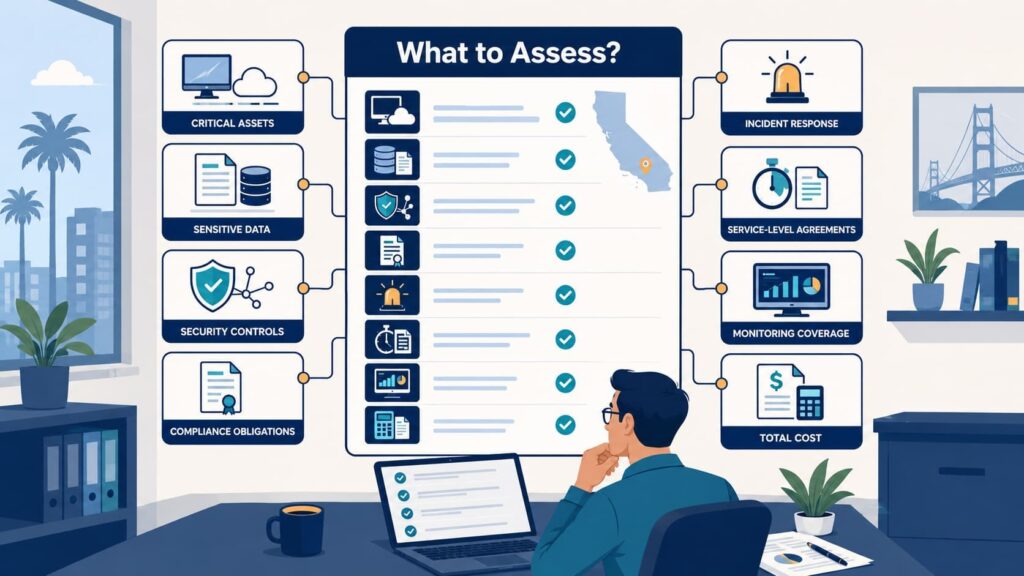
Before talking to providers, get a clear picture of the business. An outsourced security evaluation can help clarify those needs before the business commits to an outside provider. Otherwise, it’s easy to buy security tools that don’t solve the problems you have.
Look at the systems that keep the company running. That might mean email, accounting software, point-of-sale systems, cloud apps, phones, remote access, or customer portals. Then identify what data those systems hold and who can access it.
The review should document these security attributes and values:
- Critical systems and downtime limits
- Sensitive data and where it lives
- Users, admins, devices, and vendors
- MFA, firewalls, backups, patching, and monitoring
- Legal, contract, and insurance duties
- Security policies and response plans
And don’t stop at the tool list. A business may already have useful security controls in place. Replacing them all can add cost without fixing the real issue. Write down where sensitive information is stored.
Include customer records, employee files, payment information, passwords, company intellectual property, backups, and information handled by outside providers.
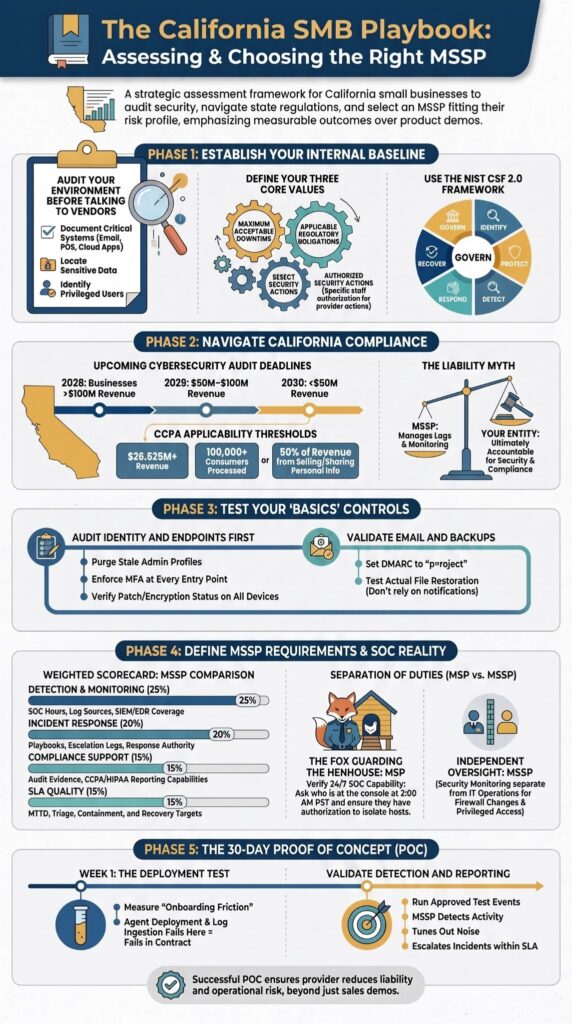
NIST Cybersecurity Framework 2.0 (released Feb 26, 2024) can help organize this review; NIST also provides a Small Business Quick‑Start Guide. NIST CSF 2.0 organizes risk across Govern, Identify, Protect, Detect, Respond, and Recover, giving the business a neutral structure for defining MSSP requirements.
As noted by National Institute of Standards and Technology (NIST):
“The goal of the Identify function is to develop an organizational understanding to manage cybersecurity risk to systems, people, assets, data, and capabilities. The activities in the Identify Function are foundational for effective use of the Framework.” – NIST Cybersecurity Framework
A security assessment should answer one basic question: What needs fixing first? Working with an expert can also help a California business distinguish urgent control gaps from areas that already have adequate protection.
A business with weak account controls may need identity work before it needs advanced threat hunting. Another company may already have strong identity controls but poor backup testing. The MSSP should fit those differences.
Why do California regulations change the MSSP assessment?
California privacy rules can change an MSSP’s required scope when a business falls within CCPA cybersecurity audit or risk-assessment requirements. But these rules don’t apply to every small business in the same way.
The California Privacy Protection Agency adopted new CCPA regulations covering cybersecurity audits and risk assessments. The rules became effective January 1, 2026.
For covered businesses, high-risk processing can trigger risk-assessment requirements, while applicable cybersecurity audit requirements add recurring evidence and reporting obligations.
So, check whether the business is actually covered before adding compliance services to an MSSP contract. For businesses subject to the cybersecurity audit rules, the first audit reporting deadlines depend on revenue.
Initial cybersecurity-audit reporting dates are April 1, 2028 for businesses above $100 million in annual gross revenue, April 1, 2029 for businesses between $50 million and $100 million, and April 1, 2030 for businesses below $50 million, subject to the applicable rules.
That means an MSSP may need to do more than monitor alerts. It may also need to produce records that support an audit.
Map each MSSP requirement to evidence you can verify, such as security configurations, access records, vulnerability reports, relevant logs, security policies, incident records, and backup test results.
A monthly report can look polished while still leaving critical gaps in the evidence. That is a common buying mistake.
In fifteen years of auditing vendor contracts, one of the biggest misconceptions observed among business owners is the assumption that an MSSP automatically absorbs their liability.
They don’t. While a vendor can execute your log management or daily monitoring, California law holds your entity ultimately accountable.
Note: While this guide outlines compliance mechanics under CPPA guidelines, it does not constitute legal counsel. You should always have a qualified privacy attorney review your provider’s Responsibility Matrix before signing any contract.
Which security controls should an MSSP assessment test first?
During initial assessments for California firms, identity controls are often audited first because attackers consistently exploit weaknesses in this area.
In one recent assessment of a 45-person accounting firm in Los Angeles, the organization had top-tier EDR deployed but was still compromised within hours because a former IT contractor’s domain administrator account remained active.
Never skip the basics: purge stale admin profiles, enforce MFA across every remote entry point, and audit user permissions before paying for fancy threat-hunting tools.
For endpoints, verify four attributes: patch status, encryption status, endpoint protection, and monitoring coverage. Record exceptions by device group or business-criticality.
Make sure alerts reach someone who can take action. Email is a common attack path for small businesses, so assess authentication, phishing resistance, and user-reporting controls.
In my evaluations, simply running phishing tests isn’t enough you need properly configured authentication protocols (SPF, DKIM, and DMARC with an explicit ‘reject’ policy) Verify SPF, DKIM, and DMARC configuration, including whether the DMARC policy is set to p=reject where appropriate.
Backups should be assessed by recovery evidence, not job completion alone: test file restoration, system restoration, recovery time, and recovery-point performance. Don’t stop at confirming that backup jobs are completed. Restore files and systems in a controlled test.
Use this basic review before buying more tools:
- Identity: measure MFA coverage, review privileged accounts, and disable stale accounts.
- Endpoints: Review patching, encryption, protection, and monitoring.
- Email: Check SPF, DKIM, DMARC, and phishing controls.
- Vulnerabilities: document scan coverage, severity levels, remediation ownership, and remediation timelines.
- Backups: Confirm that files and systems can actually be restored.
- Logging: document which sources are collected, retention periods, access permissions, and whether critical logs reach the MSSP.
And test the controls, not only the settings.
A backup that has never been restored is an assumption. An alert nobody sees is not much help. An admin account nobody reviews can become a weak point. The assessment should turn these findings into clear MSSP requirements.
If internal monitoring is weak, ask for defined SOC coverage. If endpoint visibility is poor, specify managed EDR. If response authority is unclear, put those actions into the contract. That’s where the assessment becomes useful.
It stops the buying process from turning into a contest over who has the longest product list.
How should you translate assessment gaps into MSSP requirements?
Turn each major gap into something the provider can measure. This makes scoping managed security services more precise because the provider can see exactly which gaps need coverage.
For example, limited internal monitoring might lead to a requirement for 24/7 SOC coverage. Weak endpoint visibility could lead to managed EDR. Slow incident escalation could require a specific response SLA.
For every managed area, specify the asset type, coverage level, permitted actions, responsible party, and escalation path. That includes endpoints, identity, cloud systems, email, network devices, and security logs when those areas are part of the agreed scope.
Before signing, document each integration, required permissions, data flow, supported actions, and ownership of configuration changes. Existing tools such as Microsoft Defender, Microsoft Sentinel, firewalls, endpoint platforms, and cloud services can change the work involved.
Document three things:
- What stays
- What changes
- What the MSSP manages
That makes proposals much easier to compare. One provider may bundle SIEM, EDR, vulnerability management, and training. Another may charge for each service separately. The names matter less than the outcome.
A good requirement says what the business needs to see, how fast the provider must act, and who has authority to make changes.
What should a California SMB demand from an MSSP’s SOC?
Whenever a client shows me a proposal touting ’24/7 SOC coverage,’ my immediate follow-up is: ‘Who is actually sitting at the console at 2:00 AM PST?’ In practice, many budget providers route off-hours alerts to entry-level tier-1 pools overseas who simply forward emails without taking action.
Demand to see real escalation logs, verify analyst physical locations, and inspect sample playbooks to ensure someone has both the capability and the written authorization to isolate a compromised host in the middle of the night.
For a California SOC service, document coverage hours, monitored assets, first-level triage ownership, escalation thresholds, response authority, and reporting frequency.
Ask who performs first-level triage, where the SOC operates, what triggers escalation, who receives the escalation, and what actions analysts are authorized to take.
Ask which events go to company leadership. And ask how the provider handles false positives. The SLA should define MTTD, mean time to triage, mean time to contain, and mean time to recover, with a measurement method and target for each.
Sales teams often blur MTTR by treating the time to send an email alert as the same as the time required to contain a breach.
A stronger contract separates MTTR into three stages: Triage, Containment, and Full Recovery, so all parties have a clear definition of when a response is considered complete.
Many mature SOCs split MTTR into MTTD, mean time to triage, mean time to contain, and mean time to recover. Also define response authority.
Define response actions, authorized roles, approval requirements, and escalation conditions for each action:
- Who can isolate a device?
- Who can disable an account?
- Who can block a malicious address?
- Who contacts company leadership?
- When does the provider need approval?
Get sample incident timelines and reports before signing. Breathe slowly. Read the SLA. A provider that sends alerts but can’t take action may fit one business and fail another. The right choice depends on the company’s staff, risk, and response plan.
How should you compare California MSSP providers?
Compare providers using the same weighted criteria, evidence requirements, and scoring scale for every candidate. A 1-to-5 rating can work, but each score should have evidence behind it.
If a provider claims “advanced threat detection,” ask what that means in practice. A concise scorecard could look like this:
| Criterion | Weight | Proof to request |
| Detection and monitoring | 25% | SOCcoverage hours, monitored log sources, SIEM capabilities, EDR coverage, and escalation process. |
| Incident response | 20% | Playbooks, escalation |
| Compliance support | 15% | Audit evidence |
| SLA quality | 15% | MTTD, triage time, containment time, recovery time, measurement method, and service credits. |
| Reporting | 10% | Sample reports |
| Technology fit | 10% | Integration plan |
| Contract terms | 5% | Exclusions, exit terms |
For 2025–2026, the CCPA revenue threshold is $26.625 million, while other applicability tests include processing personal information from at least 100,000 California consumers or households or deriving at least 50% of annual revenue from selling or sharing personal information.
For healthcare companies, HIPAA may matter. For businesses handling payment cards, PCI DSS may matter. Contracts can also create security duties even when a specific law does not. Good communication deserves a score, too.
If nobody knows who owns an incident ticket or who sends the next update, the process can break down fast.
Which MSSP pricing questions prevent expensive surprises?
The monthly price isn’t the whole price. MSSP pricing may be based on users, endpoints, log volume, managed services, or a combination.
Record the pricing unit, including quantity, overage rate, and annual escalation for each proposal. Ask for a cost breakdown before comparing proposals. Pay close attention to Security Information and Event Management (SIEM) charges.
In many proposals, vendors attract clients with a low base price, then add unexpected monthly overage fees for high log-data ingestion and extended storage. Buyers should make sure the quote clearly includes licensing and data retention costs for all log sources upfront.
Ask about:
- Setup and onboarding
- SIEM ingestion
- Log storage
- EDR licenses
- Vulnerability scans
- Incident-response hours
- Security training
- Remediation work
- Annual price increases
- Renewal and exit fees
And ask how long security logs remain available.
A low monthly price can rise once missing services are added. A high price can also include tools the business doesn’t need. Neither is automatically better. The real question is what security the business gets for the money.
When should a small business separate its MSP and MSSP?
Separate MSP and MSSP roles when independent oversight is needed for firewall changes, privileged access, security monitoring, or incident response. This represents a classic ‘fox guarding the henhouse’ dilemma.
When the same provider configures the firewall, manages administrative access, and conducts its own security audit, the client may lose independent oversight.
For higher-risk organizations, separating IT operations from security monitoring can help maintain independent accountability and reduce conflicts of interest.
Still, using separate providers isn’t mandatory for every small company.
| Model | Good fit |
| MSP with security services | Small, low-complexity setup |
| Independent MSSP | Higher-risk environment |
| MSP plus independent review | Extra oversight needed |
Ask who approves firewall changes, reviews administrator activity, handles security exceptions, and decides what happens after an incident.
If one provider does everything, put those responsibilities in writing. Get independent reviews when the business risk justifies them.
How can a 30-day MSSP proof of concept reduce selection risk?
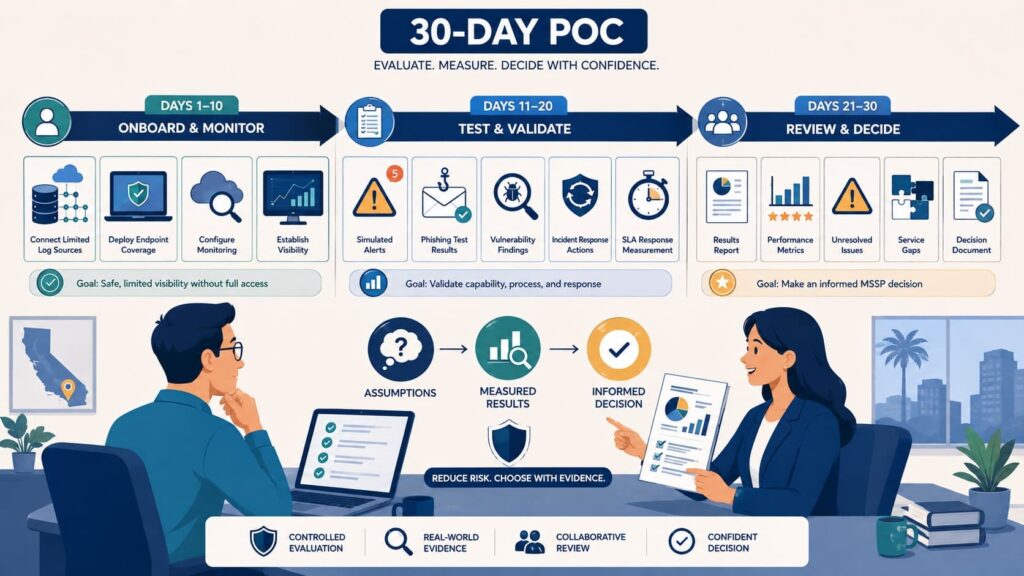
A 30-day MSSP POC should test deployment, visibility, detection, escalation, response authority, reporting, and integration before contract commitment. Treat Week 1 of your 30-day trial as a test of the provider’s operational discipline.
If an MSSP struggles to deploy endpoint agents, configure log ingestion, or establish clear rollback procedures in seven days, that friction will only multiply once you sign a multi-year contract. After setup, test the service with approved events.
Check whether the MSSP can:
- Connect agreed log sources
- Deploy endpoint agents
- Use required permissions
- Detect test activity
- Tune noisy alerts
- Escalate incidents
- Produce useful reports
Research from Chidukwani, A., Zander, S., & Koutsakis, P. shows:
“We conclude that self-reporting alone is insufficient for accurately assessing SME cybersecurity posture. To close the gap between perceived and actual security practices, independent validation and tailored frameworks are critical.” – ACM Digital Library
If the business uses Microsoft security products, test the actual setup rather than relying on a sales demonstration. Permissions and tenant access can affect what the provider can see and manage. Set success criteria before the POC begins.
Decide what needs to be detected, how quickly it should be escalated, what the report should contain, and who owns the next step. That’s a much better test than asking whether the demo looked impressive.
What should the final California MSSP assessment report contain?
The final report should map each material risk to the affected asset, control gap, business impact, recommended MSSP service, owner, priority, and target remediation date. It doesn’t need to bury leaders in technical language.
It needs to show what matters, what is missing, what the MSSP will do, and what the business will spend.
Include:
- Executive risk summary
- Critical asset and data inventory
- California and industry requirements
- Current control review
- Prioritized security gaps
- Target MSSP scope
- Required service levels
- Vendor scores
- POC results
- First 30-day priorities
- 90-day security plan
- Contract and exit terms
Keep the evidence behind the vendor scores too. Save sample reports, POC results, service commitments, integration notes, and unresolved technical issues.
Leaders should approve the security baseline, budget, response authority, accepted risk, and review schedule. Otherwise, the MSSP scope can grow over time without anyone noticing.
For businesses subject to California’s newer privacy rules, keep the compliance work visible. The MSSP can help collect evidence, monitor systems, and fix security issues, but the business remains responsible for meeting its legal duties.
What should California small businesses do after the MSSP assessment?
Don’t choose a provider because it has the biggest service catalog. Narrow the field to three to five providers. Use the same requirements and scorecard for each. Then run a POC with the strongest candidate.
Before signing, agree on:
- Service levels
- Response authority
- Reporting
- Pricing
- Included services
- Extra charges
- Exit terms
Review the MSSP at least annually using monitoring coverage, SLA performance, unresolved incidents, remediation progress, service changes, and total cost; review sooner after major technology or business changes.
Review sooner if the business makes major technology or operational changes. The CCPA rules make this kind of ongoing review more relevant for businesses that fall within their scope. Risk assessments and cybersecurity audits have specific requirements and deadlines, so the assessment shouldn’t disappear after the contract is signed. After the first audit, certifications are due annually by April 1.
Mandatory California Cybersecurity Risk Assessments: What Businesses Must Know
credits: Debbie Reynolds Consulting LLC
Under California’s updated privacy regulations (CCPA/CPRA), conducting a cybersecurity risk assessment has shifted from a recommended best practice to a strict legal compliance mandate.
Organizations handling sensitive personal data can no longer afford a purely reactive security posture; they are legally required to proactively audit, evaluate, and document their defenses.
Businesses must be prepared to submit these risk assessment records to regulatory bodies within 30 days upon request. As California sets the national standard, maintainable compliance is now vital for business continuity.
FAQ
What should a small business include in an MSSP onboarding checklist?
An MSSP onboarding checklist should document access permissions, critical assets, monitored log sources, endpoint coverage, escalation contacts, response authority, SLA targets, reporting requirements, and integration dependencies. It should also define MSSP SLA requirements, customer communication procedures, managed security visibility, and playbook documentation. Clear onboarding helps both parties establish responsibilities and begin managed security operations without unnecessary delays.
How can a small business compare MSSP pricing models?
Compare MSSP pricing by pricing unit, including users/devices, log volume, retention, monitoring coverage, response services, overage rates, renewal increases, and exit fees. It should also determine whether vulnerability management, security tuning, threat hunting, and incident response carry additional fees. During MSSP contract negotiation, review renewal terms, minimum commitments, onboarding fees, and charges for additional services.
What should an SMB ask about managed detection and response?
An SMB should ask what MDR monitors, how alerts are triaged, which events trigger escalation, what containment actions are authorized, target response times, and what evidence appears in reports. The business should also review managed security response times, MSSP escalation procedures, analyst expertise, and MSSP reporting requirements. These details clarify what the provider does after detecting suspicious activity, how quickly it acts, and when the business must approve a response.
How often should a small business review its security posture?
A small business should review its security posture at least annually and after major changes to systems, employees, locations, or cloud services. A cybersecurity maturity assessment can measure progress across access control, email security, network security, backup, and security awareness. Regular reviews also help maintain a realistic small business security baseline and identify priorities for the next security roadmap.
What California requirements can affect an SMB cybersecurity assessment?
An SMB should consider California data protection regulations, California data breach notification law, and California privacy law cybersecurity requirements when assessing its security program. Depending on the business, its size, and the information it handles, a cybersecurity compliance assessment California can identify applicable obligations and gaps involving consumer information, incident response, and data security requirements.
How can an MSSP assessment become a repeatable security program?
An MSSP assessment shouldn’t sit in a folder after it’s finished. Use it as a baseline and review it each quarter. Track monitoring coverage, vulnerabilities closed on time, phishing-test results, backup recoveries, open incidents, and SLA performance.
These measures give leaders a clearer view of security than raw alert counts. As the business changes, security needs may change too. MSSP Security can help assess those needs, reduce tool sprawl, and align services with actual risk.
A small office may need basic protection, while healthcare or financial businesses may need broader monitoring and response. Explore MSSP Security services
References
- https://csf.tools/reference/nist-cybersecurity-framework/v1-1/id/
- https://dl.acm.org/doi/abs/10.1016/j.cose.2026.104839