

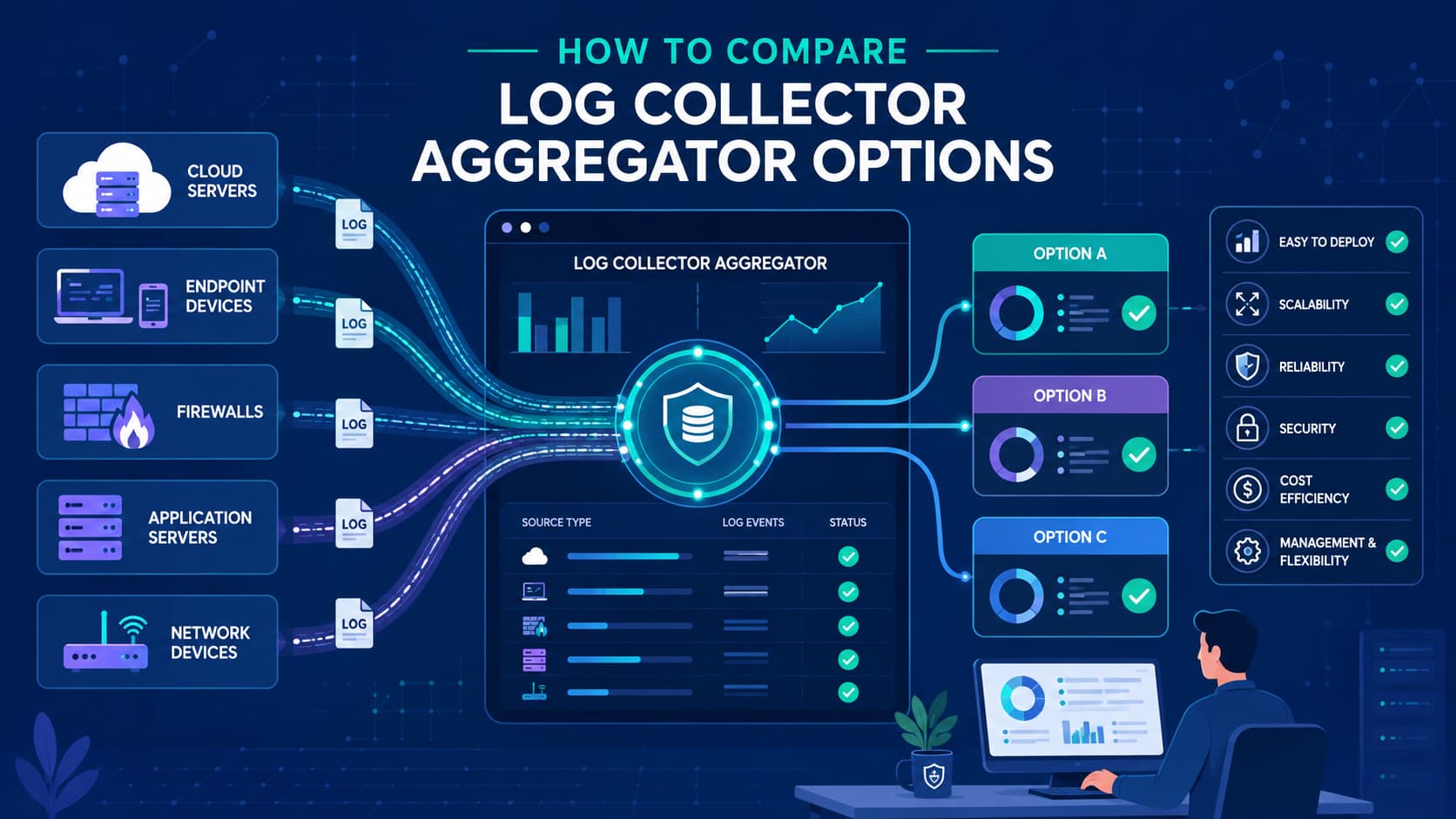
Reliable log collector aggregator options help organizations collect, normalize, and analyze logs across different environments without adding unnecessary complexity. The right setup improves visibility, supports security operations, and helps meet compliance requirements.
For Managed Security Service Providers (MSSPs) handling multiple customer environments, MSSP Security emphasizes architectures that support secure multi-tenant log collection, data isolation, and centralized management.
Choosing the right architecture early helps avoid costly redesigns later. Beyond the software itself, the overall logging design has a greater impact on scalability, performance, and long-term operational efficiency than many teams initially expect.
Log Collector Aggregator Decisions That Matter Most
- Prioritize a scalable architecture. Build a logging pipeline that can grow with your environment without adding unnecessary complexity or creating operational bottlenecks. Strengthen security from end to end.
- Use secure transport, resilient collection, and standardized parsing to protect log integrity while supporting reliable threat detection and compliance.
- Keep operations simple and sustainable. Combine centralized visibility with continuous monitoring to improve investigations, reduce management overhead, and maintain long-term logging performance.
Choosing Log Collector Agent for MSSP
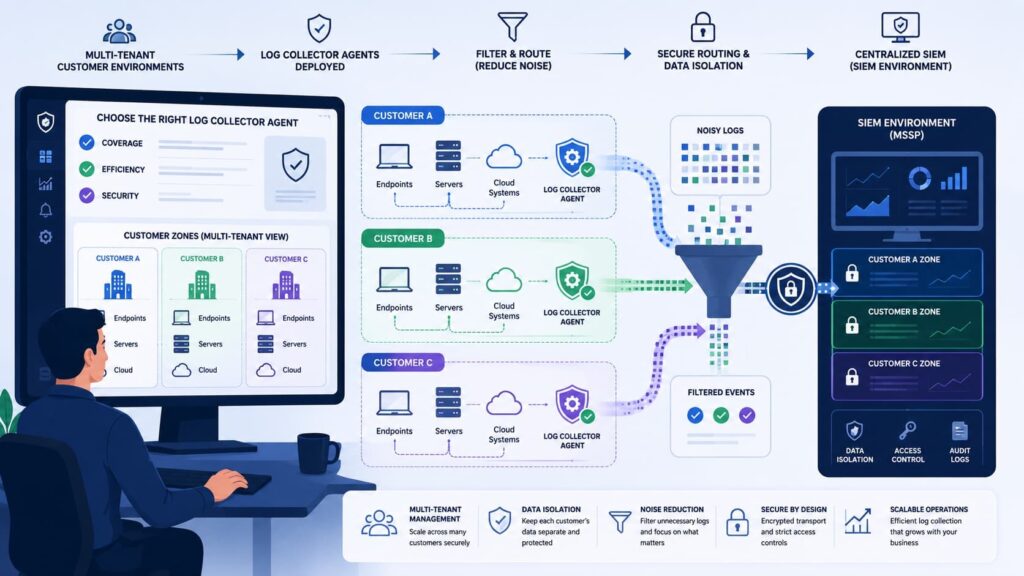
The best log collector agent for an MSSP is lightweight, resilient, secure by default, and built to maintain strict tenant isolation while handling large volumes of log data.
In our work helping MSSPs evaluate and audit security products, we’ve found that log collection itself is rarely the hardest part. The bigger challenge is keeping thousands of customer log streams organized without creating unnecessary operational overhead.
We’ve worked with providers where onboarding a new customer meant creating another custom agent configuration. It solved the immediate problem, but over time those one-off deployments became difficult to manage.
Before long, the environment was dealing with what many engineers call “agent sprawl” : hundreds or even thousands of slightly different configurations that slowed updates, troubleshooting, and maintenance.
The industry is moving toward lightweight collectors for good reason. When an agent runs across hundreds or thousands of endpoints, performance and resource usage become part of the security conversation, not an afterthought.
We’ve also seen how resilience matters during real-world incidents. A network interruption shouldn’t mean losing critical security data.
An effective log collection architecture continues buffering, queuing, and forwarding logs when connectivity returns instead of dropping events. Missing authentication logs during an outage can leave investigators without the evidence they need later.
Before selecting any agent, evaluate these capabilities:
- Multi-tenant tagging and isolation Secure
- TLS communication with mutual authentication
- Local disk or memory buffering
- Remote configuration management
- Health monitoring and telemetry
Flexible parser support for multiple log formats Once you establish a lightweight, multi-tenant agent architecture, the engineering focus shifts immediately to transit security.
Moving logs securely between distributed hybrid clouds requires more than basic encryption; it demands establishing a resilient transport layer using mutual TLS (mTLS) to enforce strict tenant isolation across the network boundary.
Secure Log Forwarding Aggregation Methods
Secure log forwarding relies on encrypted transport, mutual authentication, and validation mechanisms that protect log data from interception or tampering.
In our experience auditing security platforms for MSSPs, transport security is one of the most overlooked parts of a logging architecture. Many teams assume logs stay inside the network, but that’s rarely the case.
Log traffic often moves between cloud environments, branch offices, remote users, and third-party infrastructure, which means every connection deserves the same level of protection as other security-critical services.
One pattern we’ve seen across multiple deployments is that encryption is rarely the difficult part. Keeping certificates healthy over time is where most operational issues appear.
Certificate rotations can interrupt log ingestion when intermediate certificates, trust chains, or expiration schedules aren’t managed carefully.
The teams that avoid these problems usually automate certificate renewal and monitor certificate health before failures affect production. Industry standards reinforce that approach.
The Internet Engineering Task Force (IETF) introduced RFC 5425 for Syslog over TLS to support encrypted communication for centralized logging.
Organizations that continue using legacy UDP-based syslog accept unnecessary risks around both confidentiality and delivery reliability. As environments become more distributed, secure transport becomes less of a recommendation and more of a baseline requirement.
Secure log transportation typically includes:
| Security Feature | Purpose | Benefit |
| TLS 1.2 or TLS 1.3 | Encrypts traffic | Protects confidentiality |
| Mutual TLS (mTLS) | Verifies both endpoints | Prevents spoofed collectors |
| Certificate pinning | Confirms trusted certificates | Reduces impersonation risk |
| Message integrity validation | Detects tampering | Improves forensic confidence |
| Access controls | Restricts collector access | Minimizes attack surface |
Managing Log Source Onboarding Process
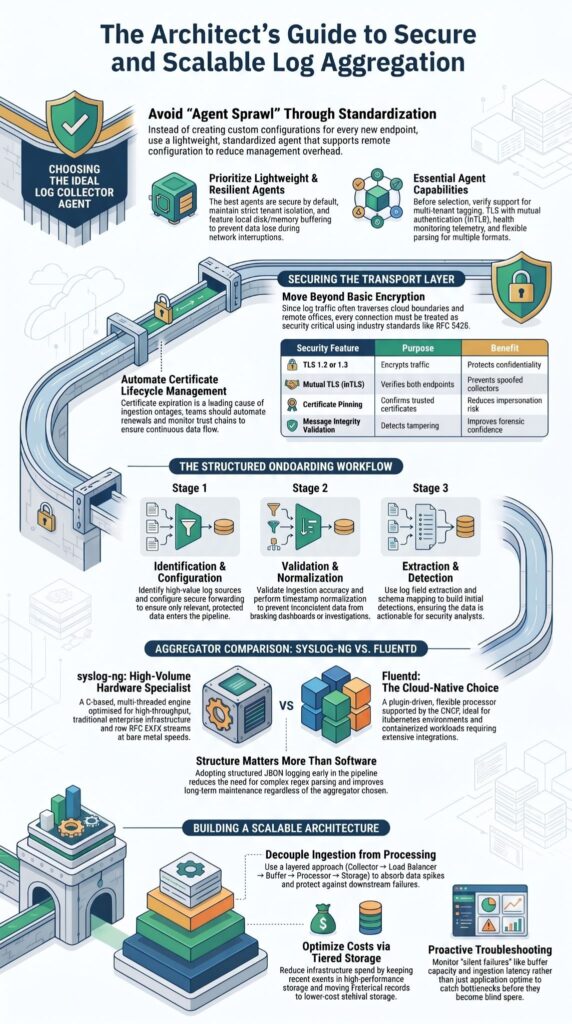
A structured log source onboarding process produces cleaner data, more accurate detections, and fewer parsing failures throughout the security platform.
Many deployment delays happen long before analysts investigate alerts. They happen when new log sources arrive without documentation, inconsistent timestamps, or unexpected formats.
Those small issues often cascade into broken dashboards and unreliable detections. Standardized fields simplify log correlation, log analytics, and cross-platform investigations.
A practical onboarding workflow usually includes four major stages.
- Identify high-value log sources first.
- Configure secure log forwarding.
- Validate log ingestion accuracy.
- Build initial detections and dashboards.
- After those steps, the work continues.
Every onboarded source should undergo log format detection, log schema mapping, log field extraction, and log timestamp normalization.
Teams should also verify timezone handling because timestamp inconsistencies remain one of the most common causes of confusing investigations. That said, parser development deserves extra attention.
We’ve repeatedly found that testing only “perfect” sample logs creates false confidence. Production environments introduce malformed entries, multiline events, escaped characters, and inconsistent fields that quickly expose weak parsing logic.
Once onboarding becomes repeatable, centralized logging starts delivering its biggest operational advantages.
Centralized Log Aggregation Benefits
Credits: Software Interviews Prep
Centralized log aggregation creates a single source of truth that improves visibility, accelerates investigations, and strengthens compliance. Organizations managing distributed infrastructure often struggle with fragmented information.
Firewall logs remain on one appliance, authentication events live elsewhere, and application logs sit inside cloud platforms. Analysts spend valuable time switching between interfaces instead of investigating threats.
Centralized log aggregation also improves operational efficiency.
- Faster log searching and log querying
- Better log reporting Stronger log compliance
- Simplified log governance
- Improved log monitoring
- More accurate log alerting
Beyond operational efficiency, centralized platforms improve storage management through tiered retention strategies.
Recent events remain in high-performance storage while historical records move into lower-cost archival storage, reducing infrastructure costs without sacrificing compliance requirements.
Of course, centralized logging introduces one practical consideration. Storage costs increase rapidly when organizations ingest every available event.
Effective log filtering, log sampling, and intelligent retention policies help balance visibility with long-term cost control.
syslog-ng vs Fluentd Comparison
Both syslog-ng and Fluentd remain strong log aggregator options, but a Fluentd comparison depends on workload characteristics, deployment model, and operational priorities. Over the years, we’ve tested both approaches in different environments.
When scaling pipeline throughput, the choice between these aggregators comes down to runtime architecture. Neither approach is universally better because architecture drives results more than software selection.
The Cloud Native Computing Foundation (CNCF) continues to support cloud-native observability projects, making Fluentd and its lightweight companion increasingly popular in Kubernetes deployments.
We deploy syslog-ng at the edge when handling dense, high-volume hardware infrastructure; its C-based, multi-threaded engine routes raw RFC 5424 streams at bare-metal speeds with a minimal memory footprint.
| Feature | syslog-ng | Fluentd |
| Performance | High throughput with multithreading | Plugin-driven, flexible processing |
| Routing | Advanced filtering and routing | Extensive plugin ecosystem |
| Parsing | Built-in parsers, regex support | Grok, regex, JSON, custom plugins |
| Cloud Integration | Traditional infrastructure focus | Strong Kubernetes integration |
| Best Fit | High-volume enterprise logging | Cloud-native environments |
Our experience suggests the decision should start with infrastructure rather than features. Traditional enterprise networks with large volumes of firewall, authentication, and infrastructure logs often value throughput and deterministic routing.
Containerized environments, on the other hand, typically benefit from cloud-native integrations and flexible deployment models. Another lesson we’ve learned is that parser maintenance matters more than feature checklists.
Teams frequently spend hours adjusting log regex parsing and log grok patterns when structured JSON logs could eliminate much of that effort. Whenever structured logging is available, adopting it early usually pays off throughout the entire log aggregation pipeline.
Choosing the collector is only one part of the equation. Cloud deployments introduce another layer of architectural considerations.
Cloud Native Log Collection Services
Cloud-native logging emphasizes scalability, automation, and resilience while supporting rapidly changing infrastructure. Modern applications rarely remain on a single virtual machine.
Containers, serverless workloads, Kubernetes clusters, and managed cloud services continuously create new log sources. A static collection strategy quickly becomes difficult to maintain.
As noted by Csáti, Pelle, & Toka:
“Collecting logs can greatly help in this regard, however, a high volume of logging data can add huge costs for the maintenance of the infrastructure gathering monitoring data. In order to increase the profitability of the application, monitoring-related infrastructure needs to have the lowest cost possible while still being able to fully serve the application’s monitoring needs.” – ACM Digital Library
Several cloud-native approaches have become common:
- Lightweight collectors deployed alongside workloads
- Managed cloud logging services
- Unified observability collectors
- Label-based indexing for scalable searches
- Horizontal scaling across ingestion nodes
After deployment, organizations should continue monitoring pipeline health instead of assuming collection remains reliable.
We have seen autoscaling environments unexpectedly generate thousands of new containers within minutes.
Without automatic log source onboarding, log indexing, and scalable log ingestion, analysts may lose visibility precisely when activity spikes. Beyond cloud scalability, preserving trust in every collected event remains essential.
Ensuring Log Data Integrity During Transport
Maintaining log integrity requires encryption, authentication, validation, and continuous monitoring throughout the transport process.
Encryption protects confidentiality, but integrity requires additional safeguards. Security teams must verify that logs remain complete, authentic, and untampered from source to destination.
The Internet Engineering Task Force (IETF) recommends secure transport mechanisms such as TLS-enabled syslog defined in RFC 5425, helping organizations protect both confidentiality and integrity.
Research from MDPI show:
“The authenticity and validity of the information stored in a logging system may be as important as being able to debug and fix observable failures and also to mitigate an ongoing attack.” – PubMed Central (PMC)
Several practices consistently improve transport reliability:
- Enable log encryption using TLS 1.2 or newer.
- Require log authentication through mutual TLS.
- Apply certificate lifecycle management.
- Verify checksums or message signatures when available.
- Monitor handshake failures proactively.
One operational lesson stands out from our deployments. Certificate rotation deserves planning equal to firewall maintenance.
Multiple organizations have experienced temporary logging outages after renewing certificates because intermediate certificate chains or trust stores were overlooked.
Automation significantly reduces that risk. Integrity extends beyond transport. Organizations also need an architecture capable of handling increasing event volumes without sacrificing performance.
Scalable Log Collection Architecture
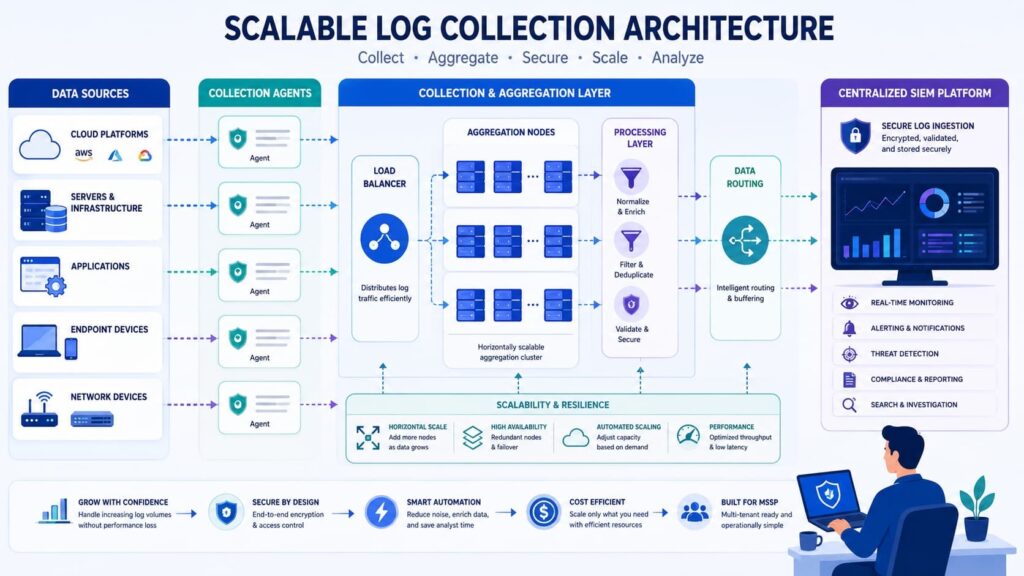
A scalable log collection architecture separates collection, processing, storage, and analysis into independently scalable layers.
As environments grow, monolithic collectors become bottlenecks that increase log latency, reduce log throughput, and complicate maintenance. Industry architectures frequently introduce buffering layers between collection and processing to improve durability.
Decoupling ingestion from downstream analytics helps absorb temporary spikes while protecting against data loss.
A resilient architecture generally includes:
- Lightweight log collector agent
- Load-balanced ingestion layer
- Log buffering and log queuing
- Processing and log normalization
- Tiered log storage Search, dashboards, and alerting
After these components are connected, monitoring becomes just as important as deployment. We’ve repeatedly found that organizations monitor application uptime but overlook ingestion health.
Tracking ingest durability and baseline volume deviations provides an early warning long before missing telemetry escalates into an un-investigatable blind spot. Performance improvements also depend on reducing unnecessary data before storage.
Filtering and Parsing Log Data Effectively
Effective log filtering and parsing reduce storage costs while improving detection accuracy. Raw logs contain valuable evidence, but they also contain enormous amounts of repetitive noise.
Filtering low-value events before indexing improves query performance without sacrificing meaningful visibility. The Open Cybersecurity Schema Framework (OCSF), an AWS-led industry initiative.
Several techniques consistently improve data quality:
- Log deduplication to remove duplicate events
- Log deduplication engine optimization for high-volume pipelines
- Log multiline parsing for stack traces
- Log pattern matching using structured parsers
- Log field extraction for consistent analytics
- Log enrichment with asset or tenant metadata
That said, parsing should remain practical. We have learned that overly complex regular expressions eventually become difficult to maintain.
Structured JSON logging, whenever available, reduces parser maintenance while improving log deduplication accuracy, log deduplication efficiency, and log deduplication reliability across large environments.
Even well-designed pipelines require ongoing operational monitoring.
Troubleshooting Log Collection Issues
Most log collection issues originate from connectivity, buffering, parsing, or synchronization failures rather than the collector itself. Teams often assume missing logs indicate software defects.
In practice, issues usually stem from expired certificates, overloaded buffers, malformed parsers, or inconsistent timestamps. Common troubleshooting priorities include:
Verify network connectivity and TLS certificates.
- Review log buffering utilization.
- Compare source event counts against log ingestion counts.
- Validate parser success rates.
- Confirm NTP synchronization.
- Monitor log deduplication monitoring and pipeline health.
One issue deserves special attention. During several customer engagements, we found that “silent failures” caused the longest investigations.
Collectors appeared healthy, but ingestion had slowed because local buffers quietly reached capacity. Simple health dashboards tracking buffer usage and ingestion latency revealed the problem within minutes instead of hours.
Regular health monitoring, proactive certificate management, and parser validation together improve log reliability, log performance, and long-term operational stability.
FAQ
How does a log collector agent improve centralized logging?
A log collector agent gathers events from multiple systems and sends them through secure log forwarding to support centralized logging. This process improves log ingestion by collecting data consistently from different environments. It also reduces manual effort, increases visibility across infrastructure, and helps security teams manage logs more efficiently for monitoring, investigations, and long-term analysis.
What should I check before building a log aggregation pipeline?
A reliable log aggregation pipeline requires a well-planned log collection architecture and an organized log source onboarding process. You should also validate log format detection, log schema mapping, log field extraction, and log parsing before deployment. These steps improve data consistency, reduce processing errors, and support more accurate searching, reporting, and analytics.
Why are log normalization and log filtering important?
Log normalization converts data from different sources into a consistent structure, while log filtering removes unnecessary records before processing and storage. Together, they improve data quality and support log enrichment, log indexing, and log searching. These practices help security teams analyze relevant events faster and reduce unnecessary resource consumption.
How can organizations protect log security during transportation?
Organizations should protect log security during log transportation by using log encryption, log authentication, and log authorization for every transmission. They should also verify log integrity to detect unauthorized changes before logs reach the destination. These security controls protect sensitive information, strengthen compliance efforts, and preserve trustworthy audit records.
How does log deduplication improve performance and storage?
A log deduplication engine removes duplicate records before log storage, which reduces storage requirements and improves log performance. Optimizing your deduplication strategy scales data pipelines efficiently without sacrificing forensic accuracy. In production, we focus on continuous stream monitoring to ensure the pipeline handles high-volume indexing spikes reliably. These improvements help organizations manage large log volumes more efficiently.
Choosing the Right Log Collector Aggregator for Long Term Success
Poor logging decisions can lead to missing data, slow investigations, and growing operational overhead. Choosing an enterprise log collector framework that scales with your infrastructure helps maintain visibility, resilience, and efficient security operations.
Prioritize secure data segregation, reliable buffering, and centralized configuration management when evaluating any logging platform. If you need expert guidance, explore MSSP Security.
With over 15 years of experience and 48,000+ completed projects, they provide vendor-neutral consulting, architecture reviews, PoC support, and practical recommendations to help MSSPs build scalable, reliable logging environments.
References
- https://dl.acm.org/doi/10.1109/NOMS54207.2022.9789850
- https://pmc.ncbi.nlm.nih.gov/articles/PMC11510748/
Related Articles
- https://msspsecurity.com/choosing-log-collector-agent-mssp/
- https://msspsecurity.com/secure-log-forwarding-aggregation-methods/
- https://msspsecurity.com/managing-log-source-onboarding-process/
- https://msspsecurity.com/centralized-log-aggregation-benefits/
- https://msspsecurity.com/syslog-ng-vs-fluentd-comparison/
- https://msspsecurity.com/cloud-native-log-collection-services/
- https://msspsecurity.com/ensuring-log-data-integrity-transport/
- https://msspsecurity.com/scalable-log-collection-architecture/
- https://msspsecurity.com/filtering-parsing-log-data-effectively/
- https://msspsecurity.com/troubleshooting-log-collection-issues/