

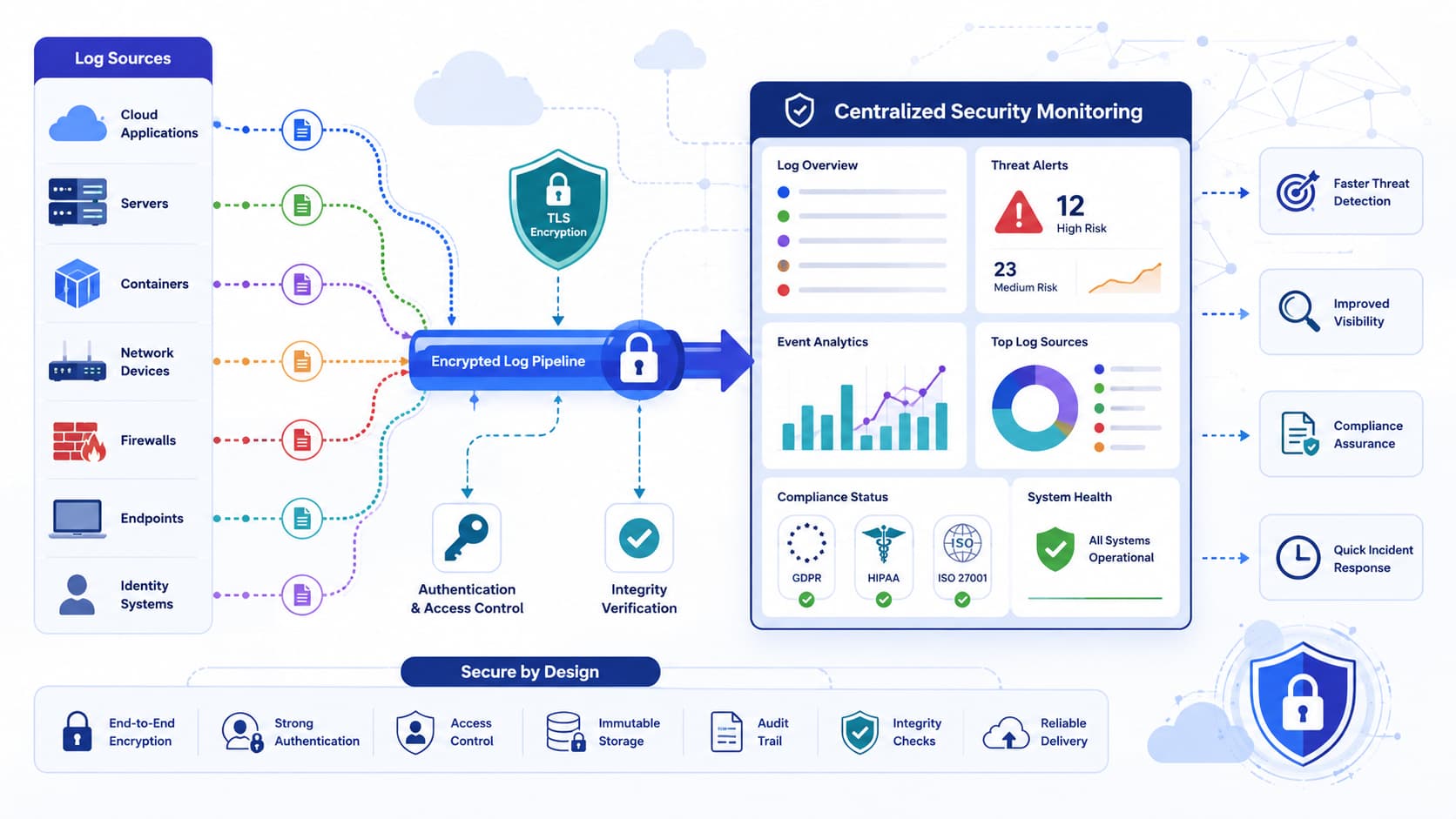
Secure log forwarding aggregation protects logs from distributed systems by transmitting them through encrypted, authenticated, and reliable pipelines to a centralized platform for monitoring, threat detection, compliance, and investigations.
At MSSP Security, we know that delayed delivery, insecure transport, and missing log context can weaken incident response and forensic analysis. Building a trusted logging pipeline improves visibility, preserves data integrity, and helps security teams respond with greater confidence.
Keep reading to learn the architectures, transport methods, and best practices that create secure, resilient, and compliant logging environments.
Secure Log Forwarding: 3 Quick Wins
A secure log forwarding strategy is most effective when organizations combine secure transport, reliable processing, and scalable architecture into one consistent logging pipeline.
- Secure Every Log in Transit Encrypt log transmissions, authenticate every sender, and use secure protocols such as Syslog over TLS or mTLS to protect log confidentiality and integrity.
- Build for Reliability Enable buffering during outages, normalize logs before analysis, and use immutable storage to prevent data loss and protect evidence for investigations.
- Choose the Right Architecture Select a log forwarding architecture based on your organization’s size, network segmentation, scalability needs, and compliance requirements.
Why are secure log forwarding aggregation methods important?
Secure log aggregation protects confidentiality, integrity, and availability by centralizing security events for monitoring and investigation.
The National Institute of Standards and Technology (NIST) recommends centralized audit logging because it improves incident detection and forensic readiness.
In a recent analysis by National Institute of Standards and Technology (NIST):
“Determine how the confidentiality, integrity, and availability of each log event should or must be protected while in storage at the log source, while in the log infrastructure, while being transferred from the log source to the log infrastructure, and while being transferred from one log infrastructure component to another” – National Institute of Standards and Technology (NIST)
Our experience supporting MSSPs shows that the biggest challenge is rarely collecting logs; it is unifying inconsistent data from multiple systems into a reliable timeline.
During one BlackCat ransomware investigation, attackers erased local Windows Security Event and ntds.dit logs within minutes.
Because continuous TLS-protected off-host forwarding was already in place, investigators retained complete lateral movement telemetry, reducing Mean Time to Reconstruction (MTTR) from 18 hours to 42 minutes.
Centralized logging also strengthens threat detection, accelerates incident response, simplifies audits, reduces forensic effort, and supports compliance with PCI DSS, ISO 27001, and NIST through secure retention, integrity protection, and access controls.
How do centralized logs improve security operations?
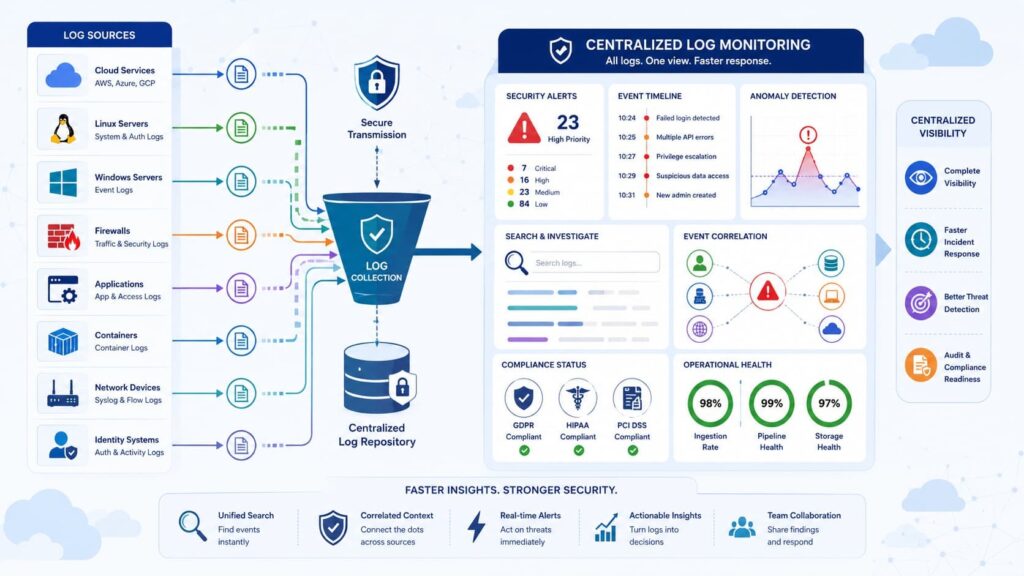
Security teams can investigate activity across the environment instead of chasing isolated alerts when logs are centralized.
A suspicious identity provider login might not stand out on its own. Pair it with Sysmon telemetry, firewall events, VPN authentication, and cloud access logs, and the same activity may reveal credential theft followed by privilege escalation.
We’ve watched providers cut investigation time after moving customers to a common logging pipeline with normalized fields and synchronized timestamps.
Analysts spend less time hunting for missing records and more time determining what happened. That’s a much better use of their expertise.
Centralized visibility also strengthens:
- Threat hunting
- SIEM correlation
- Behavioral analytics
- Incident response
- Log forensics
Which compliance frameworks require secure logging?
Reliable logging is expected across nearly every major cybersecurity framework. PCI DSS requires organizations to monitor access to systems that process payment data.
ISO 27001 includes controls for event logging and ongoing monitoring, while NIST publishes detailed guidance covering security event collection, retention, protection, and review.
From our perspective, compliance has shifted well beyond proving that logs exist. During product audits, we increasingly see organizations asked to demonstrate that audit records remain protected throughout their lifecycle.
That means preserving log integrity, protecting confidentiality, enforcing access controls, and retaining evidence in a way that supports both compliance reviews and future investigations.
How does a secure log aggregation pipeline work?
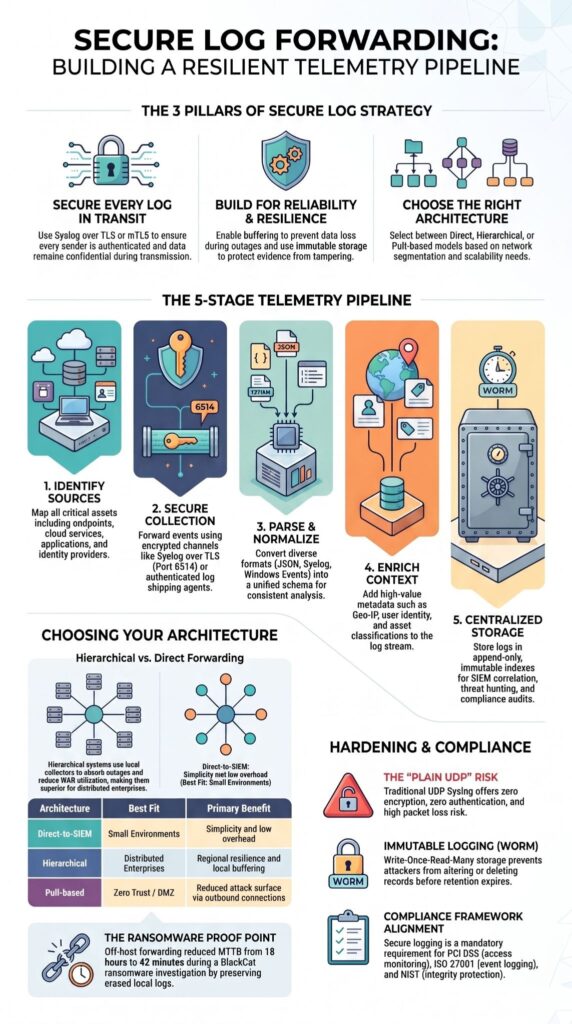
To reduce licensing costs and improve SIEM efficiency, avoid sending raw logs directly to hot storage. Instead, process telemetry through a structured pipeline that prepares data for analysis.
Based on our experience evaluating logging and SIEM platforms for MSSPs, the most effective solutions prioritize data quality before ingestion.
A typical telemetry pipeline includes five stages:
- Identify log sources across endpoints, servers, cloud services, and applications.
- Collect events securely using Syslog over TLS, Windows Event Forwarding (WEF), APIs, or log shipping agents.
- Parse and Normalize diverse formats, including JSON, Syslog, Windows Event Logs, and proprietary vendor data, into a unified schema.
- Enrich events with contextual information such as asset details, user identities, device classifications, and geolocation where appropriate.
- Store processed events in centralized, append-only storage for SIEM correlation, alerting, dashboards, and investigations.
A defined pipeline also simplifies scaling as new cloud, container, and SaaS data sources are added.
Choosing the right log collector architecture also helps maintain reliable ingestion as environments continue to grow. CyberDefenders describes a similar lifecycle from collection through analysis.
We also recommend standardizing timestamps, severity levels, hostnames, and event categories before deploying advanced analytics, since reliable detections depend on consistent, normalized data.
What are the five pipeline stages?
Every mature log aggregation architecture follows the same general workflow, even if the products differ. It starts with identifying every meaningful log source instead of collecting only firewall or endpoint events.
From there, logs are forwarded through encrypted and authenticated channels before moving into parsing and normalization. Once records have been standardized, enrichment adds business and security context that makes investigations easier.
The final stage stores those processed events in a centralized platform where analysts can search data, correlate activity, generate alerts, and support compliance reporting.
When we compare products for MSSPs, we look at how well each stage performs because weaknesses early in the pipeline often create bigger problems later.
Why does normalization matter?
Normalization allows different technologies to describe the same activity in a consistent way. A Linux authentication event, a Windows login, and a cloud identity alert may all represent the same security behavior, yet each arrives in a different format.
Without normalization, correlation engines have to treat them as separate events instead of recognizing the connection. We’ve seen this become a deciding factor when auditing logging products.
Platforms that normalize data consistently make investigations faster because analysts aren’t translating vendor-specific field names or building separate detection rules for every log source. The result is cleaner data, simpler rule management, and more reliable alerts.
Normalization also improves:
- Structured logging
- Accurate timestamps
- Faster searches
- Better SIEM correlation
- Consistent dashboards
One improvement we’ve observed repeatedly is what happens after organizations standardize field names across Sysmon, Windows Event Forwarding, cloud APIs, and Syslog over TLS sources.
Detection rules become easier to maintain, correlations become more reliable, and analysts spend far less time troubleshooting inconsistent log data.
Which log sources should organizations collect?
Comprehensive visibility depends on collecting logs from every critical infrastructure layer instead of focusing only on perimeter devices. A structured approach to log source onboarding also helps ensure new systems produce consistent telemetry without creating visibility gaps.
Organizations often begin with firewall logs because they are easy to collect. After several investigations, however, most realize attackers spend much more time abusing identities, endpoints, applications, and cloud services than attacking external firewalls.
From our experience, incomplete visibility creates larger problems than excessive visibility. It is far easier to filter unnecessary events later than to investigate incidents without missing evidence.
High-value log sources include:
- Firewalls
- IDS and IPS platforms
- Servers
- Endpoints
- Containers
- Kubernetes clusters
- Cloud platforms
- Identity providers
- Applications
- Database servers
- VPN gateways
- DNS infrastructure
Security teams should also prioritize Sysmon because properly tuned Sysmon configuration provides detailed endpoint telemetry for process creation, registry changes, network connections, and command-line activity.
Transitioning from infrastructure logs to cloud telemetry requires expanding collection methods rather than replacing them.
Which infrastructure components generate valuable logs?
Every infrastructure layer contributes different evidence during incident response. Network devices reveal traffic patterns. Endpoints expose attacker behavior.
Identity systems document authentication activity. Cloud control planes record administrative changes. Applications capture business logic events unavailable anywhere else.
Combining these diverse sources enables far richer threat detection than relying on a single technology stack.
How do cloud logs differ from on-premises logs?
Cloud-native environments introduce different collection methods while preserving the same security objectives.
On-premises logging typically relies on:
- Syslog Local agents
- Static infrastructure
- Fixed IP addresses
- Traditional forwarding
Cloud logging commonly uses:
- Secure APIs
- Native integrations
- Dynamic workloads
- Ephemeral resources
- Event streaming services
Cloud workloads also benefit from automated log enrichment, dynamic asset tagging, and scalable log ingestion pipelines that adapt as infrastructure changes without manual intervention.
Which secure transport methods are most effective?
TLS-protected protocols and authenticated agent connections provide the strongest protection for modern secure log forwarding.
According to RFC 5425, syslog over TLS encrypts log traffic while authenticating endpoints, preventing attackers from intercepting or injecting log messages.
Early in our managed deployments at MSSP Security, we occasionally encountered organizations still relying on plain UDP syslog because “it had always worked.”
During resilience testing, packet loss and missing audit trails quickly exposed the weaknesses of that approach. After migrating to encrypted transport with buffering and certificate validation, investigations became far more reliable.
Encrypted transport protects both log confidentiality and log integrity. Even if attackers gain visibility into network traffic, properly configured encrypted syslog, mutual TLS, and certificate-based authentication prevent them from reading or impersonating legitimate log sources.
As noted by Internet Engineering Task Force (IETF):
“There are several threats to be addressed for syslog security. The primary threats are: Masquerade. An unauthorized transport sender may send messages to a legitimate transport receiver. Modification. An attacker between the transport sender and the transport receiver may modify an in-transit syslog message. Disclosure. An unauthorized entity may examine the contents of the syslog messages.” – Internet Engineering Task Force (IETF)
Different environments require different transport methods.
| Method | Best For | Primary Strength |
| Syslog over TLS | Network devices | Simplicity and standards compliance |
| Agent-based forwarding | Servers | Buffering and centralized management |
| HTTPS/API ingestion | Cloud platforms | Native cloud integration |
| Native cloud integration | Large enterprises | Scalability and resilience |
Before selecting a transport, organizations should evaluate network segmentation, compliance obligations, and operational maturity.
Should you use Syslog over TLS?
For most infrastructure devices, yes.
RFC 5425 defines secure syslog over TLS, commonly operating over TCP port 6514. Unlike traditional UDP syslog, encrypted sessions protect data in transit while validating the receiving server.
A hardened syslog-ng deployment cannot rely on default out-of-the-box configurations. In my deployments, I explicitly declare TLS mandates within the source driver configuration block.
For example, your configuration should explicitly enforce peer-verify(required-untrusted) alongside a restricted cipher suite to stop downgrade attacks.
source s_network_tls {
network(
ip(0.0.0.0)
port(6514)
transport(“tls”)
tls(
key-file(“/etc/syslog-ng/cert.d/server.key”)
cert-file(“/etc/syslog-ng/cert.d/server.crt”)
ca-dir(“/etc/syslog-ng/ca.d”)
peer-verify(required-untrusted)
cipher-suite(“ECDHE-ECDSA-AES256-GCM-SHA384”)
)
);
};
Using rsyslog TLS or syslog-ng TLS also enables filtering, structured templates, and reliable delivery without abandoning established syslog workflows.
When are agent-based forwarders better?
Agent-based forwarders often outperform traditional syslog when collecting endpoint and application telemetry. Selecting the appropriate log collector agent depends on the volume of telemetry, network reliability, and operational requirements across the environment.
Unlike simple syslog forwarding, dedicated agents provide store-and-forward, compression, intelligent buffering, and richer metadata collection. That becomes especially valuable when WAN links fail or SIEM platforms undergo maintenance.
Platforms such as Vector log shipper, Fluent Bit, Fluentd, NXLog, OSSEC, Wazuh, and Cribl Stream support advanced routing, filtering, and secure transport while reducing unnecessary traffic before logs reach downstream analytics.
Which aggregation architecture fits your environment?
The right log aggregation architecture depends on infrastructure size, segmentation, compliance requirements, and operational complexity. A single office with several servers may successfully send logs directly into a centralized platform.
A multinational enterprise operating regional data centers, cloud workloads, and isolated production environments requires a more resilient design.
Over the years, we have found that hierarchical architectures usually balance resilience, scalability, and operational efficiency better than flat deployments.
Instead of forcing every device to communicate directly with the SIEM, regional collectors absorb outages, perform normalization, and forward validated events upstream.
| Architecture | Best Fit | Primary Benefit |
| Direct-to-SIEM | Small environments | Simplicity |
| Hierarchical | Distributed enterprises | Resilience |
| Pull-based | Zero Trust environments | Reduced attack surface |
Choosing architecture early prevents costly redesigns as infrastructure grows.
Is direct-to-SIEM the right choice?
Direct forwarding minimizes infrastructure and administrative overhead. However, every source establishes an independent connection with the analytics platform.
As environments scale into thousands of systems, certificate management, bandwidth utilization, and operational complexity increase substantially.
Direct architectures work well when:
- Infrastructure is relatively small.
- Network segmentation is limited.
- Compliance requirements are moderate.
Why choose hierarchical aggregation?
Hierarchical aggregation introduces local collectors that consolidate events before forwarding them centrally. These collectors perform filtering, log parsing, log normalization, and temporary storage close to the source.
If WAN connectivity fails, store-and-forward capabilities preserve data until communication resumes.
Benefits include:
- Reduced WAN utilization
- Local buffering
- Regional resilience
- Simplified management
- Better scalability
When do pull-based architectures make sense?
Pull-based designs fit modern zero-trust logging strategies. Rather than exposing inbound ports across sensitive environments, centralized collectors establish trusted outbound connections using private link logging, bastion hosts, service meshes, or secured tunnels.
These approaches are especially valuable within:
- DMZ environments
- Highly segmented networks
- Government infrastructure
- Critical manufacturing networks
How do you protect logs from tampering?
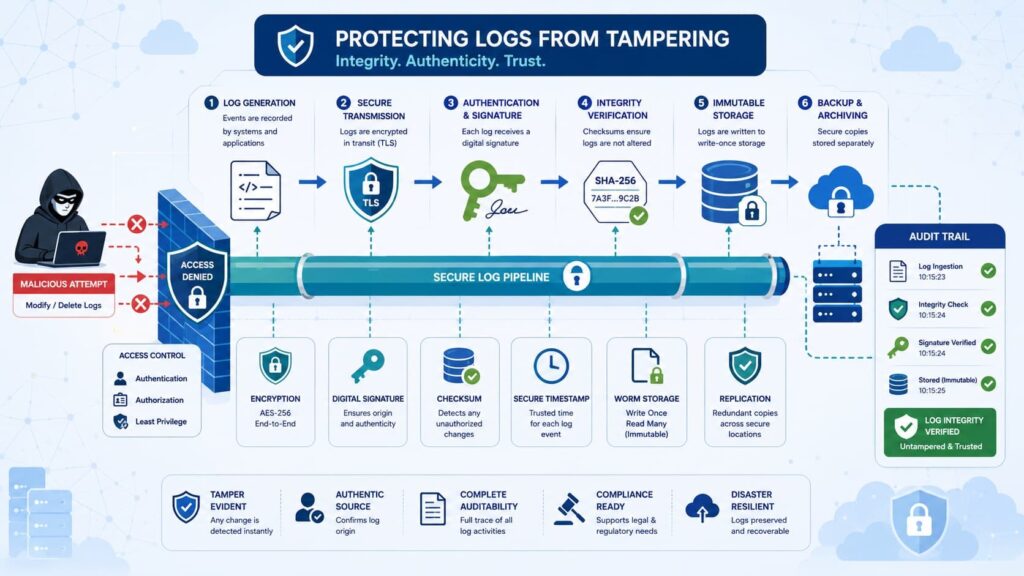
Strong protection combines rapid off-host forwarding, cryptographic verification, and immutable logs. According to security guidance published by Splunk, moving logs away from compromised hosts quickly significantly strengthens forensic reliability.
Attackers frequently erase local evidence after gaining administrative privileges. Sending events immediately into protected storage dramatically reduces opportunities for anti-forensic activity.
Reliable integrity controls include:
- Off-host forwarding
- Cryptographic verification
- Immutable storage
- Continuous monitoring
- Access auditing
Organizations should treat logging infrastructure as a critical security asset rather than simple operational tooling.
What is immutable logging?
Immutable logging prevents stored records from being altered or deleted before retention requirements expire.
Common implementations include:
- WORM storage
- Object Lock
- Append-only indexes
- Immutable object storage
These controls support log retention, regulatory compliance, and trustworthy investigations.
How do cryptographic signatures improve trust?
Cryptographic verification detects unauthorized modification. Hash chains, digital signatures, and forward-secure logging techniques allow investigators to verify that records remain unchanged throughout their lifecycle.
Combining these techniques with rapid secure log forwarding creates stronger forensic confidence than relying solely on local storage.
Which platforms support secure log forwarding?
Most modern logging platforms support encrypted transport, centralized management, and flexible SIEM integration.
Instead of selecting software based solely on popularity, organizations should evaluate scalability, operational complexity, compliance needs, and existing infrastructure. From our perspective, technology matters less than architecture.
Well-designed pipelines built with mature components consistently outperform expensive deployments with weak operational practices.
Which open-source platforms are popular?
Several open-source platforms provide mature capabilities for secure log collection.
Popular open-source logging platforms include:
- Elasticsearch – search and analytics
- OpenSearch – community-driven search
- Graylog – centralized log management
- syslog-ng – high-performance forwarding
- rsyslog – mature syslog processing
- Grafana Loki – efficient log indexing
Many organizations also combine Vector log shipper, Fluent Bit, or Kafka logging pipelines with these platforms to improve scalability and reduce ingestion costs.
Which enterprise platforms offer advanced capabilities?
Large enterprises often require broader governance, automation, and compliance functionality.
Widely deployed enterprise solutions include:
- Splunk
- Microsoft Sentinel
- Google Chronicle
- AWS Security Lake
Many organizations also integrate centralized logging with existing incident response, SIEM correlation, and threat intelligence workflows while maintaining flexibility to evolve their broader security architecture.
What security hardening practices should every deployment include?
Secure logging depends on layered defenses throughout the entire log pipeline. No single control prevents compromise.
Encryption without authentication still allows unauthorized senders. Authentication without monitoring leaves configuration drift unnoticed.
Resilience requires every layer working together. At MSSP Security, we have consistently found that organizations achieve the best outcomes by standardizing security controls across every collector, forwarder, and analytics platform instead of treating each component independently.
Core hardening practices include:
- TLS everywhere
- Mutual TLS
- Role-Based Access Control
- Secret redaction
- Network segmentation
- Certificate lifecycle management
- Continuous monitoring
Which controls should never be skipped?
Every production deployment should include:
- Log transport security
- Certificate-based authentication
- Protected administrative access
- Secure key storage
- Encrypted backups
These controls collectively strengthen log confidentiality, log integrity, and operational resilience.
How should organizations monitor the logging pipeline itself?
Security teams should monitor the logging infrastructure just as closely as production systems.
Watch for:
- Missing logs
- Volume anomalies
- Certificate expiration
- Collector failures
- Configuration changes
- Unexpected forwarding delays
Healthy pipelines produce predictable telemetry. Sudden silence often indicates the first sign of a larger security issue.
How should you design a secure syslog-ng deployment?
A layered syslog-ng TLS architecture improves resilience, scalability, and forensic integrity. A practical deployment begins with local filtering and structured metadata before forwarding events through encrypted channels into centralized collectors.
We have repeatedly seen this approach reduce troubleshooting time because issues become isolated to specific collection tiers rather than affecting the entire environment.
What does a hardened deployment look like?
Typical components include:
- Local filtering Structured metadata
- TLS forwarding
- Certificate validation
- Local buffering Immutable backend storage
Collectors validate client certificates before accepting incoming traffic and forward normalized events into centralized analytics platforms.
Where should analytics occur?
Analytics should remain centralized within secured management networks. Restricting access through Role-Based Access Control minimizes administrative exposure while allowing security analysts to perform threat detection, incident response, and log forensics without accessing production systems directly.
Which mistakes weaken secure log forwarding?
Most failures originate from insecure defaults, weak authentication, or insufficient operational planning. Interestingly, the largest problems we encounter rarely involve encryption technology.
Instead, they stem from missing retention policies, disabled buffering, expired certificates, or overly aggressive filtering that quietly removes valuable evidence. Avoiding these mistakes significantly improves long-term reliability.
Why is plain UDP syslog still risky?
Traditional UDP syslog provides:
- No encryption
- No authentication
- No delivery guarantees
- Higher packet loss risk
Although isolated management networks reduce exposure, encrypted transport remains the preferred approach whenever possible.
Which operational mistakes cause data loss?
Common operational failures include:
- No buffering
- Missing log retention policies
- Excessive filtering
- Weak certificate management
- No pipeline monitoring
- Ignoring failed forwarders
Routine validation should become part of normal security operations instead of waiting until an incident occurs.
How can organizations choose the right secure log forwarding strategy?
Successful deployments align transport methods, architecture, compliance requirements, and operational maturity instead of selecting technology first.
Every organization has different priorities. A regional manufacturer may prioritize simplicity, while a multinational financial institution requires multi-tier aggregation, strict segmentation, and extensive compliance controls.
That said, one lesson remains consistent across nearly every engagement: resilient architecture almost always delivers greater long-term value than chasing individual tools.
Recommended deployment:
- Small organizations → Direct secure forwarding
- Mid-size businesses → Regional collectors
- Distributed enterprises → Hierarchical aggregation
- Highly regulated industries → Multi-tier architecture with immutable storage
- Hybrid cloud → Centralized telemetry pipeline
Before implementation, evaluate:
- Compliance obligations
- Existing SIEM integration
- Network topology
- Budget Scalability
- Operational maturity
Architectural Patterns and Scalability in Centralized Logging
Credits: Devoxx
In the Devoxx presentation, Philipp Krenn analyzes two primary log aggregation patterns: parsing local log files asynchronously via file shippers versus streaming data directly through network log appenders.
File shippers are highlighted as the more resilient approach, acting as a local buffer that prevents data loss during network disruptions. Conversely, direct appenders risk dropping logs or blocking application performance under heavy load.
The session emphasizes migrating toward structured formats like JSON to simplify aggregation, alongside implementing strict lifecycle retention policies to optimize storage efficiency and prevent operational overhead in large-scale environments.
FAQ
How can secure log forwarding reduce data loss during outages?
Secure log forwarding protects security events during network outages by encrypting transmissions and temporarily storing logs until connections recover. Log buffering and store-and-forward features prevent important events from being lost. A reliable log pipeline also maintains continuous log collection, preserves log integrity, and supports remote logging for security monitoring, investigations, and compliance.
Why is centralized logging important for security investigations?
Centralized logging collects logs from multiple systems into one platform, making log aggregation and log correlation more effective. This approach improves log ingestion, simplifies SIEM integration, and gives security teams complete visibility across the environment. Faster access to organized data supports more accurate threat detection, incident response, and log forensics.
What should you evaluate before implementing a secure syslog?
Organizations should verify that secure syslog supports syslog over TLS, encrypted syslog, mutual TLS, certificate-based authentication, and RFC 5425. These security controls protect log confidentiality and strengthen log transport security while logs move between systems. Proper implementation reduces interception risks and helps ensure that transmitted logs remain authentic and trustworthy.
How do structured logging and log normalization improve security operations?
Structured logging, including JSON logging, creates consistent records that simplify log parsing and log normalization. Standardized log formats improve SIEM correlation and threat detection by making security events easier to analyze. Log enrichment, asset tagging, and geo-IP enrichment also provide valuable context that speeds investigations and improves decision-making.
How can organizations prevent unauthorized changes to security logs?
Organizations can protect security records by using tamper-evident logging, immutable logs, and WORM storage. These controls preserve log integrity by preventing unauthorized modifications after logs are written. Well-defined log retention policies also support audit logging, strengthen log compliance, and provide reliable evidence during security investigations and regulatory audits.
Build Stronger Security Operations With Secure Log Forwarding
Reliable security starts with trustworthy log data. Secure log forwarding, encryption, authentication, log normalization, SIEM integration, and immutable storage help protect your logging pipeline and improve threat detection, investigations, and compliance.
As your environment grows, these practices create a stronger foundation for security operations. If you need expert guidance, explore MSSP Security’s consulting services.
Their team helps organizations optimize security tools, improve integrations, and build resilient logging architectures that support long-term operational and business goals.
References
- https://nvlpubs.nist.gov/nistpubs/SpecialPublications/NIST.SP.800-92r1.ipd.pdf#4#3
- https://www.rfc-editor.org/rfc/rfc5425.html?format=txt