

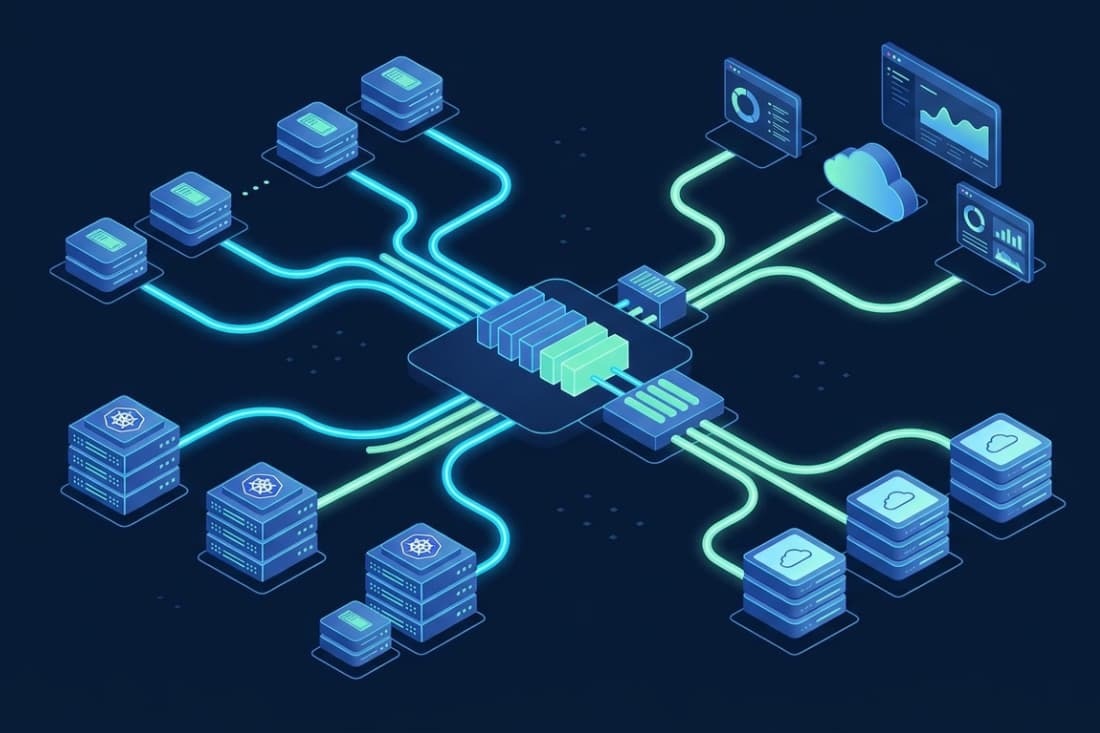
A scalable log collection system should separate collection, buffering, processing, storage, and querying. This can help teams scale bottlenecked stages independently, although shared resources and downstream limits still need testing. Kubernetes commonly uses node-level logging to send container logs to a central backend.
For MSSP Security, scaling issues often appear when one overloaded part affects everything else. Durable buffers, retries, failover, and horizontal scaling can help keep logs moving during traffic spikes. Keep reading to learn how to build the pipeline.
Scalable Log Collection: The Essentials for Reliable Growth
These key points summarize how to build a log collection pipeline that stays reliable, flexible, and cost-effective as log volume grows.
- Separate the pipeline: Let each stage scale as needed.
- Handle traffic spikes: Use buffers, queues, and backpressure.
- Build for reliability: Add retries and failover to reduce lost logs.
- Control storage costs: Use retention rules and storage tiers.
- Standardize your logs: Keep formats and metadata consistent for easier searches.
What Does A Scalable Log Collection Architecture Need?
A scalable log collection system needs enough speed, room to grow, safe buffering, and clear monitoring. A practical review should test whether a weak stage can affect the rest of the pipeline.
- High throughput: Handle steady growth and sudden traffic spikes.
- Elastic capacity: Scale collectors, processors, queues, and storage as needed.
- Durability: Buffer logs when a downstream system fails.
- Backpressure: Slow incoming data before an overloaded service causes wider failures.
- Isolation: Keep tenants, services, regions, and workloads separate.
- Operational visibility: Track lag, throughput, errors, and dropped events.
The key is to assess the full enterprise log pipeline, not only the server size. A collector may handle heavy log traffic, but storage can still become a bottleneck. When we help MSSPs review products, we look at how each part handles pressure and where failures could spread.
Log volume can increase sharply during incidents, debugging and deployment failures, so test the pipeline against measured peak scenarios
How Should The Log Collection Pipeline Be Structured?

Use a layered pipeline that keeps collection, buffering, processing, storage, querying, and alerting separate. Each stage can then scale without holding up the others.
Sources – Collectors – Buffer/Queue – Processing – Storage – Query – Alerting
This setup creates an event-driven logging flow. Applications send events without needing to know where those events will end up. Collectors capture the data, then other services process it as needed.
Insights from LinkedIn Engineering indicate
“Throughput over delivery guarantees: Kafka prioritized high throughput and durability over complex delivery semantics. That trade-off made it a perfect backbone for both real-time stream processing and offline analytics pipelines.” – LinkedIn Engineering
The log ingestion layer handles capture and transport. The log processing layer takes care of parsing, enrichment, filtering, and routing. Storage handles durability and retention, while the query layer supports investigations and analysis.
Kubernetes is a good example. Its documentation separates cluster-level logging from individual nodes. It also notes that logs should have their own storage and lifecycle, separate from pods, containers, and nodes.
In our MSSP product reviews, we often look for asynchronous logging when a system needs better resilience. A collector can put events into a durable queue while workers process them as they can. This keeps real-time log collection separate from indexing and gives the system more room during traffic spikes.
How Should Collectors Scale Across Hosts And Kubernetes?
Lightweight collectors should run close to the log sources. They should also use local log buffering and standard settings. This makes it easier to add more hosts and workloads over time.
For traditional servers, a host-level collector can read files and system logs, then send the data onward. In Kubernetes, a node-level agent can collect logs from several workloads without changing the applications.
| Pattern | Best fit | Main trade-off |
| Node-level agent | Kubernetes clusters | Shared node resources |
| Host agent | VMs and servers | Host-by-host management |
| Sidecar | Specialized workloads | Higher resource overhead |
| Direct application shipping | Controlled environments | Tighter application coupling |
When we review products for MSSPs, log collector placement is one area we check closely. A setup that looks fine in a small test can behave differently across hundreds of hosts or nodes.
Kubernetes recommends a node-level logging agent for a common cluster-wide setup. These agents are often deployed as a DaemonSet, which puts one collection process on each node.
Why Are Buffering And Backpressure Essential At Scale?
Buffers separate log producers from consumers. Log pipeline backpressure helps prevent one busy stage from causing data loss across the system.
Log volume can rise fast during an outage, security event, deployment, or debugging session. We’ve seen this issue during MSSP product reviews, especially when systems are tested with normal traffic but not sudden spikes.
What should happen during a traffic spike?
- Collectors keep accepting logs.
- A durable queue holds extra volume.
- Consumers process logs as capacity allows.
- Backpressure slows overloaded stages.
- Low-priority logs can be sampled.
- Critical logs get stronger delivery rules.
A distributed message broker can sit between collection and processing. Kafka-based systems, for example, can spread work across partitions and consumer groups. The choice of Syslog-ng and Fluentd can also affect how teams handle collection, processing, and routing as log volume grows.
At MSSP Security, we also check local log buffering. If the network fails or a central collector goes offline, agents should hold events instead of dropping them.
Buffer size should match peak traffic and expected outage time. We also recommend priority-based routing. Security and audit logs may need stronger delivery than debug data.
The goal is overload protection, not unlimited ingestion. Good systems control failures when traffic rises.
How Should Processing And Enrichment Scale?

The processing layer should stay as stateless as possible. This makes it easier to add workers as log stream processing demand grows.
This is where raw logs become useful data. Workers can parse logs, standardize fields, add metadata, remove sensitive data, filter noise, and route events.
What belongs in the processing layer?
- Parsing
- Schema normalization
- Metadata enrichment
- Redaction
- Filtering
- Sampling
- Routing
- Priority classification
In our MSSP product reviews, we look for systems that can scale without changing every source agent. More traffic should mean adding workers, not rebuilding collectors.
A typical processing layer takes events from a queue, applies changes, then sends them to hot storage, archives, security tools, or separate tenant systems. This also makes log source onboarding easier as new apps, hosts, and workloads are added.
What should every log contain?
- Timestamp
- Service
- Environment
- Host or workload
- Severity
- Correlation or trace ID
Consistent fields make structured logs easier to search and help teams trace requests across services.
But processing uses resources. Parsing every field at once can add CPU load and delay. We often keep real-time processing focused, then move heavier tasks downstream.
How Should Storage Scale As Log Volume Grows?

Storage should use hot, warm, and cold tiers so recent logs stay fast to search while older data moves to lower-cost storage.
As log volume grows, storage becomes a major cost and performance concern. SUSE warns that uncontrolled log growth can increase storage needs and make recovery harder. In our MSSP product reviews, we treat retention and data movement as part of the design from the start.
Research from Gnosis Research Center shows
“Efficiently scale log capacity. Time- or space-based data retention policies. Add servers offline and rebalance cluster.” – Gnosis Research Center
| Tier | Typical purpose | Design priority |
| Hot | Recent investigations | Fast queries |
| Warm | Historical analysis | Balanced cost |
| Cold | Compliance and archives | Low-cost durability |
Not every log needs the same level of access. Recent security events may need fast searches, while records from months ago may only need reliable archive access.
A hot tier can support active investigations and real-time log collection. Warm storage can keep useful search options while using fewer resources. Cold storage can use compressed objects for long-term retention.
This setup also helps protect the log query layer. If every old record stays fully indexed, large searches can compete with new log ingestion for CPU, memory, and storage.
FAQ
What should a scalable log collection architecture do during sudden traffic spikes?
A scalable log collection architecture should absorb sudden traffic increases without dropping events or slowing applications. Use local log buffering, log message queues, and load balancing log collectors to distribute traffic.
Log pipeline backpressure and overload protection can prevent downstream systems from becoming overwhelmed. Autoscaling log collectors can add capacity when sustained log volume exceeds normal ingestion levels.
When should you use horizontal scaling for log collection?
Use horizontal log scaling when adding more collectors can increase capacity without redesigning the entire pipeline. Distributed log collectors can share incoming workloads through load balancing, while collector clustering improves resilience.
For larger environments, regional log collectors can reduce network distance and distribute workloads. Monitor ingestion rates, queue depth, processing delays, and collector health to determine when scaling is necessary.
How can you prevent log loss when collectors or processing systems fail?
Use durable log buffering and persistent log queues so events remain available when a collector or processing service fails. Collector failover can redirect traffic to healthy instances, while reliable log delivery helps protect records during temporary outages.
Log replay capability allows systems to resend buffered events after recovery. These controls are especially useful when applications continuously generate logs.
How should a logging system handle duplicate events?
Design for at-least-once delivery when reliable event delivery matters more than avoiding every duplicate. Add duplicate log detection and log deduplication during processing, using stable event identifiers when possible.
Log offset tracking can help determine which records have already been processed. Do not assume exactly-once log processing is always practical because distributed failures can make strict guarantees difficult to maintain.
How can log storage and indexing scale as volume grows?
Separate the log storage layer from the log processing layer so each can scale independently. Central log storage can use tiered log storage to keep frequently accessed data available while moving older records to an object storage log archive.
Scalable log indexing and distributed log search should also scale independently as retention periods, query demand, and overall log volume increase.
Build A Scalable Log Collection Strategy
A scalable log collection setup should be built to grow with your environment. Separate collection, buffering, processing, storage, and search so each part can handle more data as needed. Monitoring key areas like traffic, delays, dropped logs, and storage can also help teams find problems early.
MSSP Security can help MSSPs review their current tools, reduce unnecessary complexity, and build a setup that fits their needs. The goal is simple, reliable log delivery without adding avoidable costs or workload. Talk with MSSP Security about your log collection strategy.
References
- https://www.linkedin.com/posts/maheshwari-aditya_kafka-paper-activity-7380348093608726529-x7N0
- https://grc.iit.edu/research/projects/chronolog/