


Choosing a firewall vendor takes more than comparing features or price. The right choice should fit your security needs, support future growth, and work with the way your team operates. At MSSP Security, we’ve seen organizations avoid expensive changes later by taking time to evaluate vendors before making a decision.
That means looking beyond performance to areas like compliance, ongoing support, management tools, and long-term reliability. A careful review today can save time, money, and effort down the road. Keep reading to learn what to look for before choosing a firewall vendor in California.
California Firewall Vendor Selection Snapshot
Choosing the right firewall vendor starts with compliance, continues with operational planning, and ends with long-term support that fits your organization’s needs.
- Start with compliance before comparing security features.
- Evaluate lifecycle support alongside technical capabilities.
- Use a structured checklist instead of selecting by price alone.
What Firewall Vendor Selection Criteria Matter Most In California?
Don’t start with the product. Start with the business.
It’s easy to compare firewall datasheets. Every vendor promises strong security, better visibility, and faster performance. That doesn’t tell you whether the product is a good fit six months after deployment.
When we help MSSPs review new security products, we spend more time asking questions than looking at feature lists. Who will manage the firewall? Does it have to support multiple customers? Are there compliance requirements? How often will policies change? Those answers usually narrow the list much faster than another product demo.
California organizations also have more to think about than raw security performance. Privacy laws such as CCPA and CPRA mean buyers should understand how a firewall supports logging, access controls, reporting, and audits. A product doesn’t have to do everything on its own, but it shouldn’t make compliance harder.
The same goes for regulated industries. Healthcare, finance, government, and critical infrastructure often need stronger controls than a typical business. Their buying process usually takes longer because more people are involved, from security teams to compliance officers.
We’ve also learned that buying for today’s network is rarely enough. Businesses grow. Offices move. Cloud workloads expand.
Reviewing different firewall technology options helps organizations choose solutions that can support current security needs while remaining flexible as infrastructure changes. A firewall that fits now should still make sense a few years from now.
Which Security Capabilities Should Every NGFW Vendor Provide?
Every firewall blocks traffic. That’s the starting point.
A modern NGFW should also help security teams understand what’s happening on the network and respond before small issues become larger ones. The basics haven’t changed much, but how well they’re implemented varies from vendor to vendor.
Look for capabilities such as:
- Application visibility
- Intrusion prevention
- URL filtering
- Malware protection
- VPN support
- Logging and reporting
Beyond that, pay attention to how those features work together. A next-generation firewall feature comparison can help buyers understand how different security capabilities work together in real environments.
We’ve audited products that checked every box on paper, yet simple tasks took too many clicks or required separate tools. Eventually, administrators stopped using some of the security features because they slowed down everyday work.
How Should You Evaluate Performance And Scalability?
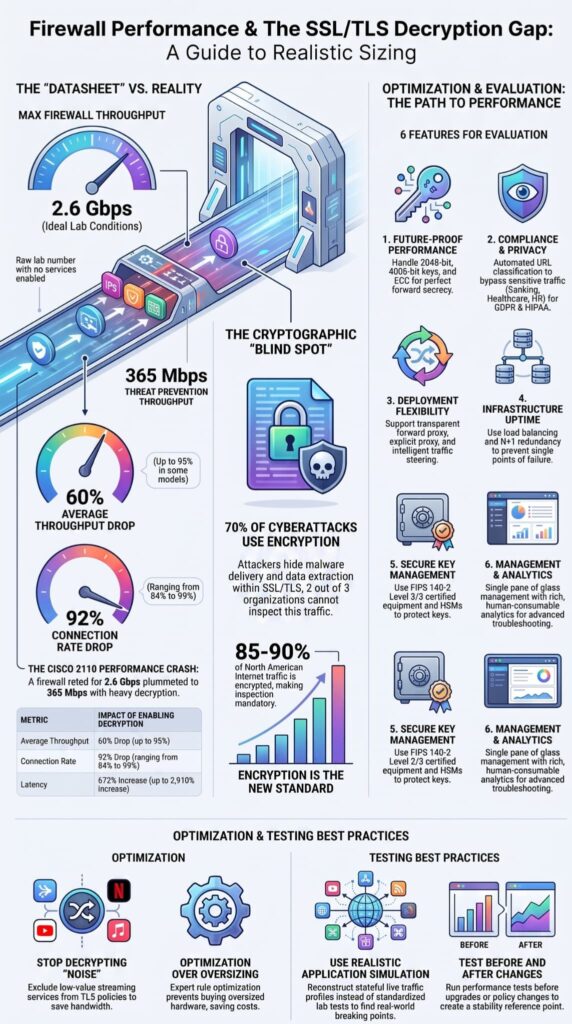
Don’t trust the biggest throughput number on the brochure.
Ask how the firewall performs with the security features enabled. Traffic inspection, IPS, malware scanning, and TLS inspection all use resources. That’s the performance users will notice after deployment.
We’ve seen buyers focus on hardware speed only to discover later that enabling security services reduced throughput much more than expected. Nobody bought the wrong firewall. They were looking at the wrong numbers.
Growth deserves the same attention.
A business with one office today may have five locations in a few years. Remote workers may double. Cloud traffic may replace traffic that once stayed inside the office. Those changes affect firewall sizing more than many buyers expect.
“Establish a security baseline of normal network activity; tune network and host-based appliances to detect anomalous behavior. Conduct regular assessments to ensure appropriate procedures are created and can be followed by security staff and end users.” – Cybersecurity and Infrastructure Security Agency (CISA)
A few questions can save trouble later.
| Review Area | Why Check It |
| Throughput with security on | Shows real performance |
| VPN capacity | Supports remote growth |
| High availability | Limits downtime |
| Multi-site support | Handles expansion |
| Hardware upgrades | Extends firewall life |
Why Do Management And Automation Matter?
Good security tools are important. Good operations matter even more.
We’ve reviewed firewall platforms that looked great during a proof of concept but became frustrating once customers were added. Simple jobs took longer than expected. Engineers had to log into multiple systems, repeat the same changes, and keep separate records. None of those tasks improved security. They only added work.
That’s why we pay close attention to how a product is managed, not only what it can do.
A strong platform should make everyday work easier. Some organizations also evaluate unified threat management devices when looking for broader security capabilities in a single platform.
Look for centralized management, clear rule management, SIEM integration, and REST API support. Those features help administrators manage more firewalls without creating extra manual work.
Automation also has its place. We’ve seen it reduce deployment time, keep policies consistent, and cut down on small configuration mistakes. But automation works best after the process is already well defined.
For example, if every customer follows a different naming standard or approval process, automation won’t solve the problem. It will only repeat the same inconsistency faster.
How Can You Evaluate Vendor Reliability?
A firewall is a long-term investment. The vendor behind it matters too.
It’s easy to focus on product features because they’re easy to compare. Vendor support is harder to measure, but it often has a bigger impact after the firewall goes live.
We encourage MSSPs to ask practical questions. How quickly does the vendor respond to critical issues? Is local support available? Can they provide experienced engineers during deployment? Those answers tell you much more than another marketing presentation.
Customer references also deserve a closer look. Instead of asking whether someone likes the product, ask what happened during upgrades, major outages, or support cases. That’s usually where the strengths and weaknesses become clear.
We’ve audited products that looked similar on paper, yet one vendor consistently delivered faster support and better documentation. Those differences may not appear during procurement, but they become obvious over the next several years.
“Enable logging on servers, firewalls, endpoint devices and cloud services. Effective logs should contain enough detail to aid incident responders. Centralize your logs with a log management solution. Centralization makes it easier to detect unusual activity.” – Cybersecurity and Infrastructure Security Agency (CISA)
Technical certifications and authorized partnerships are also worth checking. They don’t guarantee success, but they show that the vendor has invested in training, support, and recognized security practices.
What Should Every Firewall RFP Include?
A good RFP helps buyers compare vendors fairly.
Without one, every vendor highlights different strengths, making side-by-side comparisons difficult. A structured request keeps everyone answering the same questions.
Include items such as:
- Compliance support
- Service level agreements
- Support response times
- Licensing details
- Maintenance terms
- Implementation plan
- Proof of concept
FAQs
How Can I Compare Firewall Vendors Beyond Features?
California firewall vendor evaluation should go beyond a list of technical features. A thorough firewall comparison checklist should include cybersecurity vendor due diligence, vendor qualification criteria, technical certifications, customer references, deployment track record, and professional services capability. Reviewing firewall implementation support and proof of concept results also helps organizations build a stronger NGFW vendor shortlist and make more informed purchasing decisions.
What Should I Include in a Firewall Procurement Process?
A successful firewall procurement California process begins with clearly defined business, security, and compliance requirements. A firewall RFP California should specify scalability requirements, hardware throughput sizing, interface count planning, vendor SLA requirements, implementation timeline, and support response time. Following procurement best practices also improves the firewall bidding process, strengthens contract clarity, and reduces delays during vendor selection.
Why Is Local Support Important When Choosing a Firewall Vendor?
Local support coverage helps organizations resolve technical issues more quickly and reduce operational disruptions. Before selecting a vendor, review the support escalation path, uptime assurance, maintenance contract, firmware update policy, patch management support, and firewall lifecycle management. Strong implementation support and responsive service also improve business continuity, reduce operational risk, and support long-term system reliability.
How Can I Estimate the Long-Term Cost of a Firewall?
Organizations should evaluate more than the initial purchase price when selecting a firewall. A complete cost analysis should include the total cost of ownership, licensing model, subscription pricing, renewal terms, hidden costs, maintenance expenses, and future upgrade requirements. Reviewing end-of-life review findings and end-of-support risk also helps organizations avoid unexpected expenses throughout the firewall lifecycle.
What Should I Validate During a Firewall Proof of Concept?
A proof of concept should confirm that the firewall can meet both technical and operational requirements in a real environment. Organizations should evaluate centralized management, logging and reporting, SIEM integration, policy enforcement, application visibility, intrusion prevention capability, VPN support, high availability firewall, network segmentation, and compliance alignment. These tests provide clear evidence that the solution meets business needs and California compliance requirements.
Building a Strong Firewall Vendor Shortlist in California
Choosing a firewall vendor can feel overwhelming when every platform promises similar results. The right decision comes from matching security needs with compliance requirements and daily operations, not just comparing features. That approach helps your organization stay ready as risks and regulations continue to change.
If you’re looking for a simpler way to evaluate firewall vendors, MSSP Security can help. Our vendor neutral consulting includes needs analysis, vendor shortlisting, product audits, proof of concept support, stack optimization, and practical guidance backed by more than 15 years of experience and over 48,000 completed projects, helping organizations choose solutions that fit their business goals and long term security strategy.
References
- https://www.cisa.gov/news-events/cybersecurity-advisories/aa23-059a
- https://www.cisa.gov/audiences/small-and-medium-businesses/secure-your-business/use-logging-on-business-systems