

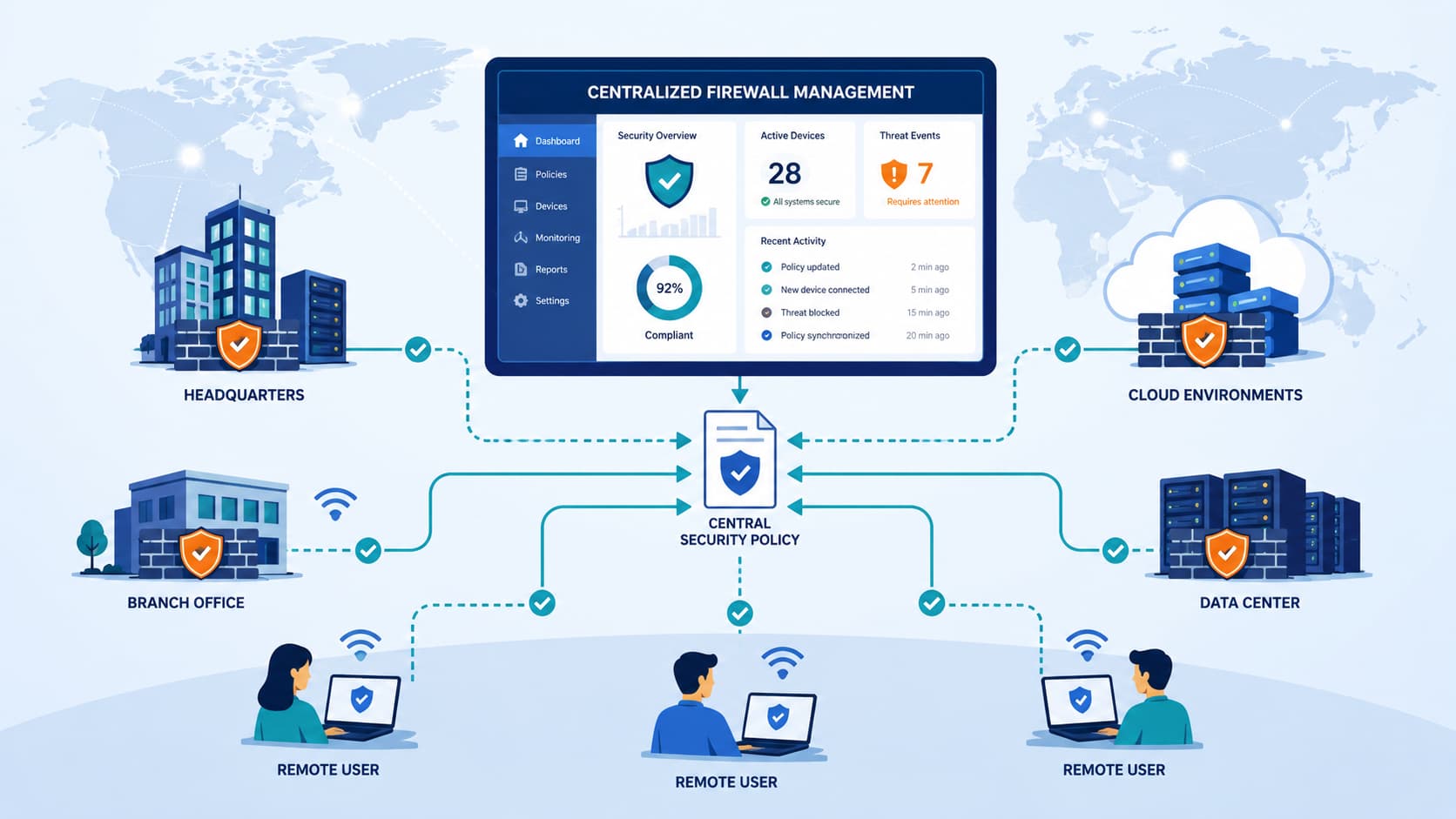
Centralized firewall management gives you a single console to manage firewall policies across every device instead of configuring each one manually. While vendor case studies report strong ROI, the biggest advantage is consistent security and simpler operations as networks grow.
At MSSP Security, we help organizations design centralized management strategies that improve visibility, reduce configuration errors, and support long-term scalability. Keep reading to learn how centralized firewall management works and whether it fits your environment.
Centralized Firewall Management at a Glance
- Improve consistency and reduce risk. Manage firewall policies from one platform to minimize policy drift, reduce configuration errors, and simplify compliance across distributed networks.
- Combine governance, automation, and visibility. Organizations typically achieve better long-term results when these three elements work together rather than relying on automation alone.
- Choose a platform that fits your environment. Evaluate your architecture, operational maturity, vendor compatibility, and long-term security goals before selecting a centralized firewall management solution.
What Are Centralized Firewall Management Tools?
Centralized firewall management tools provide a single console for enforcing security policies across branch offices, cloud environments, and remote locations.
Instead of updating firewalls individually, administrators can apply consistent policies from one place, reducing manual effort and the risk of configuration errors.
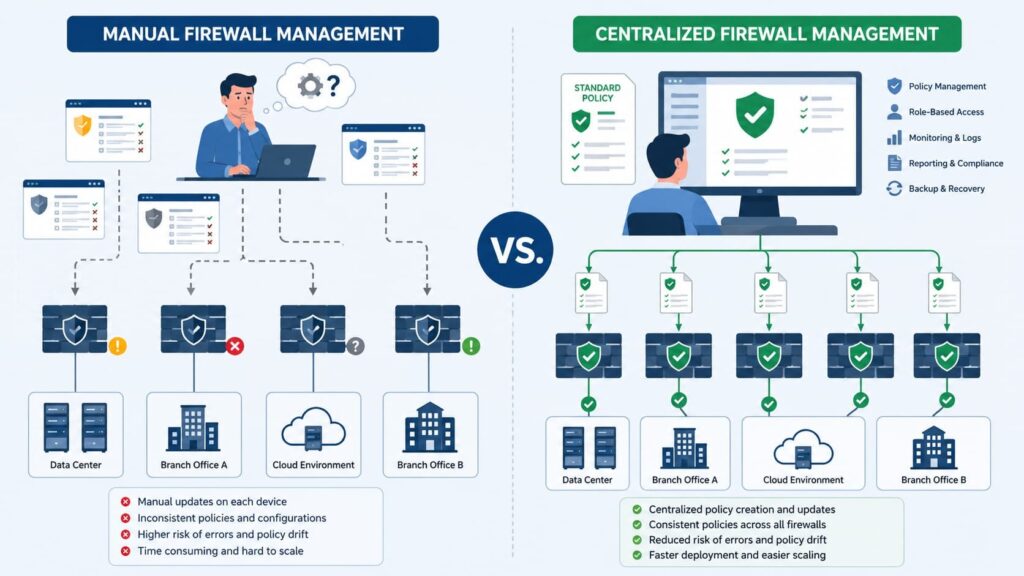
We’ve found at MSSP Security that manual management becomes increasingly difficult as organizations expand, often leading to inconsistent rules across locations.
Core capabilities typically include:
- Centralized policy management for consistent rule enforcement.
- Bulk policy deployment across multiple firewalls simultaneously.
- Role-based access control (RBAC) to manage administrator permissions.
- Log monitoring and compliance reporting for auditing and regulatory requirements.
- Configuration management and backups to simplify recovery and change tracking.
- Automated workflows that reduce repetitive administrative tasks.
Without centralized management, organizations are more likely to experience policy drift, where firewall rules gradually become inconsistent across sites.
As networks grow through cloud adoption, acquisitions, or new branch offices, these inconsistencies create security gaps. Security best practices emphasize consistent enforcement, documentation, and auditing across the environment.
Why Are Organizations Moving Away from Manual Firewall Administration?
Managing firewalls by hand is slow, error-prone, and a compliance headache. We still see administrators logging into dozens of separate devices to make the same change.
It might function at a small scale, but it falls apart as a company grows. Firewall environments can accumulate shadowed, redundant, or misconfigured rules when changes are managed manually. That’s a clear example of how manual rule management quietly builds risk over time.
Research from IEEE Xplore shows:
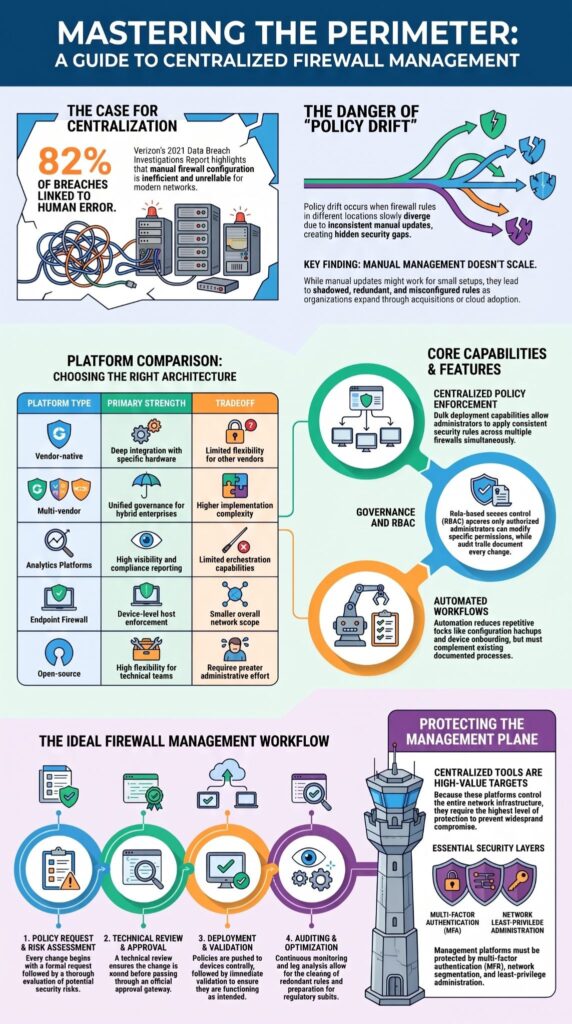
“In 2021 82% of breaches were caused by human errors in security configuration. The Verizon analysis clearly shows that traditional manual approaches to firewall configuration reveal inefficient and unreliable and are not the best course of action for modern networks.” – IEEE Xplore
For distributed companies, keeping a uniform security policy across branches, cloud systems, and hybrid setups is a constant fight. Every special case or exception adds more work and muddies the waters during an incident.
It’s worth noting, though, that just centralizing your tools isn’t a cure-all. If you don’t have clear approval steps and regular policy reviews, you’re often just moving the same old problems to a new console.
How does policy drift increase security risk?
Policy drift happens when firewall rules in different locations slowly diverge. This is usually the result of manual, inconsistent updates. his can create security gaps that attackers may exploit.
Why do distributed enterprises struggle with consistency?
Different teams, unsynchronized maintenance windows, and spotty documentation usually lead to conflicting rules. These inconsistencies pile up, making a proper security audit incredibly difficult and time-consuming for the MSSPs we advise.
Which Types of Centralized Firewall Management Platforms Exist?
Centralized firewall management tools are commonly grouped into vendor-native, multi-vendor, analytics-focused, endpoint, and open-source approaches. No single model fits every organization.
During customer assessments at MSSP Security, we generally evaluate operational goals before recommending architecture because management requirements vary significantly between enterprises.
| Platform Type | Best For | Primary Strength | Tradeoff |
| Vendor-native | Single vendor environments | Deep integration | Limited flexibility |
| Multi-vendor orchestration | Hybrid enterprises | Unified governance | Higher implementation complexity |
| Analytics platforms | Compliance reporting | Visibility and reporting | Limited orchestration |
| Endpoint firewall management | Device protection | Host enforcement | Smaller network scope |
| Open-source managers | Technical teams | Flexibility | Greater administrative effort |
Organizations should also evaluate:
- Cloud firewall management
- Firewall analytics
- Rule optimization
- Policy simulation
- Workflow automation
- Security governance
Selecting the appropriate category early simplifies future expansion.
Which Features Should You Prioritize Before Buying?
Compatibility, governance, automation, reporting, and scalability usually matter more than the total number of features. Many purchasing decisions focus heavily on dashboards, but operational workflows determine long-term success.
Evaluating firewall technology options alongside operational requirements helps organizations avoid selecting platforms based solely on feature lists. When we evaluate solutions with customers, we typically begin with three practical questions:
- Does it support every firewall currently deployed?
- Can it automate approvals without sacrificing oversight?
- Does reporting satisfy compliance requirements?
Security best practices emphasize consistent enforcement, documentation, and auditing across the environment. Organizations should prioritize:
- Firewall orchestration
- Firewall change management
- Configuration drift detection
- Policy enforcement
- Audit trail
- Security compliance tools
- Firewall reporting
- Centralized administration
Of course, automation should complement documented processes rather than replace them.
How Does Centralized Firewall Management Reduce Operational Overhead?
A centralized console replaces repetitive administration while improving visibility across the entire security infrastructure. Instead of logging into dozens or hundreds of devices, administrators manage policy from one interface. That dramatically reduces repetitive work and shortens deployment windows.
Centralized visibility can improve incident response and shorten troubleshooting time, allowing security teams to investigate incidents more efficiently.
Tasks that become significantly easier include:
- Policy deployment
- Change approval workflow
- Device onboarding Incident response
- Configuration backup
- Firewall migration
- Compliance reporting
We’ve seen organizations reduce routine maintenance windows simply by eliminating repetitive device-by-device administration. Following consistent firewall management best practices also helps teams standardize change processes while creating more time for proactive security improvements.
Why Do Firewall Automation Projects Fail?
Automation projects usually fail because organizations automate inconsistent processes instead of improving them first. Complex environments introduce variables that software alone cannot resolve.
Missing topology information, undocumented firewall rules, and outdated inventories frequently undermine automation initiatives. Community discussions consistently highlight recurring challenges:
- Multi-vendor complexity
- Incomplete topology awareness
- Limited trust in automated production changes
- Poor documentation
- Rule sprawl
Research published by operational security experts also emphasizes that successful network security orchestration depends on accurate infrastructure visibility before automation begins.
Before enabling automated policy deployment, organizations should validate:
- Configuration consistency
- Rule ownership
- Change approval workflows
- Documentation quality
- Automation performs best when operational discipline already exists.
How Do Multi-Vendor Environments Change Your Strategy?
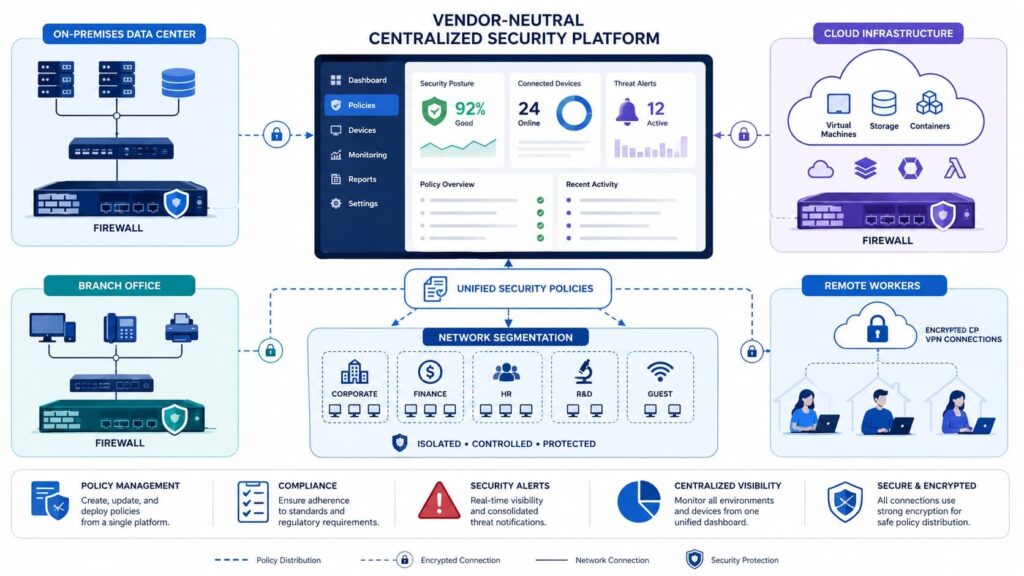
Mixed firewall ecosystems require stronger governance, policy normalization, and broader operational visibility. Single-vendor environments often benefit from native management consoles.
Hybrid environments require broader vendor agnostic management capable of coordinating multiple technologies through one security control plane.
From our experience at MSSP Security, organizations rarely stay single-vendor forever. Cloud adoption, acquisitions, and business growth naturally diversify infrastructure.
In a recent analysis by Dragos:
“The vulnerabilities inherent in relying on a single firewall vendor across all OT facilities. Over the past quarter, several OT environments suffered widespread compromises due to the use of vulnerable or end-of-life firewall products from a single vendor.” – Dragos
Multi-vendor environments benefit from:
- Centralized policy governance
- Unified reporting
- Cross-platform firewall control
- Change tracking
- Rule lifecycle management
- Firewall optimization
The larger the environment becomes, the more valuable centralized governance becomes.
What Security Risks Exist Inside Centralized Management Platforms?
Centralized management systems become valuable attack targets and require strong protection. Management-plane vulnerabilities are high-risk because they can affect the systems used to configure and monitor critical infrastructure.
Organizations should protect management platforms using:
- Multi-factor authentication
- Role based access control
- Network segmentation
- Continuous auditing
- Patch management
- Least privilege administration
Security management platforms deserve the same level of protection as the infrastructure they manage.
What Does a Real Firewall Management Workflow Look Like?
Effective firewall workflows combine governance, validation, deployment, monitoring, and continuous optimization. A mature operational workflow generally follows this sequence:
- Policy request
- Risk assessment
- Technical review
- Change approval
- Policy deployment
- Validation
- Audit logging
- Continuous optimization
Throughout our engagements, we’ve noticed administrators trust workflows they can observe and validate rather than highly automated systems they cannot easily explain. That practical confidence often determines long-term success more than feature count.
Which Centralized Firewall Management Tool Is Right for Your Organization?
The best solution depends on infrastructure, governance requirements, and operational maturity. Organizations with relatively uniform infrastructure may prefer native management platforms.
Enterprises operating hybrid environments generally benefit from broader orchestration and governance capabilities.
Rather than selecting products based solely on marketing features, organizations should compare their operational requirements with practical firewall vendor selection criteria before making long-term infrastructure decisions.
| Evaluation Area | Questions to Ask |
| Vendor compatibility | Does it support every firewall? |
| Automation | Can workflows remain controlled? |
| Compliance | Are reporting requirements covered? |
| Scalability | Will it support future growth? |
| Cloud support | Can hybrid infrastructure be managed centrally? |
| Governance | Are approvals and auditing built in? |
At MSSP Security, we encourage customers to evaluate how the platform fits operational processes instead of chasing feature lists. A well-governed platform often delivers better long-term results than one with more capabilities that remain unused.
What Trends Will Shape Centralized Firewall Management Next?
Zero Trust, cloud-native management, AI-assisted analysis, and integrated networking will shape future firewall operations.
Zero Trust continues to gain attention as organizations move toward identity-driven security. Future priorities include:
- Cloud security management
- Security posture management
- AI-assisted rule analysis
- Firewall intelligence
- Hybrid network security
- Firewall-as-a-Service
- Integrated SD-WAN management
Organizations are increasingly looking beyond perimeter protection toward unified security operations that connect identity, endpoint, cloud, and network controls.
Transforming Firewall Management Into High-Value NDR Services
Credits: WatchGuard Technologies
Traditional firewalls remain essential, but perimeter defense alone is no longer enough to stop modern attackers who bypass controls and hide within encrypted traffic. By evolving centralized firewall management into a full-spectrum Network Detection and Response (NDR) framework,
Managed Service Providers (MSPs) can gain complete network visibility. This transition allows service providers to shift from a reactive, prevention-only posture to an active, early threat-detection model, effectively neutralizing hidden internal movements and creating high-value security offerings that stand out in a crowded market.
FAQ
What are the benefits of centralized firewall management for growing networks?
Centralized firewall management allows administrators to manage security policies from a single location instead of configuring each firewall individually. This approach improves network security policy consistency, strengthens policy enforcement, reduces configuration errors, and simplifies firewall administration across multiple locations. It also improves policy visibility, supports stronger security governance, and increases operational efficiency.
How does firewall policy management reduce security risks?
Effective firewall policy management keeps security rules accurate, organized, and aligned with business requirements. Regular firewall policy review, rule optimization, rule cleanup, and consistent policy enforcement remove unnecessary or outdated rules, reduce policy drift, and minimize the risk of security gaps caused by configuration mistakes.
Can firewall management software support hybrid and cloud environments?
Yes. Modern firewall management software supports organizations that operate on-premises, cloud, and hybrid environments. A centralized console enables administrators to apply consistent policies through cloud firewall management, hybrid network security, multi site firewall control, and vendor agnostic management, making security management more efficient across distributed infrastructure.
Why is firewall automation important for enterprise security operations?
Firewall automation reduces manual work by automating firewall change management, policy deployment, configuration management, and workflow automation. Automated processes help security teams complete routine tasks faster, maintain accurate change tracking, improve security operations, strengthen policy compliance, and respond to incidents more efficiently.
How does centralized firewall management improve compliance and auditing?
Centralized firewall management improves policy compliance by maintaining a complete audit trail, generating detailed compliance reporting, and supporting regular firewall auditing. It also combines log analysis, configuration backup, and role based access control to document security changes, simplify audits, and demonstrate compliance with internal policies and regulatory requirements.
Choosing the Right Centralized Firewall Management Strategy
Centralized firewall management works best when your team can keep policies consistent without adding extra work. If your processes are not clear, even advanced features cannot solve everyday security challenges.
Building a strong management foundation first helps improve governance, reduce errors, and support future growth.
If you need expert guidance on centralized firewall management, policy optimization, or vendor-neutral security planning, MSSP Security’s consulting services can help.
Their team provides practical recommendations, proof-of-concept support, and technology selection advice to help you build a security stack that scales with your organization.
References
- https://ieeexplore.ieee.org/document/10298107/references#references
- https://www.dragos.com/blog/exploring-the-use-of-multi-vendor-firewalls-in-ot-network-security