


Cybersecurity teams evaluating SOAR vendors in Fullerton should focus on automation quality, integrations, governance, and operational fit rather than AI claims. At MSSP Security, we’ve found that successful deployments depend on how well a platform fits existing workflows and security tools, not just its feature list.
Local compliance requirements, hosting preferences, and vendor support should also factor into the decision. Keep reading for a practical framework to evaluate SOAR vendors with confidence.
What Matters Most When Evaluating SOAR Vendors?
If you’re short on time, these are the core factors worth keeping in mind when evaluating SOAR vendor capabilities in Fullerton. Focusing on these fundamentals can help you avoid costly implementation mistakes and choose a platform that supports your security operations over the long term.
- Validate bidirectional integrations with your actual SIEM, EDR, and ticketing systems first; a platform is only as strong as its connections.
- Demand human-readable, modifiable playbooks with built-in governance; automation without control is a liability.
- Choose a deployment model cloud, on-prem, or hybrid that aligns with your data residency and operational reality in Fullerton.
Why Doesn’t Fullerton Change Your Technical Evaluation?
The technical evaluation for a SOAR platform in Fullerton isn’t fundamentally different from one in Chicago or London. The core functions orchestration, automation, and response are universal. What does shift are the contours around them. Consider data residency requirements specific to California regulations, or your existing relationship with a local MSSP.
Utilizing a comprehensive Choosing SOAR Platforms Guide helps local teams outline these localized compliance criteria before committing to a vendor.
- The platform must fit within that ecosystem.
- It’s about operational fit, not geography.
- We’ve worked with teams here who assumed a cloud-first SaaS model was the only path, only to find their internal policies demanded a hybrid approach for certain data types.
- The lesson is simple, location informs context, not capability.
Which Integrations Should You Validate First?

A manufacturing company evaluating SOAR discovered that its legacy EDR lacked several API endpoints required for automated containment. During the proof of concept, analysts identified the limitation before purchasing the platform, avoiding significant integration costs later.
The most elegant playbook is useless if it can’t pull an alert from your SIEM or isolate a host through your EDR. You need to test the plumbing. During a proof of concept, you should be asking about API reliability and error handling, not just if a connector exists.
Can it perform bidirectional actions? Can it handle your authentication method, whether it’s OAuth, API keys, or certificates? What happens when the API is throttled? These are the questions that separate a robust platform from a fragile one.
- SIEM for central alert collection
- EDR/XDR for automated containment
- IAM for account-based response
- Email Security for phishing automation
- ITSM (like ServiceNow) for ticket synchronization
A mature SOAR deployment lives and dies by its API coverage. It’s the foundation.
How Mature Should Playbooks Be?
A playbook shouldn’t be a black box of code. It should be a logical flowchart of your security policy. You want to see approval stages for critical actions, like disabling a high-value account. You need rollback capability in case an automation step goes sideways.
| Maturity Element | Target Capability | Operational Objective |
| Logic Visibility | Human-readable, drag-and-drop flowchart | Allows analysts to modify workflows without a computer science degree. |
| Control Gates | Mandatory approval stages for critical actions | Prevents accidental, wide-reaching disruptions (e.g., isolating a production server). |
| Error Handling | Built-in rollback capabilities | Ensures the system can gracefully undo steps if an automation sequence fails. |
| Safety Testing | Isolated sandbox environment | Allows the team to validate logic against sample data before moving it to production. |
There must be a testing environment, a sandbox, where you can validate logic against sample data before it hits production. The goal is to codify your best analysts’ knowledge into a repeatable process that the whole team can execute.
If your analysts need a computer science degree to tweak a phishing response workflow, you’ve bought the wrong tool. The platform should empower them, not burden them.
What Makes Case Management Effective?
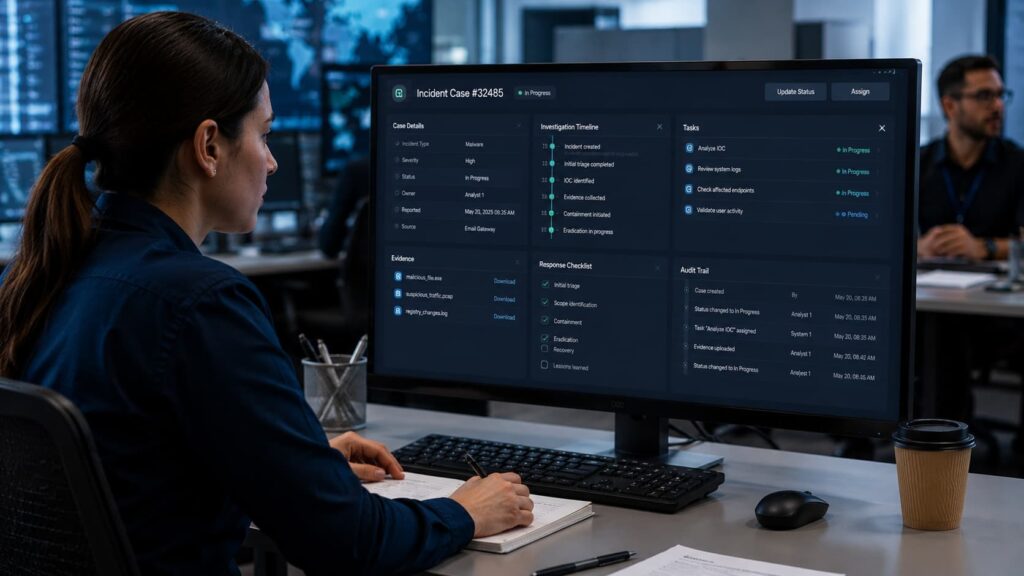
Think of it as the central nervous system of your incident response. It should automatically track every piece of evidence, from the original alert to the enriched indicators to the containment action taken. It reconstructs a timeline without manual entry. It handles analyst assignments and escalation workflows when a case sits too long.
This systematic tracking is exactly what teams look for during the security automation platform selection process to ensure the solution genuinely reduces analyst fatigue.
- Most importantly, it builds the audit trail for compliance and post-mortem reviews.
- A phishing investigation, for example, should auto-populate with email headers, extracted URLs, sandbox results, and the ticket number created in ServiceNow.
- All of it, tied to one case.
- That’s what turns a chaotic response into a defensible process.
How Can Governance Prevent Unsafe Automation?
You need fine-grained role-based access control. A junior analyst probably shouldn’t have permissions to edit a production playbook that isolates entire network segments. You need approval gates, where high-impact actions like a firewall block rule change require a senior analyst’s explicit sign-off.
“SOAR platforms have a high level of access to key security tools, so one person should not be allowed to create all the playbooks without a second check. An organization should utilize its change management process to incorporate a system where the code is reviewed prior to deployment” – GuidePoint Security.
A dry-run simulation mode is invaluable, letting you see what would happen without actually doing it. And every single action, automated or manual, must be logged with an immutable audit trail. This isn’t about slowing things down. It’s about ensuring speed doesn’t come at the cost of safety or compliance. Without these controls, automation can quickly become a liability.
Where Do SOAR Projects Usually Fail?
The classic mistake is being dazzled by a vendor demo that shows a seamless, pre-configured workflow. Then you get the platform into your environment and realize the integration with your specific EDR requires custom API work your team can’t sustain. Hidden costs emerge, not just in licensing, but in the developer hours needed to build and maintain connectors.
“SOAR helps MTTD with incident enrichment and helps MTTR because SOAR provides a space where SOC analysts can get a lot of initial information. This provides them the space to investigate the incident more quickly” – TechTarget.
There’s an overestimation of what AI can actually do out of the box. The tool becomes shelfware because the playbooks are too rigid or complex to modify. The antidote is brutally practical. Before you buy anything, document one long manual process and two frequent, repetitive tasks. Prove you can automate those in a PoC. That’s your foundation.
How Should You Compare Native and Vendor-Agnostic Platforms?
A native platform, deeply integrated with a specific vendor’s security suite (like their XDR, firewall, and cloud security), offers incredible speed and lower configuration effort within that walled garden. The trade-off is potential lock-in and difficulty incorporating best-of-breed tools from other vendors.
| Platform Type | Key Advantages | Major Trade-offs | Ideal Deployment Scenario |
| Native Platform | -Rapid deployment-Lower initial configuration effort-Seamless out-of-the-box suite integration | -High risk of vendor lock-in-Difficult to integrate best-of-breed tools from outside vendors | Organizations where 80% or more of their critical security tools come from a single vendor ecosystem. |
| Vendor-Agnostic Platform | -High architectural flexibility-Connects heterogeneous tech stacks-Prevents vendor lock-in | -Higher initial configuration overhead-Heavy reliance on ongoing API connector maintenance | Organizations utilizing a mosaic of different technologies and best-of-breed security tools. |
A vendor-agnostic platform is built to be the connective tissue across a heterogeneous stack. It promises greater flexibility and broader compatibility, but it often requires more initial configuration and relies heavily on the strength and breadth of its API connectors.
The roadmap for selecting security orchestration tool architectures comes down to a straightforward rule: If 80% of your critical security tools already come from one vendor, lean native. If you have a mosaic of different technologies, prioritize vendor-agnostic.
What Should Your Proof of Concept Include?
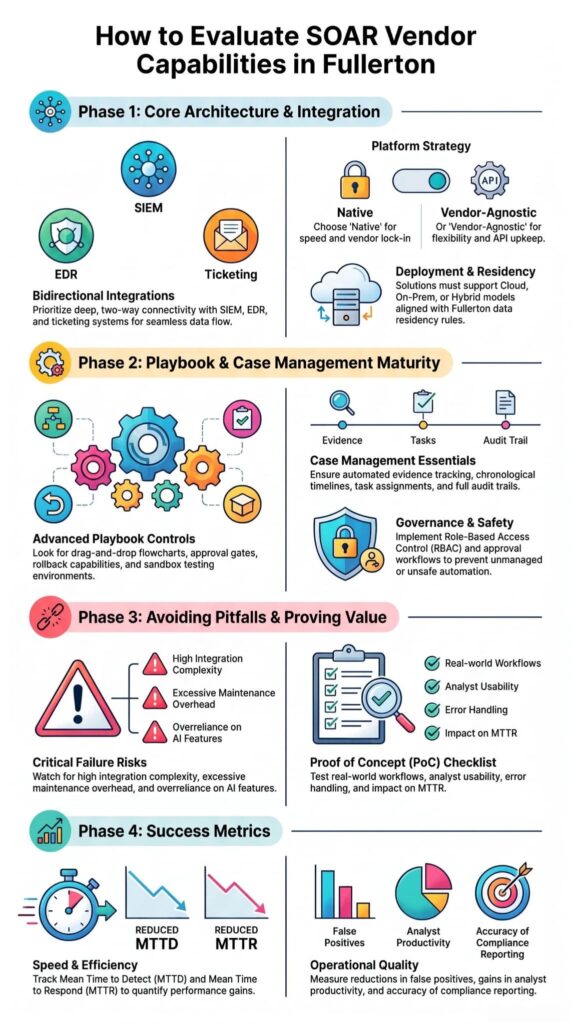
You must test with live, or near-live, integrations. Can the platform ingest an alert from your SIEM, enrich it with threat intelligence, open a case, and create a ticket in ServiceNow? Run a phishing playbook from start to finish. Attempt a malware containment workflow. Crucially, watch your analysts use it.
- Is the interface intuitive?
- What happens when you deliberately introduce an error, like a mistyped API endpoint?
- How does it fail?
- Measure tangible outcomes: did the Mean Time to Respond (MTTR) drop?
- Did it reduce the number of consoles an analyst had to switch between?
- A good PoC should last long enough to cycle through a few real alerts, but not so long it becomes a pseudo-production deployment without a decision.
How Can MSSP Security Help Your Organization Evaluate SOAR Vendors?
Credits: Stratos Cyber
We approach these evaluations from the same side of the table as our clients. The goal isn’t to sell a widget, it’s to ensure your security operations get meaningfully better. That means we start by mapping your actual technology stack and analyst workflows, not a vendor’s feature list.
We help identify the automation opportunities that will deliver the quickest wins and the highest value. We stress-test governance models to ensure they match your risk tolerance. And we’re always thinking about the long-term maintenance burden. A platform that requires a team of dedicated developers to keep running is a poor choice for most organizations.
Our role is to provide the clarity and practical roadmap you need to make a confident, informed investment in your team’s future effectiveness.
FAQs
What SOAR capabilities matter most when comparing vendors in Fullerton?
When comparing SOAR capabilities in Fullerton, focus on features that improve real-world security operations instead of long marketing checklists. A strong platform should provide reliable security orchestration, consistent automation, flexible playbooks, and seamless security stack integration.
These capabilities help strengthen security operations, increase analyst productivity, and support efficient response workflow management across daily incident handling.
How can I evaluate automation without creating vendor lock-in?
Evaluate how the vendor supports workflow automation, API integration, and API connectors across your existing security tools. Choose solutions that include human-readable playbooks, no-code automation, or low-code automation with a drag-and-drop builder.
These features reduce developer dependency, support business process alignment, simplify future updates, and lower the risk of vendor lock-in.
Which integrations should support faster incident response?
An effective platform should support reliable SIEM integration, EDR integration, ticketing integration, and threat intelligence sharing across your environment. These integrations improve alert triage, incident enrichment, response orchestration, and remediation automation by connecting important security data.
Strong integration also strengthens detection and response while improving visibility throughout the incident lifecycle.
What metrics show a SOAR platform improves security operations?
You should measure performance by tracking MTTD, MTTR, false positive reduction, benchmark metrics, and KPI dashboards over time. You should also review compliance reporting, reporting automation, response documentation, and audit trail capabilities.
These metrics provide clear evidence of improvements in SOC automation, cyber incident management, staffing efficiency, analyst workload, and ROI analysis.
How do deployment options affect long-term SOAR success?
Your deployment strategy should align with your organization’s security, compliance, and operational requirements. Compare cloud deployment, on-prem deployment, and hybrid deployment by evaluating scalability, throughput, data ingestion, and distributed ingestion capabilities.
You should also confirm that the platform supports governance controls, access control, approval workflow, operational maturity, and long-term improvements to your security posture.
How Can You Make a Confident SOAR Decision in Fullerton?
Choosing a SOAR platform is easier when you test what matters most. We’ve helped MSSPs review tools, compare vendors, and support real proof of concept testing, so we’ve seen how the right choice can improve daily security work without adding extra complexity.
If you’re planning to review or audit your next security tool, MSSP Security can help you make informed decisions with practical guidance. Every team has different needs, and the best fit is the one that works well in real situations.
References
- https://www.guidepointsecurity.com/blog/protect-your-soar/#ekit_modal-popup-6fef3bd5
- https://www.techtarget.com/searchsecurity/feature/How-SOAR-helps-improve-MTTD-and-MTTR-metrics