

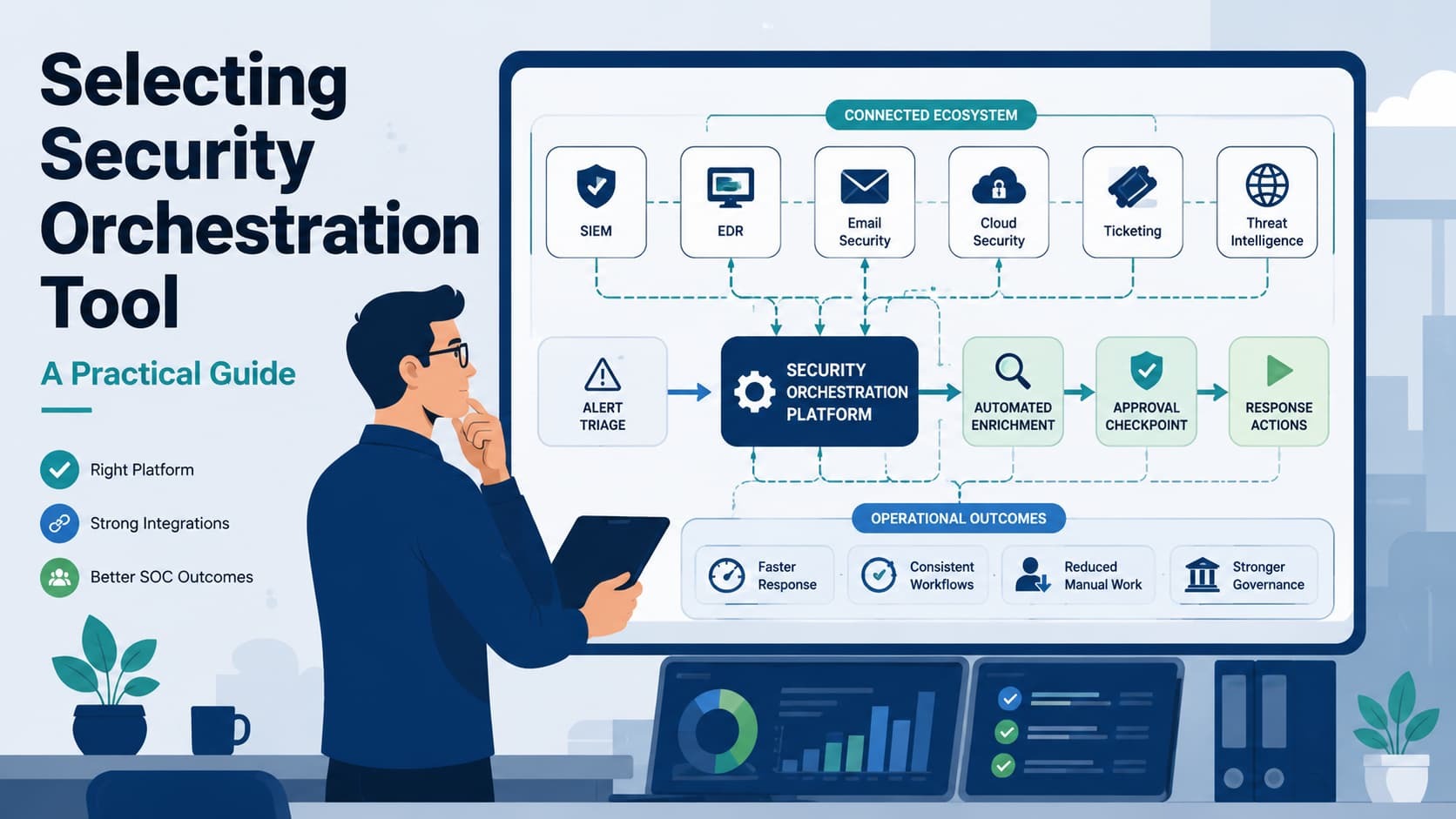
Selecting a security orchestration tool means choosing a platform that fits your SOC workflows, integrations, and response processes. At MSSP Security, we’ve found that evaluating tools against real operational scenarios leads to more practical, sustainable decisions than relying on feature comparisons alone.
This guide walks through the key factors to consider so you can choose a solution that supports your security operations today and as they evolve. Keep reading to see what matters most.
What Matters Most When Selecting a Security Orchestration Tool?
Choosing a security orchestration platform is easier when you focus on the outcomes that matter most. Before exploring the evaluation framework, keep these practical insights in mind:
- How to evaluate a security orchestration platform using operational requirements instead of feature count.
- Which capabilities deliver measurable improvements in SOC automation, security automation, and incident response automation.
- How we at MSSP Security approach platform selection using real workflows and proof-of-concept validation before deployment.
Why Is Selecting the Right Security Orchestration Tool More Important Than Choosing the Most Features?
The best platform is the one that fits your existing security operations, not the one advertising the most capabilities. Many organizations begin vendor evaluations by comparing feature matrices. During a recent SOAR evaluation for a financial services client, our team found that analysts spent nearly 40% of their investigation time manually enriching alerts.
After automating enrichment and ticket creation, average investigation time decreased while analysts handled more incidents without increasing staffing. A platform may advertise hundreds of integrations or AI-driven workflows, yet fail to streamline the daily tasks analysts perform inside the security operations center. Instead, define operational challenges first.
To align internal operations with your vendor criteria, reading a comprehensive Choosing SOAR Platforms Guide can help clarify what technical benchmarks actually matter during the vendor vetting process. Teams commonly want better alert triage, alert enrichment, case management, and workflow automation.
Solving these recurring issues usually delivers greater value than adding capabilities that remain unused.
Prioritize improvements such as:
- Reducing alert fatigue
- Eliminating repetitive investigation tasks
- Standardizing security incident workflow
- Accelerating incident management
- Improving analyst collaboration
- Simplifying compliance documentation
From our own deployment experience, organizations often discover that their biggest bottleneck isn’t technology, it is inconsistent processes. Choosing a platform that complements existing workflows enables gradual automation maturity instead of forcing disruptive operational changes.
Why do feature lists often mislead buyers?
| Feature Checklist | Operational Reality |
| Hundreds of integrations | Only a handful offer deep cross-platform integration |
| AI automation | Human approval still matters for sensitive containment actions |
| Unlimited playbooks | Long-term playbook automation maintenance becomes the bigger challenge |
Which Core Capabilities Matter Most?
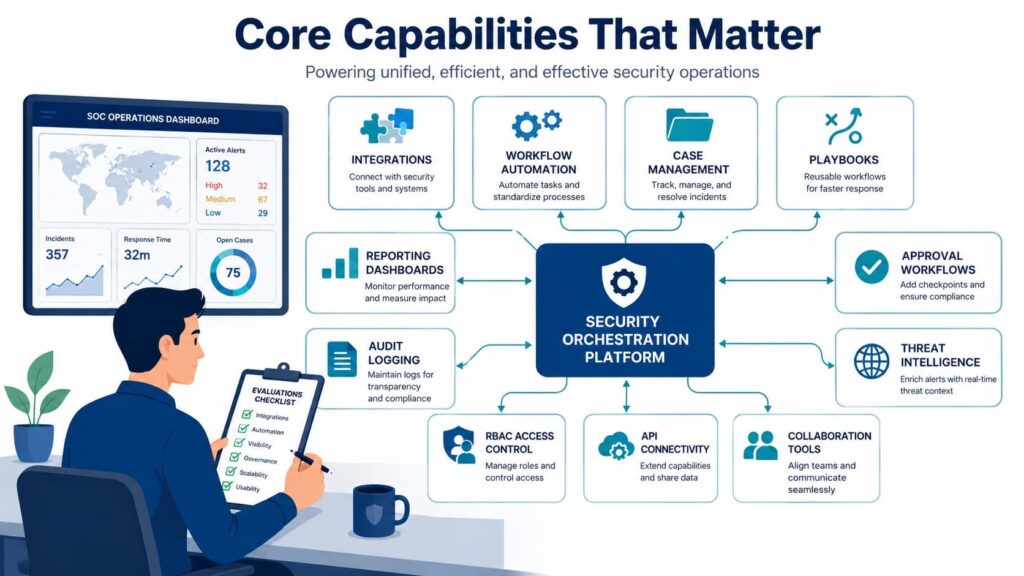
A mature security orchestration platform strengthens analysts instead of replacing them. Successful deployments combine SOAR, security workflow, and security process automation with existing operational procedures. Rather than automating everything immediately, organizations benefit from automating repeatable, low-risk activities first.
A strategic security automation platform selection process targets tools that directly minimize manual analysis overhead right from the deployment phase.
“Contemporary security information and event management (SIEM) solutions struggle to identify critical security incidents effectively due to the overwhelming number of false alerts generated by disparate security products, which results in significant alert fatigue and hinders effective incident response” – MDPI.
Look for platforms supporting:
- SIEM integration
- EDR integration
- Threat intelligence integration
- ITSM integration
- Service desk integration
- Custom connectors
- Third-party integrations
- Centralized dashboard
- Low-code automation
- No-code playbooks
Equally important is robust case management. Effective platforms maintain:
- Incident timelines
- Evidence collection
- Task assignment
- Investigation notes
- Audit trail
- Automated documentation
These capabilities improve collaboration while supporting compliance reporting and governance requirements.
How Should You Evaluate Vendors?
Evaluate platforms using your own incidents. A proof of concept built around production-like workflows provides more insight than scripted demonstrations. We recommend involving SOC analysts early because they understand where friction appears during investigations and where security task automation can save meaningful time.
Which evaluation criteria matter most?
| Area | Questions to Ask |
| Integrations | Are they deeply bidirectional? |
| Governance | Are approvals, RBAC, and audit controls included? |
| Usability | Can analysts modify response playbooks independently? |
| Scalability | Will it support future cloud growth and operational expansion? |
| Reporting | Does it simplify compliance readiness? |
Why should analysts participate in evaluations?
Analysts interact daily with security analytics, event correlation, and analyst workflow. Their practical perspective often identifies operational gaps that procurement-focused evaluations overlook. In one rollout we supported, analysts uncovered workflow bottlenecks during phishing investigations that never appeared during vendor demonstrations.
Addressing those issues early significantly improved platform adoption after implementation.
Why Do Integrations Matter More Than Automation?
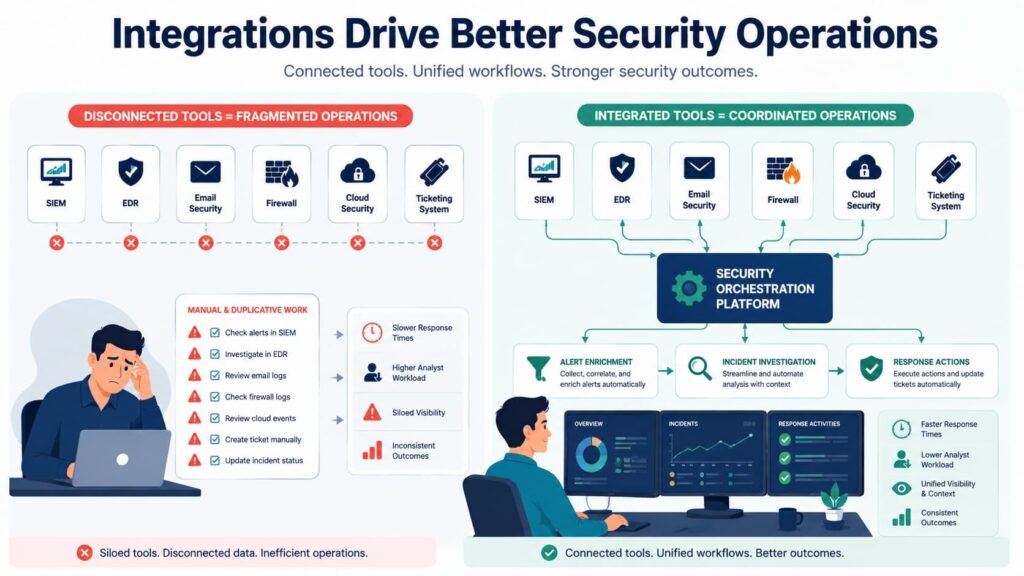
Automation only succeeds when security tools exchange accurate, contextual information. Organizations frequently underestimate the systemic challenge of integrating soar with security stack solutions that are already deeply entrenched. If telemetry cannot move reliably between systems, even sophisticated orchestration workflows deliver inconsistent results.
Prioritize integrations with:
- SIEM
- Endpoint response
- Email security
- Identity providers
- Threat feed integration
- Ticketing systems
- Cloud security controls
High-quality integrations improve:
- IOC enrichment
- Threat context
- Automated investigation
- Threat hunting automation
- Incident prioritization
When Does SOAR Actually Make Sense?
Credits: IBM Technology
Not every organization requires the same automation strategy. Smaller security teams often question whether SOAR delivers sufficient value. Community discussions consistently show that organizations benefit most when repetitive work begins consuming significant analyst capacity rather than isolated incidents.
SOAR becomes valuable when your SOC regularly handles:
- High alert volumes
- Manual enrichment
- Multiple disconnected security products
- Repetitive phishing investigations
- Consistent malware response activities
When should manual workflows remain?
Human review remains appropriate when:
- Executive approval is required
- Business disruption is possible
- Sensitive automated remediation may impact production
- Incidents extend beyond predefined response procedures
Automation should support experienced analysts not replace their judgment.
Which Workflows Should You Automate First?
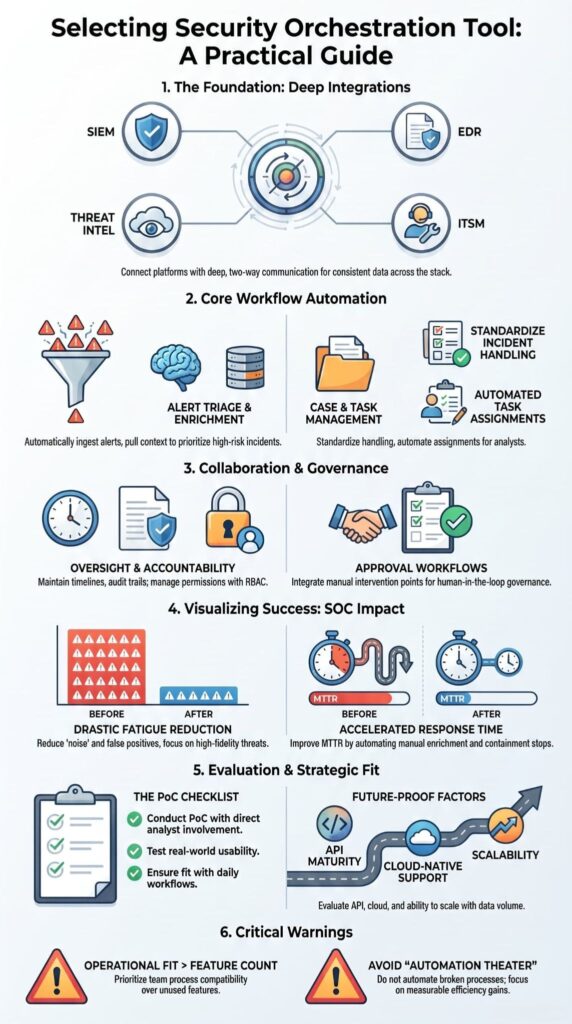
Focus on repeatable activities. Organizations usually see faster returns by automating predictable investigations before expanding into complex incident handling.
Recommended first automations:
- Phishing response
- Threat intelligence integration
- Suspicious login investigations
- Endpoint isolation validation
- Automated case creation
- Ticket creation
- Alert enrichment
These workflows frequently improve:
- SOC analyst productivity
- MTTD reduction
- MTTR reduction
- False positive reduction
- Alert fatigue reduction
Why shouldn’t everything be automated?
Automation without governance introduces unnecessary operational risk. Mature programs carefully define where approvals remain mandatory before expanding security response orchestration.
How Can You Avoid Automation Theater?
Automation should remove work not create additional engineering. One recurring lesson we’ve seen is that organizations occasionally deploy extensive playbooks before documenting existing processes.
“Preparation through planning and testing is essential for effective incident response” – NIST.
As highlighted in the report, organizations often struggle to realize the full value of security automation without clearly defined processes. Deploying extensive playbooks before documenting workflows can increase maintenance overhead without delivering measurable operational gains.
Avoid these mistakes:
- Buying before documenting workflows
- Excessive customization
- Ignoring analyst usability
- Automating unstable procedures
- Treating deployment as the finish line
Continuous refinement keeps runbook automation, playbook automation, and security control automation aligned with evolving attacker techniques.
Why Does Governance Matter in SOAR?
Governance creates trust in automation. Without strong oversight, even effective incident response automation may introduce compliance concerns or inconsistent operational behavior.
Essential governance capabilities include:
- Approval workflows
- Role separation
- Version control
- Audit trail
- Compliance reporting
- Policy enforcement
Comprehensive audit logs simplify investigations while supporting regulatory reviews and internal security assessments.
How Should You Run a Successful Proof of Concept?
A realistic proof of concept predicts operational success far better than polished demonstrations. At MSSP Security, we encourage organizations to validate platforms against existing SOC processes rather than hypothetical scenarios. That approach consistently reveals integration gaps, workflow limitations, and analyst adoption challenges before purchase decisions are finalized.
Every proof of concept should include:
- Five to eight real workflows
- Existing security toolchain integrations
- Analyst participation
- Governance validation
- Performance measurements
Success metrics should include:
- MTTR reduction
- Analyst workload
- Workflow consistency
- User adoption
- Automation accuracy
- SOC efficiency
How Can You Future-Proof Your Security Orchestration Investment?
Security operations continue evolving, and orchestration platforms should evolve alongside them.
Evaluate beyond today’s requirements by considering:
- API maturity
- Integration roadmap
- Cloud security orchestration
- Playbook maintenance
- Operational scalability
- Vendor support
- Support for future vulnerability orchestration and vulnerability management
Platforms that accommodate changing infrastructure, evolving threats, and expanding compliance obligations deliver stronger long-term value than those optimized solely for current requirements.
FAQs
How do I know if a security orchestration platform fits my existing tools?
A security orchestration platform should integrate with the tools your team already uses every day. Check whether it supports SIEM integration, EDR integration, ticketing integration, and other third-party integrations.
Strong cross-platform integration allows the platform to connect your security toolchain, reduce manual work, and create a consistent security workflow across your entire environment.
What should I automate first with SOAR?
Begin with repetitive tasks that consume the most analyst time. SOAR works well for alert triage, alert enrichment, automated case creation, and incident response automation because these processes follow predictable steps.
After those workflows are stable, expand into playbook automation, runbook automation, and automated investigation to increase SOC analyst productivity through practical security automation.
How can automation reduce alert fatigue without missing real threats?
Automation reduces unnecessary work by combining event correlation, threat context, IOC enrichment, and machine learning recommendations to evaluate alerts before analysts review them. This process improves incident prioritization, supports false positive reduction, and delivers meaningful alert fatigue reduction.
As a result, security operations teams can focus on genuine threats instead of repeatedly investigating low-risk alerts.
Why are response playbooks important for incident handling?
Response playbooks provide predefined steps for handling common incidents such as phishing response, malware response, and endpoint response. They help teams perform consistent containment actions, support automated remediation, and improve the overall security incident workflow.
Standardized response procedures also produce a reliable audit trail that simplifies compliance reporting and strengthens compliance readiness.
How do I measure the success of security workflow automation?
Measure success by tracking improvements in MTTD reduction, MTTR reduction, response time reduction, and overall SOC efficiency. You should also evaluate incident management, case management, and the effectiveness of security process automation.
These metrics show whether security response orchestration is helping your security operations center resolve incidents faster while maintaining consistent operational quality.
How Can You Choose the Right Security Orchestration Tool?
The right security orchestration tool should fit the way your team already works. Focus on real workflows, test integrations with a proof of concept, and measure success through faster response times and smoother daily operations. We’ve spent over 15 years helping MSSPs choose and review security tools that match their goals.
Our team recommends practical, vendor neutral solutions, supports PoCs, and audits existing stacks to reduce tool sprawl. Learn more about MSSP Security and how we help organizations make confident technology decisions with practical, experience-based guidance.
References
- https://www.mdpi.com/2076-3417/13/11/6610#metrics
- https://csrc.nist.gov/pubs/sp/800/61/r2/final