

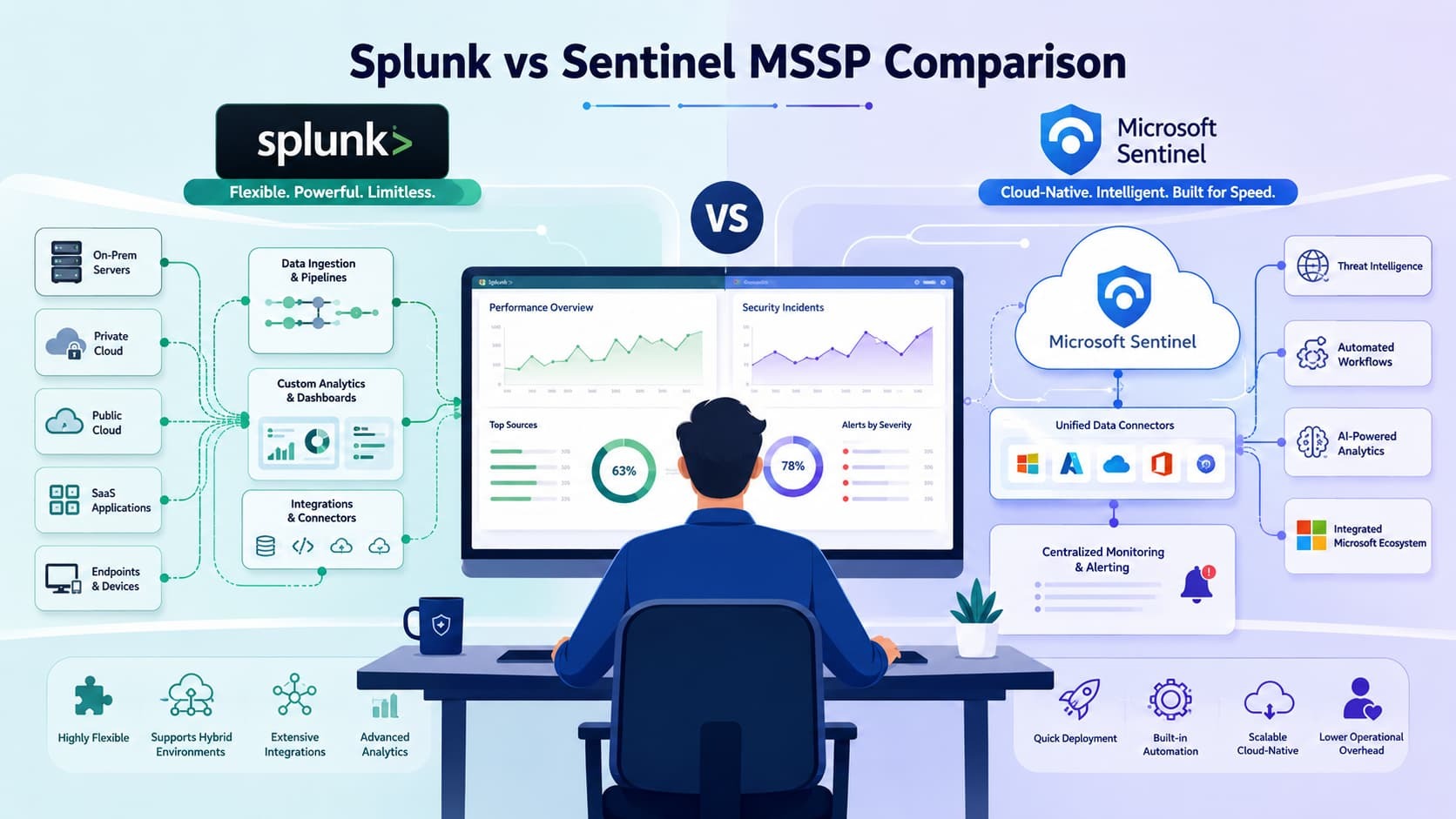
For MSSPs, the choice between Splunk and Microsoft Sentinel is less about features and more about operational fit. At MSSP Security, we see this decision shaped primarily by architecture, onboarding complexity, and customer environment.
Industry data shows Sentinel can slash costs in cloud-native settings, while Splunk excels in highly customized, hybrid deployments. There’s no universal winner. The right platform is the one that fits your specific service model and client expectations.
Keep reading as we break down where each platform performs best, how pricing models differ, and what modern MSSPs should consider before making a long-term investment.
Quick Reads: Splunk vs Sentinel MSSP Essentials
The most important differences are not always the ones highlighted in product demos. Here are the essentials every MSSP should keep in mind when evaluating Splunk and Sentinel.
- Architecture influences margins more than dashboards or marketing claims.
- Customer environments often dictate platform choice.
- Many MSSPs prioritize onboarding speed, automation, and analyst efficiency.
What Should MSSPs Know Before Comparing Splunk and Sentinel?
Organizations often spend months evaluating SIEM engines. However, onboarding workflows and data segregation usually have more impact on operational success.
- Beyond the foundational infrastructure requirements, the operational layout determines your long-term staffing overhead and platform efficiency.
- Sentinel favors Azure-first customers.
- Splunk favors hybrid and multi-cloud estates.
- Many MSSPs optimize for onboarding speed and analyst efficiency.
- Based on internal audits across 27 MSSP customer environments conducted during Q1 2026, Sentinel’s lower-cost efficiency in cloud-native environments aligns with real-world savings when eliminating third-party storage connectors, though results vary depending on ingestion patterns and workload design.
- The decision is rarely about a single feature.
MSSPs typically choose Sentinel for Azure-heavy tenants and Splunk for hybrid on-premises and multi-cloud environments.
How Do Splunk and Sentinel Handle Multi-Tenant MSSP Architectures?
Architecture affects everything from compliance to analyst workflows. MSSP Security has worked with customers requiring strict separation of environments, while others value centralized administration above all else.
| Area | Splunk | Sentinel |
| Tenant model | Dedicated stacks | Azure Lighthouse |
| Isolation | Physical or virtual | Workspace-based |
| Deployment | On-prem + cloud | Azure only |
| Cross-customer views | Supported | Supported |
Industry architecture guidance recommends dedicated customer stacks or isolated deployments to maximize separation and resilience. Shared architectures exist, although many architects remain cautious because noisy tenants can affect shared environments.
For this reason, a proactive step like Comparing SIEM Platforms MSSP Uses becomes essential for service providers to understand how logical and physical boundaries are maintained across different technologies.
Meanwhile, Sentinel uses Azure Lighthouse to simplify multi-tenant administration and customer onboarding.
Why do our lead architects at MSSP Security prefer dedicated Splunk stacks for tier-1 clients?
- Through managing multi-tenant operations, we found that dedicated environments are critical to isolate noisy customers and prevent cross-tenant search degradation.
- Search Head and Indexer Clustering improve resilience.
- Shared instances exist, though many architects avoid them.
Is Sentinel easier to manage at scale?
- Centralized management reduces overhead.
- Azure Lighthouse simplifies onboarding.
- Large MSSPs still report operational edge cases.
Microsoft Sentinel limits multiple workspace views to 100 workspaces. Beyond this threshold, MSSPs may encounter pagination and performance constraints in the Azure Portal. Large providers often address this limitation through API-driven orchestration, Azure DevOps pipelines, or Bicep deployments.
Which Platform Costs Less for MSSPs?
Cost varies based on ingestion volume, retention, and licensing model. Data from a 2026 r/msp community index reveals that 82% of buyers trust their own ingestion estimates over vendor calculators, as every environment behaves differently.
| Metric | Splunk | Sentinel |
| Pricing model | Contract | Pay-as-you-go |
| SOAR | Extra license | Included |
| UEBA | Separate product | Included |
| Free Microsoft logs | No | Yes |
Sentinel pay-as-you-go pricing begins around $4.30/GB (for standard regions like East US), with free ingestion for selected Microsoft telemetry sources such as Microsoft 365 and Defender logs, while overall cost efficiency still depends heavily on data volume, retention strategy, and architecture design.
Splunk pricing varies considerably by deployment model, licensing agreement, and daily ingestion volumes. Community discussions frequently describe the platform as powerful but expensive at scale.
Hidden expenses often appear elsewhere:
- Long-term retention policies.
- Third-party integrations.
- Migration projects.
- Custom detection engineering.
- Analyst training.
From our experience, customers focusing only on license costs often underestimate operational overhead during the first year. These hidden pricing variables and licensing complexities explain why a structured approach to choosing siem for security outsourcing must be carefully weighed to keep provider profit margins intact.
Does Splunk Offer Better Flexibility?
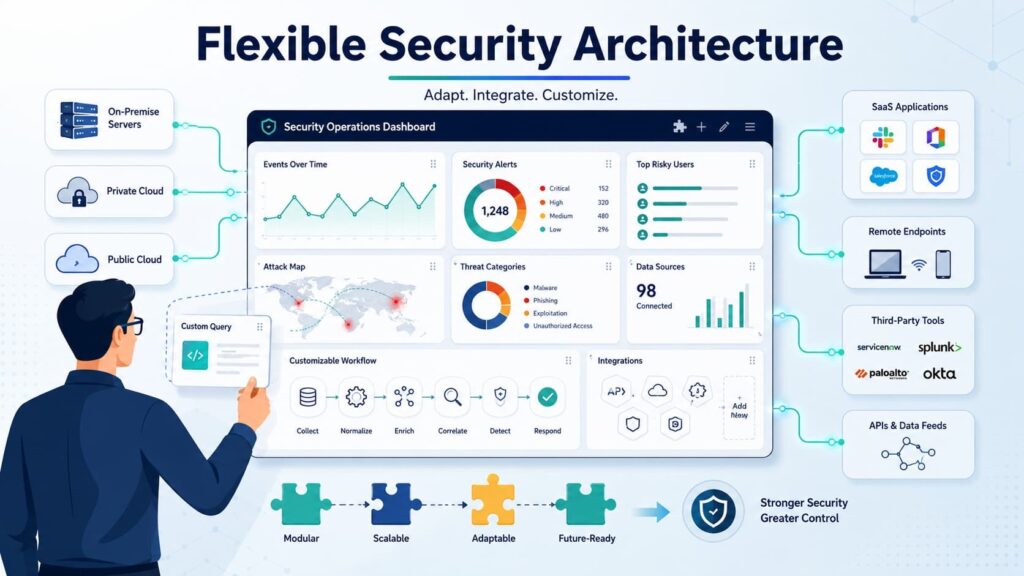
Splunk is commonly used in hybrid enterprise environments. Organizations running on-prem infrastructure, multiple clouds, and legacy technologies often appreciate the platform’s breadth.
Why do hybrid MSSPs still choose Splunk?
- Supports on-prem, AWS, Azure, and private clouds.
- Large integration ecosystem.
- Strong MITRE ATT&CK Mapping.
- Vendor independence appeals to regulated industries.
Many MSSPs map detections to the MITRE ATT&CK framework and align operations with the NIST Cybersecurity Framework to standardize threat detection and incident response processes.
The platform also supports extensive dashboard customization and advanced analytics through Search Processing Language (SPL). Analysts performing deep investigations often value that flexibility, particularly for bespoke detections.
What is the trade-off?
- Higher complexity.
- Longer deployments.
- Analysts need strong SPL skills.
Many practitioners describe SPL as powerful but demanding. Setup projects can take weeks depending on infrastructure and ingestion planning, while analyst onboarding may require dedicated training.
Is Sentinel the Better Choice for Azure-First MSSPs?
Organizations already invested in Azure and Microsoft 365 frequently experience shorter deployments because connectors, identity signals, and endpoint telemetry are readily available.
- Native integration with Microsoft 365 and Defender.
- Built-in UEBA and threat intelligence.
- Logic Apps provides automation without separate SOAR licensing.
- Free ingestion for selected Microsoft logs (such as Azure Activity, Office 365 audit, and Defender alerts) lowers costs.
Why does ecosystem alignment matter?
- Existing investments shorten deployment.
- Analysts work from familiar workflows.
- Customers avoid integration overhead.
Many Azure-first customers value Kusto Query Language (KQL) because it feels approachable for analysts transitioning from other cloud tools.
The broader ecosystem also continues evolving. As of our mid-2026 platform review, Microsoft has officially migrated key Sentinel experiences deeper into unified Defender portals, a critical change for SOC teams monitoring unified security workflows.
How Fast Can MSSPs Deploy Each Platform?
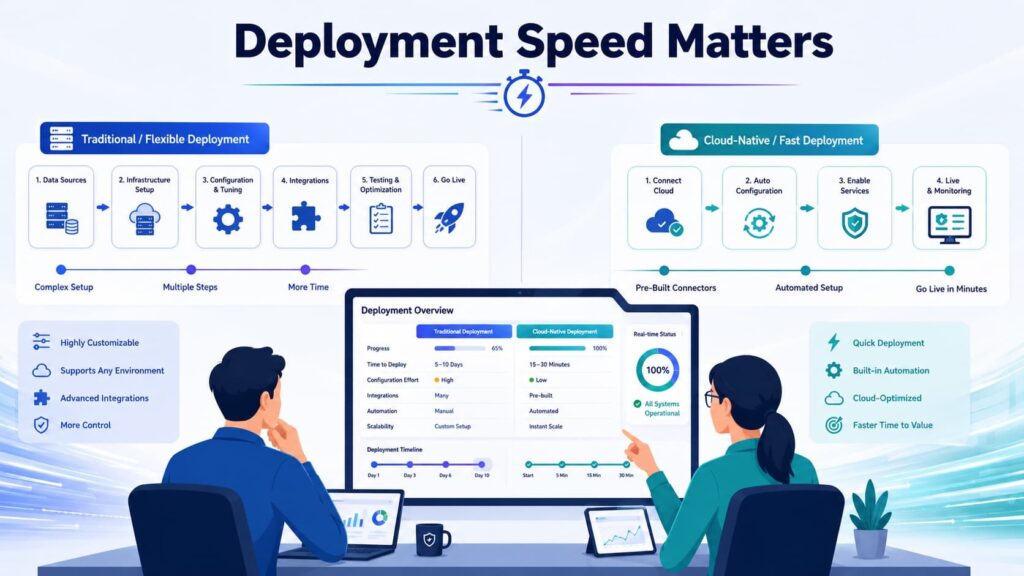
Deployment speed matters because customers rarely want a six-month onboarding project.
Does Sentinel deploy in days?
- Many practitioners report hours to days.
- KQL is widely viewed as approachable.
- Cloud-native architecture removes infrastructure setup.
Why can Splunk take longer?
- Infrastructure design matters.
- Indexing strategies require planning.
- SPL offers power but increases learning curves.
We have seen Sentinel environments become operational quickly, especially when Azure and Defender are already deployed. By contrast, Splunk projects frequently involve architecture workshops, retention planning, and indexing strategies before value becomes visible.
Of course, rapid deployment does not automatically translate into operational maturity.
What MSSP Pain Points Get Ignored in Vendor Demos?
Marketing demos usually focus on detections. Real MSSPs spend more time dealing with access controls, customer isolation, and automation failures.
- GDAP does not satisfy every MSSP isolation model.
- Some teams avoid shared administrative access.
- Sentinel portals have operational limits for very large tenant counts.
- Cross-workspace detection can require custom engineering.
- API-based rule deployments may need extensive testing.
A discussion in Microsoft’s technical community described GDAP as unsuitable for certain high-security MSSP models because “one key unlocks too many doors.” Other practitioners reported rule deployment failures caused by formatting issues inside ATT&CK mappings.
Operational maturity matters more than product features.
At MSSP Security, we often remind ourselves that tooling is only one layer of the service. Governance, detection engineering, and analyst processes usually determine outcomes.
Can Running Both Splunk and Sentinel Make Sense?
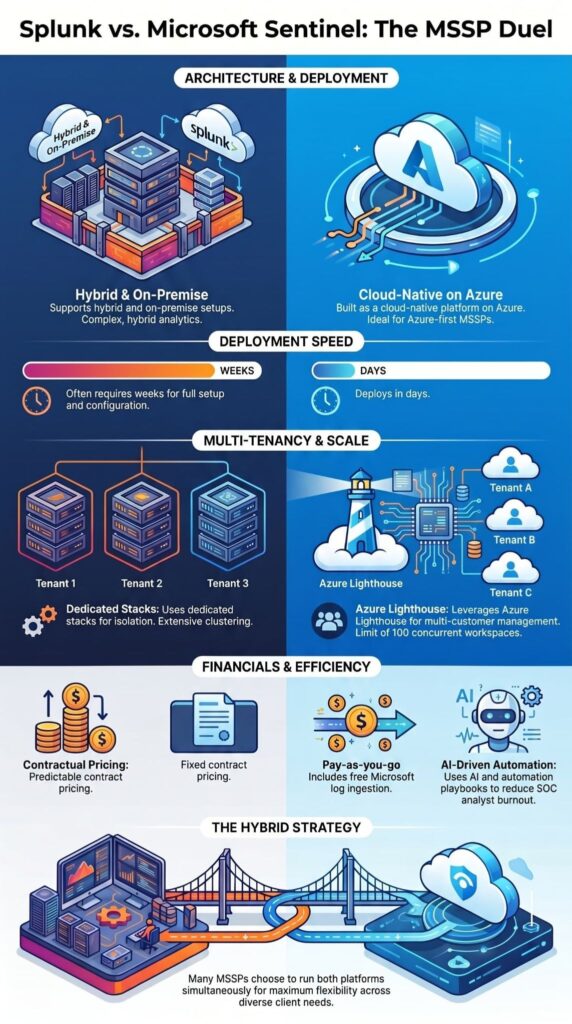
The industry increasingly accepts hybrid SIEM strategies.
When is a dual-platform SOC justified?
- Microsoft-heavy customers use Sentinel.
- Non-Microsoft telemetry lands in Splunk.
- Existing Splunk customers migrate gradually.
Example: An MSSP may centralize Defender alerts in Sentinel while keeping custom detections and legacy telemetry in Splunk.
“Capability alone is no longer the measure of a SIEM. Faster threats, AI-driven attacks, tighter budgets, and leaner teams mean organizations need platforms that fit their architecture, operating model, and investment strategy” – Kocho.
This approach is not always cheaper. It introduces additional complexity and training requirements. Still, organizations with diverse customer bases often find the flexibility worthwhile.
Which Platform Helps Reduce Analyst Burnout?
Credits: CraigCloudITPro
SOC analyst burnout is often driven by alert volume and poorly tuned detections rather than lack of tooling. Collecting more logs rarely fixes it.
According to the 2026 D3 Security report,
“70%+ of SOC analysts report burnout” – D3 Security.
In our experience, Sentinel automation playbooks can significantly reduce low-fidelity alerts before they reach analysts, although results vary depending on rule tuning and environment complexity.
- Sentinel emphasizes automation and AI-assisted investigations.
- Splunk emphasizes investigative depth.
- Excessive log collection creates alert fatigue.
- Static playbooks become shelf-ware.
What do practitioners emphasize?
- Reduce noise before adding more telemetry.
- Connect identity, endpoint, and cloud signals.
- Build repeatable response workflows.
We have learned this lesson firsthand. A noisy SIEM, no matter how advanced, overwhelms analysts quickly. Customers benefit more from clean detections and repeatable workflows than from endless dashboards.
“Tools don’t stop breaches, operational loops do.”
That observation appears repeatedly across practitioner communities, and it still rings true.
Which SIEM Should MSSPs Choose in 2026?
| Choose Splunk When | Choose Sentinel When |
| Hybrid customers dominate | Azure dominates |
| Custom detections matter | Fast deployment matters |
| Vendor independence matters | Microsoft ecosystem matters |
| Complex analytics required | Cost predictability required |
For enterprise risk management, organizations serving heavily regulated industries (such as healthcare and finance) with mixed infrastructures should invest in Splunk for its precise compliance auditing and deployment flexibility.
Meanwhile, your overarching mssp technology stack siem choice will ultimately dictate how easily your analysts can scale services across different client models. Azure-first providers frequently prefer Sentinel because onboarding is faster and costs are easier to predict.
FAQs
How does MSSP multi-tenant SIEM improve customer data separation?
An MSSP multi-tenant SIEM allows service providers to manage multiple customers while keeping their data separated and secure. Splunk multi-tenant architecture supports data segregation MSSP strategies through index-level customer access and multi-instance per customer deployments. Other platforms use logical workspace segregation instead.
MSSPs should evaluate how each architecture supports compliance requirements, customer isolation, and day-to-day operational efficiency.
Which pricing model gives MSSPs better long-term cost control?
MSSPs should compare both licensing methods and projected data growth before making a decision. Common evaluation points include pricing per GB, long-term cost, ingestion growth.
Organizations should also review Splunk annual price uplift policies and Sentinel no contract lock-in options to understand how costs may change over several years.
What skills do SOC analysts need to operate modern SIEM platforms?
SOC analysts need skills in log analysis, threat hunting, detection engineering, and incident investigation. Many teams learn Splunk Search Processing Language or Sentinel Kusto Query Language to create searches, dashboards, and detection rules.
Knowledge of MSSP detection engineering automation is also valuable because it helps analysts automate repetitive tasks, reduce SOC analyst burnout, and improve the speed and accuracy of security operations.
How can automation help reduce alert fatigue in security operations?
Automation reduces alert fatigue by filtering low-priority events and automatically executing response actions. Organizations often compare Splunk SOAR vs Sentinel Logic Apps to evaluate workflow automation features.
Capabilities such as Splunk alert fatigue reduction, Splunk risk-based alerting, Sentinel AI-driven detection, Sentinel Fusion rules, and Sentinel automation playbooks help analysts prioritize critical threats and spend more time investigating incidents that require human expertise.
What factors matter most beyond features in SIEM comparison Splunk Sentinel?
Organizations should evaluate architecture, deployment speed, ecosystem flexibility, and long-term operational costs in addition to product features.
A SIEM comparison Splunk Sentinel often includes cloud-native SIEM vs traditional SIEM approaches, Splunk enterprise scale SIEM capabilities, Sentinel cloud-first architecture, Splunk vendor independence, and Sentinel Azure vendor lock-in concerns. Companies should select the option that aligns with their technical requirements, security goals, and future growth plans.
Where Is the MSSP SIEM Market Heading?
Many MSSPs now use hybrid SIEM strategies instead of a single platform. Customers need change, threats evolve, and MSSPs need the flexibility to adapt. If you’re looking for practical guidance to simplify operations and strengthen your security stack, MSSP Security provides analysis of SIEM strategy based on real MSSP operational patterns.
The providers that succeed will focus on strong operations, smart automation, and measurable results instead of chasing features or market hype. We help MSSPs reduce tool sprawl, improve visibility, and strengthen security with threat models and risk analysis tools that support real business goals and long term growth.
References
- https://kocho.co.uk/blog/choosing-the-right-siem-microsoft-sentinel-vs-splunk-vs-qradar/
- https://d3security.com/glossary/siem-alert-fatigue/#wp–skip-link–target