

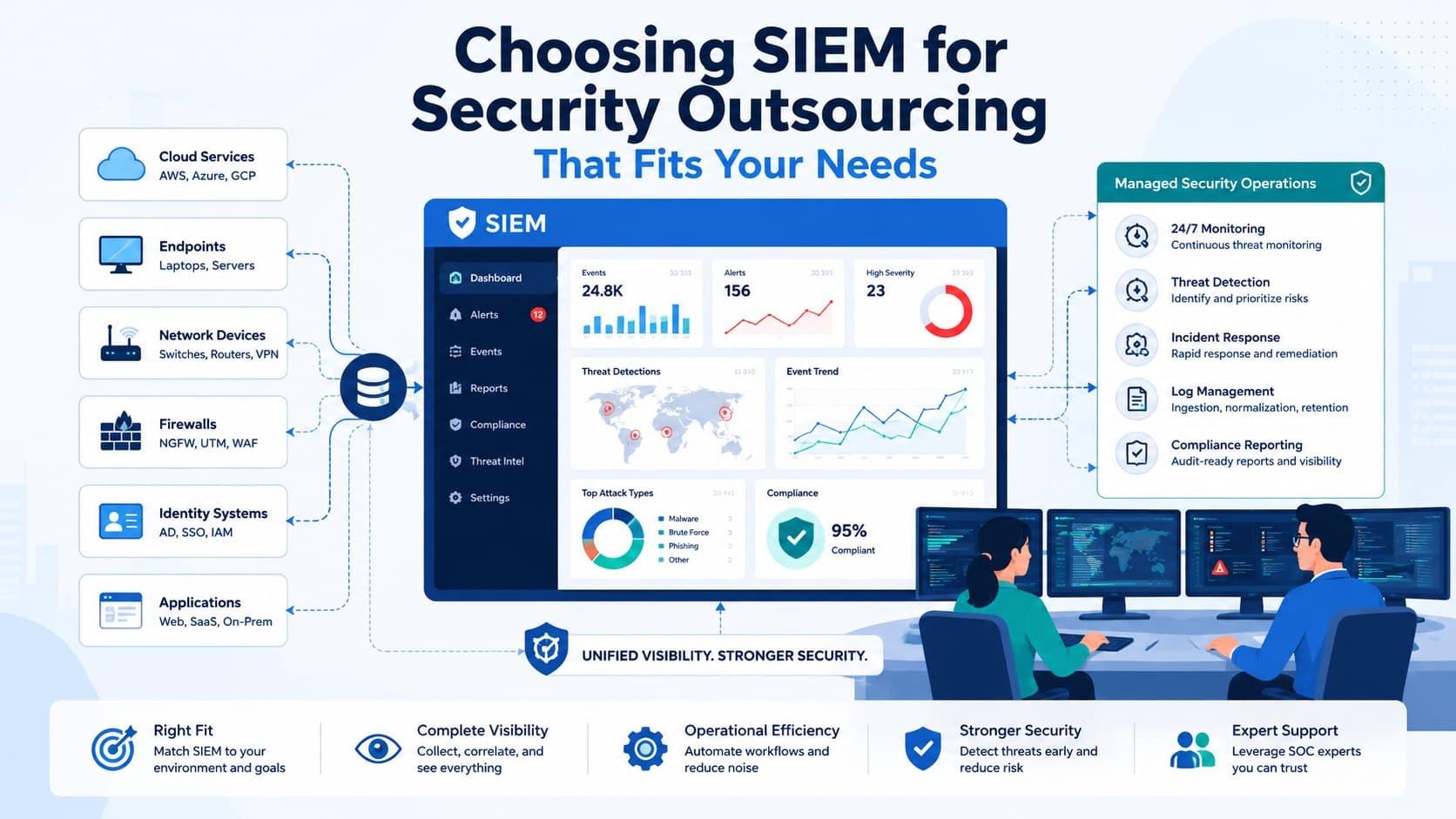
Choosing a SIEM for security outsourcing starts with finding a platform that fits your operational needs, not the most recognizable name in the market. At MSSP Security, we’ve seen organizations achieve better outcomes when their SIEM, detection workflows, and service provider are aligned with business priorities and risk exposure.
While features matter, day-to-day usability, visibility, and support often have a greater impact on success. Keep reading for a practical framework to help you choose the right SIEM for your security outsourcing strategy.
What Matters Most When Choosing a SIEM for Security Outsourcing?
Before comparing platforms, pricing, and service models, it helps to understand the factors that have the greatest impact on SIEM effectiveness and long-term security outcomes.
- Why detection quality matters more than feature lists.
- How to compare SIEM costs beyond licensing.
- Which SIEM approaches fit different security outsourcing models.
Why Is Choosing a SIEM Different When Security Is Outsourced?
Many organizations evaluate a SIEM platform as a software purchase. Security outsourcing changes that equation. The platform becomes only one component of a broader security operations strategy involving analysts, escalation procedures, threat hunting, incident response, and continuous tuning.
Industry guidance from Bulletproof emphasizes aligning the SIEM with the operating model rather than selecting software based solely on market popularity. Understanding the best siem platforms for mssp can help clarify which options excel in a collaborative environment. As an ISACA Journal analysis of SIEM challenges notes,
“This gap is the root cause of some skepticism with and disappointment in SIEM,” and that it is a “common misconception that a SIEM system is the essential component for SIEM infrastructure” – ISACA.
The infrastructure is a system of people, processes, and technology, not just the platform itself.
In outsourced SOC environments, buyers should assess:
- SOC maturity
- Detection engineering expertise
- Alert triage capabilities
- Escalation workflow quality
- Managed detection response services
A common misconception is that advanced features automatically improve security outcomes. In practice, alert fatigue and poor rule tuning frequently create larger problems than missing capabilities. Before evaluating vendors, ask one important question: Who owns use case development and detection engineering after deployment?
What changes when a provider runs the platform?
When an MSSP operates the SIEM, responsibilities expand beyond log management. The provider often manages alert triage, correlation rules, enrichment, incident escalation, and threat intelligence integration. Organizations should understand where provider responsibilities end and internal ownership begins.
Why can a great SIEM still produce poor outcomes?
A powerful SIEM platform cannot compensate for weak security operations.
We have seen organizations deploy expensive solutions only to struggle with excessive false positives because correlation rules were never tuned to their environment. Strong security monitoring depends on operational discipline as much as technology. According to independent research by CardinalOps,
“organizations are often unaware of the gap between the theoretical security they assume they have and the actual security they get in practice” – Global Security Mag.
What Business Problems Should Your SIEM Solve First?
Many SIEM projects fail because organizations attempt to solve every security challenge simultaneously. Instead, prioritize the risks that create the greatest business impact.
Are endpoint threats your biggest concern?
Endpoint telemetry should receive early attention if ransomware, insider threats, or lateral movement represent primary risks.
In our experience, identity logs and endpoint telemetry often account for the majority of high-confidence detections during the first phase of SIEM deployment.
Key capabilities include:
- EDR integration
- Endpoint telemetry collection
- Behavioral analytics
- Threat hunting support
Is identity risk driving your security strategy?
Identity attacks continue to rise across cloud environments.
Organizations heavily invested in Microsoft technologies often prioritize:
- Azure AD monitoring
- Entra ID telemetry
- Privileged account activity
- Identity-based attack detection
Do compliance requirements affect SIEM selection?
Compliance requirements frequently shape retention policies and reporting needs.
| Requirement | Validation Question |
| Audit logs | Are logs retained properly? |
| Residency | Where is data stored? |
| Reporting | Are compliance reports automated? |
Security analysts repeatedly identify incomplete telemetry as a significant contributor to SIEM failure and missed detections.
Which Log Sources Must Be Covered Before You Buy?
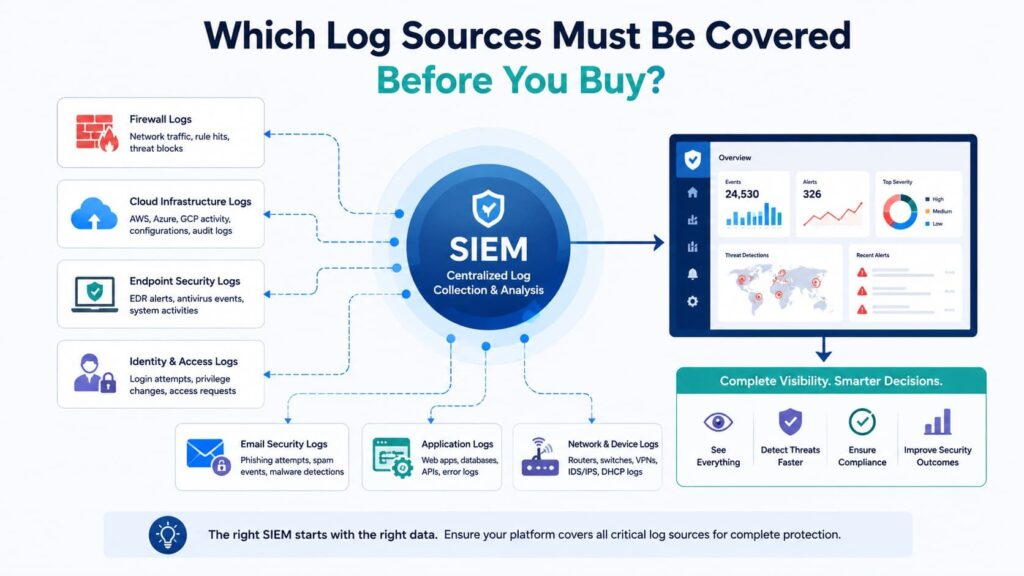
The quality of security analytics depends heavily on telemetry coverage. A SIEM platform with incomplete visibility cannot generate accurate correlations.
Can the SIEM ingest all critical telemetry?
Required log sources typically include:
- Endpoints
- Identity systems
- Firewalls
- VPN infrastructure
- Cloud services
- SaaS applications
- Network telemetry
Wazuh and other modern SIEM platforms support broad ingestion capabilities, but validation should occur before purchase decisions. Determining how these logs integrate into your infrastructure forms a foundational component of your overall mssp technology stack siem choice.
Organizations often underestimate integration complexity. API integration, log parsing, normalization, and enrichment requirements can significantly affect deployment timelines.
What happens when telemetry is incomplete?
Incomplete visibility often leads to:
- Missed attack detection
- Weak event correlation
- Inaccurate behavioral analytics
- Reduced threat hunting effectiveness
For example, if identity logs are not collected, suspicious login activity may never be correlated with endpoint behavior, leaving attackers undetected for longer periods.
Current guidance recommends onboarding high-value log sources first rather than ingesting every available data source immediately.
How Important Is Detection Quality Compared to Features?
How can you validate detection coverage?
Detection quality is not only about the number of alerts a SIEM generates. Organizations should also evaluate whether their detections cover the attack techniques most relevant to their environment.
Many security teams map detection rules against known adversary behaviors to identify visibility gaps and improve detection coverage. This process helps identify visibility gaps, prioritize new detections, and validate whether critical attack techniques are being monitored.
Common validation areas include:
- Credential access
- Privilege escalation
- Lateral movement
- Command and control activity
- Data exfiltration
Coverage validation often provides a more realistic measure of SIEM effectiveness than dashboard features alone. Coverage validation is only one part of detection effectiveness. Security teams must also evaluate the quality and operational usefulness of the alerts generated by the SIEM.
Security teams rarely suffer from insufficient dashboards. They often struggle with poor signal quality.
What causes alert fatigue?
The most common causes include:
- Excessive false positives
- Poorly tuned correlation rules
- Weak enrichment processes
- Incomplete context during investigations
Alert fatigue is widely recognized as one of the most common SIEM operational challenges. A SIEM generating thousands of low-value alerts can overwhelm analysts and increase workload. A SIEM generating thousands of low-value alerts can overwhelm analysts and increase analyst workload.
How can you measure detection quality?
| Indicator | What Good Looks Like |
| False Positive Rate | Low alert noise |
| Investigation quality | Actionable context and enrichment |
| Escalation speed | Clearly defined SLAs |
From our experience, organizations should ask vendors to demonstrate detection effectiveness using actual telemetry rather than generic dashboards. Good detection engineering often delivers more value than advanced feature catalogs.
What Does a Managed SIEM Provider Actually Handle?
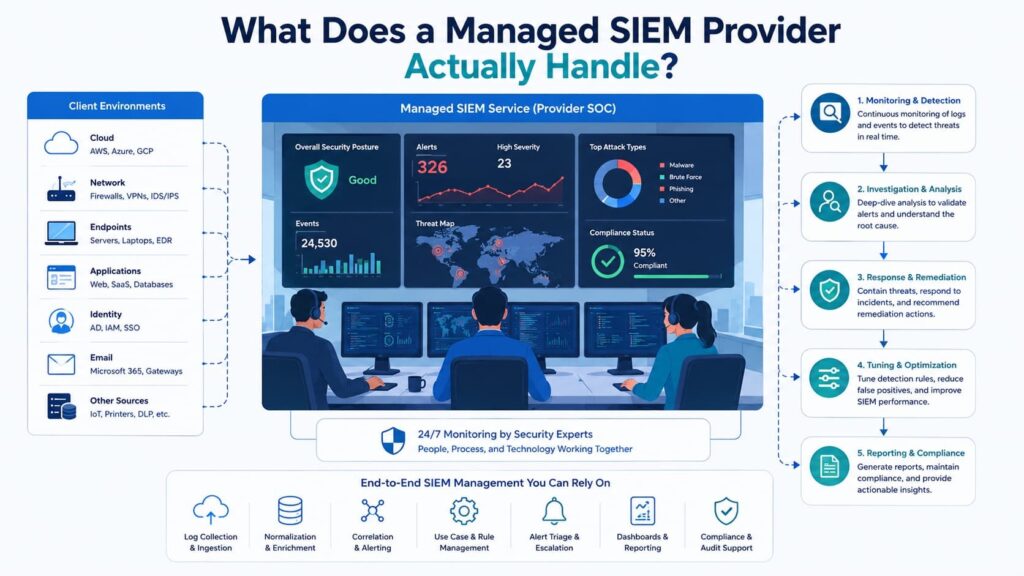
Managed SIEM, outsourced SOC, and SOC as a service offerings frequently look similar on paper. Operational reality differs considerably. When evaluating potential vendors, it helps to look at Comparing SIEM Platforms MSSP Uses to see how various engines process workloads and support multi-tenancy.
Do they only alert or actively investigate?
Common service tiers include:
- Alert forwarding
- Alert triage
- Investigation
- Threat hunting
- Containment support
Not every managed security provider offers the same depth of service.
Who owns tuning after deployment?
Possible ownership models include:
- Internal security team
- Provider-managed
- Shared responsibility
At MSSP Security, we frequently see organizations focus on SIEM functionality while overlooking escalation workflows. Yet incident escalation quality often determines whether a threat becomes a manageable event or a major breach. Documented escalation workflows should always be part of vendor evaluation.
How Should You Compare SIEM Pricing Models?
SIEM pricing can appear straightforward during procurement. Long-term operations often tell a different story.
What costs are usually overlooked?
| Cost Area | Hidden Risk |
| Data ingestion | Increased cloud logging volume |
| Retention | Long-term compliance storage |
| Integrations | Connector and API licensing |
| Consulting | Deployment and migration projects |
| Training | Analyst onboarding and certification |
Can consumption pricing become expensive?
Several factors influence costs:
- Rapid telemetry growth
- Extended retention policies
- Increased cloud adoption
- New compliance requirements
Microsoft Sentinel uses ingestion-based pricing models that may improve predictability for some organizations while creating challenges for others depending on log growth patterns. Industry guidance consistently warns that operational costs frequently exceed original licensing assumptions.
Which SIEM Fits Your Outsourcing Model Best?
Different operating models create different requirements.
| Scenario | Strong Fit |
| Microsoft-centric environment | Microsoft Sentinel |
| Google ecosystem | Google Security Operations |
| Flexible deployment needs | Wazuh Cloud |
| Minimal internal SOC | Managed SIEM Service |
When is Microsoft Sentinel a strong choice?
Organizations heavily invested in Azure often benefit from native cloud SIEM integration, centralized logging, and cloud-native scalability.
When should you consider Google Security Operations?
Google Security Operations is often attractive for organizations processing large-scale cloud logs and requiring integrated threat intelligence capabilities.
Why do some teams prefer Wazuh?
Wazuh provides deployment flexibility through cloud, hybrid SIEM, and self-managed models. Organizations seeking more control over infrastructure frequently view this flexibility favorably.
Should Small Teams Outsource SIEM Operations?
Credits: Technically U
Building an internal SOC requires significant investment. Many organizations struggle to maintain continuous monitoring and incident response coverage.
What are the benefits for lean security teams?
Pros:
- Faster deployment
- Continuous monitoring
- Experienced analysts
- Threat hunting expertise
Cons:
- Less direct control
- Provider dependency
- Escalation quality concerns
What do practitioners say about SIEM complexity?
Security communities consistently discuss:
- Staffing shortages
- Deployment burden
- Migration complexity
- Ongoing tuning requirements
Security practitioners frequently report challenges with SIEM complexity, alert fatigue, and operational overhead, particularly when detection engineering resources are limited.
Why Is SIEM Migration Harder Than Most Buyers Expect?
Migration projects rarely finish as quickly as expected. Historical data retention requirements alone can extend migration timelines significantly.
How long can migrations take?
Factors include:
- Log retention obligations
- Rule recreation
- Validation testing
- Data normalization efforts
What causes migration projects to stall?
Common obstacles include:
- Staffing constraints
- Compliance obligations
- Integration complexity
- Query performance issues
Many organizations underestimate how difficult SIEM migration becomes once years of audit trails and custom detections are involved. Budgeting for overlap between old and new environments is usually wise.
How Can You Validate a Vendor Before Signing?
A polished sales presentation rarely predicts operational success. Proof matters.
What should a proof of concept include?
- Real log sources
- Real detections
- Escalation testing
- Reporting validation
- Incident workflow reviews
Which questions expose weak providers?
Ask:
- Who tunes detections?
- How are false positives reduced?
- What happens after hours?
- How does incident escalation work?
- Who owns correlation rules?
At MSSP Security, we often recommend beginning with prioritized telemetry sources rather than full-scale ingestion. This approach reduces costs while validating detection value before expansion. Security guidance supports proving value with prioritized onboarding before broader deployment.
What Is the Safest Decision Framework for Most Organizations?
Many procurement teams reverse this sequence. The better approach focuses on outcomes.
Do you need software or operational outcomes?
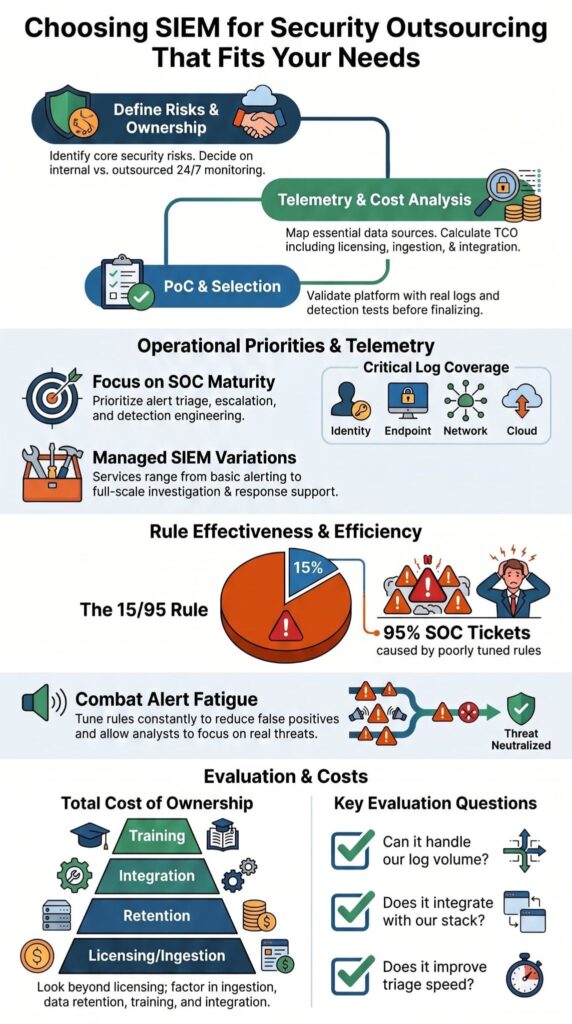
Decision sequence:
- Define risks.
- Define ownership.
- Validate telemetry.
- Compare costs.
- Run a proof of concept.
- Select the platform.
Which trade-off matters most: cost, control, or coverage?
- Lower cost → Managed service
- More control → Hybrid model
- Faster coverage → Managed SIEM
Organizations that prioritize process maturity often achieve stronger long-term security outcomes regardless of platform selection.
FAQs
How do I know if a managed SIEM is right for my security outsourcing strategy?
A managed SIEM is a good option when your organization cannot provide continuous security monitoring, alert triage, threat detection, and incident response with internal staff alone. It combines log management, event correlation, and security analytics with expert oversight.
If your team struggles to investigate alerts quickly or maintain 24/7 monitoring, a managed SIEM can improve security operations while reducing the burden on internal analysts.
What should I compare when evaluating an outsourced SOC provider?
Compare the provider’s threat detection processes, incident response procedures, escalation workflow, compliance reporting capabilities, and service-level commitments. Ask how they perform rule tuning, use case development, detection engineering, and threat hunting. You should also verify how they handle false positives and incident escalation.
These operational factors often have a greater impact on security outcomes than the underlying technology alone.
How can I estimate the total cost of SIEM ownership?
Calculate costs across several categories, including SIEM pricing, ingestion costs, data retention, implementation services, and ongoing management. Review how much data will be collected through centralized logging and how long it must be stored to meet security compliance requirements.
Compare cloud SIEM and hybrid SIEM deployment models because storage, scalability, and operational expenses can differ significantly between them.
Which data sources should be connected to a SIEM first?
Organizations should first connect identity logs, endpoint telemetry, network telemetry, and cloud logs because these sources provide visibility into user activity, device behavior, network traffic, and cloud environments. Effective log aggregation, data normalization, log parsing, and enrichment help improve event correlation and attack detection.
These foundational data sources support faster investigations and more accurate threat detection across the environment.
What questions should I ask before a SIEM implementation project?
Ask how the SIEM implementation will support security compliance, regulatory requirements, retention policy objectives, and future scalability. Request details about deployment simplicity, query performance, API integration options, and security dashboard customization.
You should also discuss proof of concept requirements, vendor evaluation criteria, automation workflows, and SIEM migration planning to ensure the platform can support long-term security monitoring needs.
What Should You Remember Before Making the Final Choice?
Choosing a SIEM for security outsourcing is ultimately an operational decision. Technology matters, but detection quality, response processes, and ongoing tuning often matter more. Whether you’re evaluating Microsoft Sentinel, Google Security Operations, Wazuh, or a managed SIEM service, focus on measurable outcomes.
Use real telemetry, validate workflows, and run a proof of concept before committing. Organizations that prioritize process before platform are often better positioned to build effective security operations. If you need support with product selection, audits, or PoC evaluations, MSSP Security can help you make informed decisions based on operational needs.
References
- https://www.isaca.org/resources/isaca-journal/issues/2016/volume-3/going-beyond-the-technical-in-siem
- https://www.globalsecuritymag.fr/CardinalOps-Research-Finds-Poor,20210210,108124.html