

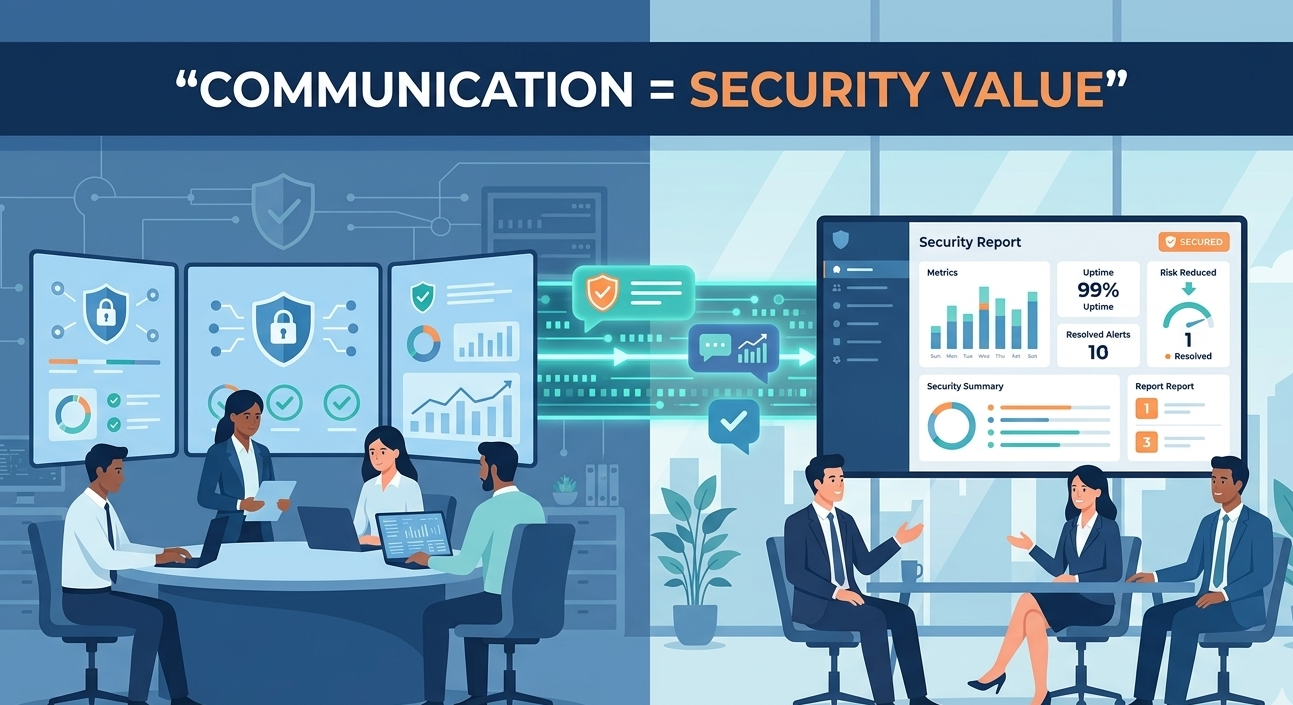
Think of your last major security incident. Was the worst part the technical scramble, or the frantic, confused call from your client? For most MSSPs, it’s the latter. A strong MSSP client communication strategy isn’t just polite, it’s your primary tool for proving value, managing risk, and building unbreakable trust.
It turns you from a vendor into a true security partner. If you want to keep clients for the long term, you need to master this. Keep reading to learn how.
Quick Insights That Matter
Before diving deeper, here are the core ideas you should keep in mind.
- Communication builds the trust that retains clients and justifies your monthly fee.
- Proactive, jargon-free updates prevent incidents and demonstrate continuous value.
- A documented strategy with clear roles and channels is your first line of defense.
The Boardroom Moment That Changed Everything
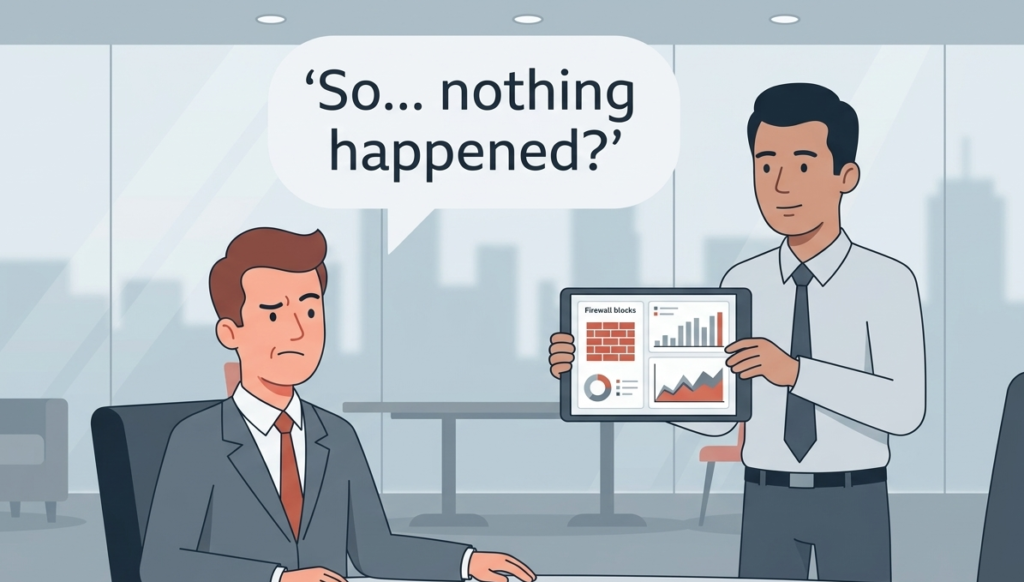
I remember sitting in a client’s boardroom, the air thick with a different kind of tension. It wasn’t about a breach, not yet. It was about the quarterly report I’d just presented. Charts showed blocked threats, patches applied, all the good work. But the CFO’s eyes glazed over.
He finally said, “So, you’re saying we pay you this much, and… nothing happened?” That was the moment it crystallized. Our technical work was flawless, but our communication was a failure.
We were a cost, not a partner. That changed everything for us at MSSP Security. We learned that what you say, and how you say it, is as critical as the alerts on your SOC screen.
Why Talking Well is Your Best Security Control
Credits: Strategy Tips – Julian Cole
You can have the finest tools, the sharpest analysts. Without clear communication, it’s a castle built on sand. Clients don’t see the thousand attacks you stop daily. They see an invoice and a report they might not understand.
The gap between your perception of value and theirs is where churn lives. Designing a thorough client communication strategy bridges that gap. It translates your work into their language: risk managed, sleep preserved, business secured.
A good strategy does three things. It educates, it reassures, and it justifies. Think of it as a continuous proof of concept for your service.
What this looks like in practice:
- A monthly briefing that links your activity to their business goals.
- An immediate, calm call during an incident that says, “We’re on it, here’s what you need to do.”
- A quarterly business review that shows ROI, not just IOA (Indicators of Attack).
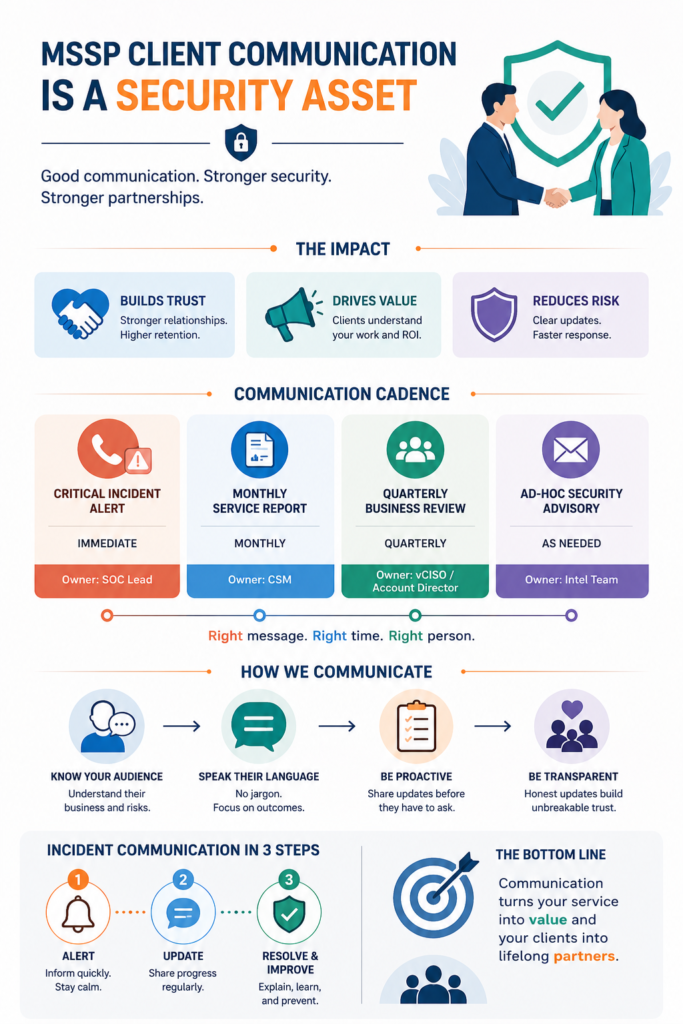
We structure our client touchpoints not as chores, but as trust-building exercises. The cadence isn’t random.
| Communication Type | Frequency | Channel | Owner | Goal |
| Critical Incident Alert | Immediate | Phone Call, then Email | SOC Lead | Instruct, calm, and lead. |
| Monthly Service Report | Monthly | PDF + 30-min call | CSM | Translate data into business value. |
| Quarterly Business Review | Quarterly | In-person/Video | vCISO/Account Dir. | Align security with business strategy. |
| Ad-hoc Security Advisory | As needed | Email Newsletter | Intel Team | Proactive education on new threats. |
This table isn’t just a schedule, it’s a promise. It tells the client exactly when they’ll hear from us and why. No surprises.
Building the Strategy: Proactive Beats Reactive Every Time
The worst time to test your communication plan is during a crisis. It must be built in calm times, practiced, and ingrained. Start by establishing communication channels and defining the “who.” Who calls the client for a critical alert? Who sends the monthly report?. Confusion here causes delays, and in security, delays are measured in dollars lost.
“Dashboards, maturity scores and technical metrics can demonstrate effort, but they rarely help executives understand what actually matters… Boards want to understand which scenarios matter most, how much exposure exists and how proposed investments reduce that exposure in practical terms.” – ISACA
At MSSP Security, we designate a primary Client Success Manager (CSM) for every account. They are the conductor, the consistent voice. The SOC provides the facts, the CSM provides the context.
Next, define the “what” and “when.” Not every event merits a 2 a.m. phone call. We use a severity matrix.
- Severity 1 (Critical): System down, active breach. Immediate phone call, followed by written summary.
- Severity 2 (High): Major vulnerability, compromised credential. Phone call within 1 hour.
- Severity 3 (Medium): Failed phishing campaign, non-critical patch. Email within 4 business hours.
- Severity 4 (Low): Informational items, scheduled maintenance. Included in regular report.
This manages client expectations and prevents alert fatigue. They know a phone call means business.
Finally, master the “how.” This is where jargon goes to die. You’re not “remediating a lateral movement path.” You’re “stopping the hacker from getting to your financial server.” Use analogies they know. Explain a firewall as a club bouncer, checking IDs. Explain multi-factor authentication as needing a key and a fingerprint to open a safe. It sticks.
The Language of Partnership: From Technical Speak to Business Talk
This is the heart of it. You must stop reporting on tasks and start reporting on outcomes. We made this shift after that disastrous boardroom meeting. Our old report listed: “146,789 firewall blocks, 2,357 malware detections.” Impressive to us, noise to them.
Our new report leads with: “Protected against 3 major ransomware campaigns targeting your industry this month. Ensured 99.99% uptime for your customer-facing application.” See the difference? One is a list of our work. The other is a statement of their safety.
We frame everything around their business risks. Instead of “applied patches,” we say “reduced the risk of a data breach from the recent critical Windows vulnerability by 95%.” We use their metrics.
For a retail client, we talk about protecting customer credit card data during the holiday surge. For a law firm, we talk about safeguarding client attorney privilege. You have to do the homework to make this link, but it’s the only homework that matters.
It also means being honest about what you don’t do. Setting clear boundaries is a communication skill. If a client asks for something outside scope, like configuring a non-managed server, we don’t just say no. We say, “That server falls outside our managed perimeter, which means we can’t guarantee its security posture.
Here’s what we recommend to bring it under our protection, or here’s how you can secure it yourself.” It’s transparent, it’s advisory, and it often leads to an upsell, not a conflict.
Transforming Incidents into Trust-Building Moments
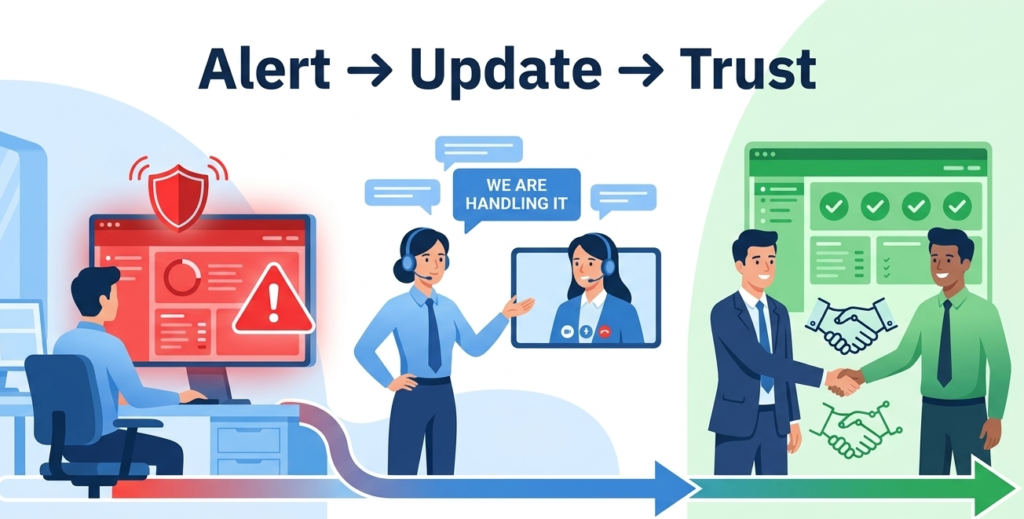
An incident is the ultimate test. Panic is natural, but having a solid incident notification communication routine allows your first message to set the tone. It must be immediate, clear, and instructional. The call starts with, “This is [Name] from MSSP Security.
We’ve detected a potential security incident. We are actively responding. Here are your next three steps.” You lead. You own it.
Then, you over-communicate. Silence during an incident is terrifying. We provide hourly updates, even if the update is “no change, still working.” It tells the client they haven’t been forgotten. The post-incident report is your final, crucial piece. It shouldn’t be a CYA document.
“A lack of clear procedures, lack of coordination, and lack of clear definitions of responsibility and authority can lead to failures when managing a real-time cyber incident.” – NIST
It should be a story: what happened, how we found it, how we stopped it, and most importantly, how we’ll prevent it next time. This turns a failure (the breach) into a demonstration of your competence (the response).
We once handled a severe phishing attack that compromised a client’s executive email. It was messy. But our post-mortem didn’t hide the details. We walked them through the attacker’s steps, showed where our controls caught some things and where they were bypassed, and laid out a 5-point plan involving better email filtering and user training.
FAQ
What is an MSSP client communication strategy?
It is a structured plan that defines how and when a Managed Security Service Provider communicates with clients during normal operations and security incidents.
Why is communication important in cybersecurity services?
Because clients cannot directly see security work, communication is how MSSPs demonstrate value, build trust, and reduce panic during incidents.
How often should MSSPs communicate with clients?
Typically through layered intervals: real-time alerts for incidents, monthly reports for performance, and quarterly reviews for strategic alignment.
What should be avoided in MSSP client communication?
Avoid jargon, overly technical explanations, inconsistent updates, and unclear escalation paths that confuse clients during critical events.
Making Communication Your Foundation
Your client communication strategy is a core security function. It manages human risk, builds trust, and secures stable revenue. To improve, document your process, gather client feedback, and run communication-focused tabletop exercises so you can act with prepared confidence.
Ready to audit your playbook? We offer expert MSSP consulting to streamline operations, optimize your stack, and boost service quality using our 15+ years of experience. Join MSSP security today for tailored guidance.
References
- https://www.isaca.org/resources/news-and-trends/isaca-now-blog/2026/five-questions-cybersecurity-professionals-will-need-to-answer-in-2026
- https://nvlpubs.nist.gov/nistpubs/ir/2022/NIST.IR.8428.pdf