


A security tool gap analysis tools an organization currently uses. It compares these tools against the company’s security risks, standards, and business needs. NIST CSF 2.0 offers a clear guide for this review. Runtime validation goes a step further by testing if existing controls actually work.
At MSSP Security, we focus on coverage instead of tool count. What matters most is what your team can protect, detect, investigate, and recover from. Read on to see how this process works in practice.
Security Quick Reads
A clear look at security gaps, system complexity, and validation steps to see if your defenses actually work.
- Identify missing, overlapping, or ineffective security capabilities.
- Tool sprawl can fragment visibility and increase operational complexity.
- Runtime validation confirms deployed controls actually work.
How Does a Security Tools Technology Gap Analysis Work?

A security tools technology gap analysis compares required security capabilities with the tools, configurations, integrations, and operational processes already in place to identify gaps in the current security posture.
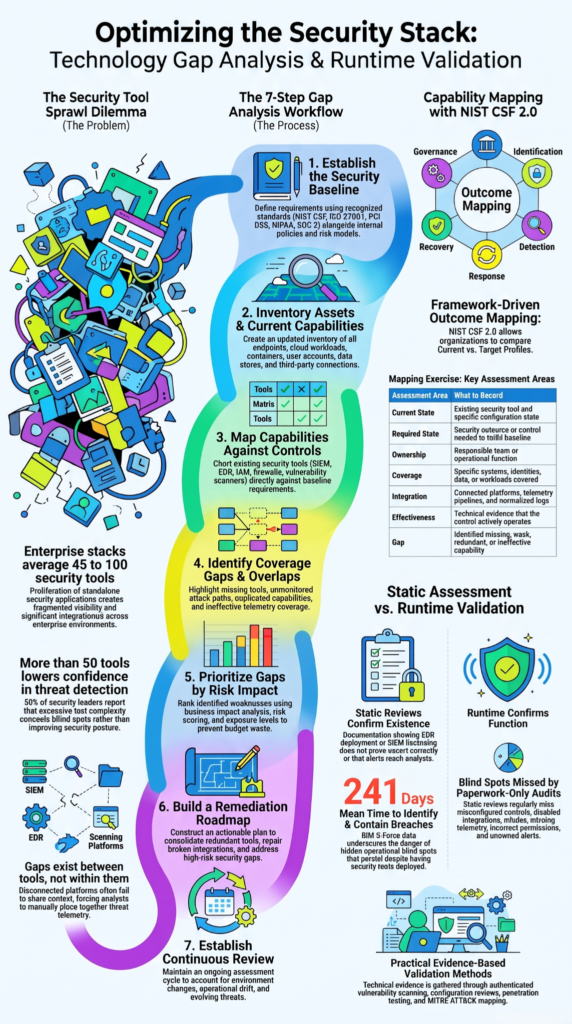
First, establish your security baseline. You can base this on industry standards like NIST, ISO 27001, PCI DSS, HIPAA, and SOC 2. It should also cover internal security policies, contract rules, and major business risks.
Next, we make a clear and updated list of all assets. It includes endpoints, servers, and user accounts. It also covers applications, cloud workloads, and network systems. Lastly, it tracks containers, data stores, and third-party connections.
Next, we match your current security tools to these requirements. These tools can include SIEM, EDR, IAM, firewalls, vulnerability scanners, cloud security tools, and monitoring platforms. This step shows what is already protected. It also reveals gaps and highlights areas that need a closer look.
The core workflow is straightforward:
- Define the required security baseline.
- Inventory existing security tools and capabilities.
- Map capabilities against required controls.
- Identify missing, overlapping, or ineffective coverage.
- Prioritize gaps using risk and business impact.
- Build a remediation roadmap.
- Establish continuous review.
Assessments become more useful when they move beyond simple checklists. They should record ownership, integration status, configuration state, telemetry coverage, and operational use.
Why Does Security Tool Sprawl Create Technology Gaps?
Credit: IBM Technology
Security tool sprawl creates gaps by adding fragmented visibility, duplicated features, integration headaches, and extra analyst work. We’ve seen MSSPs struggle with this while selecting and auditing new tools isn’t always better.
Studies show enterprises using 45 to 100 tools face bigger challenges. Organizations with over 50 tools report weaker confidence in threat detection. Half of security leaders say complexity hides blind spots.
A scanner might spot an open asset, an EDR track endpoints, and SIEM log events. But none share enough context, so teams must connect the dots themselves.
More tools can boost capability on paper but don’t always lift security equally. The gaps lie between tools, not within them.
Our gap analysis covers:
- Redundant features
- Fragmented data
- Failed integrations
- Alert overload
- Complex setups
- Unused functions
At MSSP Security, we look at consolidation only after mapping tools, capabilities, and risks. This helps reduce tool sprawl without creating new security gaps.
How Can You Map Security Tools Against NIST CSF 2.0?
NIST CSF 2.0 gives a clear way to map security tools to goals across governance, identification, protection, detection, response, and recovery. We often use it with MSSPs to tie tools directly to measurable outcomes, not just inventories.
As highlighted by NIST
“Identifying and analyzing the differences between the Current and Target Profiles enables an organization to find gaps and develop a prioritized action plan for addressing those gaps.” –NIST
| Assessment Area | What to Record |
| Current state | Existing tool and configuration |
| Required state | Security outcome or control needed |
| Ownership | Responsible team or function |
| Coverage | Systems, identities, data, or workloads covered |
| Integration | Connected platforms and telemetry |
| Effectiveness | Evidence that the control operates |
| Gap | Missing, weak, redundant, or ineffective capability |
For example, an MSSP might have IAM but lack privileged access monitoring in the cloud. The tool’s present, but the control isn’t complete.
This applies to SIEM, EDR, XDR, DLP, vulnerability management, and incident response too. NIST’s framework also links to other cybersecurity best practices, helping MSSPs match controls to their risk and architecture.
We’ve found NIST CSF 2.0 a practical map for MSSPs to spot and fix gaps, while a readiness assessment helps identify security requirements.
Why Should Runtime Effectiveness Be Validated Beyond Compliance?
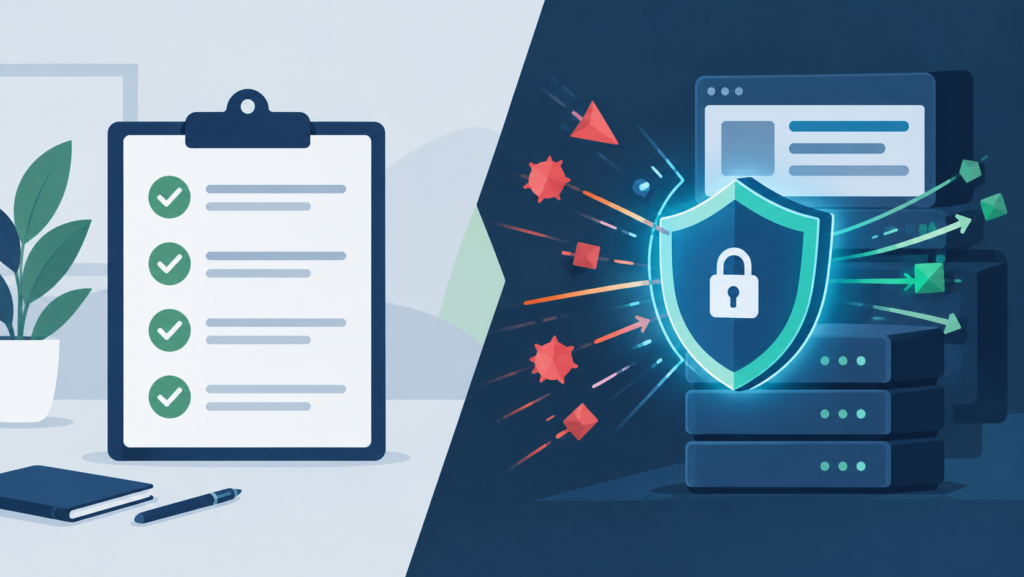
Static security assessments confirm that a control exists. Runtime validation tests whether that control actually works in its specific environment. This distinction is vital. Documentation may show an EDR platform is deployed, but it does not prove endpoints are reporting correctly. Similarly, a SIEM may be licensed without confirming that logs arrive, normalize, trigger detections, and reach analysts.
Research from IBM X-Force shows
“Organizations were able to identify and contain a breach within a mean time of 241 days, the lowest it’s been in nine years.” –IBM X-Force
The supplied research identifies this problem as a difference between architectural coverage and dynamic runtime coverage. Configuration reviews can miss disabled integrations, unmonitored attack paths, ownership problems, and visibility failures, making remediation harder to prioritize.
Our practical approach is to connect documentation with technical evidence. That can include authenticated vulnerability scanning, configuration reviews, penetration testing, manual verification, and MITRE ATT&CK mapping.
What Can Static Reviews Miss?
Static reviews can miss operational conditions that change after deployment, including:
- Misconfigured security controls
- Disabled integrations
- Missing telemetry
- Unmonitored attack paths
- Incorrect access permissions
- Unowned alerts
- Incomplete cloud or identity coverage
A tool may show 100% deployment while only a portion of the environment actually reports usable telemetry.
How Can Runtime Validation Strengthen the Assessment?
Runtime validation checks whether security controls perform under real operating conditions. A vulnerability assessment identifies potential weaknesses. Penetration testing determines if those weaknesses can be exploited.
Information Security Stack Exchange research confirms that these methods answer different questions through broad scanning and deep validation.
Pro tip: Tool deployment demonstrates capability availability, not necessarily effective protection.
Of course, not every organization needs an immediate red-team exercise for every gap. The depth of testing should match the risk, exposure, business impact, and available evidence.
That distinction keeps the technology gap analysis focused on security outcomes rather than paperwork. The next step is separating genuine weaknesses from scanner noise, where contextual validation becomes just as important as automated discovery.
FAQs
What should a technology gap analysis include when reviewing an organization’s security posture?
A technology gap analysis should review security controls, asset inventory, and threat detection. It must also cover vulnerability management, security architecture, compliance requirements, and risk management.
How does a cybersecurity gap analysis identify weaknesses in security tools?
A cybersecurity gap analysis compares your existing tools with your security requirements. It identifies weaknesses in threat detection, security monitoring, access control, and incident response.
When should a security assessment include vulnerability assessment and threat modeling?
A full security assessment should also include vulnerability assessments and threat modeling. These steps help identify exploitable weaknesses and evaluate your attack surface.
How can organizations prioritize security gaps without unnecessarily increasing the security budget?
You can prioritize security gaps using several methods. These include risk scoring, business impact analysis, cost of risk, and remediation planning. This approach ensures you address the most significant weaknesses first.
Which frameworks can organizations use to measure security maturity and support compliance monitoring?
Organizations can use frameworks like NIST CSF, ISO 27001, PCI DSS, HIPAA, and SOC 2. These help evaluate security maturity, establish governance, and monitor compliance.
Build a Stronger Security Stack With Technology Gap Analysis
Security tools often leave gaps or overlap. This makes it difficult to assess your current protection level. A technology gap analysis compares your security stack against your business needs, risks, and required standards. NIST CSF 2.0 can also help identify areas that need attention. More tools don’t always mean better protection.
Want to improve your security stack with practical guidance? Expert MSSP consulting can help reduce tool sprawl, improve integration, and support better technology decisions. Get the right guidance to build a security stack that aligns with your operational needs and business goals.
References
- https://www.ibm.com/think/x-force/2025-cost-of-a-data-breach-navigating-ai?gh_jid=7171045?
- https://www.ipa.go.jp/security/reports/oversea/nist/ug65p90000019cp4-att/begoj9000000d412.pdf