

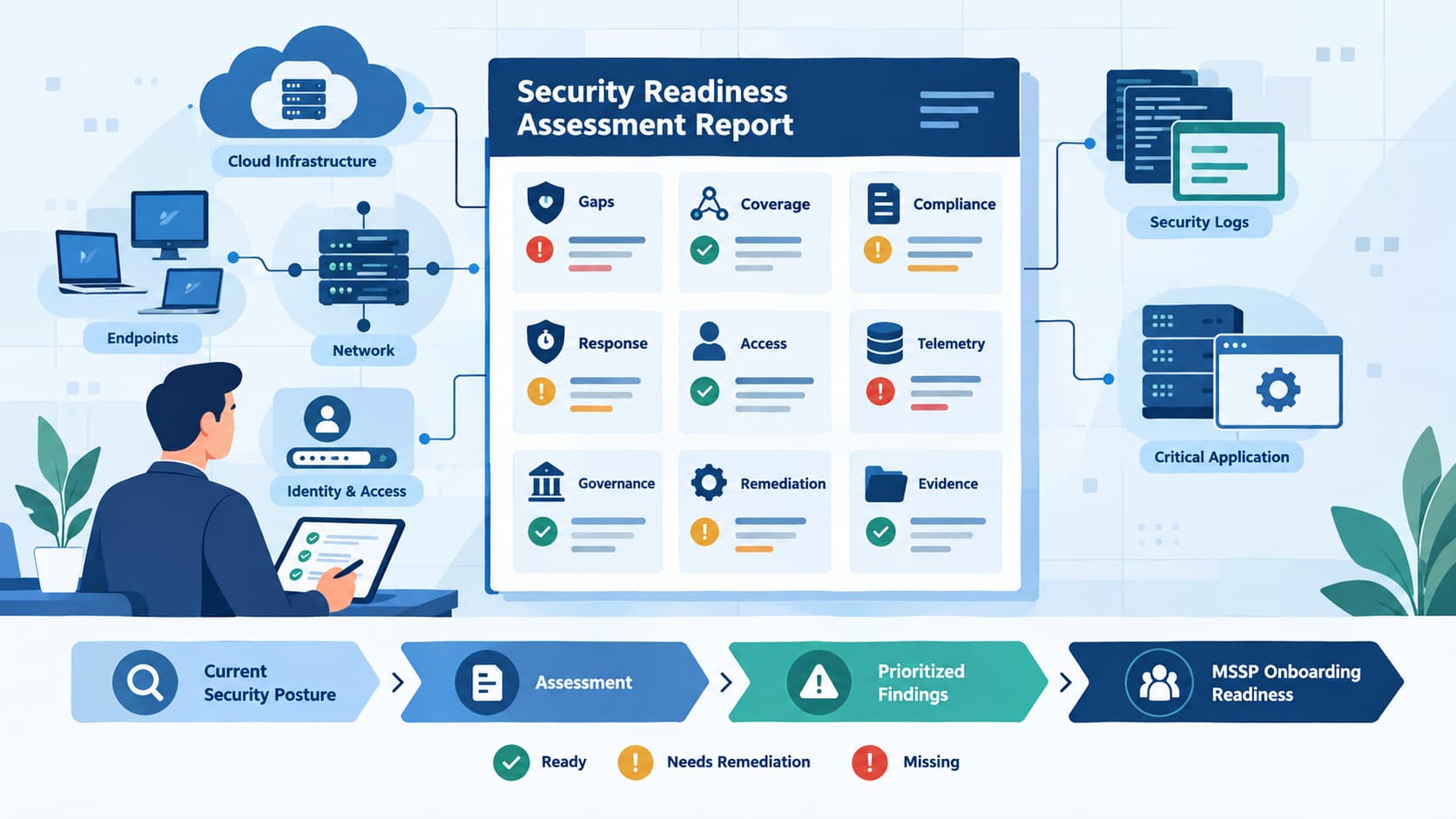
Signing an MSSP contract without auditing your technical readiness is a fast way to waste budget on a SOC that cannot protect you effectively.
Before paying for 24/7 monitoring, confirm that your log sources are usable, access permissions are approved, and your team knows who handles a 2:00 AM escalation.
Kaseya reported that 73% of surveyed MSPs called cybersecurity a top revenue driver in 2024. But readiness is about more than provider demand. MSSP Security helps organizations assess technical gaps, operational responsibilities, and onboarding requirements.
Keep reading to learn how to score gaps and build a practical onboarding plan.
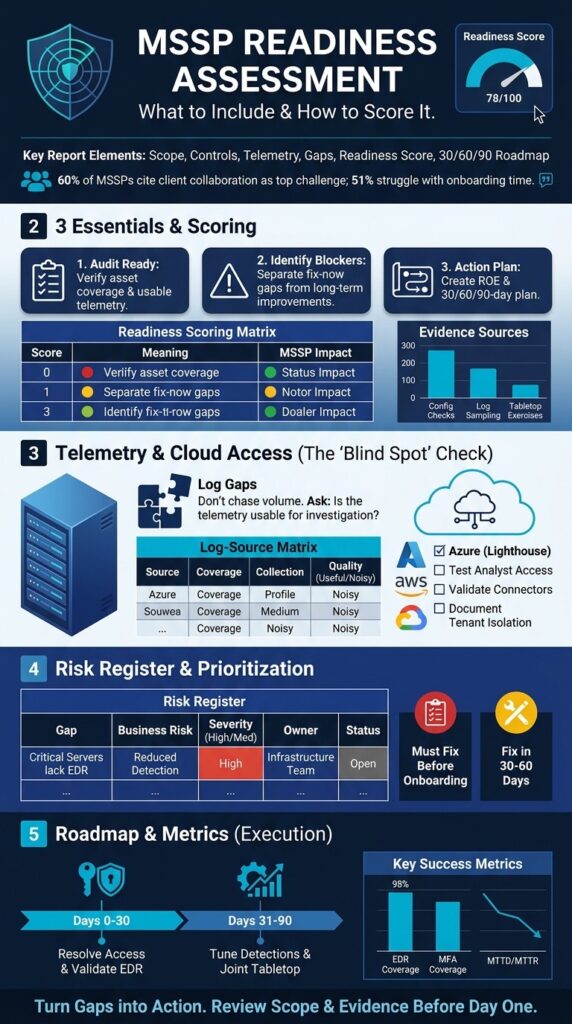
MSSP Readiness: 3 Essentials to Remember
A practical MSSP readiness assessment shows what is ready, what could block onboarding, and what needs to happen next.
- Check what is actually ready. Review security controls, asset coverage, telemetry, access, compliance, governance, and incident response using verified evidence.
- Separate blockers from improvements. Identify gaps that could prevent onboarding, assign owners, and prioritize remediation based on security risk and MSSP service impact.
- Turn findings into an action plan. Use the assessment to build clear readiness scores, Rules of Engagement, success metrics, and a practical 30/60/90-day onboarding roadmap.
What Is an MSSP Readiness Assessment Report?
An MSSP readiness assessment shows whether a company can support managed security services and where gaps could slow onboarding. It reviews security controls, telemetry, access, processes, compliance needs, and operational dependencies.
A clear gap analysis report can help organize these findings into documented risks, affected controls, and remediation priorities.
The report should show the current state first. Then it should point out anything that could limit monitoring, detection, escalation, or response. But readiness isn’t the same as security maturity. A company can have security gaps and still be ready for an MSSP.
What matters is whether the provider has sufficient access, visibility, and usable data to perform its role effectively. Experience from dozens of SOC onboarding audits shows that seemingly minor oversights, such as unmapped service accounts or missing API permissions, can quickly escalate into project delays or complete implementation stoppages.
In fact, industry data from Kaseya’s 2024 MSP Benchmark Report shows cybersecurity is a primary revenue driver, yet client communication and onboarding delays remain the single largest bottleneck for over 50% of providers (as tracked by MSSPAlert).
- Scope: Define what was reviewed and document the asset and system list.
- Controls: Identify existing protections and assign maturity ratings.
- Telemetry: Document what can be monitored through a log-source matrix.
- Gaps: Record missing or weak controls in a risk register.
- Readiness: Classify the environment as ready, conditional, or not ready.
- Roadmap: Define the 30/60/90-day onboarding plan.
The report helps security leaders, IT teams, executives, and the MSSP. But there’s another group to think about: the people choosing the security products behind the service. A product may claim wide coverage.
That doesn’t prove it will deliver useful data in a real environment. So test the claim against evidence. That’s where product reviews can help.
What Does the Assessment Actually Produce?
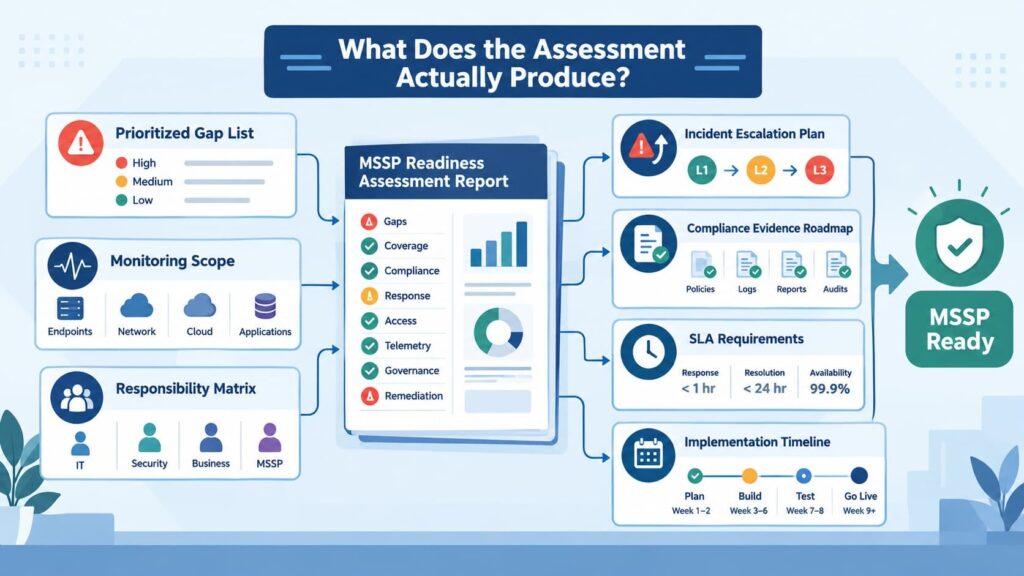
A useful assessment should give the MSSP a readiness score, known gaps, owners, onboarding dependencies, and clear success measures.
Depending on the project, it may also include framework mappings, an evidence register, an asset inventory, and an onboarding checklist. One problem shows up often. A security control may exist but still be hard for the MSSP to use.
For example, an EDR tool may cover most endpoints while several critical servers remain outside the platform.
The company can say EDR is deployed. But the MSSP still has a blind spot. So the report needs to connect each finding to evidence, risk, ownership, and timing. Otherwise, the score tells only part of the story.
Why Does MSSP Readiness Matter Before Onboarding?
MSSP readiness can reduce onboarding problems by finding missing controls, incomplete telemetry, access limits, and unclear responsibilities before they affect service delivery.
As highlighted by MSSPAlert:
“60% of respondents said that ‘effective communication and collaboration with clients’ posed the biggest challenge for their organization” and “51% identified client onboarding as a task that consumes too much time.” – MSSPAlert
Kaseya reported that 78% of surveyed MSP respondents viewed cybersecurity as a top IT challenge in 2024. But operational readiness isn’t only a technical issue.
Basic problems can slow a project down. Administrator access hasn’t been approved. The asset list is incomplete. A needed log source isn’t supported.
Nobody knows who should receive an escalation. And those gaps can delay detection work. A readiness review finds these issues while the organization still has time to fix them. The assessment should look at five areas:
- Technical readiness, usable telemetry
- Operational readiness, escalation handling
- Governance readiness, clear ownership
- Commercial readiness, scope and SLAs
- Compliance readiness, evidence and retention
Not every gap should stop onboarding. A missing dashboard may be fixed during the first day. Missing EDR coverage on critical servers is another matter. That distinction matters when an MSSP selects products or sets the order of work.
What Should an MSSP Readiness Assessment Measure?
The review should cover identity, endpoints, networks, vulnerabilities, backups, incident response, logging, cloud systems, governance, and compliance. But don’t stop with technical controls.
Identifying gaps in the current security posture helps show where controls, ownership, or operational processes may not provide the expected level of protection.
A company can have strong security tools and still struggle during an incident if nobody owns the escalation. That’s an operational gap, not a product gap.
Use evidence-based checks for:
- MFA on critical access
- EDR coverage and health
- Patch status
- Backup testing
- Privileged access
- Network segmentation
- Firewall rules
- Security monitoring
Product reviews should also check whether the tools can produce the data and evidence the MSSP needs. A tool can look good during procurement.
Then deployment tells a different story. That happens more often than it should. Readiness audits can be structured around the NIST CSF 2.0 framework, which reflects today’s evolving threat landscape.
Its core functions Govern, Identify, Protect, Detect, Respond, and Recover provide a practical structure that applies across both on-premises datacenters and multi-cloud environments.
The evidence tells the real story. And that’s where the assessment earns its value. It shows what the customer has, what the selected products can cover, and which gaps could affect service delivery.
How Should You Scope and Structure the Assessment?
Before scoring anything, define the business units, environments, assets, frameworks, stakeholders, evidence sources, and review methods. Otherwise, the score can look more precise than it really is.
A security gap analysis should establish these boundaries before findings are scored or prioritized.
We’ve seen reports give a detailed readiness score even though only part of the environment was reviewed. That’s risky. The MSSP may plan onboarding around a picture that isn’t complete. So document the assessment boundary first.
What Evidence Should You Collect?
Evidence should show both the technology in use and how the organization operates it.
Common sources include:
- Asset and application inventories
- Network and data-flow diagrams
- Identity and access reports
- EDR and vulnerability reports
- SIEM and log inventories
- Backup documentation
- Incident-response procedures
- Compliance requirements
Also check whether the evidence matches the products under review. A vendor may claim broad coverage. The better question is whether the product can collect, process, and act on the data the MSSP needs.
Which Assessment Methods Work Best?
Interviews alone aren’t enough. Combine them with document reviews, configuration checks, technical scans, log sampling, and tabletop exercises.
The exact mix should match the environment and the questions the MSSP needs to answer. Record the evidence date, too. Security environments change quickly. A configuration export from six months ago may not match production now.
That can create avoidable surprises during an audit. In my experience on the assessment line, written policies rarely match production reality.
Never accept a policy document as proof; always demand a live system export or configuration audit demonstrating that MFA is actively enforced across all domain admin accounts and VPN endpoints.
Check the evidence. That approach gives the MSSP a better basis for product selection and onboarding decisions.
How Can You Score MSSP Readiness Consistently?
MSSP readiness needs a scoring method that connects each control to evidence, risk, business impact, and remediation status.
We prefer a four-level scale. It’s easy for executives to read, but it still gives technical teams enough detail.
| Score | Meaning | MSSP impact |
| 0 | Not implemented | Major blocker |
| 1 | Partly implemented | Remediation needed |
| 2 | Implemented | Usually ready |
| 3 | Optimized | Strong foundation |
Every score should point to evidence.
Also separate control maturity from MSSP readiness. A company might have a strong vulnerability program but lack the API access needed to send that data into the provider’s workflow.
The control looks mature. The service still has a problem. SOC-CMM can also help when the assessment focuses on security operations maturity rather than the number of security products installed.
The scoring model should answer three questions:
- What exists?
- Does it work?
- Can it support the MSSP service?
That last question is often the one that finds gaps in telemetry, integrations, or cloud access.
Which Telemetry and Logging Gaps Can Block MSSP Monitoring?
If your systems don’t send clean activity data (telemetry) to the monitoring team, the SOC is essentially operating blind.
Beyond basic firewalls, you must verify that identity tools, cloud environments, and email gateways are active and storing logs long enough for an analyst to trace an attack.
Identity systems, privileged accounts, endpoints, cloud control planes, email, and key applications may need early attention.
For MSSPs reviewing security products, a connector alone isn’t enough. The data must also be useful to analysts.
A log-source matrix should record:
| Attribute | What to check |
| Source | System creating the logs |
| Coverage | Full, partial, or missing |
| Collection | Agent, API, syslog, or connector |
| Retention | Current retention period |
| Quality | Useful, noisy, or unusable |
| Compatibility | Ready, conditional, or blocked |
We’ve found that connected doesn’t always mean useful. Some systems can produce huge amounts of low-value data. That adds noise without helping detection. Don’t chase log volume.
Ask whether the MSSP has the right telemetry when an incident happens. The data should also include enough context for an analyst to investigate it.
How Should Cloud and Multi-Tenant Access Readiness Be Assessed?
Cloud readiness starts with access. Check tenant access, delegated permissions, connectors, workspaces, and ownership.
AWS, Microsoft Azure, and Google Cloud use different identity and security models, so the assessment should account for those differences.
For Azure, review areas such as Azure Lighthouse, GDAP, Entra relationships, workspace design, connector ownership, and analyst permissions. Then test the access.
We’ve seen setups that looked correct during deployment but failed when analysts needed to investigate an incident. That’s not a small issue. Migration waves should also follow technical risk instead of contract dates alone.
Representative canary tenants, clear exit criteria, and a short monitoring period between waves can help where the environment supports that approach.
Use a practical checklist:
- Review delegated access
- Confirm connector ownership
- Test analyst access
- Document tenant isolation
- Assign a go/no-go owner
- Record rollback ownership
What Does a Tenant Exit Checklist Include?
Each tenant or major environment should pass a clear exit gate before the next onboarding wave starts.
- Workspace onboarding complete
- Analyst access tested Incidents visible
- Alerts validated
- Playbooks tested
- Connectors checked
- Rollback owner documented
We’ve learned that an installed connector doesn’t prove the workflow is ready. An analyst may lack incident access. An automation rule may depend on fields that changed during migration.
So follow the whole path, from event creation to investigation and escalation. If one key part fails, don’t move the tenant forward.
How Should Compliance Requirements Affect MSSP Readiness?
Compliance needs should map to the MSSP service scope. That includes monitoring, evidence, retention, and response duties.
NIST CSF, CIS Controls, ISO 27001, HIPAA, CMMC, and SOC 2 can create different requirements.
Treat them as part of the service review, not as paperwork for later. For example, a regulated organization may need specific log retention, access reviews, incident records, or evidence ownership.
Those needs can affect product selection and service design. Before the scope is final, document data residency and retention requirements.
And separate compliance support from certification. An MSSP can monitor controls or help collect evidence, but that doesn’t mean the customer is automatically compliant.
What Should the MSSP Readiness Risk Register Contain?
Each major gap should link to the business risk, affected assets, owner, deadline, and onboarding impact.
A useful register turns a finding into an action.
- Gap: Critical servers lack EDR
- Risk: Reduced detection coverage
- Severity: High
- Owner: Infrastructure team
- Target: Before go-live
- Dependency: Change approval
- Status: Open
Also mark whether the issue blocks onboarding, can be fixed during onboarding, or belongs in a longer-term plan. That distinction helps.
A missing dashboard may be inconvenient. Unmanaged privileged accounts can create a serious problem during an incident.
Which Gaps Should Be Prioritized?
Rank findings by security impact and their effect on onboarding.
- Must fix before onboarding
- Fix in first 30 days
- Fix in days 31-90
- Longer-term work
This gives the MSSP a roadmap instead of a pile of findings. Risk also depends on the customer. A healthcare provider may rank a weakness differently from a manufacturer or software company. We’ve found that context matters more than dramatic wording.
How Should Rules of Engagement Be Defined Before Go-Live?
Rules of Engagement should state what the MSSP can do without approval and what needs client approval. Without clear permission, an analyst may find a compromised endpoint but hesitate to isolate it.
By then, the threat may have moved. Agree on these permissions before production monitoring begins. Also check whether the selected security products can perform the approved actions.
- Endpoint isolation, critical incident
- Account disablement, identity owner
- Indicator blocking, network owner
- Credential revocation, security owner
- Infrastructure changes, approval required
Emergency contacts, severity levels, after-hours escalation, evidence requirements, and notification duties should be documented. Then test them.
Test the process before the incident.
How Should MSSP Onboarding Be Sequenced After the Assessment?
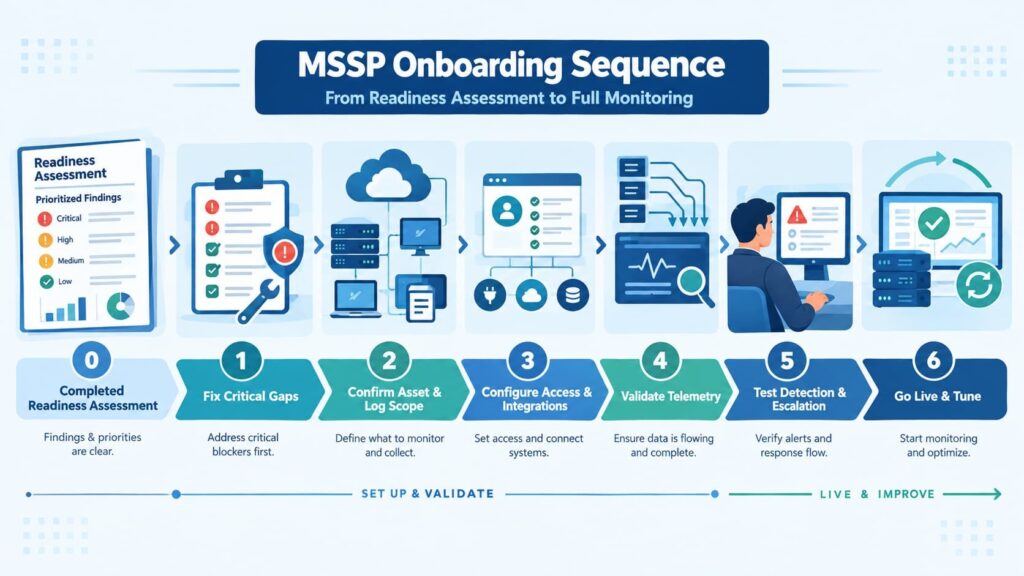
Assessment findings should become phased onboarding work.
As noted by Hack The Box:
“MSSPs are excellent at scaling detection and monitoring across clients, but need deeper preventive and adversary simulation capabilities to keep pace with sophisticated threat actors,” – Hack The Box
First, fix access and visibility. Then tune detection. After that, test response and address longer-term improvements.
Trying to fix everything at once can create new problems.
Days 0-30
Resolve critical access gaps
- Enforce required MFA
- Validate EDR coverage
- Connect priority log sources
- Finalize Rules of Engagement
- Confirm escalation contacts
The team should also establish the security baseline, critical asset list, communication channels, and change process.
Days 31-90
Expand telemetry coverage
- Tune detection rules
- Improve vulnerability SLAs
- Run a joint tabletop
- Set recurring security reporting
This is where false-positive tuning and detection work become practical. Analysts now have enough real activity to see what needs adjustment.
After 90 Days
Longer-term work can focus on:
- Automated response
- Better detection engineering
- Remaining compliance gaps
- Maturity reviews
- Retention and cost reviews
Don’t force the calendar. A 30/60/90-day plan should match the environment. Complex cloud systems, several business units, incomplete inventories, or strict regulatory needs may require more time.
Which Metrics Should Prove MSSP Readiness and Success?
Set baseline metrics before onboarding. Then compare them after deployment.
Useful measures include EDR coverage, log-source coverage, MFA coverage, critical vulnerabilities, MTTD, MTTR, false positives, and incident escalation time. But don’t use the same targets for every customer.
An acceptable MTTD or MTTR depends on risk, staffing, technology, and contract terms. A metric can look good on its own and still miss the service’s real purpose. The MSSP contract should define measurable service expectations.
Monthly dashboards can track performance. Quarterly business reviews can focus on trends, recurring risks, and investment decisions. Keep the QBR practical.
How Can an MSSP Readiness Assessment Become Repeatable?
A readiness assessment is more useful when the same process is used each time. A basic cycle looks like this:
- Discover, inventory assets
- Assess, validate controls
- Score, apply criteria
- Prioritize, rank risks
- Remediate, assign owners
- Onboard, test integrations
- Measure, set baselines
- Reassess, review changes
Where APIs are available, parts of evidence collection can be automated. But automation doesn’t remove the need for verification.
Check what the data says. Repeatability matters. Security teams must run readiness reviews using standardized scoring rubrics every six to twelve months. Standardized audits allow leadership to measure concrete improvements in log coverage, tool maturity, and incident response times over time.
What Should the Final MSSP Readiness Assessment Report Include?
The final report should bring the main findings together.
A practical structure includes:
- Executive summary
- Scope and methodology
- Environment overview
- Security-control assessment
- Telemetry and logging readiness
- Cloud and access architecture
- Compliance alignment
- Risk and gap register
- MSSP readiness score
- Rules of Engagement
- 30/60/90-day roadmap
- Metrics and success criteria
- Evidence appendices
The appendices should contain the proof behind major findings.
Include the asset inventory, network diagrams, log-source matrix, framework mappings, evidence register, RACI, Rules of Engagement, remediation tracker, and onboarding checklist. Keep the evidence attached.
That makes later product reviews and audits easier.
What Should Executives Learn From the Assessment?
Executives should know whether onboarding can proceed, which risks need attention, who owns the work, and what investment is needed.
The executive section should stay short.
- Overall readiness
- Top business risks
- Onboarding blockers
- Required investment
- Expected timeline
- Success measures
- Executive decision
A one-page summary can turn a long technical report into clear decisions.
What Makes the Report Credible?
Credibility comes from evidence.
Strong reports use clear scoring rules, named owners, remediation actions, stated assumptions, assessment dates, framework references, and repeatable measurements.
Also document uncertainty. If a company can’t prove that a backup has been restored successfully, don’t treat the backup policy as proof of recovery readiness.
Be clear about what isn’t verified. That approach gives the MSSP a more useful picture of the environment. It also separates what a product claims from what the customer can prove in practice.
How Do You Turn an MSSP Readiness Report Into an Onboarding Plan?
The report shouldn’t sit in a folder after delivery. Use it as the baseline for scope, remediation, ownership, onboarding, and post-launch measurement.
Before signing, validate the service scope and major blockers. Before go-live, resolve critical access and technical gaps, or document who accepts them.
During onboarding, track telemetry, permissions, detection use cases, dependencies, and readiness gates.
After launch, measure coverage, response, alert quality, and agreed service results. We find that the strongest reports answer five questions:
- What must change?
- Why does it matter?
- Who owns it?
- When will it happen?
- How will success be proven?
For organizations choosing their first managed security service provider, MSSP Security can be considered as one option alongside defined evaluation criteria. The assessment itself should stay vendor-neutral and evidence-based.
Tie each decision to business risk and what the environment can support. Need help building your MSSP readiness baseline? Review your current scope, evidence, and onboarding gaps before the first monitoring wave begins.
Accelerating Your MSSP Transformation
Credits: Lumifi
Transitioning from a traditional MSP to a Managed Security Services Provider requires a deliberate shift in operational strategy, toolsets, and mindset.
Successfully scaling managed detection and response involves navigating key maturity stages, eliminating critical operational bottlenecks, and aligning your security framework with client demands.
By evaluating your current infrastructure and identifying gaps early, you can streamline the migration process, mitigate common deployment risks, and accelerate your time-to-market.
Ultimately, establishing robust SOC capabilities and standardized processes enables your team to deliver proactive threat hunting, elevate service delivery, and build a high-margin security practice designed for long-term growth.
FAQ
What should I check before starting an MSSP readiness assessment?
Before starting an MSSP readiness assessment, verify your asset inventory completeness, critical asset identification, identity and access review, privileged access management, security telemetry readiness, and incident response readiness. Also review your patch management cadence, backup and recovery validation, MFA enforcement policy, and EDR deployment status. These checks can identify onboarding issues before the SOC onboarding process begins.
How can I tell if my organization is ready for SIEM integration?
Review your log forwarding configuration, required data sources, log retention requirements, timestamp consistency, and alert requirements. Your SIEM integration checklist should also cover security monitoring coverage, threat detection coverage, use case validation, and false positive tuning. Complete security telemetry readiness checks before integration to reduce unnecessary alerts and improve the quality of monitoring data.
Which MSSP evaluation criteria matter most when selecting a provider?
Prioritize MSSP evaluation criteria that match your operational requirements, including MSSP service scoping, incident response readiness, threat detection coverage, security operations maturity, reporting, and response responsibilities. Review MSSP contract SLAs, security service level agreement terms, escalation procedures, and MTTD and MTTR baselines to determine whether a managed security service provider can meet your needs.
How do I prepare for compliance and cyber insurance requirements?
Start with a security control assessment to identify missing controls and supporting evidence. Depending on your industry, this may include compliance gap analysis, ISO 27001 readiness, SOC 2 preparation, CMMC compliance assessment, or HIPAA security assessment. For cyber insurance readiness, document security policies, control ownership, incident procedures, risk management practices, and evidence of implemented safeguards.
What should a security readiness assessment produce after testing?
A security readiness assessment should produce clear findings that support risk register creation, security maturity scoring, and remediation roadmap planning. The final report should identify control weaknesses, assign ownership, explain business impact, and recommend corrective actions. It should also provide an executive security summary and relevant security KPIs and metrics for tracking progress over time.
Turn MSSP Readiness Into a Clear Action Plan
An MSSP readiness assessment shows where security operations stand before onboarding and identifies gaps in access, telemetry, governance, and processes.
The goal isn’t perfection but knowing what needs attention first. A useful assessment provides an evidence-based baseline, clear priorities, and ownership for each next step.
For expert support, MSSP Security offers vendor-neutral consulting covering needs analysis, auditing, vendor selection, stack optimization, and PoC support.
With 15+ years of experience and 48K+ completed projects, its team can help turn assessment findings into practical decisions. Start with gaps that could block delivery, then address the rest over time.
References
- https://www.msspalert.com/native/beyond-security-why-client-collaboration-is-the-biggest-challenge-for-mssps
- https://resources.hackthebox.com/the-global-cyber-skills-benchmark-2025-mssps