

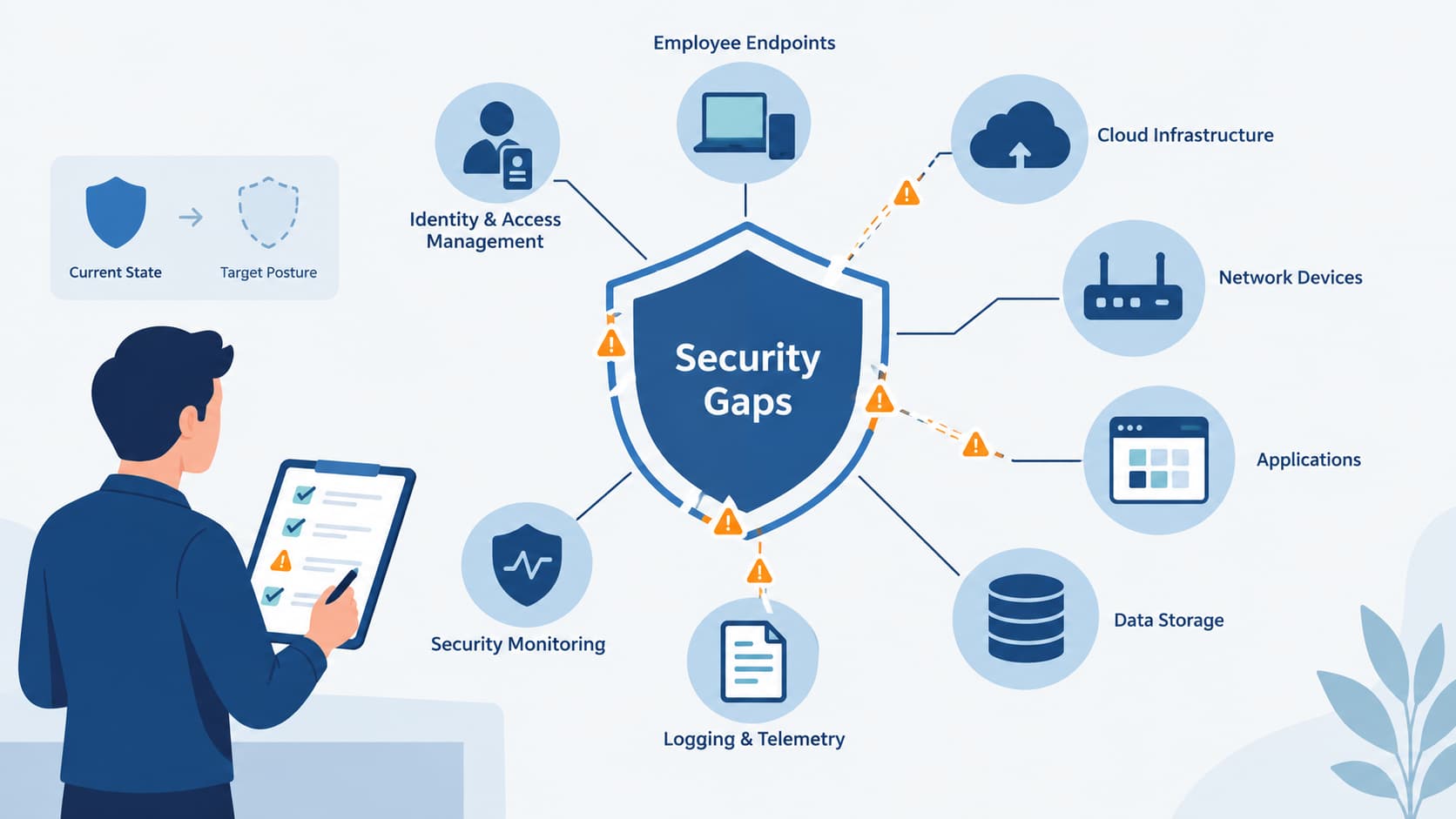
Security gaps become clear when you compare what your organization does today with the controls you expect to have, then test whether those controls work. NIST CSF 2.0 provides a practical structure: Govern, Identify, Protect, Detect, Respond, and Recover.
However, the framework alone cannot reveal every weakness. You need evidence, control testing, business risk, and clear ownership for each fix.
At MSSP Security, we use these elements to build a baseline based on how security operates day to day, not just how it looks on paper. Keep reading to see how to build that process.
Security Posture Gap Check: What Matters Most
A quick summary of the core steps for identifying gaps in your current security posture:
- Define the target state using NIST CSF 2.0, regulatory requirements, and business risks.
- Validate real control performance with asset inventories, configurations, logs, testing, and attack-path analysis.
- Prioritize and close gaps based on business impact, exposure, exploitability, clear ownership, and measurable remediation.
Why do security posture gaps remain hidden despite having security tools?
A security posture gap exists when actual security results fall short of the target, even when the tools, policies, and dashboards look healthy. We’ve seen this during MSSP product reviews.
A team may have several security platforms in place, yet still lack proof that those controls hold up during real use. A scanner might report missing patches. An identity review may flag excessive access.
But those findings don’t show whether the weaknesses connect in a way that could harm the business. Our approach looks past product ownership. We check what each control can actually do, what evidence supports it, and where it fails.
That leaves plenty of activity outside the view of those environments.
A useful model is:
- Current state: What security achieves today
- Target state: What security needs to achieve
- Gap: The difference between them
- Remediation: Owned actions to close it
We use this model when helping MSSPs select and audit security products, using an MSSP gap analysis to connect findings with evidence and control performance instead of the number of tools in the stack.
Compliance evidence still has value, but it doesn’t prove that security works during an attack. Keep reading.
What exactly counts as a gap in your current security posture?
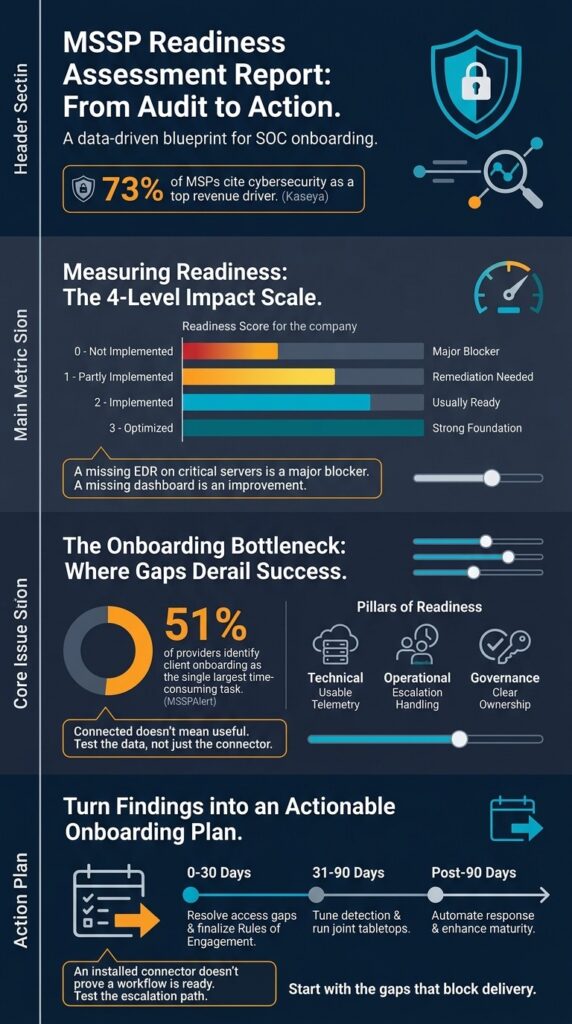
A practical cybersecurity gap analysis separates security program gaps into three categories: controls that are not implemented, controls that are only partially implemented, and controls that exist but are ineffective.
- Not implemented: The expected control does not exist. For example, privileged accounts may have no MFA protection.
- Partially implemented: The control exists but does not cover the entire environment. Employees may use MFA while service accounts or privileged identities remain outside the control.
- Ineffective: The control exists but does not produce the expected security outcome. A SIEM may have detection rules configured, for example, but critical logs may never reach the platform.
We’ve seen this during product assessments. An MSSP may have an MFA policy, an identity platform, and access reviews, but technical evidence can tell another story. Old accounts may still be active.
Privileged access may be broader than expected. Service accounts can also sit outside the MFA control. On paper, it looks covered. In practice, gaps remain.
That’s why our reviews pull evidence from several places:
- Policy and governance records
- Technical configurations
- Security logs and telemetry
- Tickets and remediation history
- Access reviews Test results
- Recovery exercises
This separates control existence from control effectiveness. And that matters when an MSSP is reviewing IAM, endpoint security, cloud controls, application security, or incident response products.
A product can meet the requirements during selection and still fall short after deployment. Test the difference before signing the contract.
How should you define the target security state before looking for gaps?
The target security posture should be based on a recognized framework, regulatory requirement, threat model, or business standard.
It shouldn’t be defined by whatever score a security product reports. These give teams a way to compare the current position with the security outcomes they need. In our work with MSSPs, we usually see several references used together:
- NIST CSF 2.0 for risk management
- ISO/IEC 27001 for ISMS controls
- CIS Controls for technical safeguards
- Regulatory requirements such as PCI DSS, HIPAA, NIS2, SOC 2, and CMMC
But the framework is only part of the target. Business risk matters too.
A hospital won’t have the same priorities as a SaaS provider. A manufacturer may have different concerns from a financial services company.
For a business with high ransomware exposure, our review may focus on backup recovery, RTO/RPO alignment, privileged access, endpoint controls, and recovery testing.
A cloud-native software company may need more attention on CSPM, CI/CD controls, secrets, containers, and application attack paths.
We’ve found the target state is far more useful when each expected outcome has an owner, evidence requirement, and clear test for success. Otherwise, it becomes another document that looks good until someone has to check it.
What should you inventory before assessing security controls?
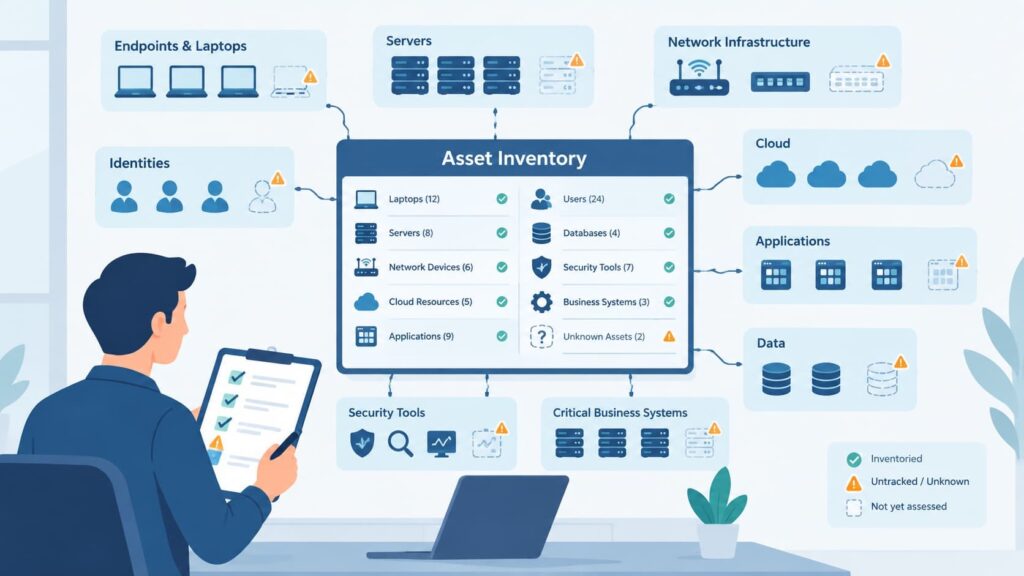
Security posture assessment starts with visibility. If an asset isn’t known, its exposure can’t be reviewed properly. The inventory should cover technology, identities, data, dependencies, and third parties.
That includes endpoints, servers, network devices, cloud resources, SaaS applications, APIs, databases, containers, Kubernetes environments, privileged accounts, service accounts, and external integrations.
Which assets should be included?
Organizations should account for:
- Endpoints, servers, IoT, and OT
- Applications, APIs, databases, SaaS, and cloud
- Containers, Kubernetes, CI/CD, repositories
- Privileged identities and service accounts
- Internet-facing assets and exposed services
We’ve seen gaps appear because an asset was never added to the inventory. A forgotten development server can create an attack surface management gap.
An orphaned cloud resource may stay misconfigured. A former employee’s account can become a stale identity risk. And a service account with broad permissions may create a PAM gap that endpoint scanning won’t catch.
Which data and dependencies matter?
Security teams should map:
- Sensitive data and classification
- Critical business processes
- Application dependencies
- Data flows between environments
- Suppliers and technology partners
- External integrations and trust relationships
At MSSP Security, we treat shadow SaaS, orphaned resources, unmanaged identities, and undocumented integrations as visibility issues first.
That matters when we help MSSPs assess or select security products because weak inventory data affects every finding that follows. Without that context, a security score can look precise while covering only part of the environment.
How do you map existing controls against the target framework?
Map each applicable requirement to the evidence available today, its implementation status, owner, and business relevance. NIST CSF 2.0 provides Core outcomes and Informative References that can support this work.
In our assessments, we treat the result as a working control matrix for security gap analysis, not another compliance checklist.
| Requirement | Current state | Evidence | Gap | Owner |
| MFA | Partial | IAM configuration | Admin accounts excluded | IAM |
| Logging | Partial | SIEM ingestion report | Critical SaaS absent | SOC |
| Backups | Implemented | Restore test | RTO not validated | Infrastructure |
| Vulnerability management | Partial | Scan and ticket data | Critical SLA exceptions | Infrastructure |
| Cloud security | Partial | CSPM findings | Public resources unresolved | Cloud Security |
Evidence can tell a different story than an interview. We’ve reviewed environments where a control was marked as implemented because the policy existed, while configuration data showed that only some privileged accounts followed it.
Logging has the same problem. A SIEM may receive events from a system, but those logs might not support a useful detection. So we separate implemented, partially implemented, ineffective, and not evidenced.
This gives MSSPs a clearer view when we assess or audit security products. We’re not trying to hand out another green status. We want to show what the control does, where it falls short, and who owns the fix.
That distinction can expose policy gaps and weak GRC controls that a yes-or-no checklist may miss.
Which technical tests reveal gaps that documentation misses?
Technical validation shows whether a control holds up during real operations. A product dashboard can say one thing. Testing may show another.
We’ve seen tools report healthy coverage while testing exposed gaps in configuration, detection, or recovery. Our assessments can include:
- Vulnerability and configuration reviews
- Identity and privileged-access reviews
- Threat modeling and attack-path analysis
- Penetration testing for high-risk systems
- Detection testing against ATT&CK techniques
- Backup restoration exercises
- Incident-response tabletop exercises
- Cloud and SaaS configuration reviews
Each test answers a different question. Vulnerability scanning can find known weaknesses. Penetration testing checks whether selected weaknesses can be exploited. Threat modeling helps show how an attacker might move through an environment.
Recovery testing is another matter. It checks whether critical services can really be restored. We’ve used this approach when helping MSSPs audit security products, and the results aren’t always what the dashboard suggests.
A tool may report full coverage while testing shows that key events aren’t detected or that a recovery process fails under pressure. Closing a ticket doesn’t prove the gap is gone. Run the test. Review the evidence. Verify the control again.
Why should detection coverage be tested separately?
Having a SIEM doesn’t mean an organization can detect the attacker activity that matters. We’ve seen this during MSSP product reviews, where a platform reports strong coverage but important telemetry never reaches the SIEM.
In a recent analysis by CardinalOps:
“SIEMs ingest enough data to cover 90% of techniques. Reality: Actual detection coverage is only 22%.” – CardinalOps
CardinalOps’ 2025 analysis looked at 13,000 detection rules and more than 2.5 million logs. Average ATT&CK detection coverage was 22% across the production environments studied.
Our testing follows the full chain:
Asset → telemetry → log forwarding → detection → alert triage → investigation → response
A break anywhere can create a SIEM coverage gap or a detection engineering gap. We’ve found that dashboards rarely tell the full story. Test it. Threat hunting and SOC maturity should also be reviewed alongside detection coverage.
A busy SOC can miss important activity, while a quiet SOC may have too little visibility to generate useful alerts. For an MSSP, the better question isn’t how many ATT&CK techniques a product claims to cover.
It’s whether the product can detect activity across the attack paths that matter to its customers, and whether analysts can act on those detections.
How should you prioritize the gaps you find?
Security gaps should be ranked by business impact, likelihood, exposure, exploitability, and control effectiveness. A long findings list doesn’t tell leadership what needs attention first.
We’ve seen assessment reports with dozens of low-risk issues sitting beside a small number of weaknesses that could seriously affect a customer. Those high-impact findings can get buried if everything receives the same priority.
A useful scoring model considers:
| Factor | High-risk signal |
| Business impact | Critical service or regulated data |
| Exposure | Internet-facing or broadly accessible |
| Exploitability | Known or actively exploited weakness |
| Control weakness | Missing or ineffective control |
| Detection | Little or no relevant visibility |
This turns findings into decisions. An internet-facing application with an actively exploited vulnerability, weak identity controls, and limited logging should move faster than an internal workstation with a minor configuration issue.
We use that same thinking when reviewing vulnerability management, network segmentation, cloud security, and third-party risk products for MSSPs. Remediation effort matters too.
A serious weakness that can be fixed quickly may need attention before a larger architecture project that takes months.
The risk register should explain what’s wrong, why it matters, who owns it, and how closure will be tested. Otherwise, a closed ticket can look like a closed risk. It isn’t.
Why can tool sprawl create new security posture gaps?
Tool sprawl can add more data without adding useful context. We’ve seen this during MSSP product reviews. One platform reports vulnerabilities, another flags identity risks, another tracks cloud issues, and the SIEM generates alerts.
Each dashboard may look fine on its own. But once the findings are compared, ownership can become unclear and duplicate issues can pile up.
As noted by SAMENA:
“Visibility keeps showing up in this survey because it is genuinely hard to fix. Most organizations have the tools. Getting them to produce a coherent picture across teams that do not share priorities is where the work actually is.” – SAMENA
A 2026 SANS Institute SOC survey found that 24% of cyber leaders named poor enterprise-wide visibility as their biggest barrier to SOC effectiveness. That lines up with what we see in product reviews. More tools don’t always mean better visibility.
A practical review should examine:
- Overlapping scanners and duplicate findings
- Disconnected dashboards and data sources
- Findings without accountable owners
- Licensed tools with weak configuration
- Alerts analysts struggle to investigate
At MSSP Security, we look for a clear link between each product and a security outcome. When we help an MSSP select or audit a tool, we ask what it adds, what evidence supports that claim, and who operates it.
Still, consolidation isn’t always the answer. Some specialized products cover needs that broader platforms can’t replace. The better question is whether each tool has a defined outcome and an owner who can prove it.
What new security posture gaps should teams assess in AI and cloud environments?
AI and cloud environments introduce access paths that older control reviews may miss. We’ve seen this area raise questions around agent identities, permissions, secrets, data movement, workloads, and automated workflows.
AI adds another identity problem. An agent may reach applications, APIs, files, credentials, or cloud services without being treated like a normal user.
Where are AI-related gaps emerging?
Teams should assess:
- Unscoped AI agent identities
- Excessive agent permissions
- Unsanitized model or agent context
- Secrets exposed to workflows
- Cross-run memory and data persistence
- Missing runtime monitoring
- Weak development and production separation
CI/CD pipelines need the same attention. If an automated workflow can deploy code, access secrets, or change infrastructure, its permissions are part of the security boundary.
In our product reviews for MSSPs, we look beyond whether a platform claims pipeline coverage. The useful evidence shows what an automated identity can reach and what happens if that identity is misused.
Which cloud gaps deserve priority?
Cloud reviews should focus on:
- Excessive IAM permissions
- Public storage exposure
- Orphaned resources
- Weak network segmentation
- Unmonitored SaaS integrations
- Unencrypted sensitive data
- Poor secrets management
- Vulnerable workloads
CSPM can surface these issues, but the finding needs context. We’ve seen public storage flagged as high risk when it held test data, while a less obvious identity issue affected production resources. Context matters.
A public bucket holding regulated customer records is a different risk from one containing test files. An unused cloud account also carries less immediate risk than a production identity with administrator access.
Our assessments connect CSPM findings with data classification, application dependencies, DSPM, and identity relationships. The question is where sensitive data can move, who can influence that movement, and whether the controls around those paths hold up.
How should detection gaps be connected to real attack paths?
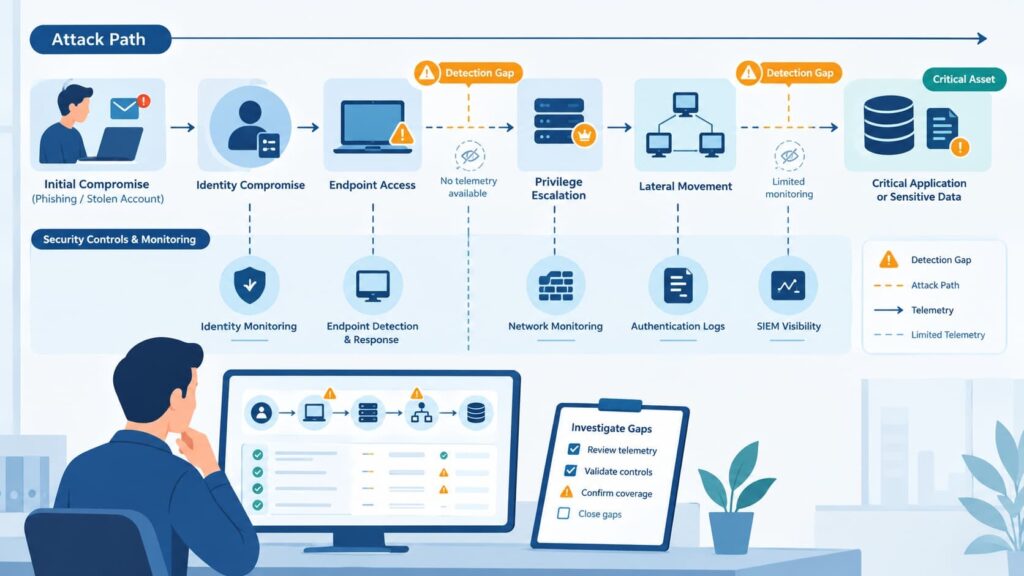
Detection gaps should be tested against realistic attacker actions, not by counting SIEM rules. We start with an attack scenario, map the behavior to relevant MITRE ATT&CK techniques, then check whether the right telemetry exists and whether the SOC can act on what it sees.
A practical workflow looks like this:
- Identify critical attack scenarios.
- Map behavior to ATT&CK techniques.
- Identify required log sources.
- Test whether detections trigger.
- Measure analyst response.
- Record missing telemetry or logic.
- Assign remediation owners.
We’ve seen this expose gaps that rule counts hide. If an attacker takes over a privileged account, the review should check whether authentication logs arrive, unusual-access detections fire, privileged activity is visible, and analysts know what to do next.
If one link fails, the response process has a measurable gap. Detection quality matters too. Too many low-value alerts can bury useful signals. Too few may mean important activity isn’t visible.
When we help MSSPs audit or select security products, our review covers detection coverage, alert quality, investigation time, escalation paths, and response capability.
A detection can fire correctly and still be a weak control if analysts have no useful path for investigation. The dashboard isn’t the capability.
What the team can detect and act on is.
When should security teams treat OT and specialized environments differently?
OT environments need a different approach to security assessment. Operational dependencies, safety requirements, legacy systems, and production uptime affect what can be changed and how it should be tested.
We’ve seen IT controls create problems in OT when those differences aren’t considered. A routine office patch may need extensive testing on an industrial controller.
A segmentation change can also affect production if the engineering dependencies aren’t understood first.
The SANS Institute’s 2025 State of ICS/OT Security research gathered responses from more than 330 industry professionals and examined capability gaps across industrial environments.
An OT-focused assessment should examine:
- Legacy and unsupported systems
- Remote administrative access
- Vendor connectivity
- Industrial protocols
- IT-to-OT pathways
- Network segmentation
- Backup and restoration procedures
- OT-specific incident response
- Safety and availability requirements
We also test whether a compromise in corporate IT could reach operational systems. A remote-access account or weak segmentation can look minor by itself, but the risk changes when those controls connect IT to production.
For MSSPs selecting or auditing security products, our focus is whether the tools can support OT without creating operational risk. Risk isn’t the same everywhere. It depends on the process, architecture, safety impact, and what happens if production stops.
Bridging Security Gaps with Zero Trust Architecture
Credits: Bare Metal Cyber
A security program is only as strong as its weakest uncovered area. Performing a gap analysis provides a structured approach to compare existing controls and processes against industry frameworks like NIST or ISO, highlighting compliance deficiencies and actionable areas for improvement.
By combining this evaluation with a Zero Trust architecture operating on the principle to “never trust, always verify” organizations eliminate implicit trust across every access point. This integrated approach ensures continuous authentication and helps redesign your infrastructure to significantly reduce overall exposure and prevent potential breaches.
FAQ
What should a security posture assessment measure first?
A security posture assessment should establish the current security state across identity, endpoints, cloud, applications, networks, data, monitoring, and recovery. Teams should compare these findings with their target security posture to identify missing, inconsistent, or ineffective controls. This baseline makes it easier to determine which security weaknesses require immediate attention.
How can a cybersecurity gap analysis help prioritize security weaknesses?
A cybersecurity gap analysis identifies controls that are missing, incomplete, or ineffective. Teams can prioritize these findings by considering business impact, system exposure, regulatory requirements, and remediation effort. This approach also helps organizations quantify technical security debt and focus resources on weaknesses that create the greatest risk.
How can teams identify identity and access management gaps?
Teams can identify identity and access management gaps by reviewing MFA adoption, privileged access, password policies, service accounts, and inactive accounts. They should also examine joiner, mover, and leaver processes to confirm that access changes occur promptly. These reviews can reveal excessive, outdated, or inappropriate access to business systems and sensitive data.
When should organizations assess cloud and application security gaps?
Organizations should assess cloud and application security gaps when they introduce new workloads, change infrastructure, or release new applications. Reviews should cover CSPM gaps, DSPM gaps, ASPM gaps, container security gaps, and CI/CD security gaps. These areas can reveal cloud misconfigurations, insecure application components, and weaknesses in development and deployment processes.
How can security teams track whether gap remediation is working?
Security teams can track remediation by using security metrics and KPIs that measure control improvements, risk reduction, response readiness, and remediation progress. Security scorecards can show whether identified weaknesses are improving over time. Teams should also maintain risk register updates with clear owners, deadlines, and measurable remediation outcomes.
Build a Security Posture You Can Trust
Security gaps become harder to manage when you cannot see which controls reduce risk. You need evidence that shows where defenses fall short and what deserves attention first.
MSSP Security can help turn that evidence into practical next steps. With 15+ years of experience and 48K+ projects completed, our consulting supports needs analysis, vendor selection, auditing, stack optimization, and PoC support to improve visibility and reduce tool sprawl.
The goal is not a perfect security score, but a program where risks are visible, weaknesses have owners, and improvements can be measured over time.
References
- https://ciberseguridadtic.es/actualidadinfraestructura/los-siem-solo-detectan-el-22-de-las-tecnicas-mitre-attck-segun-cardinalops-202506109298.htm
- https://www.samenacouncil.org/samena_daily_news?news=111164#1