

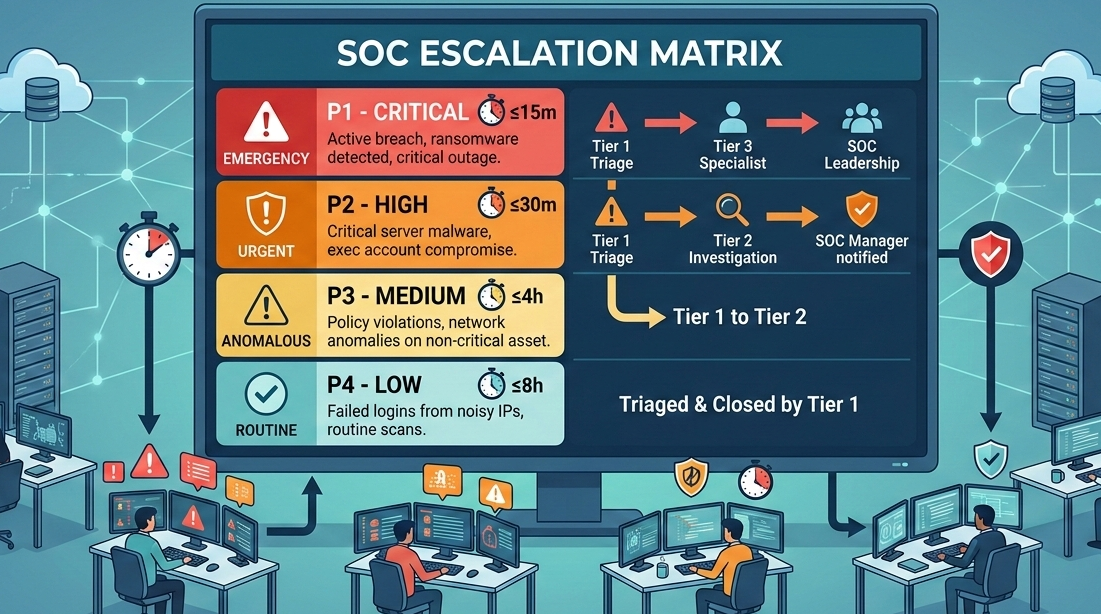
You need a SOC escalation matrix example because, without one, critical alerts get lost in the noise. We’ve seen it happen. An analyst, buried under 200 daily alerts, misses the one beaconing signal from a compromised domain admin account. Weeks later, it’s a full-blown breach.
A proper matrix isn’t just a document, it’s the nervous system of your Security Operations Center. It dictates who needs to know what, and when, turning chaotic reactions into a coordinated defense. Keep reading to see a real-world example you can adapt, and learn how to build a process that actually works under pressure.
Main Points to Remember
These points highlight what makes a matrix effective during real incidents, when teams must respond quickly and decisions cannot rely on guesswork.
- A functional matrix moves incidents based on asset criticality and business impact, not just technical severity scores.
- Automatic triggers, like executive account compromises, must bypass all tiers to ensure immediate, senior-level response.
- Regular tabletop exercises are non-negotiable to test and validate that your paper process works in a crisis.
What a Real SOC Escalation Matrix Looks Like
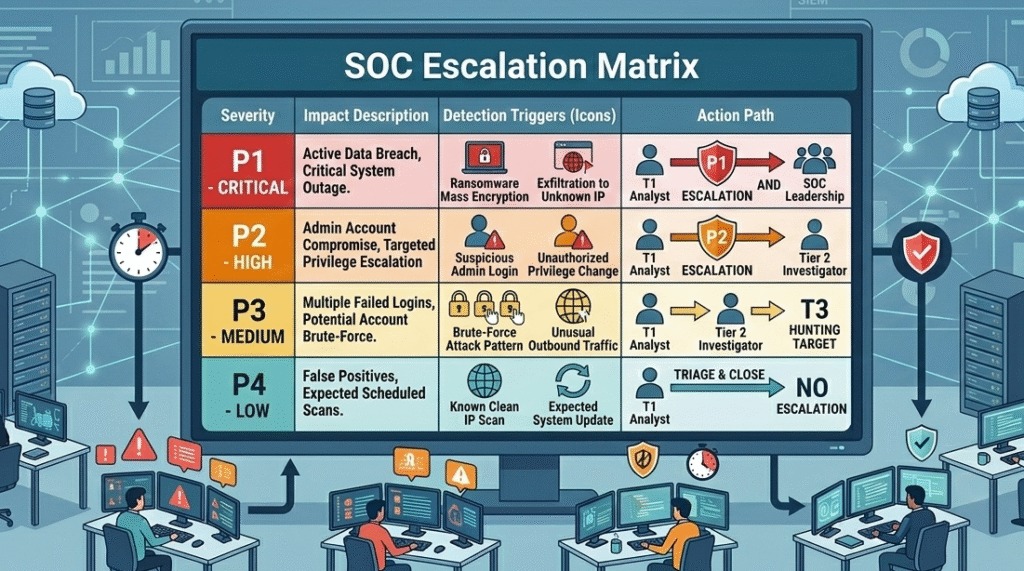
Forget vague templates. The core of a useful matrix is a clear, actionable table that everyone, from Tier 1 to the CISO, can reference in a panic. It binds severity to a specific action path.
Here is a concrete example based on common industry frameworks and our own operational experience.
| Severity Level | Impact Description | Initial Response SLA | Escalation Path & Key Roles |
| P1 – Critical | Active data breach, ransomware execution, critical system outage. | ≤15 minutes | Tier 1 → Immediate notification to CISO & SOC Manager. External IR and Legal counsel are engaged concurrently. |
| P2 – High | Confirmed malware on a critical server (e.g., database), suspicious activity on an executive account. | ≤30 minutes | Tier 1 → Escalation to Tier 2 for deep-dive. SOC Manager notified for oversight. |
| P3 – Medium | Policy violations, anomalous network traffic from a non-critical asset. | ≤4 hours | Handled within the SOC team (Tier 1 to Tier 2). Documented for weekly review. |
| P4 – Low | Routine scans, isolated failed login attempts from known noisy IPs. | ≤8 hours | Triaged and closed by Tier 1 analysts. Used for tuning detection rules. |
This structure eliminates guesswork. Notice how P1 incidents jump straight to leadership. That’s intentional. In a real ransomware event, you don’t have time for a linear handoff. The matrix authorizes that break-glass procedure upfront.
The most common mistake is letting time be the only trigger. A P3 alert on a public-facing web server might be more urgent than a P2 on an isolated test machine. Your matrix must account for context.
- Asset value and role in the business.
- Data sensitivity involved in the alert.
- Threat intelligence linking the activity to an active campaign.
Building the Matrix: Severity is Just the Start
Credits: K Dinesh Kumar
Calling something a P1 or a P4 is just the first step. That old classification system is too rigid for today’s threats. Real priority shifts with context. We’ve seen a “medium” alert on a domain controller trigger a full-scale response, while a “high” alert on a lobby printer gets closed minutes later. The target matters more than the tag.
“The SOC escalation matrix provides a clear path for alerts to move from initial detection to higher-level analysis by defining exactly when a Tier 1 analyst must hand off a ticket to Tier 2 or Tier 3 specialists based on predefined severity thresholds.” – UnderDefense
Our work within the mssp incident escalation framework shows us the difference. An internal SOC might miss the broader pattern, but our team sees threats across dozens of client environments.
We help MSSPs build that flexibility in, often by tagging assets with business-criticality scores in their SIEM, so the system itself adjusts the escalation path.
The Human Chain: Who Does What When
A good response plan maps people, not just procedures. When roles get confused, everything grinds to a halt.
Our Tier 1 analysts act as triage. They monitor the console, validate alerts, and filter noise, aiming for quick classification and initial containment. If they can’t solve it fast, they escalate.
Tier 2 responders are the investigators. They take the escalated case, perform a deep forensic dive to find the root cause, and execute full containment. Their documentation is critical for the final report.
Tier 3 and management handle specialist threats and command. This group includes senior hunters and the SOC Manager, who coordinate with external forensics and manage notifying stakeholders to ensure strategic and legal alignment. The CISO steps in for major incidents to guide strategic and legal decisions.
The handoff between tiers is where most plans fail. We insist the matrix mandates what data gets passed, IOCs, affected hosts, actions taken, so Tier 2 never starts from scratch.
Triggers That Demand Immediate Action
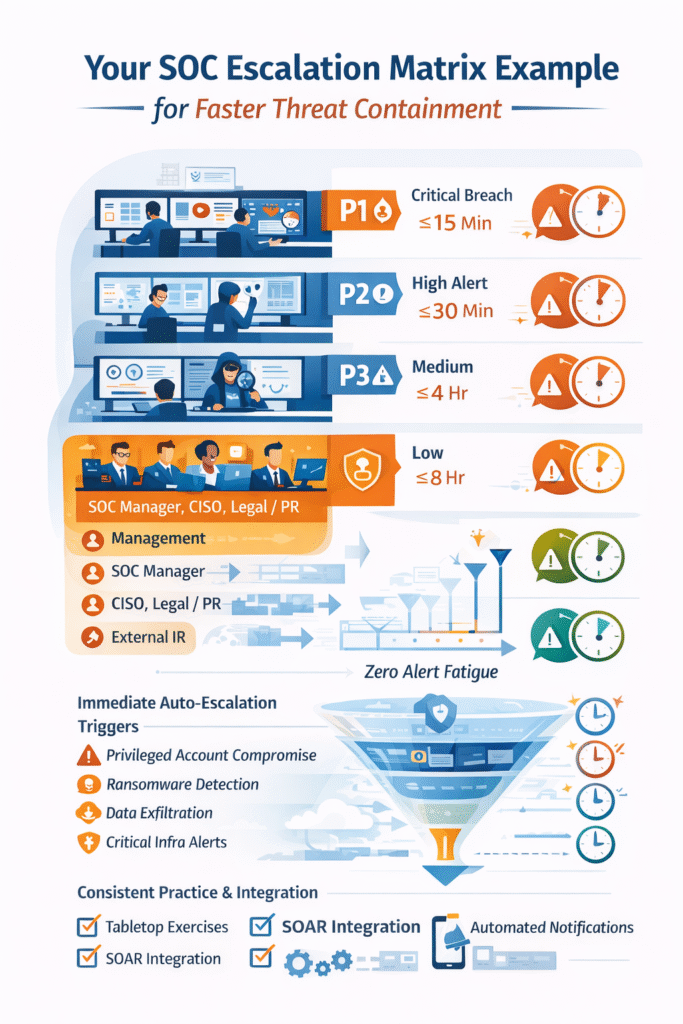
Waiting for an SLA timer to expire is a failure. Certain conditions must trigger an automatic, immediate escalation. These are your tripwires.
“The SOC escalation matrix typically follows a tiered structure where Tier 1 analysts perform initial triage and basic remediation, Tier 2 handles more complex investigations and deep-dive analysis, and Tier 3 involves advanced threat hunting or specialized forensics.” – Lobehub
- Compromise of a privileged identity (Domain Admin, Cloud Admin, Executive account).
- Detection of ransomware-specific behaviors (mass file encryption, ransom note drops).
- Significant data exfiltration to a unknown external destination.
- Alerts from critical infrastructure like SCADA systems or payment processors.
In our operations, these triggers are automated. When our systems detect a domain admin account logging in from a new country at 2 AM, it doesn’t just create a ticket. It pages the on-call Tier 3 analyst and the SOC Manager simultaneously, with a pre-populated incident channel.
The matrix pre-authorizes this. It removes the hesitation an analyst might feel about “bothering” someone senior. That hesitation is what attackers bank on.
Making It Work: Implementation and Testing
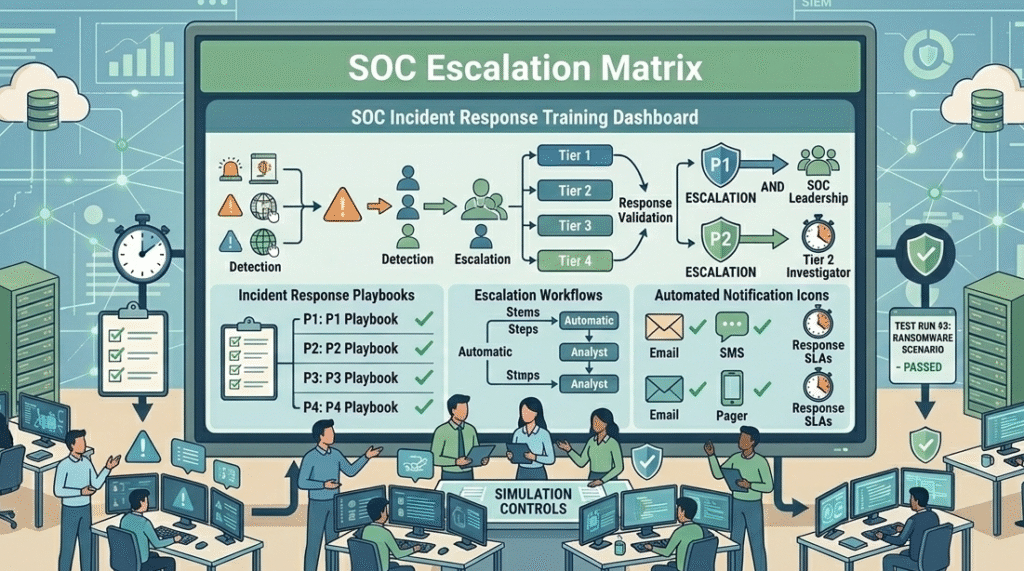
A matrix in a PDF is a fantasy. It only becomes real when your incident escalation procedures are integrated into your daily tools and validated through rigorous testing under stress.
You must codify it into your SOAR platform and ticketing system. Automate the notifications, use PagerDuty, Slack, or MS Teams to alert the right people based on the severity and triggers. The playbook for a P1 incident should automatically create a war room channel and add the key personnel listed in the matrix.
Then, you have to test it. Relentlessly.
- Tabletop Exercises: Quarterly, walk through a realistic scenario (e.g., “We have ransomware on the accounting server.”). Do people know their roles? Does the contact list work? You’ll find gaps.
- Purple Team Drills: Let your offensive security team simulate an attack. See if the detection triggers the correct escalation in your SIEM-SOAR workflow. This is the only way to know for sure.
- Post-Incident Reviews: After every real P1 or P2 event, gather the team. Was the matrix followed? Where did it slow down? Tune it based on lived experience, not theory.
FAQ
How do escalation levels affect response time during major security incidents?
Escalation levels determine how quickly security incidents move through the incident response process. In a SOC escalation matrix, each severity level maps to specific escalation paths and response time targets.
Clear escalation triggers ensure the incident response team reacts immediately to events like a data breach or ransomware activity. Without defined escalation levels, security teams may delay critical decisions during active incidents.
What factors should define escalation triggers in a SOC escalation matrix?
Escalation triggers should reflect real operational risks, not just severity tiers. Many security operations center teams use asset criticality, threat intelligence, and unusual user behavior as triggers.
For example, alerts involving privileged accounts, supply chain systems, or sensitive databases often require faster threat escalation. Clear triggers help security teams avoid confusion when security incidents escalate rapidly across cloud environments.
How can threat intelligence improve escalation paths in incident response?
Threat intelligence gives analysts the context needed to prioritize incidents correctly. When threat intelligence feeds reveal active ransomware operators or supply chain attacks, security teams can adjust escalation paths quickly.
Instead of treating alerts equally, the SOC escalation matrix allows incident management teams to escalate risks based on emerging threats, helping the incident response team respond faster.
Why do many security operations centers struggle with alert overload?
Alert overload happens when a security operations center receives too many SIEM alerts without clear prioritization. Without a strong escalation matrix or workflow diagram, security teams waste time investigating low-risk events.
Proper alert management, supported by threat intelligence and structured escalation paths, helps analysts focus on high-risk security incidents and reduces unnecessary problem escalation.
From Blueprint to Active Defense
A SOC escalation matrix turns response plans into clear action during high-pressure incidents. It ensures every team member knows when and how to act, reducing confusion and response delays.
Draft your matrix, integrate it into your security tools, and test it regularly with tabletop exercises. If you want expert guidance to strengthen escalation workflows and optimize your security stack, explore consulting from MSSP Security.
References
- https://socradar.io/efficiency-in-the-soc-a-roadmap-to-building-an-effective-incident-response-plan/
- https://lobehub.com/ko/skills/mukul975-anthropic-cybersecurity-skills-building-soc-escalation-matrix