


The determine MSSP requirements process helps organizations identify business needs, security risks, technical capabilities, and operational expectations before selecting a Managed Security Service Provider (MSSP). A clear assessment helps align security services with existing infrastructure, internal resources, and business priorities.
At MSSP Security, we focus on understanding each organization’s environment and translating its security goals into practical service requirements. Keep reading to learn how to assess your security needs, define MSSP requirements, and prepare for provider selection.
Before Choosing an MSSP: Three Things to Get Right
A few important steps can make the MSSP selection process clearer and more effective:
- Assess Security Needs: Identify business goals, critical assets, security gaps, and compliance obligations.
- Set Service Expectations: Document technical needs, service scope, SLAs, and incident response procedures.
- Review Before Moving Forward: Align stakeholder expectations, prioritize requirements, and get approval before creating the MSSP RFP.
How Do You Start the MSSP Requirements Determination Process?
The MSSP requirements determination process begins by identifying business objectives, security challenges, operational needs, and product expectations. An MSSP needs assessment helps providers understand whether they need new security tools, improved threat detection, stronger incident response, or better support for customer environments.
At MSSP Security, we consider both technical capabilities and operational fit through our evaluation, selection & onboarding consulting services. This includes reviewing existing tools, integration needs, service priorities, and potential limitations.
The National Institute of Standards and Technology (NIST) emphasizes that security controls must address requirements from multiple organizational sources:
“The controls address diverse requirements derived from mission and business needs, laws, executive orders, directives, regulations, policies, standards, and guidelines.” – NIST
This reinforces the importance of considering business objectives, regulatory obligations, and internal policies when defining MSSP requirements. These factors help ensure that product evaluation criteria reflect the organization’s broader security and operational needs.
Key steps include:
- Assess security needs: Identify cybersecurity challenges, service gaps, critical assets, and customer requirements.
- Involve stakeholders: Gather input from security leadership, operations, engineering, compliance, procurement, and service management.
- Conduct discovery: Use stakeholder interviews and MSSP scoping workshops to clarify expectations and assign responsibilities.
- Define evaluation criteria: Turn business and technical needs into measurable product requirements.
Once these requirements are documented, MSSPs have a clearer basis for comparing security products, assessing vendor capabilities, and identifying solutions that fit their service model. This preparation also helps ensure that product decisions support both current customer needs and future service development.
How Do You Assess Security Risks and Requirements for an MSSP?

A security risk assessment helps MSSPs identify customer vulnerabilities, existing control gaps, and security capabilities that need improvement. This step in the MSSP requirements determination process provides a foundation for evaluating new security products and defining monitoring priorities.
We recommend reviewing security policies alongside operational evidence, including incident records, vulnerability reports, system configurations, and access logs. The assessment should cover:
- Potential threats: Ransomware, phishing, unauthorized access, and exposed systems.
- Existing controls: Firewalls, endpoint protection, identity management, and access restrictions.
- Security gaps: Missing controls, unresolved vulnerabilities, and limited incident response capabilities.
- Business impact: Financial, operational, and reputational risks.
- Threat landscape: Cloud misconfigurations, outdated applications, remote access, and third-party connections.
For example, repeated unauthorized login attempts may indicate a need for stronger identity monitoring. We use findings like these to help MSSPs define practical product evaluation criteria.
At MSSP Security, we also consider whether a potential solution addresses identified risks, integrates with existing tools, and improves detection coverage. Prioritizing gaps by business impact helps providers focus on capabilities that matter most to their customers.
How Do You Identify Critical Assets and Sensitive Data for MSSP Requirements?
Identifying critical assets and sensitive business data helps MSSPs understand what their customers need to monitor and protect. As part of the MSSP requirements determination process, an accurate IT asset inventory gives providers a clearer picture of the infrastructure, applications, identities, and data they will need to support.
When reviewing an MSSP’s product requirements, we look beyond the number of devices or systems involved. Asset ownership, operating systems, business purpose, network connections, and existing security controls all influence whether a new product will fit the customer’s environment.
A useful inventory should cover several asset categories and record the information needed to assess monitoring coverage:
| Asset category | Information to document |
| Endpoints | Device types, quantities, and ownership |
| Cloud infrastructure | Platforms, workloads, and configurations |
| Applications | SaaS tools and critical business systems |
| Identity systems | Identity providers and access sources |
| Sensitive data | Classification and storage locations |
| Network infrastructure | Devices, connections, and topology |
MSSPs should also identify crown jewels, classify sensitive information, and review access permissions to establish protection priorities. For example, customer databases and authentication systems may require closer monitoring because unauthorized access could disrupt operations or expose confidential information.
From our product assessment perspective, asset classification helps determine whether a security solution provides sufficient visibility and coverage. It also allows us to examine integration requirements, data handling capabilities, and onboarding complexity before an MSSP adopts a new product.
How Do You Define MSSP Security and Technical Requirements?
Credit: Technically U
Defining MSSP security and technical requirements helps providers translate customer needs into measurable capabilities, monitoring coverage, and integration criteria. As part of the MSSP requirements determination process, we recommend reviewing existing technologies before selecting new products to identify compatibility issues and avoid overlapping tools.
An MSSP should consider security capabilities such as continuous monitoring, threat detection, vulnerability management, endpoint security, and incident response. Technical requirements should also cover SIEM and EDR platforms for security event collection and endpoint monitoring, firewalls and cloud platforms for infrastructure protection, identity systems for authentication and access management, and ticketing systems for incident documentation and response tracking.
At MSSP Security, we assess whether potential products support these requirements through reliable APIs, compatible integrations, and appropriate access controls. For example, connecting an identity provider can help an MSSP collect authentication logs and investigate suspicious activity. Integration testing should confirm that data collection, alert delivery, and communication between platforms work as expected before deployment.
How Do You Define Logging, Telemetry, and Data Requirements for an MSSP?

Logging and telemetry requirements are an important part of the MSSP requirements determination process because they define what security data providers need to collect, monitor, and retain. These requirements support threat detection, incident investigation, and monitoring coverage.
MSSPs should identify relevant data sources, including endpoint and server logs, firewall activity, cloud infrastructure, identity authentication events, SaaS applications, and security platform alerts. They must also establish data ownership, secure collection methods, event types, and log retention periods based on investigation needs and compliance obligations.
MITRE ATT&CK explains the role of data sources in security monitoring:
“Data sources represent the various subjects/topics of information that can be collected by sensors/logs. Data sources also include data components, which identify specific properties/values of a data source relevant to detecting a given ATT&CK technique or sub-technique.” – MITRE ATT&CK
This guidance reinforces the importance of identifying both the sources of security data and the specific event details needed for threat detection. MSSPs can use this distinction when defining telemetry requirements and assessing whether security products provide sufficient visibility into relevant activities.
At MSSP Security, we consider data collection and integration capabilities when assessing new security products. A data source onboarding plan should document integration dependencies, access permissions, and validation procedures. We also recommend testing whether incoming logs are complete, readable, and useful for security monitoring. A successful connection alone does not guarantee reliable telemetry or effective detection.
How Do You Define MSSP Service Scope and Responsibilities?
Defining the MSSP service scope clarifies which assets and security activities the provider manages, what remains the customer’s responsibility, and where approval is required. This process should follow clearly documented defining MSSP service requirements to establish service expectations, operational boundaries, and accountability.
The scope should cover monitoring, alert investigation, incident response, vulnerability management, reporting, and out-of-scope activities. A responsibility matrix or RACI model can identify who is Responsible, Accountable, Consulted, and Informed for each activity. For example, an MSSP may investigate endpoint alerts but need customer approval before isolating production servers.
We also assess whether potential security products support these agreed responsibilities through suitable access controls, integrations, and response capabilities. Incident procedures should distinguish actions the MSSP can perform independently from those requiring customer authorization, such as disabling accounts or shutting down critical systems. Clear authority limits help MSSPs select products that fit their service commitments without introducing unnecessary operational risks.
How Do You Define MSSP Incident Response and Escalation Requirements?
MSSP incident response requirements define how providers detect, investigate, classify, and respond to security incidents. As part of the MSSP requirements determination process, these procedures should establish response expectations, communication channels, and escalation authority before service delivery begins.
An MSSP should provide incident detection, severity classification, investigation, containment support, evidence collection, and post-incident analysis. Escalation requirements must also identify severity levels, primary and backup contacts, notification timelines, and procedures for critical incidents outside business hours.
At MSSP Security, we assess whether potential security products support these workflows through reliable alert routing, incident documentation, and response capabilities. For example, a suspected ransomware incident may require endpoint isolation and coordination with customer IT teams, subject to agreed authorization.
An incident notification policy should cover incident severity, affected systems, business impact, investigation status, actions taken, and recommended next steps. Separating initial alerts from detailed incident reports helps customers make timely decisions while investigations continue.
How Do You Define MSSP Service-Level Agreements and Reporting Requirements?
MSSP service-level agreements (SLAs) establish measurable targets for monitoring, incident acknowledgment, investigation, escalation, and reporting. As part of the MSSP requirements determination process, these targets should reflect business risks and clearly explain how service performance is measured.
An MSSP agreement should define monitoring availability, response timelines, customer notifications, reporting frequency, and support arrangements. It should also distinguish Mean Time to Detect (MTTD) from Mean Time to Respond (MTTR), with clear definitions for detection, acknowledgment, investigation, containment, and resolution. For example, a critical incident may require acknowledgment within 15 minutes, depending on the agreed service scope.
At MSSP Security, we assess whether new security products provide reliable monitoring data, alert tracking, and reporting features to measure SLA compliance. Executive reports should summarize incident trends, service performance, outstanding vulnerabilities, and business risks, while technical reports provide detailed investigation records and compliance evidence.
How Do You Define MSSP Compliance and Regulatory Requirements?
MSSP compliance and regulatory requirements determine how providers collect, process, store, and report security information. As part of the MSSP requirements determination process, providers should identify applicable regulations, including GDPR, HIPAA, PCI DSS, ISO/IEC 27001, and local data protection laws such as Indonesia’s Law No. 27 of 2022 on Personal Data Protection.
Requirements may cover data residency, retention periods, access restrictions, and incident notification obligations. MSSPs should also establish the compliance evidence customers may need, including monitoring records, incident reports, access logs, vulnerability assessments, and security configuration documentation.
At MSSP Security, we assess whether potential security products support these obligations through reliable audit trails, evidence retention, and accessible reporting. Compliance responsibilities must also be documented clearly. Customers generally retain responsibility for their regulatory obligations, while MSSPs provide agreed security records, audit support, and data protection controls. Legal and compliance teams should review the final agreement to confirm that these responsibilities align with applicable regulations.
How Do You Align MSSP Requirements With Budget and Resource Constraints?
MSSP budget and resource constraints determine which security capabilities providers can deliver sustainably. As part of the MSSP requirements determination process, organizations should consider licensing fees, infrastructure upgrades, integration costs, onboarding, and ongoing support expenses.
Existing security tools may reduce implementation costs, but we recommend checking their compatibility, licensing limits, and configuration requirements before selecting new products. Internal resources also matter, including security personnel, IT support, incident response capabilities, and staff availability for approvals and escalations.
At MSSP Security, we assess whether potential products fit an MSSP’s financial and operational capacity, not just its technical requirements. Capabilities should be prioritized according to business risk, compliance obligations, and implementation feasibility. Classifying requirements as mandatory, high, medium, or optional gives providers a consistent evaluation framework. This approach helps MSSPs control costs while maintaining essential security coverage and planning additional capabilities for future expansion.
How Do You Validate and Document MSSP Requirements?
MSSP requirements validation ensures that documented business needs, technical capabilities, and stakeholder expectations are aligned before procurement begins. As part of the MSSP requirements determination process, each requirement should have an assigned owner, priority, and measurable acceptance criteria where applicable.
A validation workshop brings security, IT, compliance, procurement, and finance teams together to review technical requirements, service scope, integration needs, incident response procedures, and conflicting expectations. The resulting MSSP requirements document should include risk assessment findings, asset inventories, logging requirements, SLAs, regulatory obligations, and budget constraints. These details can be organized into a defining security service scope document that records service coverage, responsibilities, exclusions, and operational expectations.
At MSSP Security, we use documented requirements as a baseline for evaluating and auditing new security products. Vague expectations should be replaced with specific criteria, such as monitoring coverage, operating hours, and alert handling procedures. Final approval from security leadership, IT management, compliance, procurement, and finance confirms that requirements are ready for product selection and procurement.
How Do You Develop an MSSP RFP Using Validated Requirements?
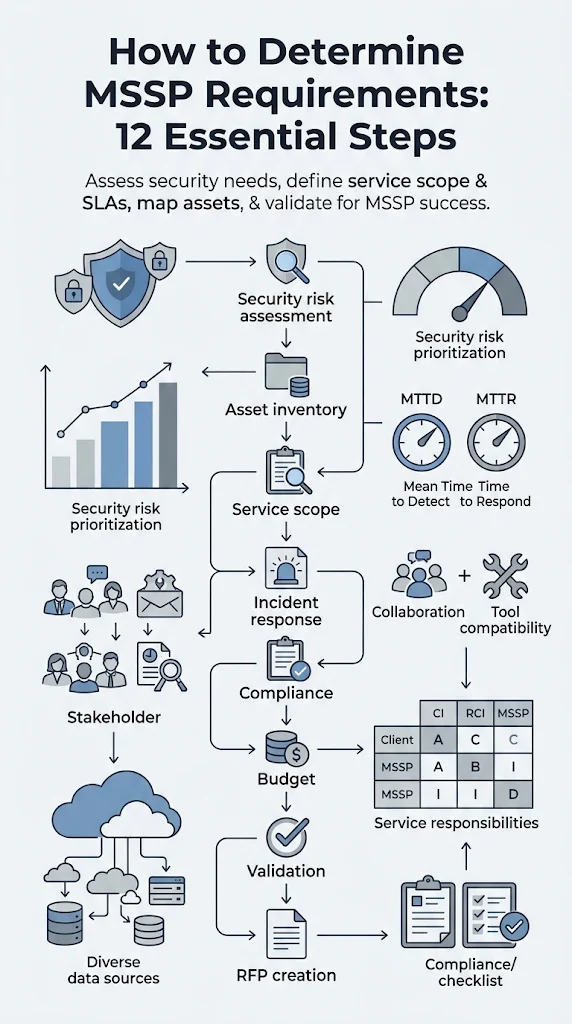
An MSSP Request for Proposal (RFP) converts approved requirements into procurement criteria, allowing providers to respond to consistent business, technical, and operational expectations. The MSSP requirements determination process should provide the foundation for this document.
A comprehensive RFP should cover security objectives, monitoring capabilities, technical integrations, incident response, SLAs, compliance obligations, service scope, pricing, and implementation expectations. MSSPs should also define the supporting documentation and service details providers must submit.
At MSSP Security, we recommend evaluating proposals against consistent criteria, including service capabilities, SIEM and EDR compatibility, operational readiness, SLA commitments, audit support, and commercial terms. Product demonstrations and technical documentation can help verify claims that written proposals cannot establish.
Before procurement proceeds, stakeholders should approve mandatory requirements, acceptance criteria, and outstanding contractual details. This MSSP requirements sign-off creates a reliable baseline for comparing proposals, selecting security products, negotiating terms, and preparing implementation.
FAQ
What Is the MSSP Requirements Determination Process?
It is a structured process for identifying business, security, technical, operational, and compliance needs before engaging a Managed Security Service Provider. It includes discovery, risk assessment, asset inventory, service definition, and stakeholder approval.
What Are the Most Important Technical Requirements for an MSSP?
Important technical requirements include SIEM integration, EDR monitoring, firewall visibility, cloud connectivity, identity integration, log collection, and ticketing system connectivity. The exact requirements depend on the organization’s infrastructure and security risks.
How Do You Determine Which Assets an MSSP Should Monitor?
Identify critical business assets, classify sensitive data, assess risk exposure, and establish monitoring priorities based on business impact. Include endpoints, servers, cloud workloads, identity systems, network devices, and business-critical applications.
What Is the Difference Between MSSP Service Scope and Service Responsibilities?
Service scope defines which assets and services are covered by the agreement. Service responsibilities identify which activities belong to the MSSP, the customer, or both. Both must be documented to prevent operational misunderstandings.
How Do You Set MSSP SLA Requirements?
Define measurable expectations for monitoring availability, incident acknowledgment, investigation, response, escalation, and reporting. Targets should reflect incident severity, business risk, and the organization’s operational needs.
How Do You Finalize MSSP Requirements Before Vendor Selection?
A structured MSSP requirements determination process helps turn security objectives into clear technical, operational, and business requirements before vendor selection. Before issuing an RFP, validate critical asset coverage, integration needs, service responsibilities, compliance obligations, incident response procedures, and SLA targets.
At MSSP Security, we help MSSPs evaluate and audit security products, reduce tool sprawl, and optimize their technology stacks. Our consulting services include needs analysis, vendor shortlisting, proof-of-concept support, and actionable recommendations backed by over 15 years of experience and 48K+ completed projects.
Ready to build a security stack that fits your business goals? Contact MSSP Security to discuss your requirements.
References
- “Security and Privacy Controls for Information Systems and Organizations.” NIST Computer Security Resource Center, September 2020. Accessed November 9, 2026.
- “Data Sources.” MITRE ATT&CK, October 2025. Accessed November 9, 2026.