


A security service scope document defines the cybersecurity services a provider delivers, each party’s responsibilities, and the boundaries of service delivery. It specifies what an MSSP will monitor, manage, report, and support under the agreement.
A clear document helps prevent disputes, control scope creep, and set measurable expectations. Verizon’s 2026 Data Breach Investigations Report found that third-party supply chain breaches accounted for 48% of reported breaches.
This highlights the need for clear vendor responsibilities. MSSP Security emphasizes defining these terms before onboarding. Keep reading to learn how to prepare a practical scope document.
What to Check Before Security Monitoring Begins
Before onboarding starts, make sure your defining security service scope document covers these three areas:
- Assets covered: List the systems, applications, devices, and environments included in the agreement.
- Monitoring duties: Clarify which assets the MSSP must monitor and what technical requirements apply.
- Service boundaries: Review the inventory with internal IT and security teams to catch missing assets and avoid gaps in monitoring.
What Does a Security Service Scope Document Cover?
A defining security service scope document sets out the services, responsibilities, deliverables, and limitations agreed upon by a security provider and its customer. It gives both parties a clear reference for what the engagement includes. You may also see it called a security scope of work, security services statement of work, or security service definition document.
For MSSPs that need support with product evaluation and implementation planning, evaluation, selection & onboarding (consulting) can help align technology decisions with service requirements and operational goals.
The document differs from a statement of work (SOW), which outlines activities, milestones, timelines, and commercial terms. A master service agreement covers broader legal obligations, including liability, confidentiality, and payment.
In our consulting work, we also look for gaps between these documents. For example, a promise of continuous monitoring should match the listed assets, log sources, monitoring hours, and escalation procedures. Incident remediation, forensic investigation, and infrastructure recovery should also be stated separately rather than assumed to be included.
Why Does Defining Security Service Scope Matter?

A defining security service scope document helps MSSPs set clear service boundaries, match customer expectations with technical capabilities, and assign operational responsibilities. When these details are missing, even a small change in customer requirements can lead to scope creep, extra costs, or disagreements over who handles the work.
Consider a customer that initially requests endpoint monitoring but later wants to add cloud environments, subsidiaries, or a newly acquired business. Each addition may require new integrations, product licenses, and analyst capacity. We advise MSSPs to document these changes and agree on the additional requirements before expanding the service.
Third-party environments also deserve attention when defining service boundaries. Verizon’s 2026 Data Breach Investigations Report highlights this risk:
“Supply chains get riskier as third-party involvement in breaches is up 60%: As companies rely more heavily on external vendors, threat actors are exploiting those vulnerabilities, with breaches involving a third party now accounting for 48% of all breaches.” – Verizon
This finding reinforces the need to specify which external systems, supplier connections, and third-party services are covered by the MSSP agreement, rather than assuming they are automatically included.
The scope must also reflect the customer’s business needs. A financial company may need stronger identity monitoring, while a manufacturer may prioritize operational technology and production networks. When we assess security products, we look at whether their features can support these requirements and fit the MSSP’s planned service offering.
Clear responsibilities are just as important during an incident. For instance, an MSSP may detect suspicious endpoint activity, but isolating a production server could require customer approval. That authority should be agreed upon before an incident occurs.
Without these boundaries, providers risk monitoring gaps, delayed response, unclear accountability, unexpected costs, and incomplete reporting.
What Should a Defining Security Service Scope Document Include?

A defining security service scope document should explain service objectives, technical coverage, operational responsibilities, deliverables, exclusions, and approval requirements. Clear descriptions help both parties understand the MSSP’s commitments.
The document should distinguish between functional and non-functional requirements. Functional requirements cover activities such as security monitoring, threat detection, vulnerability scanning, incident escalation, and reporting. Non-functional requirements define service conditions, including availability, monitoring hours, response targets, data retention, and access restrictions.
Before documenting these components, MSSPs should establish the services, coverage, and performance expectations they intend to deliver. Our guide to defining MSSP service requirements explains how to translate operational needs into clear service commitments.
Key components include service objectives that establish business and security goals; technical scope that identifies covered systems and environments; and operational scope that outlines monitoring and response activities. It should also assign provider and customer responsibilities, specify reports and other deliverables, identify excluded activities, and document governance procedures such as approvals and change control.
We recommend separating technical coverage from operational duties. Including a cloud environment for log monitoring, for example, does not automatically make the MSSP responsible for configuration or remediation. A recognized cybersecurity framework can help organize requirements across governance, identification, protection, detection, response, and recovery.
How Do You Identify Assets and Environments Covered by Security Services?
Credit: Datadog
Start by listing every asset, system, application, location, and environment included in the MSSP agreement. A defining security service scope document should make clear what the provider is expected to monitor and which systems fall outside its responsibility. We use this inventory as a starting point when reviewing whether an MSSP’s security products can support its planned service coverage.
A structured determine mssp requirements process can help providers identify business priorities, technical dependencies, and security capabilities before finalizing the asset inventory.
Group assets by category to make the list easier to check:
- Endpoints: Workstations, laptops, servers, and mobile devices.
- Network infrastructure: Firewalls, routers, switches, and VPN gateways.
- Cloud and SaaS: Accounts, subscriptions, tenants, regions, and business applications.
- Identity systems: Authentication platforms and privileged accounts.
- Business applications and logs: Databases, internal software, security events, and application logs.
For each asset, record its identifier, owner, location, and coverage status. When assessing security products, we also check whether they can collect the required logs, support API integrations, and meet data retention requirements.
Subsidiaries and third-party environments need separate coverage definitions. Monitoring a customer’s connection to a supplier, for example, does not mean the MSSP manages the supplier’s entire infrastructure.
Data classification, access restrictions, storage locations, and deletion requirements should also be documented. These details help MSSPs understand what information their tools can access and whether the selected products meet the customer’s security requirements.
How Should You Define Security Service Inclusions and Exclusions?
A defining security service scope document should spell out which activities the MSSP will handle and which remain outside the agreement. This distinction matters because customers may assume that a security service covers more than the provider has agreed to deliver. Clear inclusions and exclusions help both parties avoid disputes over responsibilities, additional work, and costs.
The UK National Cyber Security Centre (NCSC) reinforces this requirement in its guidance on choosing a managed service provider:
“The contract should clearly specify what is and what is not included.” – NCSC
This highlights why MSSPs should document service boundaries in clear terms rather than leave customers to interpret what the agreement covers.
An inclusion and exclusion table makes these boundaries easier to review:
| Service area | Included work | Possible exclusion |
| Security monitoring | Monitoring agreed log sources | Unlisted systems |
| Incident response | Detection and notification | Containment without approval |
| Vulnerability management | Scheduled scanning | Unapproved remediation |
| Penetration testing | Testing approved targets | Unlisted systems |
| Reporting | Reports on the agreed schedule | Custom reports outside the agreement |
| Endpoint security | Monitoring covered devices | Unmanaged personal devices |
We advise MSSPs to list exclusions in plain terms rather than relying on broad statements. Common examples include physical security, application development, hardware replacement, infrastructure recovery, and remediation without customer approval. Each exclusion should clarify whether the customer handles the work or needs a separate service agreement.
Product selection also needs to reflect these boundaries. When we assess a security tool, we check whether its features support the activities included in the service. A tool that detects threats, for example, may not provide the remediation capabilities a customer expects.
If a customer later requests investigation of a compromised application, the MSSP should check whether that work falls under the original agreement. If not, both parties can discuss a formal scope change before the provider takes on additional responsibilities. Review these boundaries during onboarding and service reviews, not only when an incident occurs.
Who Is Responsible for Security Service Delivery?
A defining security service scope document should make it clear which tasks belong to the MSSP and which remain with the customer. Both parties need to understand who makes decisions, handles incidents, and approves actions that could affect business operations. Without this agreement, security teams may duplicate work or leave important tasks unattended.
A responsibility matrix helps put these duties in writing:
| Activity | MSSP responsibility | Customer responsibility |
| Security monitoring | Monitor agreed systems | Provide asset and log access |
| Incident notification | Detect and report alerts | Coordinate internal response |
| Containment | Perform authorized actions | Approve restricted actions |
| Asset inventory | Validate monitoring coverage | Maintain accurate records |
| Vulnerability management | Scan and report findings | Decide on remediation |
We also recommend using a RACI matrix to assign who is Responsible, Accountable, Consulted, and Informed for each activity. When we review security products for MSSPs, we check whether their features and access controls support these assigned duties. A tool may detect suspicious activity, for example, but that does not mean it can safely isolate a production system without approval.
The scope should name primary and backup contacts, communication channels, emergency approval authority, and procedures for unavailable contacts. These details give analysts a clear route to follow when an incident needs a quick decision. Agree on them before monitoring begins.
What Service Levels and Operational Expectations Should an MSSP Define?
A defining security service scope document should specify service hours, monitored systems, alert response targets, and notification responsibilities. These details help the MSSP and customer understand what the service covers and what each party must deliver.
Not every activity needs 24/7 coverage. For example, an MSSP may provide continuous automated monitoring while handling routine investigations and service reviews during business hours. We recommend documenting these differences, including maintenance windows, holiday coverage, and planned interruptions.
Incident severity levels should also guide response priorities. Critical incidents, such as an active compromise of a critical system, require immediate escalation. High-severity alerts, including suspected unauthorized access, need priority investigation. Medium-severity events receive standard investigation, while low-severity informational alerts follow routine handling.
Response targets should be agreed upon by both parties. The scope must also identify notification contacts, approved communication channels, and the information required in incident alerts.
When assessing security products, we check whether their monitoring, alerting, and integration capabilities support these commitments. Metrics such as active log sources and monitored assets also help MSSPs identify coverage gaps before they affect service delivery.
Which Deliverables and Acceptance Criteria Should an MSSP Document?
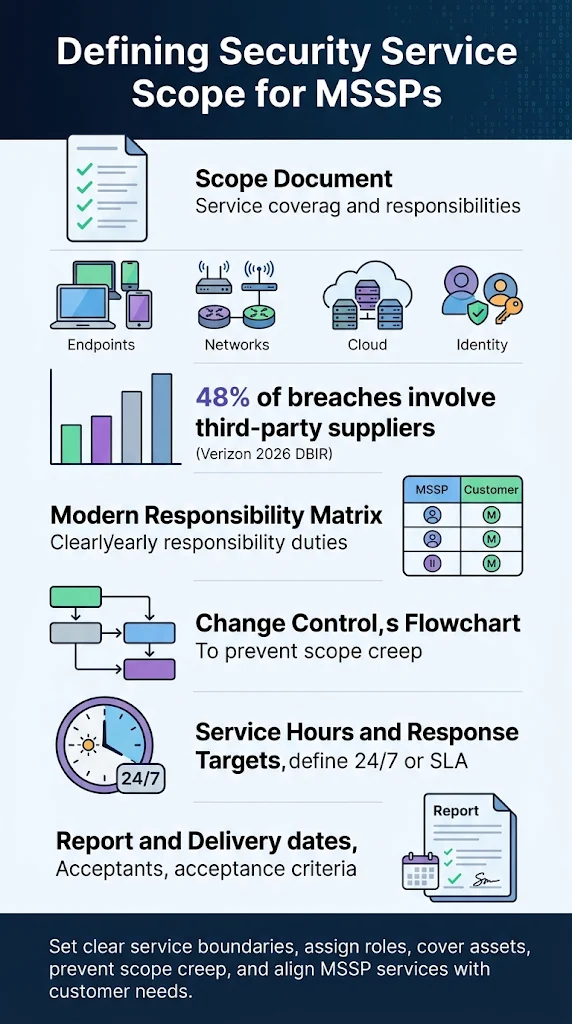
A defining security service scope document should identify each deliverable, its owner, submission schedule, and acceptance criteria. Without these details, an MSSP may provide reports that meet the agreement but fail to address the customer’s actual needs.
Common deliverables include monitoring reports, which summarize the reporting period and asset coverage, and incident reports, which document detection details and response actions. Vulnerability assessments should specify the systems reviewed, while security recommendations should outline key findings and remediation priorities. MSSPs should also provide service reviews according to an agreed meeting schedule and asset coverage reports showing inventory updates and monitoring status.
Reporting frequency should match the service requirements. Critical incidents may require immediate escalation, while routine SOC reports can be delivered monthly.
We also recommend agreeing on acceptance criteria before work begins. For example, a monthly monitoring report should include covered assets, alert statistics, significant incidents, and outstanding recommendations. When auditing security products, we assess whether their reporting and export features can produce these details without excessive manual work.
Regular service reviews help both parties address performance, unresolved issues, and changing requirements. Monthly operational meetings and quarterly strategic reviews are possible arrangements, depending on the engagement.
How Can You Prevent Scope Creep and Manage Scope Changes?
A defining security service scope document should include a formal change control process for handling requests that affect agreed services, responsibilities, or deliverables. This allows an MSSP to accommodate new requirements without taking on unplanned work or costs.
Common changes include adding endpoints, expanding cloud monitoring, extending service hours, or introducing incident response activities. We recommend handling each request through these steps:
- Record the request: Document the business reason and expected outcome.
- Review the impact: Identify affected assets, services, integrations, and responsibilities.
- Check feasibility: Assess technical requirements and operational risks.
- Estimate resources: Calculate additional staffing, licensing, costs, and implementation time.
- Obtain approval: Secure authorization from designated representatives.
- Update the agreement: Revise the scope document, SOW, and related records.
A change order may require approval from the customer’s security manager or contract owner and the provider’s service delivery manager. When we assess new security products, we also consider whether additional integrations or licenses could affect the original service commitments.
Avoid treating informal discussions as approval. Keep a revision history so both parties can track approved changes, costs, responsibilities, and effective dates.
How Do You Review and Approve a Defining Security Service Scope Document?
Before approval, a defining security service scope document should be checked against actual business requirements, technical coverage, and operational responsibilities. The review should involve customer security leaders, IT and cloud managers, application owners, legal and procurement teams, and the MSSP’s service delivery and SOC leads. Each stakeholder must verify the requirements within their area.
Compare the listed assets and environments with current inventories, cloud accounts, network diagrams, identity systems, and application registers. Confirm that every in-scope asset has an owner and a clearly defined coverage status. Resolve missing information before signing.
We recommend using a final checklist to confirm that the document includes:
- Business objectives and service requirements.
- In-scope assets, inclusions, and exclusions.
- Customer and provider responsibilities.
- Service levels, deliverables, and escalation authorities.
- Change control and approval procedures.
- Authorized sign-offs, version numbers, and revision dates.
Both parties should retain the same approved version in an accessible location. This gives service teams a consistent reference and helps prevent disputes over coverage or responsibilities.
FAQ
What Is the Difference Between a Security Service Scope Document and an SOW?
A security service scope document defines service coverage, responsibilities, and boundaries. A Statement of Work (SOW) outlines the activities, milestones, timelines, and commercial terms required to deliver the agreed services.
Who Is Responsible for Maintaining the Security Service Scope?
Both the MSSP and customer share responsibility. The MSSP defines its service commitments, while the customer provides accurate asset information, access, and necessary approvals. Both parties should review and update the document when requirements change.
What Happens If a Security Incident Requires Actions Outside the Agreed Scope?
The MSSP should follow the documented escalation and authorization procedures. Activities such as system isolation, forensic investigation, or remediation may require customer approval or a separate agreement.
How Often Should an MSSP Review Its Service Scope Agreement?
The scope should be reviewed during scheduled service reviews and whenever significant changes occur, such as new systems, cloud environments, security requirements, or service responsibilities.
Can Security Product Limitations Affect an MSSP’s Service Commitments?
Yes. Product limitations involving integrations, monitoring coverage, reporting, or response capabilities can affect service delivery. MSSPs should assess these capabilities during product selection to ensure their technology stack supports the agreed commitments.
How Can MSSP Security Help Define a Clear Service Scope?
A clear security service scope aligns service coverage, responsibilities, and customer expectations with business objectives.
At MSSP Security, we help MSSPs select security products, audit existing tools, and optimize their technology stack. With over 15 years of experience and 48K+ projects completed, our consulting includes needs analysis, vendor-neutral product selection, vendor shortlisting, PoC support, and actionable recommendations.
We also help identify integration gaps, reduce tool sprawl, and improve security visibility so MSSPs can build a stack that supports their operational needs.
Strengthen your security services with the right technology and guidance. Contact MSSP Security to discuss your requirements.
References
- “Choosing a managed service provider (MSP).” National Cyber Security Centre, 24 November 2025. Accessed 10 November 2026.
- “Vulnerability exploitation top breach entry point, 2026 industry-wide DBIR finds.” Verizon, 19 May 2026. Accessed 10 November 2026.