


A Security Maturity Evaluation Service California helps organizations measure how well their cybersecurity programme manages risk, protects critical systems, and supports business operations. Security tools and policies alone do not guarantee effective protection or reveal every gap.
At MSSP Security, we review governance, processes, people, technology, and security controls using evidence and organizational context. The assessment identifies weaknesses, compares current maturity with target levels, and helps prioritize improvements. Keep reading to learn how the assessment process, scoring, controls, and next steps work.
Security Maturity: What Matters Most
Before looking at the assessment process, here are three practical points worth knowing about Security Maturity Evaluation Service California:
- Assess the full security programme: Review governance, processes, people, technology, risk management, and security controls rather than focusing on individual tools.
- Prioritize gaps by risk: Use maturity scoring and benchmarking to identify important weaknesses and determine which remediation efforts deserve attention first.
- Track progress against a baseline: Compare assessment results over time to see whether security maturity is improving and whether completed remediation has delivered the expected results.
What Is a Security Maturity Evaluation Service in California?
A Security Maturity Evaluation Service California helps MSSPs understand how effectively their cybersecurity programme, controls, and security products work in practice. Rather than checking whether a tool simply exists, we look at how well it is configured, managed, integrated, and aligned with the security risks it is meant to address.
A cybersecurity maturity assessment service California can provide a structured way to establish the current state of an MSSP’s security capabilities and identify areas that require improvement.
A cybersecurity maturity assessment California service can help MSSPs:
- Establish their current security maturity
- Identify gaps and control weaknesses
- Compare current and target maturity levels
- Review security controls effectiveness
- Prioritize practical improvements
In our consulting experience, security gaps are often caused by configuration, integration, ownership, or process issues rather than missing technology. We therefore assess the existing security stack before suggesting another product.
This approach helps MSSPs make better product selection and audit decisions. Our focus is to determine whether a genuine technology gap exists, whether an existing capability can be improved, or whether a new security product would provide meaningful value.
How Does a Cybersecurity Maturity Assessment Evaluate Your Security Programme?

A cybersecurity maturity assessment looks at how security operates across people, processes, technology, governance, and measurement. Rather than relying on policies alone, we use available evidence to understand how controls perform in the real environment.
This evidence-based approach helps organizations evaluate security program effectiveness California teams need to understand whether security capabilities are delivering their intended outcomes.
A typical assessment includes:
- Establish the baseline: Review current capabilities, controls, risks, and security priorities.
- Review documentation: Examine policies, procedures, risk records, findings, and product documentation.
- Interview stakeholders: Discuss responsibilities, processes, and operational challenges.
- Examine evidence: Review configurations, reports, logs, and control records.
- Assess control effectiveness: Determine whether controls work as intended.
- Score maturity: Compare capabilities with the chosen model and target state.
- Identify gaps: Separate missing capabilities from configuration, integration, ownership, or process issues.
- Prioritize risks: Consider exposure, business impact, and remediation needs.
In our experience with MSSPs, a product can be fully deployed yet still fail to address the underlying problem. An information security gap analysis and cybersecurity gap assessment help us determine whether the issue requires a new product or better use of what is already available. This makes product selection and security audits more evidence-based and practical.
How Does NIST CSF 2.0 Support Security Maturity Assessment and Scoring?
The NIST Cybersecurity Framework (CSF) 2.0 gives organizations a practical structure for reviewing cybersecurity through Govern, Identify, Protect, Detect, Respond, and Recover. A NIST CSF 2.0 maturity assessment can compare current practices with desired outcomes while giving MSSPs a consistent way to review security capabilities.
The assessment can consider:
- Current cybersecurity practices
- Target cybersecurity outcomes
- Organizational risk
- Existing security controls
- Security responsibilities
- Supporting evidence
- Gaps between current and target states
NIST CSF 2.0 provides a practical structure for viewing security maturity across connected capabilities. The table below shows what each function covers and how the findings can relate to MSSP security operations.
| NIST CSF 2.0 Function | What the Assessment Reviews | MSSP Security Considerations |
| Govern | Strategy, roles, policies, risk management, and oversight | Risk ownership, governance, and business alignment |
| Identify | Assets, risks, dependencies, and priorities | Asset visibility, vulnerability management, and third-party risk |
| Protect | Safeguards that reduce cybersecurity risk | IAM, endpoint, network, cloud, and data protection |
| Detect | Capabilities for identifying security events | Monitoring, logging, SIEM, alerting, and threat detection |
| Respond | Processes for managing security incidents | Investigation, escalation, communication, and containment |
| Recover | Capabilities for restoring operations | Backup, disaster recovery, business continuity, and lessons learned |
NIST CSF implementation tiers can add useful context about how consistently cybersecurity risk management is applied across the organization. A NIST CSF maturity assessment tool can help organize evidence, assessment criteria, and scoring, but we do not treat its output as the final answer.
In our experience auditing security products, a score is only useful when we can explain what sits behind it. A security maturity scorecard should show whether controls actually work, while a cyber maturity scorecard can track maturity, gaps, business impact, cybersecurity risk, evidence, recommended improvements, and remediation progress.
This makes security maturity scoring more practical for MSSPs. It helps us determine whether a weakness reflects a genuine product gap or something that can be addressed through better configuration, integration, ownership, or processes.
Which Security Controls Should a Maturity Assessment Review?

A security controls assessment examines whether controls are properly configured, managed, integrated, and delivering the expected protection. For MSSPs, we focus on whether existing products work effectively before deciding if another solution is needed.
Key areas include:
- Identity and access: An identity and access management assessment reviews authentication, authorization, account lifecycle, access reviews, and privileged access.
- Network and endpoints: A network security assessment, firewall configuration review, and endpoint security assessment can identify configuration and protection gaps.
- Vulnerability management: We review how vulnerabilities are identified, prioritized, assigned, remediated, and verified.
- Cloud security: A cloud security maturity assessment examines identity, configurations, data protection, logging, monitoring, and governance.
- Security monitoring: A security monitoring assessment and SIEM maturity assessment determine whether collected events support effective detection and investigation.
From our product audits, capable tools can still underperform because of configuration or integration issues. Reviewing security controls effectiveness helps MSSPs distinguish a genuine technology gap from a problem that can be fixed within the existing security stack.
How Do Governance, Risk, and Compliance Affect Security Maturity?
Security maturity depends on more than technical controls. A security governance assessment reviews how security decisions are made, who owns risks, and whether cybersecurity supports business goals. We typically examine:
- Security roles, policies, and standards
- Risk ownership and acceptance
- Leadership oversight and reporting
- Security decision-making
- Alignment with business objectives
A security strategy evaluation can then show whether these practices support wider operational needs. For MSSPs, this context is valuable when selecting or auditing security products because technology decisions should reflect real risks.
A GRC maturity assessment also looks at how governance, risk, and compliance activities work together, including risk treatment, compliance management, control ownership, security metrics, and audits.
Third-party risk should not be overlooked. A third-party risk management assessment and vendor security assessment can review vendor classification, security evidence, contracts, risk ratings, approval, and ongoing monitoring. In our experience, this helps MSSPs identify gaps that fragmented vendor reviews may miss and supports a practical cybersecurity risk assessment California organizations can use.
Which Compliance Frameworks Can a Security Maturity Assessment Cover in California?
Credit: Optic Cyber
A security maturity assessment can support several compliance and security frameworks, depending on an organization’s industry, data, contracts, and risk profile. A compliance readiness assessment checks how current practices align with applicable requirements, while we also consider whether security products support those controls effectively.
Common assessment areas include:
- NIST 800-53 security assessment: Reviews applicable security and privacy controls and supporting evidence.
- NIST 800-171 gap assessment: Identifies gaps in protecting controlled information.
- CMMC readiness assessment: Helps identify control and evidence gaps before formal assessment activities. A CMMC readiness assessment consultant California organizations engage should consider both documentation and actual implementation.
- ISO 27001 readiness assessment: Reviews progress toward an information security management system.
- SOC 2 readiness assessment: Examines whether relevant controls are properly designed and operating effectively.
“This publication can be used in conjunction with its companion publication, NIST Special Publication 800-171A, which provides a comprehensive set of procedures to assess the security requirements.” – National Institute of Standards and Technology (NIST)
Depending on the environment, we may also review HIPAA security risk assessment, PCI DSS gap assessment, CCPA security controls review, and CPRA cybersecurity assessment.
From our experience with MSSPs, compliance should support the wider security programme, not simply prepare an organization for an audit.
How Can Organizations Assess Incident Response and Security Resilience?
A security programme needs to do more than prevent threats. An incident response maturity assessment looks at whether teams can detect, investigate, contain, and recover from incidents. We typically review:
- Response roles and responsibilities
- Detection and escalation procedures
- Investigation and communication
- Evidence preservation
- Containment and recovery
- Post-incident reviews and lessons learned
Incident response plan testing and tabletop exercises can reveal issues that written plans may miss, such as unclear responsibilities, communication delays, or operational dependencies. From our experience with MSSPs, testing also helps determine whether existing security products support the response process effectively.
A ransomware readiness assessment can further examine backup availability, recovery priorities, system restoration, communication, and critical business dependencies.
Meanwhile, a business continuity assessment considers whether essential operations can continue during disruption, while a disaster recovery maturity assessment reviews the ability to restore critical systems and services.
Together, these reviews provide a clearer view of security resilience and whether response and recovery capabilities work under realistic conditions.
How Can Organizations Measure and Continuously Improve Security Maturity?
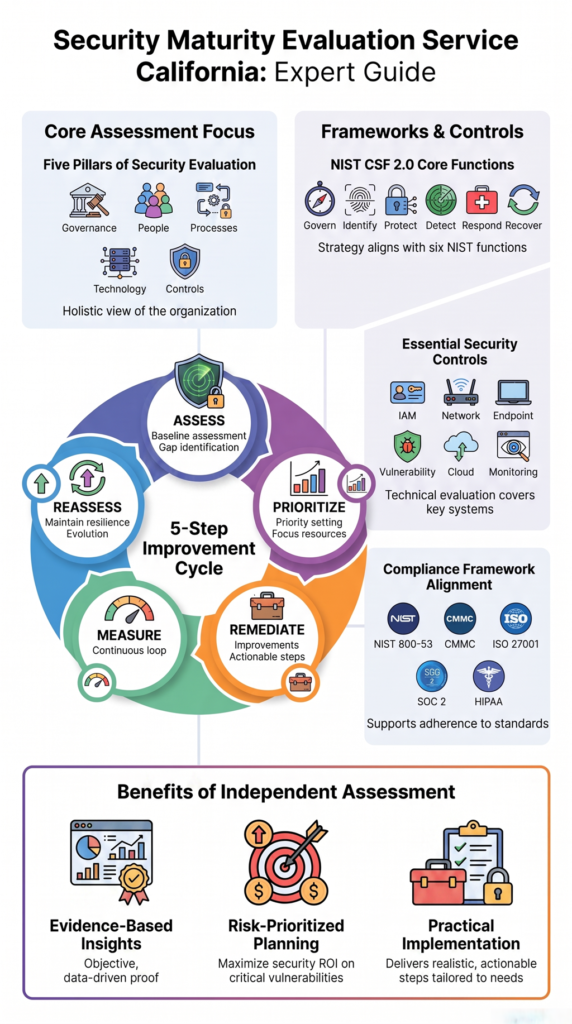
A security maturity assessment gives an organization a baseline, but the real value comes from tracking what changes afterward. We help MSSPs compare current capabilities with a realistic target and determine whether remediation is actually reducing risk.
A practical process includes:
- Establish a baseline: Record current maturity and key security gaps.
- Set a target: Define the maturity level based on risk, business needs, and applicable requirements.
- Choose metrics: Track control effectiveness, remediation, and meaningful security outcomes.
- Implement improvements: Address the highest-priority weaknesses.
- Measure progress: Compare results with the original baseline and target.
- Reassess: Confirm improvements remain effective over time.
Effective benchmarking security maturity level should reflect the organization’s actual risk rather than an arbitrary score. A cyber maturity scorecard can track governance, identity, vulnerability management, monitoring, incident response, data protection, and third-party risk.
From our experience auditing security products, measuring security maturity progress also requires looking beyond scores. A documented and tested process may represent significant improvement even when the numerical rating changes only slightly.
ISO reinforces this continuous-improvement approach, stating:
“The ISO/IEC 27001 standard provides companies of any size and from all sectors of activity with guidance for establishing, implementing, maintaining and continually improving an information security management system.” – International Organization for Standardization (ISO)
This supports the idea that security maturity should not be treated as a one-time measurement. Instead, organizations can use assessment results to identify weaknesses, implement improvements, measure their effectiveness, and continue reassessing their security posture over time.
The cycle remains simple: Assess → Prioritize → Remediate → Measure → Reassess.
How Can a Risk-Based Cybersecurity Improvement Roadmap Prioritize Security Gaps?
Finding security gaps is only the starting point. A cybersecurity improvement roadmap helps MSSPs and their clients decide what needs attention first based on actual risk, business impact, and available resources.
We typically consider:
- Impact on critical systems and data
- Likelihood of exploitation or failure
- Regulatory or contractual requirements
- Existing compensating controls
- Business dependencies
- Implementation effort and resources
- Expected reduction in risk
This creates a risk-based security roadmap instead of a generic list of technical findings. A security remediation plan can then assign each action an owner, priority, timeline, dependency, and expected outcome.
From our experience auditing security products, not every gap requires another tool. Some issues can be resolved through better configuration, integration, processes, or ownership. Security controls prioritisation helps separate urgent technology gaps from lower-risk improvements.
Priorities can be grouped into:
- Immediate: Critical vulnerabilities, access issues, control failures, or urgent compliance gaps
- Near-term: Process, monitoring, documentation, training, and consistency improvements
- Long-term: Governance, architecture, automation, and measurement
Keeping the roadmap flexible and assigning measurable outcomes makes continuous security maturity improvement easier to track and manage.
Why Is an Independent Security Assessment Valuable in California?
An independent security assessment California organizations commission provides an outside view of how effectively their security programme operates. For MSSPs, this can be valuable when reviewing an existing security stack or evaluating a new product.
We look beyond product claims to determine whether controls work as expected and whether another solution is actually needed.
An independent review can examine:
- Security control effectiveness
- Configuration and integration issues
- Existing technology gaps
- Product feature usage
- Risk and business impact
- Whether new technology is justified
From our experience, a weak security result does not always mean another product is required. Configuration, ownership, integration, or process issues may be the real cause.
At MSSP Security, we use evidence to connect technology, governance, risk, and business objectives. Depending on scope, an evaluation may provide a security maturity scorecard, information security gap analysis, risk-prioritized recommendations, a security remediation plan, and a cybersecurity improvement roadmap.
This gives MSSPs practical findings for improving existing controls, auditing products, and making more informed technology decisions.
When Should a California Organization Conduct a Security Maturity Assessment?
There is no fixed schedule for a cybersecurity maturity assessment. The right timing depends on the organization’s risk profile, technology environment, business changes, regulatory needs, and current security maturity.
A California organization may benefit from an assessment when:
- Its technology environment changes significantly
- A security incident occurs or is narrowly avoided
- Security responsibilities change
- New regulatory or contractual requirements apply
- Leadership needs clearer cybersecurity investment priorities
- Previous assessment findings remain unresolved
- A compliance assessment is approaching
- Major cloud or technology projects are introduced
- Third-party or supply-chain risks increase
- A new security baseline is needed
For MSSPs, we also find reassessment useful after major changes to the security stack or remediation work. It can show whether a new product, configuration change, or process improvement actually delivered the expected result.
Rather than simply confirming that recommended actions were completed, we look at whether those changes improved security controls effectiveness and reduced the underlying risk. This helps MSSPs make better decisions about existing products and future security investments.
FAQ
What Is a Security Maturity Evaluation?
A security maturity evaluation assesses how effectively an organization’s cybersecurity capabilities are designed, implemented, managed, measured, and improved across governance, processes, people, technology, controls, risk, and compliance.
How Is a Maturity Assessment Different From a Cybersecurity Audit?
A cybersecurity audit typically checks whether specific controls or requirements are met. A maturity assessment takes a broader view of how effective and developed the overall security programme is and where it should improve.
Can a Maturity Assessment Support CMMC and NIST CSF 2.0?
Yes. A CMMC readiness assessment can identify gaps and remediation priorities, while NIST CSF 2.0 can provide a structured approach for evaluating current practices, target outcomes, and maturity.
What Does an Independent Security Assessment Provide?
An independent security assessment provides an external view of security capabilities, controls, governance, and risks. For MSSPs, we can also assess whether existing products work effectively and whether a new solution is genuinely needed.
How Often Should Security Maturity Be Measured?
There is no fixed schedule. Periodic reassessment is useful after major technology changes, security incidents, significant remediation work, or changes in regulatory and contractual requirements.
What Should Organizations Know About Security Maturity Evaluation Services in California?
A Security Maturity Evaluation Service California helps MSSPs understand how effectively their cybersecurity programme manages risk across governance, processes, technology, controls, resilience, and compliance. We focus on evidence, not scores alone, helping identify meaningful gaps and practical priorities.
At MSSP Security, our consulting supports vendor-neutral product selection, security product auditing, stack optimization, and PoC guidance. With 15+ years of experience and 48K+ projects completed, we help MSSPs reduce tool sprawl and improve their security stack. Explore MSSP Security consulting services
References
- https://csrc.nist.gov/pubs/sp/800/171/r3/final
- https://www.iso.org/standard/27001
Related Articles
- https://msspsecurity.com/cybersecurity-maturity-assessment-service-california/
- https://msspsecurity.com/evaluate-security-program-effectiveness-california/
- https://msspsecurity.com/nist-csf-maturity-assessment-tool/
- https://msspsecurity.com/cmmc-readiness-assessment-consultant-california/
- https://msspsecurity.com/benchmarking-security-maturity-level/
- https://msspsecurity.com/measuring-security-maturity-progress/
- https://msspsecurity.com/independent-security-assessment-California/
- https://msspsecurity.com/evaluation-selection-and-onboarding-consulting/