


To evaluate security program effectiveness California organizations should determine whether security controls reduce risk, support business goals, and work consistently in daily operations. Policies, tools, and compliance documents alone do not prove effectiveness.
A practical assessment reviews governance, control performance, cybersecurity maturity, technical safeguards, risk management, and measurable outcomes. This helps identify weaknesses, prioritize risks, and guide security improvements based on actual needs.
As technology and threats change, regular evaluation also helps maintain effective controls. Keep reading with MSSP Security to learn how each area can be assessed and measured.
Security Effectiveness: What to Check First
Before you evaluate security program effectiveness California organizations, focus on three practical areas:
- Measure effectiveness: Track relevant KPIs and security metrics to see whether the program is delivering expected results.
- Validate controls: Test security controls in practice to confirm they work as intended and address identified risks.
- Prioritize improvements: Use assessment findings to address critical gaps and build a practical, risk-based security roadmap.
How Can Organizations Evaluate Security Program Effectiveness in California?
To evaluate security program effectiveness California organizations should assess whether their security program works in practice, rather than simply confirming that controls and security products are in place. A California security programme effectiveness assessment should consider four areas:
- People: Security responsibilities, awareness, training, and accountability.
- Processes: Policies, risk management, procedures, and incident handling.
- Technology: Security controls, monitoring, identity management, and infrastructure protection.
- Governance: Leadership oversight, decision-making, and security responsibilities.
An information security programme review can show whether these areas work together. In our consulting work with MSSPs, we have seen products that appeared suitable during selection but revealed integration, operational, or capability gaps during closer review.
We help MSSPs assess and audit security products against their intended requirements. Security assessment expert California can provide an additional perspective when organizations need an objective review of their security capabilities and product choices.
How Can Organizations Measure Cybersecurity Program Effectiveness?
A cybersecurity programme evaluation California organizations can use should be based on evidence showing how security performs over time. An information security performance evaluation can combine operational data, interviews, documentation reviews, and technical findings rather than relying on whether a control is simply listed as implemented.
“Organizations have requested guidance on measurement programs that will help them make data-driven, risk-based decisions.” – NIST
This reinforces the value of using measurable evidence when assessing whether security investments and controls are producing the expected results.
Useful security performance metrics California organizations can track include:
| Metric | What It Helps Measure |
| Mean Time to Detect (MTTD) | How quickly threats are identified |
| Mean Time to Respond (MTTR) | How quickly incidents are addressed |
| Vulnerability remediation time | How efficiently weaknesses are resolved |
| Incident frequency | Changes in security event patterns |
| Control coverage | Whether key assets and risks are protected |
| Phishing simulation results | Security awareness across employees |
| Security exceptions | Where controls are bypassed or unavailable |
A cybersecurity KPI assessment becomes more useful when metrics are connected to actual business risk. In our work with MSSPs, we have found that a security product can report strong performance figures while still falling short of operational requirements because of limited integrations, incomplete coverage, or workflow issues. Looking at the evidence behind the numbers helps our clients make better product selection and audit decisions.
Before setting new targets, teams should establish a baseline for each relevant security performance metric. This creates a clear reference point for tracking changes and determining whether a security product, control, or process is delivering the expected improvement. Used consistently, these measurements provide practical evidence when organizations evaluate security program effectiveness California.
How Should Organizations Assess Security Controls, Governance, and Risk Alignment?

When organizations evaluate security program effectiveness California, one of the first things to review is whether security controls match the risks the business actually faces. Having a control documented or included in a security product does not necessarily mean it works well in practice. Its value depends on how it is implemented, managed, and used.
A practical review should consider:
- Control design and implementation: Check whether controls address relevant risks and are deployed as intended.
- Operating effectiveness: Look at whether controls continue to work consistently during normal operations.
- Governance ownership: Identify who is responsible for security decisions, risks, and control performance.
- Policy enforcement: Check whether teams follow the security requirements that have been established.
- Exception management: Review how exceptions are approved, recorded, and followed up.
- Risk acceptance: Confirm that accepted risks are understood and formally approved.
A cybersecurity governance assessment can help clarify how these responsibilities are handled, while an information security governance review looks at the policies and processes behind them. A risk management programme evaluation then helps connect those decisions to the risks that deserve the most attention.
Our work with MSSPs often includes reviewing whether a security product delivers what it was selected to provide. We look at its capabilities, integrations, implementation requirements, and available audit evidence. Security controls validation and security controls assurance can support this review before deeper technical testing takes place.
The goal is simple: make sure controls, governance, and risk decisions support one another rather than operating as separate pieces of the security program.
What Should a Cybersecurity Maturity Assessment Measure?

A cybersecurity maturity assessment California organizations conduct looks beyond whether security controls exist. It considers how consistently the organization can manage security activities, maintain processes, and improve its capabilities over time. Security Maturity Evaluation Service California can help organizations establish a structured baseline for understanding where their security capabilities currently stand.
This is different from effectiveness: effectiveness asks whether controls produce the intended results, while maturity asks how consistently and systematically the organization can perform those activities.
California cybersecurity maturity metrics can cover areas such as governance, risk management, asset management, identity and access management, vulnerability management, monitoring, incident response, recovery, security awareness, and third-party risk.
A security programme maturity assessment can place these capabilities into practical stages:
- Initial: Security activities are mostly reactive or inconsistent.
- Developing: Processes are emerging but not consistently applied.
- Defined: Documented processes and responsibilities are established.
- Managed: Performance is measured and actively managed.
- Optimized: Capabilities are continuously reviewed and improved.
A security capability maturity model and cyber maturity scorecard can make these results easier for leadership to understand. Rather than presenting a long list of technical findings, the assessment shows where capabilities stand and where improvement would have the greatest value.
In our work with MSSPs, maturity reviews can also help when evaluating security products. A product may offer strong capabilities, but those capabilities still need to fit the MSSP’s processes, resources, and operational maturity. We use the maturity baseline to help identify what should improve next, rather than treating a higher score as the goal itself.
What Security Gaps and Cyber Risks Should Organizations Assess?
A strong security program can still have weak points that are easy to miss during routine reviews. Identifying those areas is an important part of how organizations evaluate security program effectiveness California and decide where security resources should go.
A security gap analysis California can highlight areas where current practices, controls, or capabilities do not meet business or security requirements. Rather than treating every gap equally, a cyber risk programme assessment helps determine which ones could have the greatest impact.
Several factors can help set priorities:
- Business and operational impact
- Likelihood of exploitation
- Criticality of affected assets
- Existing safeguards
- Effort required to address the issue
For example, an organization may have a documented vulnerability management process but still leave critical issues unresolved. That operational gap may deserve more attention than several lower-risk findings.
An independent security assessment California can provide another perspective. In our work with MSSPs, we also review whether security products actually address the gaps they were selected to solve. We look at coverage, integrations, implementation needs, and operational fit before drawing conclusions about a product’s value.
The result is a clearer view of what is missing, what matters most, and where action should begin.
What Should Technical Security Controls Validation Cover?
Credit: ProfessorBlackOps – CyberSecurity for the people
Technical validation shows whether security controls work in the real environment, making it an important part of how organizations evaluate security program effectiveness California. A technical security assessment can review vulnerabilities, infrastructure, cloud systems, identities, data, and third-party connections.
For cloud environments, the Cloud Security Alliance (CSA) Cloud Controls Matrix (CCM) provides a structured reference for assessing cloud security controls.
“It can be used as a tool for the systematic assessment of a cloud implementation.” – CSA
This supports a more structured review of whether cloud controls are properly implemented and aligned with security requirements.
Key areas include:
- Vulnerability management: A vulnerability management assessment reviews how weaknesses are found, prioritized, fixed, and verified. A vulnerability scanning service can identify potential issues, while penetration testing California can test whether they are exploitable.
- Infrastructure and cloud: An endpoint security assessment, network security assessment, and cloud security assessment can identify weaknesses across systems and configurations.
- Identity and data: An identity and access management assessment, privileged access management review, and data protection controls assessment examine access and sensitive information.
- Third parties: A vendor security assessment can uncover risks introduced by external providers.
In our MSSP consulting work, we also review whether security products deliver their promised coverage, integrations, and capabilities. Testing technology against actual requirements often reveals issues that product documentation does not show.
Does Security Monitoring Support Effective Incident Response?
Effective monitoring is a key part of how organizations evaluate security program effectiveness California. Teams need to know whether they can spot suspicious activity, investigate useful signals, and respond before an incident grows.
A SIEM effectiveness assessment can review:
- Log and asset coverage
- Alert quality and prioritization
- Detection rules
- Investigation workflows
- Response integration
A SOC maturity assessment adds context by reviewing the people, processes, and technology behind security operations. Meanwhile, threat detection effectiveness focuses on whether analysts can identify meaningful activity without being overwhelmed by false or low-value alerts.
Incident response should also be tested. An incident response maturity assessment and incident response plan assessment can review roles, escalation, communications, evidence handling, and recovery. In our experience, an incident response exercise often exposes issues that documents do not reveal.
For ransomware concerns, a ransomware readiness assessment can test detection, containment, backup protection, recovery, and communication. When working with MSSPs, we also review whether security products deliver the monitoring and response capabilities they were selected to provide.
Can Compliance Frameworks Help Measure Security Effectiveness?
Compliance gives organizations a useful baseline when they evaluate security program effectiveness California, but passing a requirement does not necessarily mean the security program works well. Compliance asks whether expected requirements are being met; effectiveness asks whether those practices help manage real security risks.
A security compliance assessment can review how current practices align with applicable requirements, while a security policy compliance review checks whether those policies are actually followed. Common assessment lenses include:
- NIST CSF assessment California: Reviews cybersecurity capabilities and outcomes across key areas.
- NIST CSF maturity assessment: Looks at how consistently those capabilities are managed.
- NIST 800-53 control assessment: Examines control implementation and supporting evidence.
- ISO 27001 internal audit: Reviews the information security management system and related processes.
- SOC 2 readiness assessment: Identifies control or evidence gaps before an examination.
Depending on the organization’s requirements, additional readiness support may also be useful. For organizations working toward CMMC requirements, a cmmc readiness assessment consultant California can review current controls, documentation, and readiness gaps.
In practice, we have seen organizations meet documented requirements while still having weaknesses in detection, response, or everyday control operation. That is why cybersecurity standards compliance should be treated as one part of a wider effectiveness review.
For MSSPs, our reviews also consider whether a security product supports the controls, evidence, and processes required by the chosen framework. This can uncover product limitations that may not appear during a basic compliance review.
How Should Security Assessment Findings Be Prioritized?
An assessment becomes useful when its findings lead to clear decisions. To evaluate security program effectiveness California organizations need to turn those findings into practical priorities rather than leaving them in a report. A security remediation roadmap can rank issues based on:
- Severity and likelihood of exploitation
- Business and asset criticality
- Financial and regulatory impact
- Existing compensating controls
- Implementation effort and available resources
A risk-based security roadmap helps distinguish urgent issues from improvements that can be handled over time. Resilience should also be considered. A cyber resilience assessment can examine the ability to maintain operations during an incident, while a cyber resilience maturity assessment can review recovery capabilities.
Related reviews may include a business continuity programme assessment and disaster recovery maturity assessment.
In our work with MSSPs, we often find that findings become more useful when connected to specific product and operational decisions. We assess whether a proposed security solution addresses the identified gap, fits existing workflows, and justifies its implementation effort. This turns assessment results into practical next steps.
What Keeps a Security Program Effective Over Time?
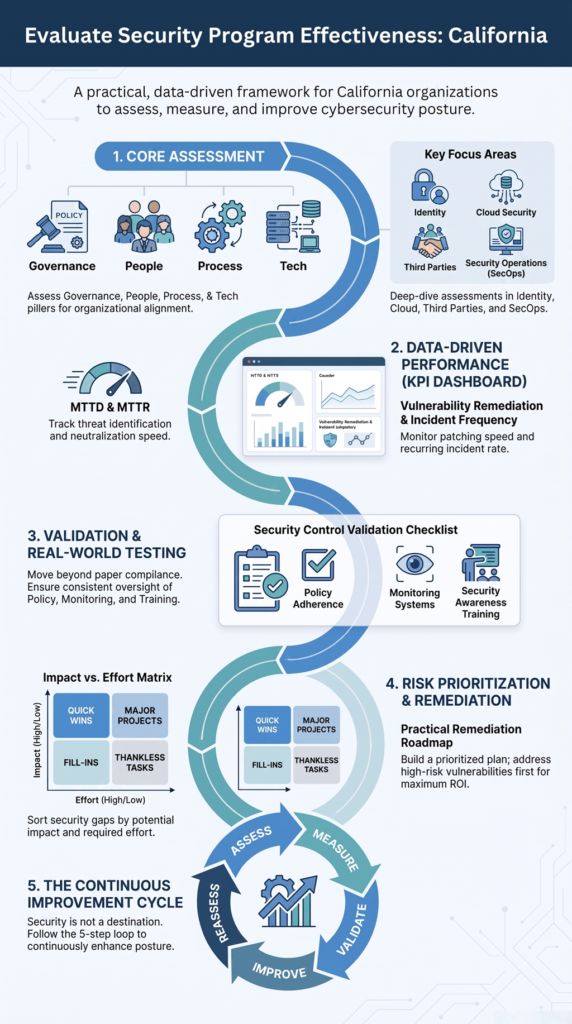
Security effectiveness can change as new vulnerabilities emerge, technologies evolve, and business needs shift. That is why organizations should treat continuous security improvement as an ongoing process rather than a one-time assessment.
A simple cycle can keep the process moving:
Assess → Measure → Validate → Improve → Reassess
The first assessment establishes a baseline. Performance metrics show whether controls are delivering results, while technical validation provides evidence of how they operate in practice. Later reassessments can then show whether changes have actually improved the security program.
A cybersecurity assessment report can bring these findings together, covering:
- Current maturity and performance
- Key security gaps and risks
- Control effectiveness
- Compliance observations
- Recommended improvements
- Progress against the security roadmap
In our work with MSSPs, we find that reassessment is particularly useful after a new security product or major control change is introduced. It helps confirm whether the solution delivers the expected results instead of assuming implementation equals effectiveness.
Ultimately, organizations evaluate security program effectiveness California more accurately when they measure progress over time, not just at a single point.
FAQ
How do you evaluate security program effectiveness in California?
Organizations can evaluate security program effectiveness by reviewing governance, security controls, risk management, technical capabilities, compliance, incident response, and performance metrics. A useful assessment combines documentation reviews, interviews, control testing, technical validation, and measurable KPIs.
What metrics are used to measure cybersecurity program effectiveness?
Common metrics include Mean Time to Detect (MTTD), Mean Time to Respond (MTTR), vulnerability remediation time, incident frequency, control coverage, phishing simulation results, and security monitoring performance. These metrics are most useful when connected to business risk and tracked over time.
What should be included in a security program effectiveness assessment?
A comprehensive assessment can include governance, security controls, risk management, technical validation, cybersecurity maturity, performance metrics, compliance, incident response, and remediation planning. The exact scope should reflect the organization’s risk profile, technology environment, business priorities, and security objectives.
Can compliance prove that a security program is effective?
Not by itself. Compliance shows that an organization meets specific requirements, but it does not necessarily prove that controls work effectively against real-world threats. Control testing, technical assessments, risk analysis, and performance measurements provide additional evidence.
How often should an organization evaluate its security program?
There is no single schedule that fits every organization. Risk exposure, regulatory requirements, technology changes, and major security initiatives can influence the timing. A comprehensive assessment can establish a baseline, while ongoing monitoring and periodic reassessments help track whether security improvements remain effective.
How Can You Tell If Your Security Program Works?
An effective security program is not defined by the number of controls or compliance requirements completed. Organizations should evaluate security program effectiveness California based on evidence that controls reduce risk, weaknesses are addressed, and improvements deliver measurable results.
In our work with MSSPs, we also review whether security products deliver the capabilities they were chosen for. For support with product selection, auditing, stack optimization, or PoC support, connect with MSSP Security to discuss your requirements and next steps.
References
- https://cloudsecurityalliance.org/research/cloud-controls-matrix
- https://www.nist.gov/news-events/news/2024/01/nist-offers-guidance-measuring-and-improving-your-companys-cybersecurity