

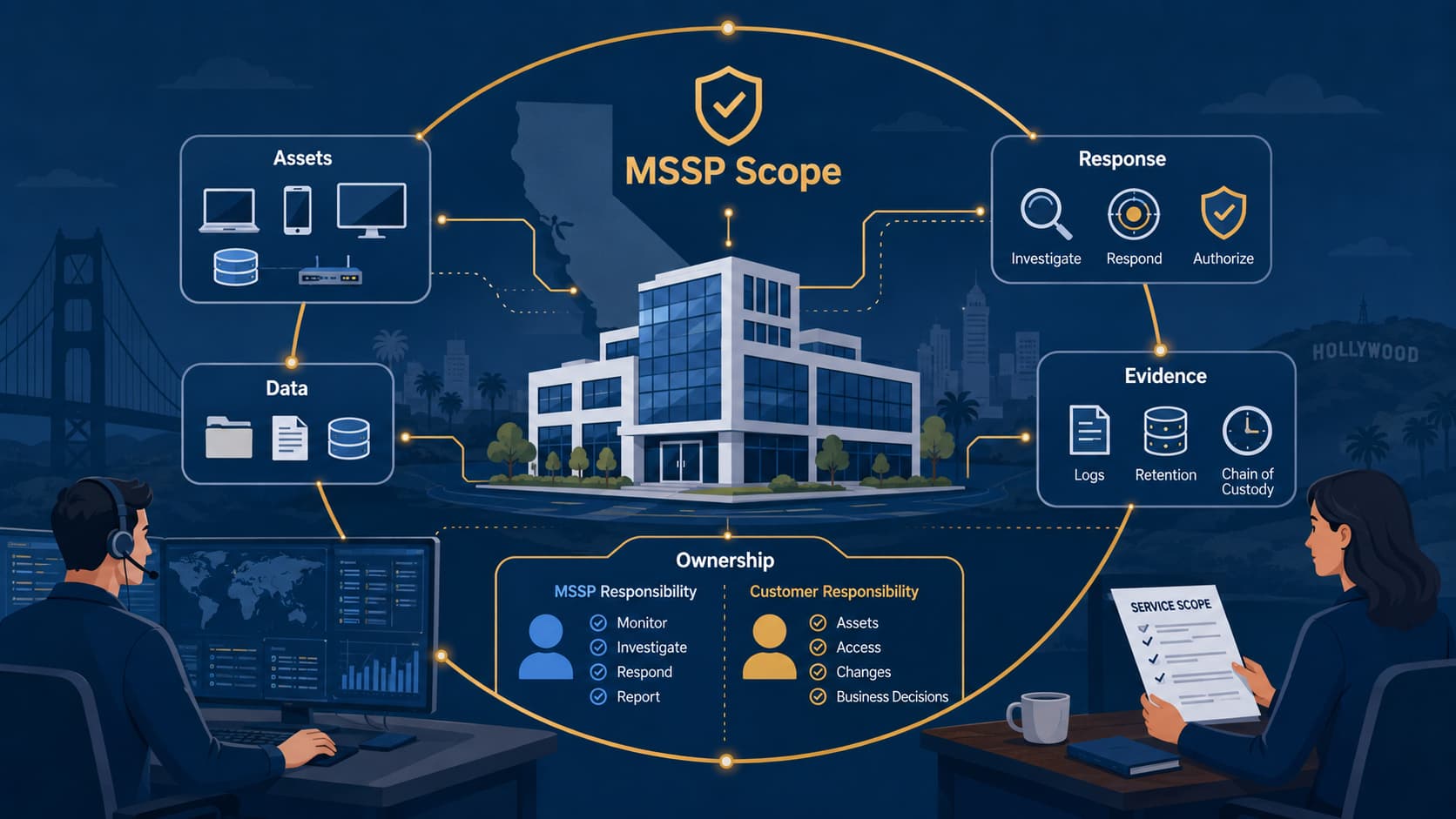
California businesses should scope managed security services around assets, data, access, response, evidence, and ownership not only 24/7 monitoring.
The California Privacy Protection Agency (CPPA) made new cybersecurity audit and risk assessment rules effective January 1, 2026, with requirements that phase in for qualifying businesses.
Contracts should clearly state who monitors systems, handles alerts, accesses data, and preserves records after an incident. They should also define provider and customer responsibilities.
MSSP Security helps businesses create clearer security requirements and operational boundaries. Keep reading to see how to build a practical managed security scope from the ground up.
California MSSP Scoping: 3 Things That Matter Most
- Define what is protected. Scope critical assets, sensitive data, cloud systems, identities, endpoints, and telemetry so important systems do not fall outside managed security coverage.
- Define who does what. Set clear ownership for monitoring, investigation, notification, containment, evidence preservation, privacy support, legal decisions, and recovery. SLAs should make these duties measurable.
- Plan for incidents and change. Test response authority, reporting, evidence handling, pricing, data export, and provider offboarding before a serious incident occurs. A strong MSSP scope should work beyond the first alert.
What should a California MSSP scope define first?
A California MSSP scope should define business risks and service limits before selecting tools such as SIEM, EDR, or firewalls. NIST CSF 2.0 organizes cybersecurity outcomes into six concurrent Functions: Govern, Identify, Protect, Detect, Respond, and Recover.
NIST does not prescribe a fixed implementation sequence. As a practical scoping approach, begin with a needs assessment that documents critical services, sensitive data, risk tolerance, and decision authority, then use those requirements to evaluate tools.
We’ve also seen MSSPs pick products before they fully define the customer’s needs. That can create gaps.
Before selecting or auditing a product, the parties should document the customer’s industry, locations, users, critical services, downtime tolerances, regulatory and insurance requirements, incident history, existing controls, and ownership assumptions.
The product price isn’t the full cost. Licensing, setup, integrations, support, analyst time, and future replacement can add up.
A useful scope should spell out:
- Industry, regulatory, contract, and insurance needs
- Critical assets, services, and data
- Customer-owned and provider-run controls
- Monitoring, investigation, response, and reporting
- Costs, exclusions, and dependencies
An MSSP is a service category, not a complete scope. The SOW should identify what each tool covers, where it falls short, and what remains the customer’s responsibility. The SOW should settle those questions before the contract is signed.
As noted by GetCybr:
“The problem is that none of it is documented in a way that satisfies an insurer, an enterprise procurement team, or a board that just got a cyber insurance renewal notice with a 40% premium increase. NIST CSF 2.0 is the documentation layer.” – GetCybr
How should California businesses identify assets and data?
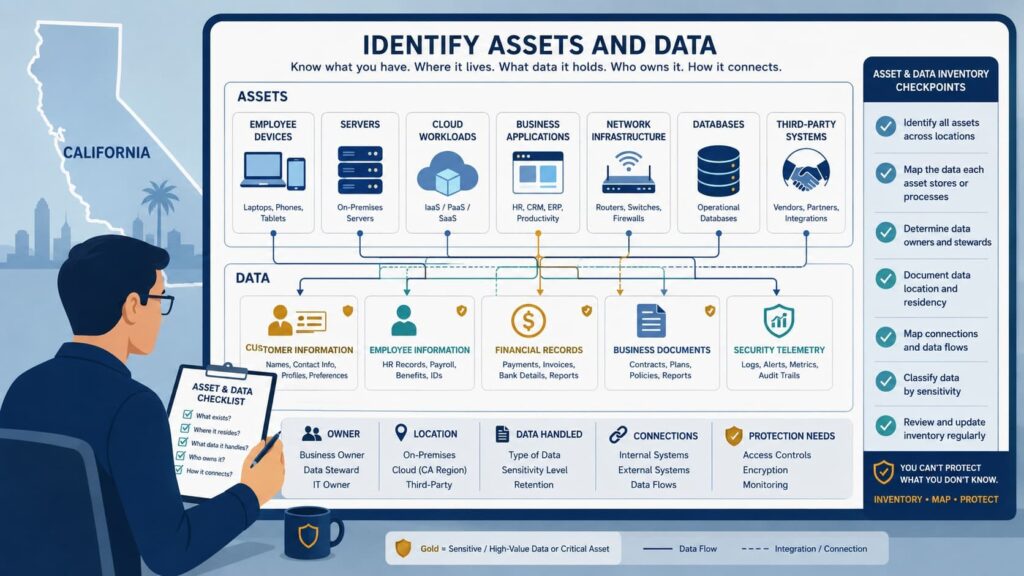
California businesses should map their assets and data before setting the scope for managed security services. A cybersecurity requirements analysis can help connect those assets, data types, business needs, and security responsibilities before an MSSP solution is selected.
The inventory should cover endpoints, servers, identity systems, SaaS platforms, cloud workloads, networks, applications, databases, backups, mobile devices, IoT, APIs, VPNs, and internet-facing services.
NIST describes CSF 2.0 as a flexible framework, so there isn’t one technology list that fits every company. A 50-user firm may have different requirements from a 5,000-user healthcare provider because of differences in critical services, data, threat exposure, regulation, staffing, and risk tolerance.
- Assets: owner, criticality, exposure, technology
- Identity: users, admin accounts, service accounts
- Data: personal, payment, health, sensitive data
- Cloud: accounts, workloads, admin activity
- Telemetry: source, delay, retention, health
- Response: priority, authority, escalation path
Before an MSSP sends security data into a new product, we also check what that data contains. Logs may contain personal information subject to California law, depending on the data elements, business, purpose, and applicable exemptions.
During product reviews, we ask a few basic questions early. Who owns the asset? Who manages it? How important is it? Is it exposed to the internet? What could an attacker reach through it? These answers help an MSSP see whether a product fits the customer’s actual environment.
Broad monitoring can look good on paper while key systems sit outside the scope. We’d rather find that gap during an audit than after an incident.
Which security outcomes should the MSSP actually own?
The SOW should assign the MSSP contractual accountability for specified service outcomes while preserving the customer’s ultimate responsibility for business, legal, risk-acceptance, and recovery decisions unless expressly delegated.
A good managed security services scope should tie each service to something the customer can check. NIST CSF 2.0 helps with this because it focuses on security outcomes without telling an organization which tools to buy.
A useful buyer test is: what happens when an alert arrives at 2 a.m.? The answer should be clear. Who reviews it? Who gets called? What evidence is available? Can the MSSP contain the threat? What gets recorded? If nobody can answer those questions, the scope needs work.
- Detect threats across agreed systems
- Review and investigate useful alerts
- Notify the right customer contacts
- Contain threats within approved limits
- Preserve evidence and case records
- Track vulnerabilities and needed fixes
- Produce security and compliance records
- Improve detection coverage over time
This approach also gives customers something they can review. A large company may need round-the-clock response, while a smaller business may need a narrower service.
Either way, another dashboard isn’t enough. If an MSSP can’t explain what happens during ransomware, account takeover, or business email compromise, the service isn’t fully defined.
What should managed SIEM and MDR coverage include?
Managed SIEM and managed detection and response (MDR) should have separate scopes. SIEM generally provides telemetry ingestion, normalization, correlation, search, retention, and alerting.
MDR is a service model involving human or automated detection, triage, investigation, threat hunting, customer communication, and if contracted response actions. We’ve seen confusion when both services are treated as the same thing.
- SIEM: log sources, retention, tuning
- MDR: investigation, notification
- Threat hunting: frequency and coverage
- Evidence: retention and export
- Response: who can approve action Microsoft 365, Entra ID, firewalls, VPNs, endpoints, DNS, cloud systems, and key applications can all produce different evidence.
A managed SOC should explain how those signals are connected, normalized, reviewed, and escalated. The phrase ‘24/7 SOC monitoring’ is insufficient by itself.
The SOW should state whether continuous coverage means telemetry collection, automated alerting, analyst triage, investigation, notification, threat hunting, or response. Regulated companies have more reason to ask what an outsourced security team actually does.
More telemetry isn’t always better. Our focus is on useful detections, clear analyst duties, and a response process the customer can understand.
How much response authority should an MSSP receive?
Response authority should be explicit for endpoint isolation, account disablement, IP blocking, email quarantine, firewall changes, token revocation, and cloud workload actions.
A provider cannot safely promise a managed response without defining the boundary between advice and action. The provider should distinguish analyst recommendations, customer approvals, preauthorized actions, and automated actions.
| Action | Possible authorization |
| Endpoint isolation | Advisory / approval / preauthorized |
| Account disablement | Approval / preauthorized |
| Firewall block | Approval / automated |
| Email quarantine | Automation permitted only for defined confidence / severity conditions; otherwise customer approval required. |
| Token revocation | Approval / preauthorized |
A useful SLA also separates alert acknowledgment, incident investigation, customer notification, and threat containment.
They are not interchangeable measures. This distinction becomes especially important during ransomware, privileged-account compromise, or cloud-account takeover.
A provider might acknowledge an alert within minutes while still needing additional time to determine whether isolation is safe. The customer should therefore define which actions can happen automatically, which require approval, and which remain advisory.
That structure supports co-managed SOC models without creating uncertainty during a live event.
Insights from NHI Management Group indicate:
“Managed services help most when the internal team lacks 24×7 coverage but still retains policy authority and accountability. They are strongest for monitoring, triage, and operational support. They become risky when the outsourcing model blurs who owns privileged access changes, exception approval, or lifecycle offboarding.” – NHI Management Group
Why is alert volume a poor MSSP success metric?
Alert counts show how much work a SOC handles. They don’t show whether the customer is safer. Better California cybersecurity metrics look at detection quality, investigation work, escalation choices, containment, and open high-risk gaps.
High ticket closure volume does not necessarily demonstrate risk reduction. That’s a useful warning. High activity can look good on a report without showing much about actual risk.
The scope should measure:
- Critical alerts reviewed within
- SLA Required assets sending telemetry
- Detection coverage for agreed threats
- Investigation quality
- Mean time to notify
- Mean time to contain
- Repeat incidents
- Critical vulnerability age
- Suppression and exception quality
A practical quality test is to review serious incidents from the first alert through closure. It’s much harder to hide gaps that way.
The review can show whether analysts connected identity, endpoint, network, vulnerability, and cloud evidence. It also answers a basic question: what does “closed” mean? Was the alert investigated? Was the threat contained? Was the issue fixed? Or did someone dismiss it? The scope should make that clear.
What context does an MSSP need before it can investigate effectively?
An MSSP needs business and technical context because raw security data rarely tells the whole story. An unusual login may be an attack, or it may be a normal action by the right person. Missing business context can turn a useful alert into a false alarm.
The provider should have access to trusted information about asset owners, business importance, user roles, vulnerabilities, cloud resources, network design, maintenance windows, and service accounts.
NIST treats cybersecurity as risk management, not as a group of separate tools. That matters for managed SOC operations in California because analysts need to know what an event means before deciding what to do.
- Trusted asset inventory
- Identity and privilege data
- Vulnerability and exposure data
- Cloud resource owners
- Business criticality ratings
- Network and application details
- Change calendars
- Approved testing windows
- Emergency contacts
Missing business context can materially change the interpretation of an alert. A login from a new location might make sense for a traveling administrator. The same login from a dormant privileged account is another story.
The MSSP should be able to tell the difference using documented customer data. Guessing shouldn’t be part of the process.
How should Microsoft 365 identity monitoring be scoped?
Microsoft 365 security monitoring should cover more than user logins. The scope should include interactive and non-interactive sign-ins, admin changes, OAuth activity, app registrations, service principals, mailbox rules, and other key administrative events.
We’ve found that identity attacks can hide in places basic login monitoring doesn’t cover. Extra sign-in logs cover interactive, non-interactive, service-principal, and managed-identity sign-ins;
Entra audit logs cover directory changes. Mailbox rules and broader Microsoft 365 activity should be separately scoped through Microsoft 365 audit or Defender telemetry. A California MSSP should be able to walk through how it investigates a possible identity breach across those areas.
The scope also needs clear rules for:
- Log retention
- Investigation access
- Escalation criteria
- Account disablement
- Session revocation
- Customer approval
That last part matters. If an MSSP can disable an account or revoke active sessions, the contract should say when it can act without approval and when the customer must decide.
During product reviews, we look for these details because a tool can collect the right data without giving analysts enough access or authority to use it. The scope needs both.
How should California privacy obligations affect the MSSP contract?
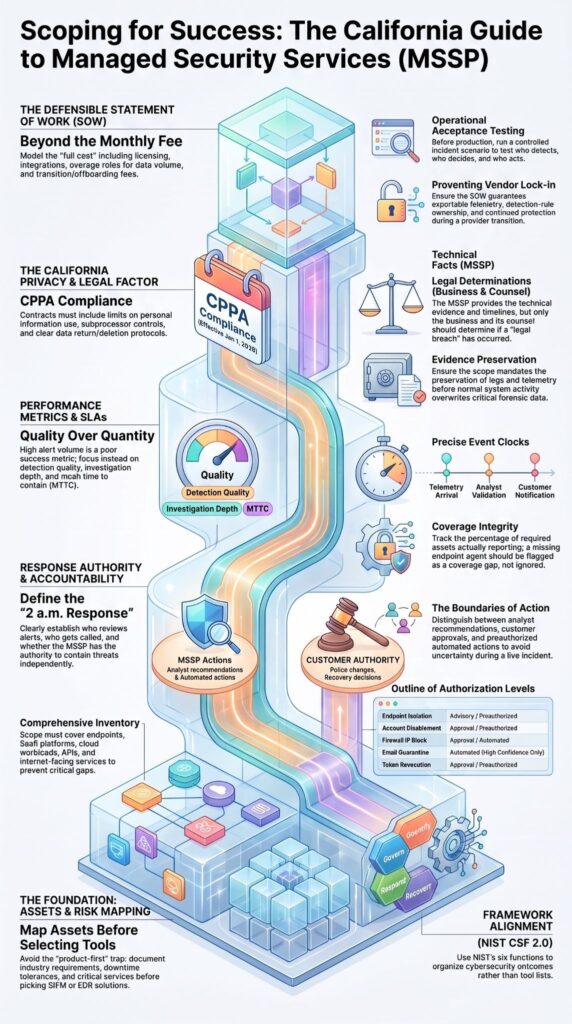
California privacy requirements should be written into the MSSP contract because security logs can contain personal information.
The contract needs to say what the MSSP can do with that data, who can see it, how long it stays in the system, and what happens when the service ends. The CPPA states that the regulations took effect January 1, 2026.
The cybersecurity-audit and risk-assessment duties apply only to covered businesses meeting the relevant criteria, and audit-certification deadlines are phased by revenue. So the contract shouldn’t leave data handling as an afterthought.
Include:
- Limits on personal information use
- Rules for sale and sharing
- Subprocessor controls
- Data return and deletion
- Processing locations
- Incident cooperation
- Audit and assessment support
- Access restrictions
- Retention periods
- Termination steps
We also separate security work from legal responsibility. An MSSP may collect evidence, investigate systems, and provide incident facts. That doesn’t mean it should decide every privacy issue for the customer.
Those are different jobs. In our MSSP reviews, we look for clear lines of ownership. The scope should say which controls the provider runs, which it monitors, and which stays with the customer.
That makes the contract easier to review when an audit, incident, or product change puts those responsibilities to the test.
Who decides whether a security event becomes a legal breach?
The MSSP should provide technical facts, evidence, timelines, and investigative support. The legally responsible entity and its counsel should determine whether notification is required, while other parties may have independent statutory or contractual duties.
The response plan should separate technical investigation from legal and regulatory analysis. The responsible business entity, with counsel as appropriate, should determine notification obligations based on the applicable statute, data, facts, and timing.
The California Attorney General explains that California breach reporting requirements generally apply when specified personal information is acquired, or reasonably believed to have been acquired, by an unauthorized person.
A California breach response scope should therefore identify the people responsible for data classification, counsel engagement, insurance notification, regulatory communication, and public statements.
The MSSP can support those functions without assuming authority it was never contracted to exercise.
- The MSSP may be contractually responsible for technical investigation and evidence preservation, subject to the customer’s access, oversight, and legal-hold requirements.
- Customer owns: data classification and legal determinations.
- Shared: regulatory notification support and incident coordination.
- External counsel: legal advice and notification analysis; legally responsible entity: final organizational decision.
The distinction matters during ransomware, credential compromise, cloud takeover, and suspected data exfiltration. A provider should preserve relevant endpoint, identity, network, email, cloud, and SIEM evidence before normal system activity overwrites it.
The scope should also define when legal counsel or a forensic specialist enters the process. Digital forensics may be included in a separately defined incident-response retainer, but it should not be assumed merely because an MSSP provides MDR.
How should an MSSP map services to security frameworks?
Framework mapping should show which controls the MSSP operates, monitors, supports, or leaves to the customer.
NIST CSF 2.0, CIS Controls, ISO/IEC 27001, SOC 2, PCI DSS, and HIPAA can provide useful reference points without turning monitoring into an automatic compliance claim.
For example, managed vulnerability-scanning services can support Identify and Protect outcomes, while SIEM monitoring and threat detection support Detect.
Incident response and endpoint isolation support Respond. Asset coverage generally supports Identify, SIEM monitoring supports Detect, incident response supports Respond, and vulnerability management can support Identify and Protect.
The mapping should show whether the MSSP operates, monitors, or merely supports each control.
The customer should also distinguish compliance evidence from compliance ownership. A SOC 2 report or related evidence, PCI DSS evidence, or HIPAA documentation may support an audit without proving full compliance.
This distinction is useful for California cybersecurity audit support because auditors need evidence of controls and governance, not simply a vendor dashboard. A cybersecurity consultant can help map responsibilities, but the MSSP SOW should remain the authoritative operational document.
What should a California MSSP responsibility matrix contain?
A responsibility matrix should assign one accountable owner for every high-impact security task. A practical RACI model should cover emergency containment, privileged-account actions, firewall changes, patch exceptions, breach assessment, regulatory notification, forensics, backup restoration, and public communications.
The customer also has obligations. Those may include maintaining asset information, approving access, supplying emergency contacts, reporting infrastructure changes, identifying maintenance windows, and authorizing sensitive containment actions.
The scope should identify those dependencies in writing.
- MSSP: monitor, investigate, escalate, document, and perform authorized actions
- Customer: provide context, access, approvals, contacts, and business decisions
- Shared: incident exercises, tuning, remediation planning, and service reviews
- External counsel or specialists: legal determinations and separately contracted forensic work
This model works well when internal security staff retain strategic control while an outsourced SOC supplies continuous monitoring and investigation.
How should service levels and KPIs be written?
Every managed security service SLA should define the event clock, measurement method, exclusions, dependencies, and responsible party.
A useful SLA avoids vague promises such as “rapid response.” Instead, it states whether the clock begins when telemetry arrives, when an analyst validates an alert, or when the customer is contacted.
| Metric | Define precisely |
| Acknowledge | Time to recognize the alert |
| Triage | Time to begin investigation |
| Notify | Time to contact the customer |
| Contain | Time to authorized containment |
| Coverage | Percentage of required assets reporting |
| Vulnerability remediation | Closure by agreed risk tier |
The same discipline should apply to monitoring across endpoints, cloud accounts, firewalls, email, identity systems, and applications.
A missing endpoint agent should affect coverage reporting rather than silently disappear from the denominator.
Reasonable exclusions can include documented customer delays, unsupported systems, maintenance windows, unavailable customer contacts, and third-party platform outages. Those exclusions should be measurable rather than broad escape clauses.
A good managed security service SLA also defines escalation when the customer does not respond. Critical incidents cannot depend on an undefined phone tree.
How should the technical architecture be validated?
The MSSP architecture should demonstrate tenant isolation, privileged-access controls, encryption, administrative logging, evidence integrity, credential protection, and reliable data export.
A multi-tenant security operations center should demonstrate logical tenant segregation, access controls, encryption, administrative logging, evidence protection, and continuity procedures.
The customer should understand where logs are stored, who can access them, how analyst actions are recorded, and what happens when the platform becomes unavailable.
The architecture review should cover:
- Logical tenant segregation
- Dedicated or appropriately restricted administrative accounts
- Mandatory MFA
- Privileged-action logging
- Tamper-evident or protected logs
- API credential storage
- Encryption in transit and at rest
- Raw-data access
- Backup and platform-outage procedures
- Data and configuration export
A controlled live demonstration can complement architecture documents, assurance reports, customer references, and contract review.
Ask the provider to start with a suspicious identity event, pivot into endpoint and network evidence, show the analyst decision, perform a controlled response action, preserve the evidence, and export the resulting record.
The exercise tests managed SIEM, endpoint detection and response, network detection and response, identity threat detection, security log monitoring, and incident documentation in one workflow.
What should MSSP onboarding prove before production acceptance?
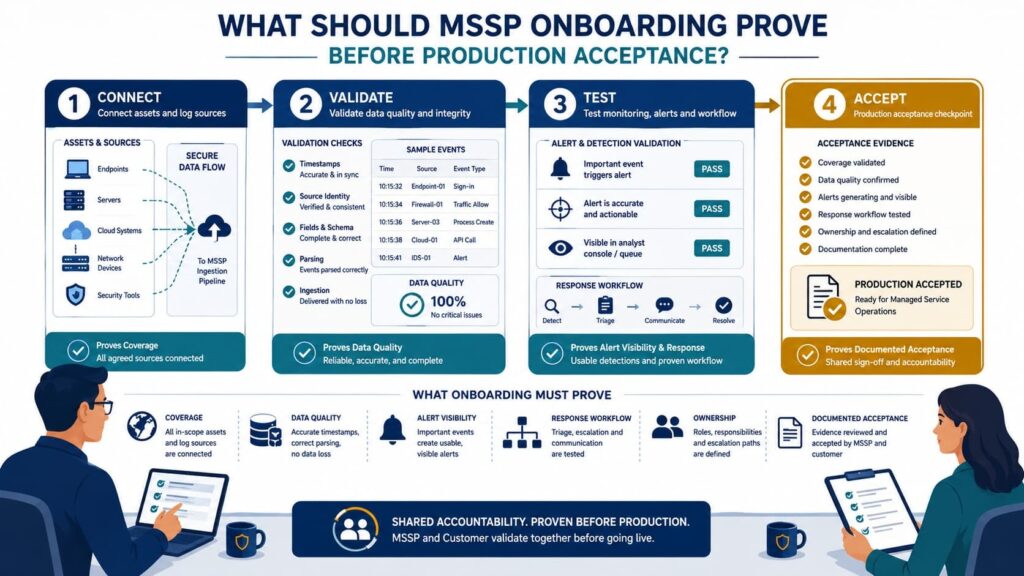
MSSP onboarding should operate as a defined project with measurable acceptance criteria rather than an informal agent-installation exercise.
A strong onboarding process usually takes several phases. Discovery validates assets and dependencies. Architecture establishes access and telemetry paths. Integration connects identity, endpoint, network, cloud, and SaaS sources.
Baseline tuning removes known noise. Testing then proves that alerts reach the right analysts and customer contacts.
A practical sequence includes:
- Validate assets and architecture.
- Finalize privacy and escalation requirements.
- Integrate identity, endpoint, network, cloud, and SaaS telemetry.
- Establish detection baselines.
- Test alert routing.
- Run an incident-response workshop.
- Test authorized containment.
- Establish vulnerability baselines.
- Deliver customer training.
- Approve operational acceptance.
Acceptance should require critical-asset telemetry, tested notification paths, approved incident playbooks, and a documented first reporting cycle. The onboarding phase should be treated as an operational handoff, not merely an agent-installation exercise.
That distinction matters because endpoint agents, secure log forwarding, cloud permissions, firewall APIs, and identity integrations can all fail after installation if ownership is unclear. Of course, onboarding requirements should reflect the environment.
A small business may need endpoint security management, firewall management, managed email security, and vulnerability scanning first, while a larger enterprise may require cloud SIEM, threat hunting, API security monitoring, and complex incident-response workflows.
How should MSSP pricing be scoped to avoid hidden costs?
Pricing should identify every major billing unit and distinguish recurring managed services from professional services and incident-specific work.
Common variables include endpoints, servers, users, SIEM data volume, log retention, cloud accounts, network devices, vulnerability targets, internet-facing applications, threat hunting, and response coverage.
California buyers should also clarify how pricing changes when telemetry volume increases, new cloud accounts are added, or an incident requires engineering beyond normal monitoring. Contracts should define overage rules before these events occur.
Separately priced services may include penetration testing, digital forensics, major incident response, custom detection development, firewall projects, cloud remediation, migrations, and large-scale agent deployment.
The monthly fee rarely represents the full cost. Buyers should model licensing, implementation, integrations, retention, support, analyst labor, professional services, overages, incident response, and transition costs.
Our scoping process therefore treats pricing as part of the service architecture. If a service requires a separate license, professional-services engagement, retention tier, or emergency response fee, that dependency should be clearly documented in the SOW.
How can buyers avoid MSSP vendor lock-in?
The contract should define tool ownership, license transferability, data export, detection-rule ownership, configuration handover, emergency console access, and transition support.
Vendor lock-in can appear harmless during onboarding because standardized tooling makes operations easier.
The problem becomes visible when a customer changes providers and discovers that detection rules, historical telemetry, configurations, or response permissions cannot move with the relationship.
The scope should require:
- Exportable telemetry
- Detection-rule export
- Configuration handover
- Credential transition procedures
- Customer administrative access
- Defined termination timelines
- Continued protection during transition
Documentation of dependencies Subprocessor termination procedures. A particularly useful question is: ‘What stops working when the MSSP relationship ends?
The answer should cover EDR, SIEM, log forwarding, managed firewall services, cloud integrations, email security, vulnerability scanning, dashboards, historical evidence, and response automation. That question also protects operational continuity during provider transition.
If a provider owns the only security console and the relationship ends during a transition, the customer may temporarily lose visibility exactly when continuity matters most.
What should a California MSSP statement of work contain?
A defensible MSSP SOW should make technical, operational, privacy, security, and transition boundaries testable. Working with an experienced MSSP needs assessment consultant can help clarify those requirements before they become contractual gaps.
It should be reviewed by qualified legal counsel where regulatory, privacy, insurance, or breach-notification obligations are involved. It should connect assets → data → threats → controls → actions → evidence without leaving responsibility hidden inside marketing terminology.
The document should contain:
- Executive objectives and assumptions
- In-scope and out-of-scope assets
- Data categories and processing locations
- Service descriptions
- Detection and response use cases
- Severity definitions
- Containment authority
- Escalation contacts
- SLA and KPI definitions
- Privacy and data-protection terms
- Framework mapping
- Customer responsibilities
- MSSP responsibilities
- Architecture requirements
- Onboarding milestones
- Pricing and overage rules
- Change-management procedures
- Business-continuity provisions
- Termination and transition obligations
What should buyers test before signing?
A controlled incident scenario should test who detects, who investigates, who decides, who acts, what evidence survives, and what the customer receives afterward.
This tabletop can cover phishing, business email compromise, ransomware, compromised credentials, cloud-account takeover, or exploitation of an internet-facing application.
The provider should explain the decision path instead of simply showing a severity label. The exercise should also test the customer’s side.
Someone must answer the emergency phone, approve sensitive actions when required, identify affected data, involve counsel, and coordinate recovery. That is where managed security services California buyers often find the largest gap.
Even when the technology is functioning, the operational design remains incomplete if no one knows who authorizes containment or owns breach-notification coordination.
Mitigating Shadow AI Risks with Enterprise Browsers
credits: NBT Systems Cybersecurity
Unmanaged generative AI usage inside corporate networks creates severe data leakage and compliance vulnerabilities. Traditional network controls struggle to monitor text typed into AI prompts or sensitive files uploaded to external browsers.
Implementing an enterprise browser solves this scoping challenge by providing visibility directly at the user endpoint. By governing interactions within the browser, security teams can dynamically block unauthorized AI tools, prevent sensitive data exfiltration, and control extension permissions.
This ensures employees leverage modern productivity tools safely without exposing proprietary corporate data to external language models or unmonitored cloud environments.
FAQ
What should a California MSSP provide for a small business?
A California MSSP should match small business cybersecurity California services to the organization’s actual risks, staffing, and budget. The scope should state whether it includes cybersecurity monitoring California, threat detection California, managed vulnerability scanning California, and incident response California. It should also explain how the provider handles confirmed incidents and when the customer is contacted.
How can I compare managed SOC California options for my business?
Compare managed SOC California services based on monitoring hours, alert handling, escalation procedures, response times, and reporting. The scope should clearly state whether 24/7 SOC monitoring California, threat hunting California, security log monitoring California, and managed detection and response California are included. Ask who investigates serious alerts, who approves response actions, and how quickly the provider must respond.
Do managed security services cover cloud systems and remote users?
Managed security services can cover cloud systems and remote users, but the scope must identify each covered system. Ask whether cloud security services California include cloud configuration monitoring California, identity threat detection California, and SaaS security monitoring California. For remote users, confirm whether endpoint security management California, VPN security monitoring California, and managed email security California are included in the service.
What should be included in California breach response support?
California breach response should define who investigates incidents, preserves evidence, communicates with stakeholders, and supports legal review. The scope may include cyber incident response California, digital forensics California, ransomware protection California, and California breach notification support. The technical team should document the incident and provide evidence, while the customer and legal advisers determine whether notification requirements apply.
How often should a California cybersecurity provider review security risks?
A California cybersecurity provider should review security risks regularly and after major changes or security incidents. The scope can include cybersecurity risk assessment California, vulnerability management California, third-party risk management California, and security maturity assessment California. Organizations should also reassess their security needs after adding critical systems, changing vendors, expanding cloud use, or facing new compliance requirements.
California MSSP Scoping: From Tools to Accountability
When choosing managed security services in California, the real challenge is knowing who handles what when an issue appears. A strong MSSP scope should define monitoring, investigation, response, and customer responsibilities.
That’s the reality check. MSSP Security helps MSSPs improve operations, reduce tool sprawl, optimize security stacks, and make clearer technology decisions. With 15+ years of experience and 48K+ projects completed, its consulting includes needs analysis, vendor shortlisting, PoC support, auditing, and actionable recommendations.
The goal is not more technology, but clear responsibilities, measurable requirements, and practical security operations.
References
- https://getcybr.com/insights/msp-nist-csf-2-compliance-service-line
- https://nhimg.org/faq/when-does-managed-security-services-help-identity-teams-most/