

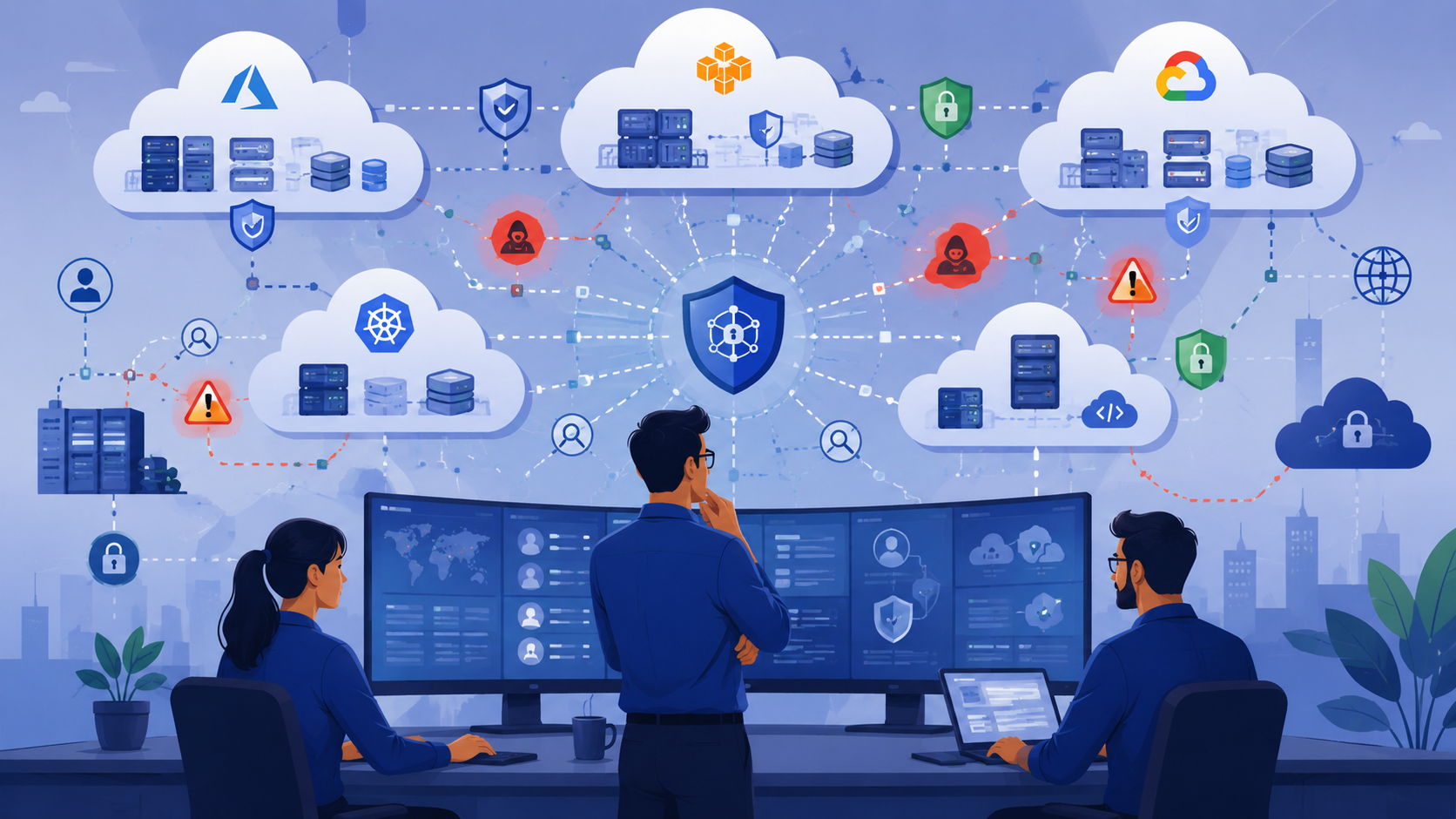
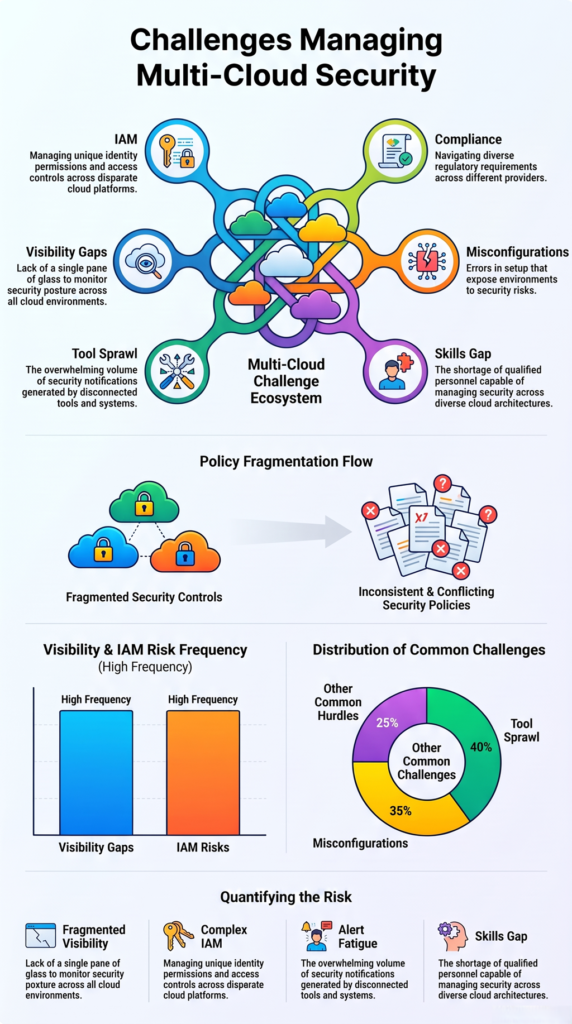
Challenges managing multi cloud security often occur when organizations protect multiple cloud environments with different configurations, policies, access models, and monitoring processes.
While multi-cloud adoption improves flexibility, it can create fragmented visibility, inconsistent controls, and monitoring gaps. From our experience evaluating security strategies, many organizations have security tools in place but struggle to connect them effectively.
MSSP Security assessments help identify these gaps and improve alignment across cloud environments through better governance, visibility, and security processes. Keep reading to explore the key challenges and strategies for improving multi-cloud security.
What To Remember About Multi-Cloud Security Challenges
Understanding the challenges managing multi cloud security helps organizations identify where their security strategy needs stronger focus. Here are the main points to keep in mind when improving protection across multiple cloud environments:
- Organizations need to address visibility gaps, inconsistent security policies, IAM risks, and operational challenges to maintain stronger protection across multiple cloud environments.
- A scalable security approach depends on aligning security tools, governance processes, and teams with continuous assessments and consistent security controls.
- Security providers can strengthen multi-cloud protection by reviewing existing capabilities, reducing unnecessary complexity, and selecting solutions that support long-term security and business objectives.
What Makes Multi-Cloud Security Complexity Difficult to Manage?
Multi-cloud security complexity often begins with limited visibility across different cloud environments. Each platform may have its own architecture, configurations, security models, and monitoring processes, making it harder for teams to maintain a consistent view of their security posture.
The issue is not always a lack of security data. Many organizations collect information from multiple sources but struggle to connect those insights effectively. Implementing effective secure log forwarding aggregation methods helps organizations centralize security data from different cloud environments while maintaining reliable monitoring and analysis. This approach allows security teams to improve event correlation and gain better insight into their overall security posture.
Without centralized visibility, teams may find it difficult to:
- Correlate security events across environments
- Identify potential risks faster
- Understand whether security controls are applied consistently
From our experience helping MSSPs evaluate security products, visibility gaps often become more noticeable as cloud environments expand. We review whether security solutions provide the right monitoring, integration, and analysis capabilities to support multi-cloud operations.
Google Cloud highlights that managing multiple security controls requires careful coordination:
“The security engineer that needs to configure and operate multiple security controls to correctly interact with one another.” – Google Cloud
This reflects a common challenge in multi-cloud environments, where disconnected tools and security processes can make it harder to maintain consistent visibility and protection across platforms.
Observability across cloud platforms is also more challenging as organizations use distributed services, containers, APIs, and dynamic resources. A unified view helps security teams better understand activity, investigate issues, and make informed decisions as their cloud infrastructure grows.
How Can Organizations Maintain Consistent Security Policies Across Multiple Clouds?
Maintaining policy consistency across providers is one of the key challenges managing multi cloud security. As organizations expand across multiple cloud environments, they need a clear governance model to apply security standards consistently while supporting business operations.
Different cloud platforms may have unique workflows, control structures, and security processes. Without proper policy governance, teams may create inconsistent approaches that make it harder to maintain a strong security posture.
From our experience helping MSSPs evaluate and audit security products, we often find that policy gaps are not always caused by missing tools. Instead, they often come from difficulties in applying security controls consistently, maintaining ownership, and keeping policies aligned as environments change.
Organizations can improve policy alignment by:
- Defining security baselines
- Assigning clear control ownership
- Reviewing policies regularly
- Aligning security standards with business needs
As multi-cloud environments continue to grow, maintaining consistent policies becomes harder without a clear understanding of where gaps usually occur. Identifying these challenges helps security teams focus their efforts on improving governance and keeping security standards aligned across different cloud platforms.
| Security Policy Challenge | Impact on Multi-Cloud Environments | Recommended Approach |
| Different security control structures across cloud platforms | Makes it difficult to apply consistent security standards across environments | Establish unified security baselines that can be adapted across cloud platforms |
| Lack of clear control ownership | Creates confusion around who manages specific security responsibilities | Define ownership for security policies, controls, and governance processes |
| Inconsistent policy enforcement | Creates security gaps between different cloud environments | Regularly review and validate policy implementation across platforms |
| Changing cloud requirements | Causes existing policies to become outdated as environments evolve | Continuously update security policies based on business and security needs |
A flexible governance model helps teams maintain consistent protection without limiting cloud adoption. By improving policy alignment, organizations can reduce security gaps while keeping multi-cloud operations scalable and adaptable.
Why Is Identity and Access Management More Complex in Multi-Cloud Environments?
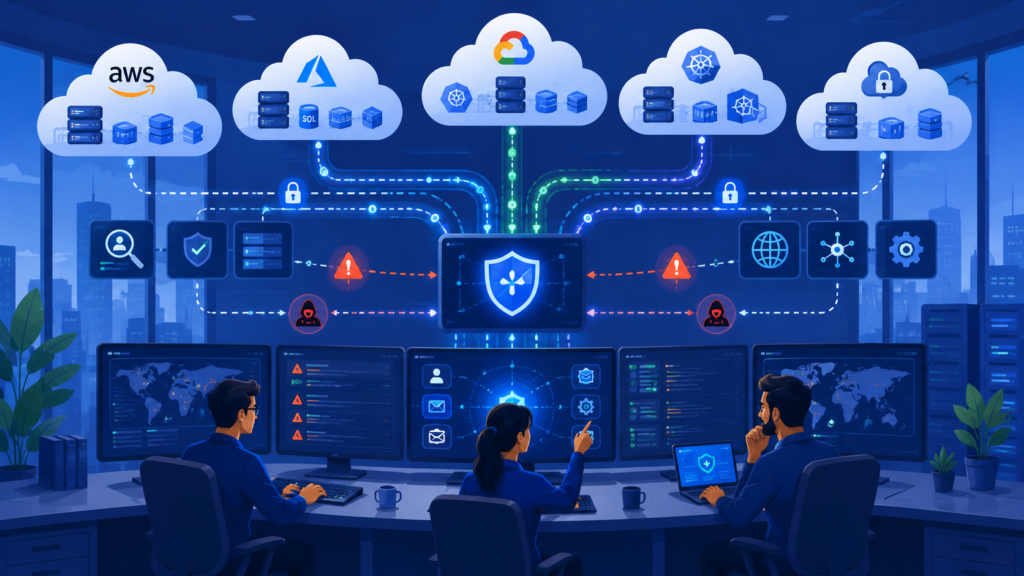
Identity and access management complexity is one of the biggest challenges managing multi cloud security. As organizations expand across multiple cloud environments, controlling access becomes harder due to different permission models, identity structures, and security workflows.
IAM across multiple clouds involves more than managing employee accounts. Organizations must also secure developers, administrators, service accounts, APIs, and workload identities that interact with cloud resources. Without proper controls, teams may face risks such as:
- Excessive permissions
- Limited access visibility
- Unmanaged identities
- Privileged access risks
From our experience helping MSSPs evaluate and audit security products, we often find IAM gaps appear as organizations scale quickly. A stronger approach requires least privilege access, regular permission reviews, and better identity governance. Effective IAM helps organizations maintain secure access while supporting business operations across multiple cloud environments.
How Can Organizations Improve Multi-Cloud Monitoring and Incident Response?
Managing monitoring and incident response across multiple cloud environments is one of the key challenges managing multi cloud security. Security teams must analyze large amounts of data from logs, applications, identities, and network activity while ensuring threats are detected and handled quickly.
The main difficulty is not collecting security data but turning it into actionable insights. Without effective log correlation and detection workflows, teams may struggle to investigate suspicious activity or connect related security events.
Improving detection workflows often requires stronger cloud native siem soar capabilities that help security teams collect, analyze, and respond to security events across multiple cloud environments. These capabilities can support better alert prioritization, automated response actions, and more efficient incident investigation.
Alert fatigue can also reduce response efficiency when analysts receive too many low-priority alerts from different systems. Organizations need better prioritization and incident workflows to focus on critical risks.
Effective multi-cloud incident response requires:
- Clear investigation procedures
- Cross-cloud threat detection
- Security automation
- Regular response testing
From our experience helping MSSPs evaluate security products, we assess whether solutions support practical monitoring, detection, and response processes across complex cloud environments.
How Can Organizations Reduce Misconfiguration Risks in Multi-Cloud Security?
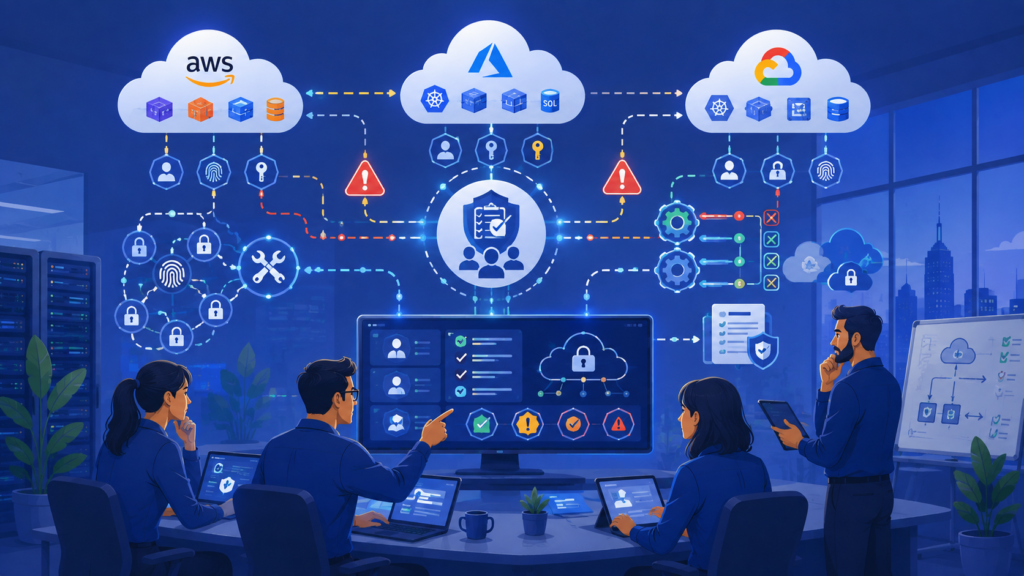
Misconfiguration remains one of the most common challenges managing multi cloud security. As organizations operate across multiple cloud environments, different configurations, permission models, and security requirements can make it harder to maintain consistent protection.
Small configuration mistakes can create security gaps, such as:
- Excessive user or application permissions
- Incorrect network access settings
- Unprotected cloud resources
- Inconsistent security configurations
From our experience helping MSSPs evaluate and audit security products, we often find that misconfiguration risks increase as cloud environments change over time. Without regular configuration reviews and clear security baselines, teams may struggle to keep controls aligned with current requirements.
A stronger approach focuses on consistent configuration management, regular assessments, and security standards that can be applied across multiple cloud environments. These practices help organizations reduce exposure while maintaining the flexibility of modern cloud operations.
How Do Organizations Protect Data Across Multiple Cloud Environments?
Protecting data across multiple cloud environments is one of the key challenges managing multi cloud security. As organizations move information between platforms, they must maintain consistent protection across storage, processing, and data transfer activities.
Data governance becomes more complex as teams need to track where data is stored, how it moves, and who can access it. Without proper controls, organizations may face:
- Unclear data ownership
- Inconsistent protection standards
- Compliance difficulties
- Limited visibility into data movement
Encryption consistency and key management are also important because sensitive data requires protection across different environments. Organizations must properly manage encryption keys, access controls, and security processes to reduce exposure.
From our experience helping MSSPs evaluate and audit security products, we often find data protection gaps occur when security controls are not aligned. Reviewing product capabilities and integration support helps organizations improve data governance and maintain stronger protection across multi-cloud environments.
How Can Organizations Secure Networks and Applications Across Multiple Clouds?
Securing networks and applications across multiple cloud environments is another important challenge managing multi cloud security. As organizations connect workloads, APIs, and services across different platforms, they need strong controls to protect communication and prevent unauthorized access.
Inter-cloud communication security becomes more critical as applications become distributed. Without proper protection, weak connections can increase the risk of lateral movement and security incidents.
Organizations should focus on:
- Secure API management
- Strong network segmentation
- Protected communication channels
- Consistent access controls
API security helps prevent attackers from exploiting exposed services, while network segmentation limits the impact of compromised workloads.
From our experience helping MSSPs evaluate and audit security products, we often assess how solutions support integration, monitoring, and security enforcement across complex environments. A strong network and application security strategy helps organizations maintain protection while supporting multi-cloud flexibility.
How Does Multi-Cloud Adoption Expand the Attack Surface?
Multi-cloud adoption expands the attack surface by adding more workloads, applications, integrations, and connections that require protection. These challenges managing multi cloud security become more difficult as organizations manage growing cloud environments with different services and access points.
New workloads, temporary resources, and external integrations can introduce risks if they are not properly secured. Organizations should pay attention to:
- Exposed APIs and application endpoints
- Unmanaged workloads
- Forgotten cloud resources
- Third-party integrations
- Shadow IT deployments
CIS emphasizes the importance of understanding assets before applying security protections:
“In order to protect what you have, you first must know what you have.” – Center for Internet Security (CIS)
This principle is highly relevant in multi-cloud environments, where organizations may struggle to identify unmanaged workloads, forgotten resources, and unknown integrations that increase their attack surface.
Shadow IT can create additional security gaps when teams adopt cloud services without proper review. These unknown resources may operate outside established security controls.
From our experience helping MSSPs evaluate and audit security products, we often see attack surface risks increase as cloud environments expand. Reviewing security capabilities, monitoring coverage, and risk management processes helps organizations maintain better control over their growing multi-cloud infrastructure.
How Can Organizations Reduce Tool Sprawl in Multi-Cloud Security Operations?
Managing multiple security tools across cloud environments can create operational challenges and become one of the key challenges managing multi cloud security. As organizations adopt different solutions for monitoring, compliance, identity protection, and risk management, security teams may struggle with disconnected systems and complex workflows.
Many MSSPs evaluate Cloud Native Security Tools MSSP to determine whether security platforms can provide better integration, visibility, and operational efficiency across different cloud environments. Selecting the right tools requires understanding how each solution fits into existing security workflows rather than simply adding more technologies.
Tool sprawl can lead to issues such as:
- Limited security platform integration
- Lack of a unified dashboard
- Difficult cross-account management
- Inconsistent security processes
Without proper integration, analysts may spend more time collecting information from different tools instead of responding to security risks.
From our experience helping MSSPs evaluate and audit security products, we often find that organizations need better alignment between existing capabilities rather than more solutions. Reviewing product functionality, integration options, and operational requirements helps MSSPs select security technologies that support a more manageable multi-cloud security strategy.
How Can Organizations Address Skills Gaps in Multi-Cloud Security?
Addressing skills gaps is an important step in managing the challenges managing multi cloud security. As cloud environments become more complex, teams need strong knowledge of cloud architecture, security controls, compliance requirements, and operational processes.
Organizations may face challenges such as:
- Limited cloud security expertise
- Lack of ongoing training
- Knowledge silos between teams
- Weak DevSecOps collaboration
Security teams, developers, and infrastructure teams need better communication to apply security practices consistently. Without proper knowledge sharing, security requirements may be missed during cloud changes and deployments.
From our experience helping MSSPs evaluate and audit security products, we often find that effective security decisions depend on both technology and team readiness. We help assess whether solutions match operational capabilities, integration needs, and long-term security goals.
Building stronger skills, improving collaboration, and creating a security-focused culture helps organizations manage multi-cloud environments more effectively.
How Do Compliance and Governance Become More Challenging in Multi-Cloud Environments?
Managing compliance across multiple cloud environments creates additional challenges managing multi cloud security. Organizations must maintain regulatory requirements, collect audit evidence, and ensure security responsibilities are clearly defined across different platforms.
Key challenges include:
- Difficulty collecting audit evidence
- Complex compliance reporting
- Regulatory control mapping
- Shared responsibility confusion
- Third-party security risks
As cloud environments grow, teams may struggle to maintain clear ownership of security responsibilities. The shared responsibility model can become confusing when organizations do not understand which controls they must manage internally.
From our experience helping MSSPs evaluate and audit security products, we often find that governance gaps come from disconnected processes rather than missing tools. Reviewing security capabilities, reporting functions, and compliance support helps MSSPs identify solutions that better fit their customers’ needs.
A structured governance approach helps organizations improve accountability, maintain compliance, and manage multi-cloud environments more effectively.
What Strategies Help Build a More Effective Multi-Cloud Security Approach?
Credit: IBM Technology
Building an effective strategy is essential for addressing the challenges managing multi cloud security. Organizations need a structured approach that connects security technologies, operational processes, and business requirements across different cloud environments.
A strong multi-cloud security framework should focus on:
- Unified visibility across environments
- Identity governance and access controls
- Security automation
- Continuous security assessments
- Incident response readiness
As cloud architectures evolve, organizations must also consider protecting different workloads, including containers, microservices, and serverless applications. These technologies require security practices that support flexibility without adding unnecessary complexity.
From our experience helping MSSPs evaluate and audit security products, we often find that successful security strategies depend on alignment between tools, processes, and teams. We help MSSPs assess product capabilities, integration support, and operational fit to make better technology decisions.
A scalable security approach helps organizations improve resilience, maintain protection, and manage multi-cloud complexity more effectively.
How Can MSSP Security Help Organizations Address Multi-Cloud Security Challenges?
MSSP Security helps organizations and security providers address the challenges managing multi cloud security by evaluating security strategies, reviewing product capabilities, and identifying improvement opportunities.
Managing multiple cloud environments requires more than adding security tools. Organizations need solutions that work together, support operational workflows, and align with business requirements.
Key areas to evaluate include:
- Security policy alignment
- Monitoring and threat detection capabilities
- Identity and access controls
- Security tool integration
- Product scalability
From our experience helping MSSPs select and audit security products, we often find that the main challenge is not the lack of available solutions. Instead, teams need better visibility into which technologies fit their environment and long-term goals.
Through structured assessments, MSSP Security helps MSSPs make informed technology decisions, reduce security gaps, and build a more manageable multi-cloud security approach without adding unnecessary complexity.
FAQ
How Does Security Governance Change in a Multi-Cloud Environment?
Security governance becomes more complex in a multi-cloud environment because organizations must maintain consistent policies, ownership models, and compliance requirements across different platforms. A mature governance approach requires clear security responsibilities, standardized controls, continuous reviews, and better alignment between business and security teams.
What Makes Multi-Cloud Security Monitoring Difficult to Scale?
Multi-cloud monitoring becomes challenging because security teams must collect, analyze, and respond to data from multiple environments with different structures and workflows. Organizations need centralized visibility, effective threat detection processes, and security solutions that can integrate across complex cloud architectures.
How Can Organizations Maintain Consistent Security Controls Across Multiple Clouds?
Organizations can maintain consistent security controls by establishing security baselines, improving policy enforcement, and regularly assessing cloud configurations. A structured approach helps reduce configuration gaps while allowing teams to maintain flexibility across different cloud environments.
Why Is Identity Governance Critical in Multi-Cloud Security?
Identity governance is critical because organizations manage more users, applications, service accounts, and workloads across multiple environments. Without proper IAM processes, teams may struggle with excessive permissions, unclear access ownership, and difficulty performing access reviews.
How Can MSSP Security Help Organizations Improve Multi-Cloud Security Strategy?
MSSP Security helps organizations and security providers evaluate existing security approaches, identify gaps, and make better decisions when selecting or improving security solutions. Through product assessments, capability reviews, and security evaluations, MSSP Security helps align technology choices with operational and business requirements.
How Can Organizations Build a Stronger Multi-Cloud Security Strategy?
Managing multi-cloud security requires more than adding security tools. The challenges managing multi cloud security often come from gaps in visibility, governance, identity management, and security operations. From our experience supporting security evaluations, organizations achieve better protection by aligning technology, processes, and people.
Through MSSP Security consulting services, we help MSSPs evaluate security capabilities, identify gaps, reduce tool sprawl, and improve security alignment through vendor-neutral product selection, auditing, and stack optimization. A structured approach allows teams to manage cloud complexity while maintaining flexibility and scalability.
References
- https://cloud.google.com/blog/products/identity-security/google-cloud-security-foundations-guide
- https://www.cisecurity.org/insights/blog/first-steps-to-overcoming-a-lack-of-asset-visibility