

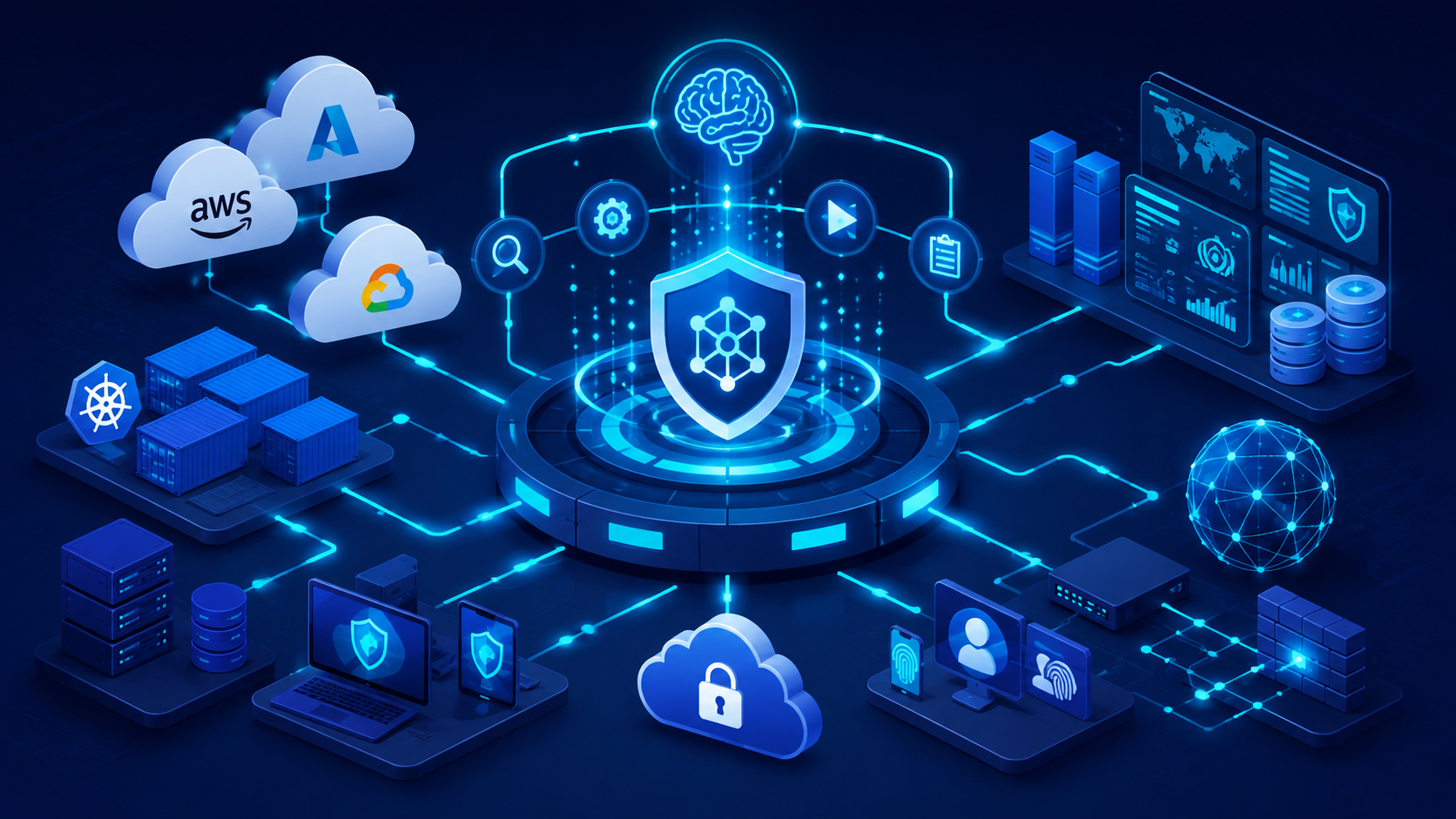
Cloud native SIEM SOAR capabilities combine centralized threat monitoring, automated response, and security orchestration to help organizations detect, investigate, and respond to cyber threats across cloud and hybrid environments.
By integrating SIEM and SOAR into a unified security operations approach, security teams can improve visibility, streamline investigations, and reduce response times while supporting long-term scalability.
At MSSP Security, we help organizations evaluate and strengthen these capabilities. Keep reading to learn how cloud native SIEM SOAR capabilities can improve modern security operations.
Cloud Native SIEM SOAR at a Glance
Before exploring each capability in detail, here are the key points to keep in mind.
- Cloud native SIEM SOAR capabilities combine centralized monitoring, AI-driven analytics, and automation to improve threat detection and incident response.
- SIEM and SOAR integration streamlines security event correlation, alert enrichment, and automated workflows, reducing manual effort for security teams.
- Organizations can improve SOC efficiency, gain multi-cloud visibility, and strengthen security operations with a well-planned strategy and guidance from MSSP Security..
Why Do Cloud Native SIEM SOAR Capabilities Matter?
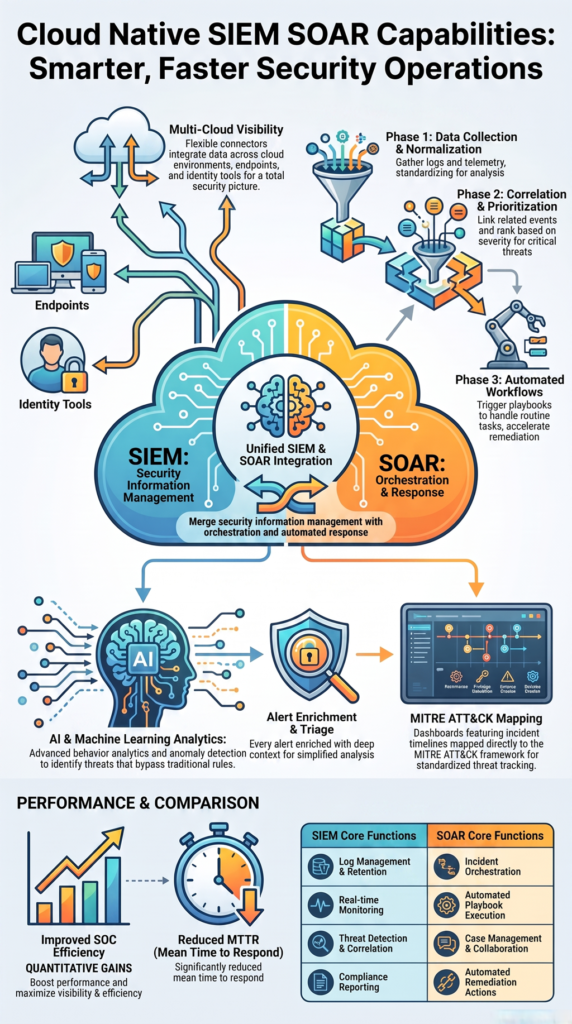
Cloud native SIEM SOAR capabilities bring Security Information and Event Management (SIEM) and Security Orchestration, Automation, and Response (SOAR) together in a unified approach to security operations.
Instead of relying on separate tools, organizations can monitor security activity, investigate threats, and coordinate response efforts from a single environment. This simplifies security operations across cloud, multi-cloud, and hybrid infrastructures.
While the two technologies work together, each serves a distinct purpose:
- SIEM collects logs, events, and telemetry from multiple systems to identify suspicious activity.
- SOAR uses those insights to automate workflows, coordinate response actions, and reduce repetitive tasks.
Together, they create a more connected and efficient security operations process.
While SIEM and SOAR work together within a unified platform, understanding their individual roles makes it easier to see how cloud native SIEM SOAR capabilities improve both threat detection and incident response.
The table below summarizes their core functions.
| Capability | SIEM | SOAR |
| Primary Purpose | Collects, normalizes, and analyzes security data | Automates security workflows and incident response |
| Primary Data Input | Logs, events, and telemetry from multiple sources | Alerts, incidents, and contextual data from SIEM and connected security tools |
| Core Function | Threat detection, event correlation, and security monitoring | Response orchestration, workflow automation, and incident management |
| Typical Actions | Detects suspicious activity, correlates events, and prioritizes alerts | Executes playbooks, enriches alerts, isolates affected assets, and notifies security teams |
| Primary Outcome | Improved visibility and faster threat detection | Faster, more consistent, and automated incident response |
The Australian Cyber Security Centre highlights this value by stating:
“These platforms can enhance the general visibility of what is happening on your organisation’s network by collecting, centralising, and analysing important, qualified event data that would otherwise be extremely complex and scattered.” – Australian Cyber Security Centre
As cloud environments continue to grow, many security teams struggle with disconnected tools and manual workflows. We’ve worked with MSSPs facing these same challenges while evaluating new security platforms. Our role is to assess and audit security products to ensure they align with existing workflows, integration requirements, and long-term operational goals.
Organizations comparing Cloud Native Security Tools MSSP solutions should look beyond feature lists and evaluate how well each platform supports day-to-day operations. In our experience, cloud native SIEM SOAR capabilities deliver the greatest value when they strengthen established security processes rather than operate as standalone technology.
Why Is Cloud SIEM Automation Essential for Cloud Native SIEM SOAR Capabilities?
Cloud SIEM automation is a core component of cloud native SIEM SOAR capabilities because it helps security teams process large volumes of security data quickly and consistently. Instead of relying on manual review, automation moves security events through a structured workflow that improves data quality before analysts begin their investigation.
A typical automation pipeline includes:
- Collecting logs and telemetry from multiple data sources.
- Normalizing security data into a consistent format.
- Correlating related events to identify suspicious activity.
- Prioritizing alerts based on risk and context before investigation.
This process reduces repetitive work while giving analysts more reliable information to work with. From our experience advising MSSPs, automation is most effective when it fits existing workflows rather than operating as a standalone feature.
We help MSSPs evaluate and audit security products to ensure their automation capabilities support operational goals, integrate with existing environments, and provide a strong foundation for threat investigation and incident response as security operations continue to grow.
How Do AI-Driven Analytics and Machine Learning Strengthen Cloud Threat Detection?
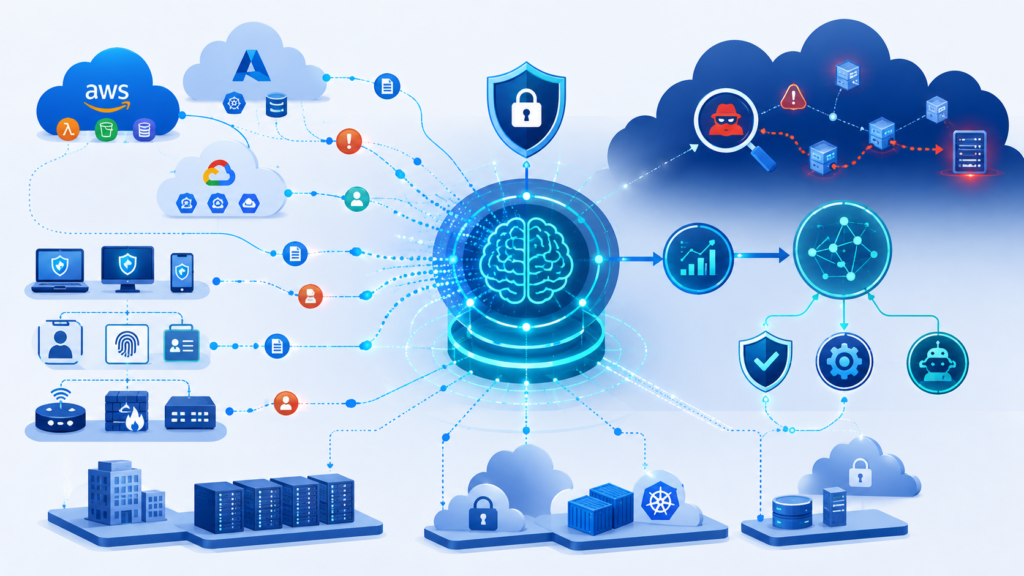
Modern attacks often develop through small behavioral changes that traditional rule-based detection can overlook. As part of cloud native SIEM SOAR capabilities, AI-driven analytics, machine learning, and behavioral analytics help security teams recognize suspicious patterns across cloud environments before they develop into larger security incidents.
These technologies improve cloud threat detection by identifying:
- Unusual user and entity behavior through UEBA capabilities.
- Suspicious access patterns that differ from normal activity.
- Privilege misuse and abnormal device behavior.
- Emerging threat patterns based on historical and real-time security data.
Rather than depending only on predefined rules, machine learning continuously analyzes security telemetry to uncover indicators that may suggest an evolving attack. This gives analysts more context during threat investigations and supports proactive threat hunting.
From our experience advising MSSPs, AI capabilities deliver the greatest value when combined with experienced analysts. We help MSSPs evaluate and audit security products to determine whether AI, machine learning, and behavioral analytics provide meaningful detection improvements instead of simply adding more complexity to security operations.
How Does Security Event Correlation Improve Cloud Threat Detection?
Security event correlation is a core part of cloud native SIEM SOAR capabilities because it helps security teams understand how seemingly unrelated events are connected. Instead of analyzing alerts one at a time, a correlation engine links activity across multiple systems to uncover suspicious behavior and reveal attack chains that may otherwise go unnoticed.
Strong security event correlation helps organizations:
- Connect related events across cloud, endpoint, network, and identity environments.
- Reveal attack chains by linking activities that occur over time.
- Improve cloud threat detection with broader security context.
- Support faster investigations by helping analysts focus on meaningful patterns instead of isolated alerts.
For example, a single failed login attempt may not indicate a threat. However, when repeated authentication failures are followed by privilege changes and access from an unfamiliar location, the platform can correlate those events into a single incident.
This level of visibility is especially valuable for organizations focused on securing identities cloud on prem, where authentication data from cloud and on-premises identity systems must be analyzed together to detect suspicious activity more accurately.
From our experience helping MSSPs evaluate and audit new security products, correlation capabilities are more important than simply having a large number of detection rules. We assess whether a platform can connect related events, provide actionable context, and help analysts identify real threats with greater confidence while reducing investigation time.
How Do Automated Playbooks Improve Security Orchestration?
Automated playbooks turn cloud native SIEM SOAR capabilities into repeatable security workflows. Instead of deciding every response step manually, security teams can define actions that run automatically when specific conditions are met. This helps create consistent security operations while reducing delays during common incidents.
A typical playbook might follow this workflow:
- Detect suspicious malware activity.
- Collect relevant logs and endpoint details.
- Enrich the event with threat intelligence and asset context.
- Isolate the affected device or disable a compromised account.
- Notify the SOC team and create an incident case for review.
Low-code and codeless automation allow security teams to update these workflows without extensive programming knowledge, making it easier to adapt as security requirements change.
The Australian Cyber Security Centre also emphasizes that automation is intended to support, not replace, security professionals:
“A SOAR platform will never replace human incident responders; however, by automating some actions involved in responding to specific events and incidents, it can allow staff to focus on the more complex and high-value problems that the event or incident has generated.” – Australian Cyber Security Centre
As we work with MSSPs selecting and auditing new security products, we pay close attention to how playbooks operate in real environments. We evaluate whether they are flexible enough to support existing workflows, integrate with connected security tools, and reduce repetitive work without limiting analyst oversight. In our experience, well-designed playbooks improve operational consistency while allowing analysts to focus on incidents that require human judgment.
How Do Alert Enrichment and Incident Triage Improve Alert Quality?
Security teams often receive thousands of alerts every day, but not every alert requires immediate action. As part of cloud native SIEM SOAR capabilities, alert enrichment adds valuable context so analysts can understand which events deserve attention first instead of reviewing every notification manually.
Enriched alerts typically include:
- Threat intelligence from trusted security sources.
- User and asset context to identify affected systems.
- Historical activity that shows previous behavior.
- Risk scores that help measure potential impact.
- Supporting evidence that reduces false positives.
With this additional context, incident triage becomes faster and more consistent. Analysts can prioritize high-risk alerts while filtering out low-value events that would otherwise consume valuable time.
As we help MSSPs evaluate and audit new security platforms, we look closely at how alert enrichment improves decision-making. In our experience, platforms that provide meaningful context and accurate risk scoring enable security teams to reduce false positives, prioritize alerts with greater confidence, and use analyst time more effectively.
How Do Connectors and Integrations Expand Cloud Native SIEM SOAR Capabilities?
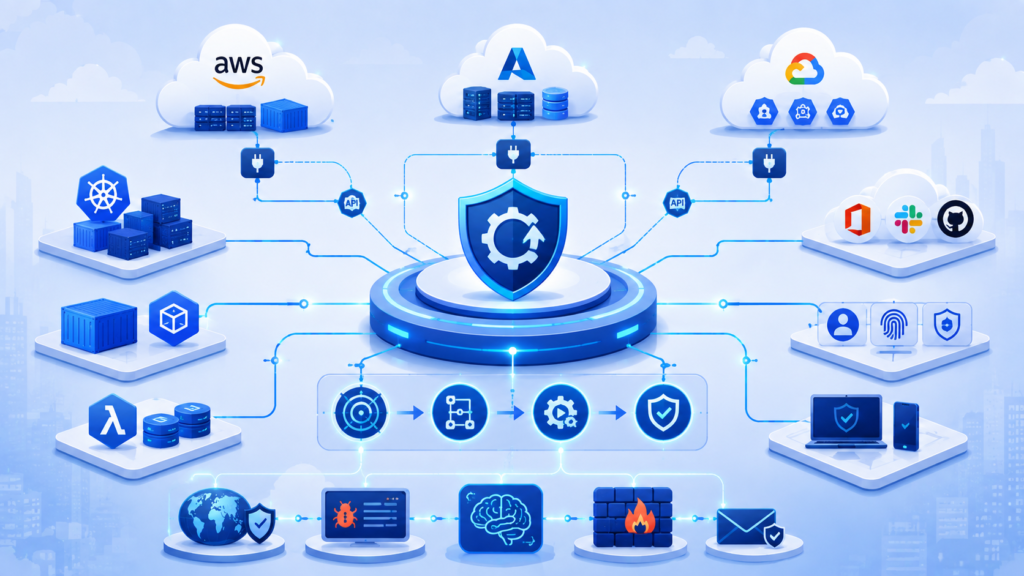
The effectiveness of cloud native SIEM SOAR capabilities depends on the quality and variety of connected data sources. Modern security environments span cloud platforms, SaaS applications, endpoints, networks, identity services, containers, and Kubernetes clusters. Without reliable integrations, security teams can face visibility gaps that make threat detection more difficult.
As cloud architectures continue to evolve, organizations are also adopting serverless applications and event-driven services. Addressing serverless security monitoring challenges requires flexible connectors and integrations that provide consistent visibility across both traditional and cloud-native workloads.
A modern platform should support multiple integration methods, including:
- Native connectors for major cloud services and security platforms.
- APIs and webhooks for connecting custom applications and workflows.
- Third-party integrations with endpoint, identity, and network security tools.
- Connector-based ingestion for SaaS applications, Kubernetes clusters, containers, serverless workloads, and other multi-platform data sources.
Beyond connectivity, many platforms also include custom analytics rules and security content packs that help organizations tailor detections to their environment while reducing deployment time.
As we help MSSPs evaluate and audit new security products, integration capabilities are one of the first areas we assess. We look at how easily a platform connects with existing technologies, how well it supports future growth, and whether it can adapt to changing customer environments. In our experience, flexible integrations create a stronger foundation for scalable and unified security operations.
How Does a Unified Security Dashboard Improve Incident Management?
A unified security dashboard gives security teams a single place to monitor alerts, manage incidents, and track ongoing investigations. As part of cloud native SIEM SOAR capabilities, it brings together security data, analyst activities, and operational insights, making it easier to understand what is happening across cloud and hybrid environments.
A well-designed dashboard typically includes:
- Visual incident timelines to show how an attack unfolds over time.
- MITRE ATT&CK mapping to connect observed activity with known attack techniques.
- Asset and user context to identify affected systems quickly.
- Severity views and incident ownership to help teams prioritize and assign work.
- Executive reporting and compliance dashboards for operational and audit visibility.
These capabilities give analysts the context they need while helping managers monitor team performance and security trends from the same interface.
As we work with MSSPs evaluating and auditing new security platforms, we assess whether dashboards support real operational needs instead of simply displaying more data. In our experience, dashboards that combine meaningful context, clear ownership, and actionable reporting help security teams respond more efficiently and maintain consistent operations across multiple customer environments.
How Do Cloud Native SIEM SOAR Capabilities Deliver Better Business Outcomes?
Credit: Mohd Maaz
The value of cloud native SIEM SOAR capabilities extends beyond faster threat detection. Organizations also use these platforms to improve operational performance, make better use of security resources, and measure the effectiveness of their security investments.
Key business outcomes include:
- Higher SOC efficiency through streamlined security operations.
- Lower operational costs by reducing repetitive manual tasks.
- Reduced analyst burnout with fewer low-value alerts to review.
- Improved compliance through centralized reporting and audit-ready security data.
- Better resource optimization by helping teams focus on higher-risk activities.
Many organizations also track security KPIs to measure long-term performance, including:
- Mean Time to Detect (MTTD)
- Mean Time to Respond (MTTR)
- Case closure rate
- False positive rate
As we help MSSPs evaluate and audit new security platforms, we encourage looking beyond technical features alone. We assess whether a solution supports measurable business outcomes, fits operational requirements, and provides long-term value. In our experience, organizations achieve the strongest results when cloud native SIEM SOAR capabilities improve both security performance and overall business efficiency.
How Should Organizations Evaluate Cloud Native SIEM SOAR Capabilities?
Selecting cloud native SIEM SOAR capabilities involves more than comparing feature lists. The right platform should support current security operations while remaining flexible enough to adapt as environments, threats, and business requirements evolve.
When evaluating a platform, organizations should ask:
- Can it scale as cloud workloads and security data continue to grow?
- Can it automate repetitive tasks without limiting analyst oversight?
- Can it integrate with existing cloud, endpoint, network, and identity security tools?
- Can it support multi-cloud and hybrid environments from a single platform?
- Can it retain logs long enough to meet operational and compliance requirements?
- Can it reduce analyst workload by improving data quality and investigation efficiency?
These questions help organizations evaluate how well a platform fits their operational needs instead of focusing only on technical specifications.
As we work with MSSPs selecting and auditing new security products, we use a similar evaluation framework to compare platforms against integration requirements, operational workflows, and long-term business goals. In our experience, the strongest security outcomes come from choosing cloud native SIEM SOAR capabilities that align with both technical requirements and day-to-day security operations rather than simply offering the longest list of features.
FAQ
Can Small Organizations Benefit From Cloud Native SIEM SOAR Capabilities?
Yes. Cloud native SIEM SOAR capabilities are not limited to large enterprises. Many cloud-native platforms offer scalable deployment options that allow small and mid-sized organizations to improve threat detection, automate routine security tasks, and increase visibility without building a large security operations center.
How Long Does It Take to Implement Cloud Native SIEM SOAR Capabilities?
Implementation timelines vary depending on the size of the environment, the number of connected data sources, and integration requirements. Organizations with existing cloud security tools can often deploy core capabilities more quickly, while larger or more complex environments typically require additional planning, testing, and workflow customization.
Which Data Sources Should Organizations Connect First?
Organizations usually begin with the security data sources that provide the greatest visibility into their environment. Common priorities include cloud platforms, identity and access management systems, endpoint security tools, network devices, and business-critical applications. Starting with high-value data sources helps improve detection quality while simplifying future integrations.
Can Cloud Native SIEM SOAR Capabilities Help With Compliance?
Yes. Many platforms support compliance initiatives by centralizing log retention, maintaining audit trails, and providing reporting features for regulatory frameworks. While they do not guarantee compliance on their own, they help organizations collect and organize the security evidence needed for audits and ongoing governance.
Do Cloud Native SIEM SOAR Capabilities Replace SOC Analysts?
No. These capabilities are designed to support security analysts, not replace them. Automation handles repetitive tasks such as data collection and workflow execution, while analysts focus on threat validation, investigation, decision-making, and incident handling. From our experience advising MSSPs, the best results come from combining automation with skilled security professionals and well-defined operational processes.
How Can Organizations Get the Most Value From Cloud Native SIEM SOAR Capabilities?
Getting the most from cloud native SIEM SOAR capabilities requires more than choosing advanced security technology. Organizations achieve better results when SIEM and SOAR align with skilled teams, well-defined processes, and long-term security goals.
From our experience advising MSSPs, vendor-neutral evaluation and continuous optimization lead to stronger security outcomes and better operational efficiency.
Ready to optimize your security stack? Explore MSSP Security’s consulting services for product selection, technology audits, and stack optimization.
References
- https://www.cyber.gov.au/business-government/detecting-responding-to-threats/event-logging/implementing-siem-soar-platforms/implementing-siem-and-soar-platforms-executive-guidance
- https://www.cyber.gov.au/business-government/detecting-responding-to-threats/event-logging/implementing-siem-soar-platforms/implementing-siem-and-soar-platforms-practitioner-guidance