

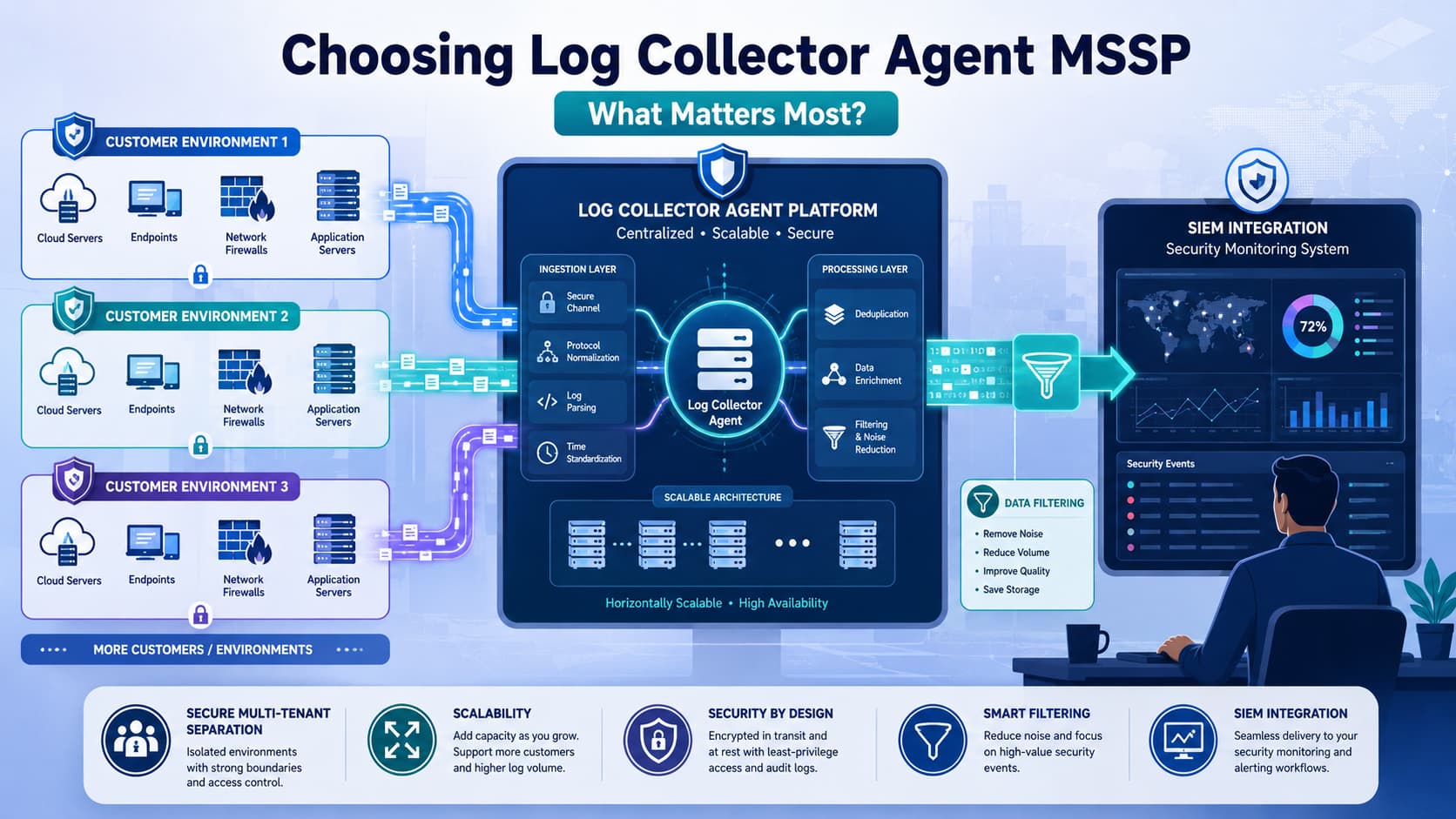
Choose a log collector agent that scales efficiently, protects customer data isolation, and filters unnecessary noise before events reach your SIEM.
Collecting every log may seem thorough, but it can increase costs without improving security visibility. At MSSP Security, we have seen how simpler, smarter collection strategies are easier to manage across different client environments.
Industry guidance from Datadog, Microsoft, and The Australian Cyber Security Centre (with CISA and partners) also highlights the importance of timely log ingestion for faster incident detection.
Keep reading for a practical framework based on real-world experience and current guidance.
Build a Scalable Log Collection Strategy
Choosing the right log collector agent for an MSSP starts with architecture, not features. A scalable foundation improves operational efficiency, reduces long-term costs, and supports consistent security monitoring as customer environments grow.
- Prioritize multi-tenant architecture with strong tenant isolation before evaluating advanced features.
- Reduce SIEM costs through selective forwarding, log aggregation, and edge filtering instead of collecting every event.
- Validate core capabilities including lifecycle management, cloud integrations, and log normalization before production deployment.
Why Is Choosing a Log Collector Different for MSSPs?
Managing log collection across dozens or even hundreds of customer environments changes what matters most. Scalability, tenant isolation, and operational efficiency quickly become bigger priorities than collecting every possible event.
Enterprise teams usually support a single environment. An MSSP doesn’t have that luxury. Every customer brings different infrastructure, compliance requirements, and operational expectations.
Across our consulting engagements, we’ve audited environments where strong security products became painful to manage because they were deployed with a single-tenant mindset. The technology wasn’t the problem.
The architecture was. Once customer numbers grow, administrative overhead grows with them unless the platform was designed for multi-tenancy from the beginning.
Modern platforms now support petabyte-scale ingestion, so raw capacity is no longer the main differentiator. Vendors such as Datadog design ingestion pipelines for large, distributed environments. That changes how products should be evaluated.
A platform that performs well inside one enterprise can become difficult to operate when customer isolation, delegated administration, and tenant-specific reporting are introduced.
Several capabilities become non-negotiable as an MSSP scales:
- Customer-specific RBAC
- Separate dashboards and reporting
- Centralized policy management
- Secure audit logging
- Flexible log routing
- Tenant-level retention policies
We’ve also found that many providers underestimate how much day-to-day administration increases as new customers are added.
In practice, centralized policy deployment, consistent log normalization, and remote collector management often save far more engineering time than advanced analytics introduced later. Those operational gains usually deliver value every day.
Why doesn’t enterprise guidance scale to MSSPs?
Most enterprise deployment guides assume one security team, one compliance framework, and one centralized infrastructure. That’s rarely how managed security providers operate.
One customer may need PCI DSS reporting, another works under HIPAA or ISO 27001, while others have entirely different contractual requirements. Some environments standardize on Microsoft Sentinel.
Others continue running Splunk, QRadar, or OpenSearch. Migration projects often require logs to be delivered to multiple SIEMs at the same time. We’ve seen this become a common requirement during platform transitions.
That level of variation turns a log management platform into far more than a collector. It becomes a routing and management layer that needs to adapt to each customer’s environment without increasing operational complexity.
What operational problems appear at scale?
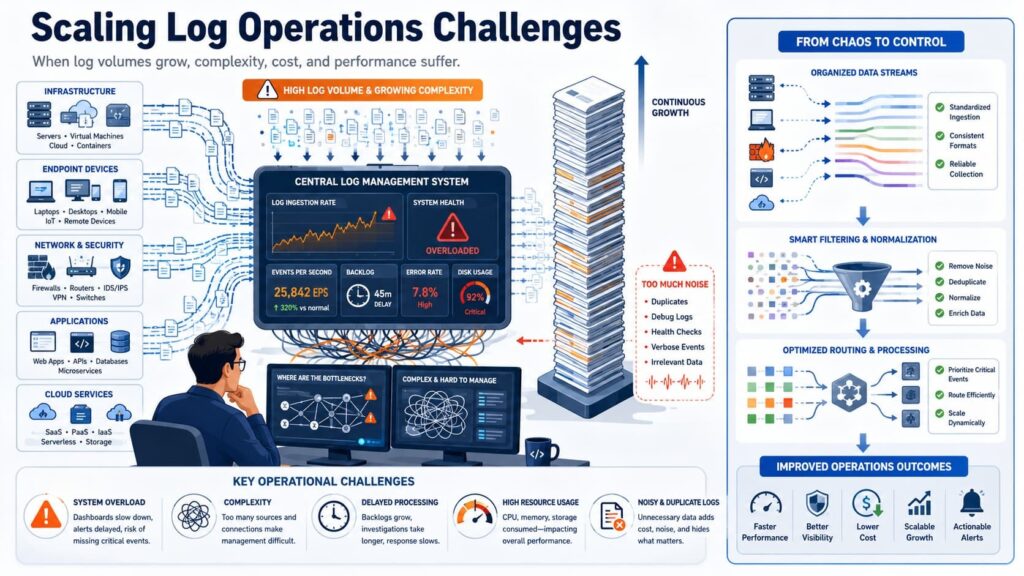
Small inefficiencies rarely stay small. One collector becomes hundreds. A handful of endpoint agents turns into thousands.
Cloud log sources multiply, customer requirements evolve, and routine maintenance starts consuming engineering time that should be spent improving detection and response. This is where we’ve consistently seen centralized lifecycle management pay off.
Teams that can deploy policy changes remotely, monitor collector health from a single interface, and normalize logs consistently across customers spend far less time on repetitive administration.
That leaves more time for higher-value work, including security investigations, platform improvements, and helping customers strengthen their overall security posture.
Which Deployment Model Fits Your Clients Best?
For many MSSPs, centralized collectors strike the best balance between operational efficiency and visibility. Lightweight endpoint agents still have an important place, but they’re usually reserved for workloads that need deeper telemetry.
After reviewing and auditing log collection strategies across different providers, we’ve found that keeping endpoints as simple as possible usually pays off over time.
Instead of deploying another agent to every system, many organizations benefit from collecting logs centrally. Upgrades become easier, configuration changes are more consistent, and troubleshooting takes less effort because there are fewer moving parts.
Industry research supports this direction as well. Industry benchmarks and vendor case studies (e.g., Datadog Observability Pipelines) show consolidated collection pipelines can achieve several-fold throughput improvements over older multi-stage designs.
That doesn’t mean one model fits every environment. Some organizations operate under strict regulatory requirements or manage isolated networks where dedicated endpoint collection is still the better choice.
We evaluate those situations individually rather than assuming every customer should follow the same deployment model.
| Model | Best For | Primary Tradeoff |
| Centralized collector | Most MSSP deployments | Reduced endpoint visibility |
| Agent-based | High-security workloads | More lifecycle management |
| Hybrid architecture | Mixed environments | Higher operational complexity |
The architecture should support operational goals, not marketing claims.
Should you deploy centralized collectors?
Centralized collectors reduce endpoint overhead by receiving telemetry from multiple sources before parsing, enriching, filtering, and forwarding logs to the SIEM.
Implementing secure log forwarding practices also helps maintain reliable data transfer, protect sensitive telemetry, and ensure logs reach the correct destination without unnecessary exposure.
That approach gives providers more control over what reaches downstream platforms while reducing unnecessary ingestion.
Typical collection sources include:
- Windows Event Forwarding (WEF)
- NXLog
- rsyslog
- Network appliances
- AWS CloudTrail
- Azure Activity Logs
- Microsoft 365 logs
- API-based integrations
Another advantage is selective forwarding. Unnecessary events can be filtered before they ever reach the SIEM, which helps reduce storage costs and makes downstream analysis easier.
Across the environments we’ve reviewed, centralized collection has consistently reduced maintenance effort. Policy changes happen at a small number of collection points instead of thousands of individual endpoints, making upgrades and operational changes much easier to manage.
Before recommending additional endpoint agents, we usually determine whether centralized collection already provides the visibility the customer needs.
When are endpoint agents still necessary?
Endpoint agents remain the right choice when organizations need detailed endpoint telemetry, Sysmon data, application monitoring, or incident response capabilities that centralized collectors cannot provide.
Platforms such as Elastic Agent, Azure Monitor Agent (AMA), and the OpenTelemetry Collector all support richer telemetry while allowing centralized policy management.
Planning still matters.
We’ve audited customer environments where Microsoft Defender for Endpoint, AMA, separate logging agents, and third-party collectors were all collecting nearly identical Windows events. The result wasn’t better visibility.
It was duplicated data, higher ingestion costs, more storage consumption, and extra tuning work for security teams. In cases like these, our recommendation is usually to reduce overlap before adding another collector.
A leaner logging architecture is often easier to operate, easier to audit, and far less expensive over the long term without giving up meaningful detection coverage.
What Makes Multi-Tenancy Truly Secure?
True multi-tenancy requires isolated data, permissions, routing, and reporting instead of separate dashboards alone.
One lesson we’ve learned while designing customer environments at MSSP Security is that dashboard separation creates a false sense of security if the underlying data remains shared.
Proper RBAC, independent audit trails, and tenant-specific log routing matter far more than visual organization.
Elastic documentation clarifies that Kibana Spaces organize dashboards and detection rules but do not isolate underlying source indices unless index-level or document-level security is configured.
For MSSPs supporting regulated industries, that distinction can become critical during compliance audits or customer assessments. Security should extend beyond visibility into storage architecture and operational boundaries.
A secure multi-tenant design typically includes:
- Dedicated indices or tenant-specific storage
- Granular RBAC Independent audit trails
- Separate log retention policies
- Encrypted transport and storage
- Customer-specific reporting
We’ve also found that customers increasingly request evidence of isolation during onboarding. Meeting those requests becomes much easier when separation is built into the architecture rather than added later.
Do dashboards equal data isolation?
No. Dashboards simplify administration but do not automatically separate stored telemetry. Proper isolation usually combines schema mapping, dedicated indices, log encryption, customer-specific routing rules, and permission boundaries that prevent accidental data exposure.
Multi-cluster versus index isolation
Organizations seeking the highest degree of isolation often choose separate clusters, while others balance cost and security through dedicated indices with carefully designed RBAC.
Neither option is universally correct. The right decision depends on customer requirements, operational maturity, and compliance obligations.
How Can You Reduce SIEM Costs Without Losing Visibility?
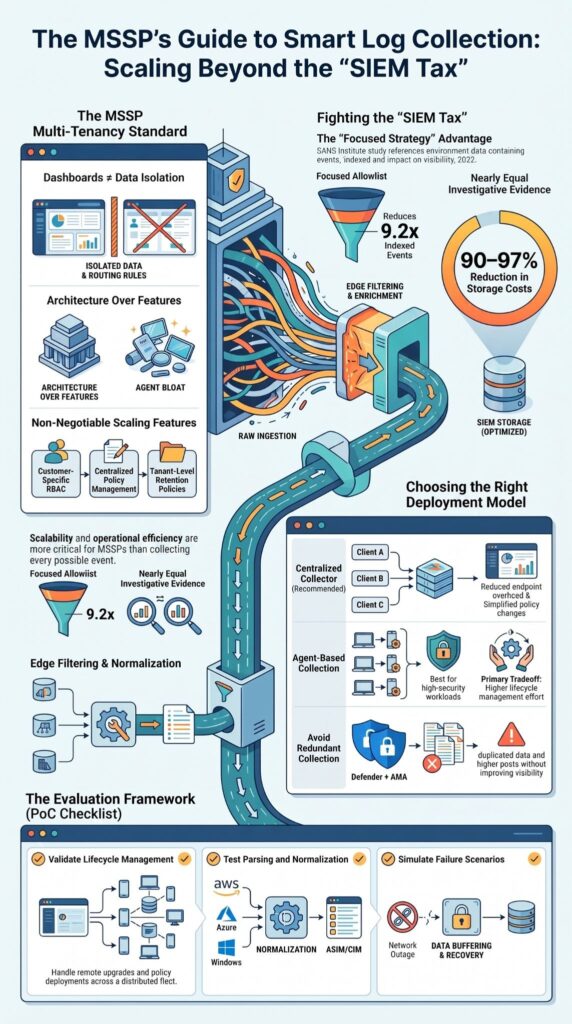
Reducing ingestion volume before events reach the SIEM is usually more effective than expanding storage capacity later. A well-designed log collector aggregator helps centralize processing, filtering, and routing decisions before data reaches downstream security platforms.
Among security teams, the phrase “SIEM tax” has become common because forwarding every available event creates rapidly increasing licensing and infrastructure costs.
We’ve inherited several environments where default configurations generated massive data volumes without improving threat detection. Industry guidance increasingly recommends filtering, log aggregation, log normalization, and log de-duplication at the collection layer.
Snare reports up to 90–97% reduction in SIEM storage and ingestion costs through filtering, enrichment, and routing before ingestion. Instead of forwarding everything, effective architectures prioritize valuable telemetry.
Data from SANS Institute demonstrates:
“Over a 9-day observation window, the focused strategy reduced exported Pub/Sub topic storage from 383.53 GiB to 18.7 GiB (20.5× reduction; 95.1% lower) and reduced indexed events from 134,765,353 to 14,640,637 (9.2× reduction; 89.1% lower).The coverage of the performed GCP and GKE control-plane procedures was practically equal between the dump-everything and focused pipelines, meaning that a focused allowlist can lower the volume of ingest without significantly worsening evidence usable in investigations.” – SANS Institute
Recommended optimization techniques include:
- Selective forwarding
- Log compression
- Log aggregation
- Log de-duplication
- Log filtering
- Intelligent log routing
Of course, aggressive filtering should never eliminate forensic evidence. During our deployments, we typically begin with conservative filtering rules, monitor detection quality, and gradually optimize ingestion after understanding customer activity patterns.
Why is forwarding everything expensive?
Every duplicated Windows event, cloud API response, or repeated authentication log increases storage, indexing, and query costs. Beyond that, analysts must investigate additional noise, slowing SOC automation, incident response, and anomaly detection.
Which edge filtering techniques work best?
Edge collectors perform log parsing, Grok patterns, enrichment, and routing before forwarding telemetry. That architecture minimizes unnecessary traffic while preserving security-relevant events, improving both operational efficiency and detection quality.
Which Features Matter Most During Evaluation?
Scalability, lifecycle management, normalization, and routing flexibility consistently deliver greater operational value than long feature lists.
We’ve participated in proof-of-concept projects where advanced analytics impressed during demonstrations but became difficult to maintain once hundreds of customer environments entered production. Reliable operations depend on predictable data quality.
As noted by Korea Citation Index:
“Due to inconsistent formats and fields in security logs from various information protection systems, as well as differing standards for classifying attack types and assessing risk levels, a separate preprocessing step is required to make logs suitable for AI learning. This inconsistency may lead to misclassification when AI learns from logs categorized differently for similar attacks…this study analyzes the effort involved in preprocessing logs and proposes a log standardization method. By empirically verifying the improvement in AI training efficiency through standardized logs, the necessity and effectiveness of log standardization are demonstrated.” – Korea Citation Index
An effective evaluation should verify:
- Log parsing
- Log enrichment
- Schema mapping
- ASIM
- CIM
- API integrations
- Dual-shipping
- Remote lifecycle management
| Evaluation Area | Why It Matters |
| Parsing | Consistent detections |
| Normalization | Reusable rules |
| Cloud support | Modern infrastructure |
| Routing | Flexible architectures |
| Lifecycle management | Lower operational effort |
According to Datadog, consistent normalization allows reusable detection logic across multiple environments, reducing engineering effort while improving investigation quality (Datadog OCSF normalization enables reusable detection rules across sources).
What should every proof of concept include?
Every pilot should validate cloud log collection, remote upgrades, parsing consistency, and failover behavior instead of focusing solely on dashboards.
Efficient log source onboarding processes are also important because MSSPs continuously add new customers, applications, cloud services, and security data sources over time.
Testing production workflows uncovers limitations that feature comparisons rarely reveal.
Essential evaluation checklist
We generally recommend evaluating:
- API-based collection
- Microsoft Sentinel compatibility
- Fleet Server management
- OpenTelemetry Collector support
- Distributed collectors
- Real-time alerting
- Log correlation
- Alert correlation and analytics integration
How Should You Handle Cloud Log Collection?
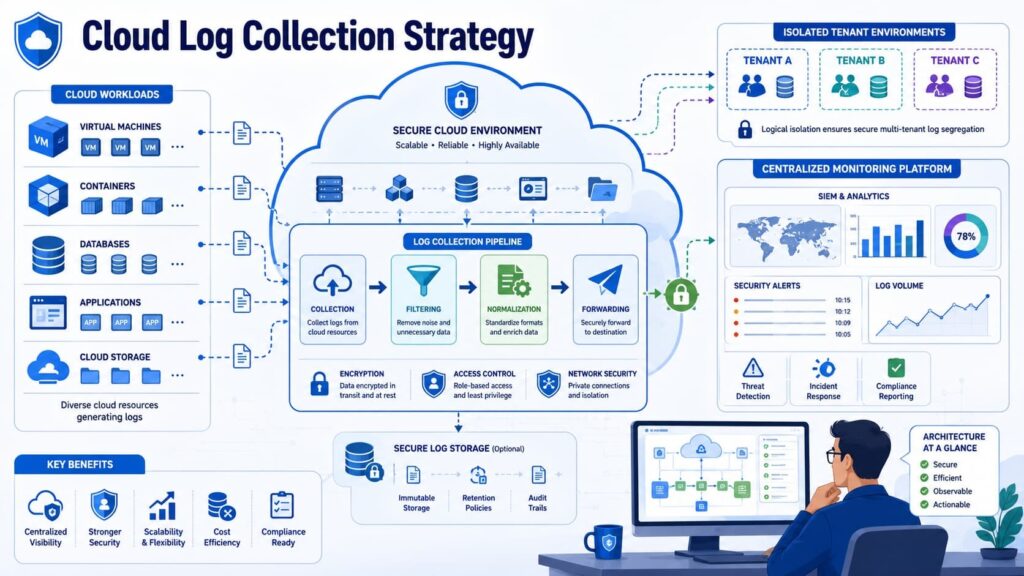
Native cloud APIs simplify maintenance, but tenant-specific configuration remains essential. Cloud-first customers increasingly expect collection from AWS CloudTrail, Azure Activity Logs, M365 logs, and SaaS platforms without deploying unnecessary endpoint software.
Our deployments have shown that cloud-native integrations reduce maintenance overhead, but careful planning still determines long-term success. Selective collection also prevents excessive log ingestion costs.
Supported cloud sources should include:
- AWS CloudTrail
- Azure Activity
- Logs Microsoft 365
- API-based SaaS integrations
Practitioners report significant ingestion reductions when using Azure Monitor Agent (AMA) with Data Collection Rules (DCR); Microsoft documents filtering/transform capabilities that can materially reduce volume, though exact savings depend on environment.
Why do Azure Data Collection Rules matter?
Data Collection Rules (DCR) determine which telemetry reaches downstream platforms. Well-designed DCRs reduce unnecessary events while preserving security visibility, making them one of the most effective tools for SIEM cost optimization.
What cloud sources should be supported?
A modern log collector agent should support hybrid infrastructure without requiring completely separate collection architectures. That includes cloud APIs, hybrid identity, endpoint telemetry, and centralized policy management.
What Hidden Technical Pitfalls Surprise MSSPs?
Duplicate ingestion, configuration conflicts, and policy design frequently create larger operational problems than throughput limitations. Community discussions around Elastic Agent illustrate this clearly.
Administrators have reported 30 GB+ per month generated across just 15 agents after enabling certain agent telemetry settings (Elastic Discuss, 2021: administrators reported 30GB+/month with ~15 agents when both ‘Collect Agent Logs’ and ‘Collect Agent Metrics’ were enabled).
Small configuration mistakes become expensive at scale.
Common hidden pitfalls include:
- Port 514 conflicts
- Duplicate cloud polling
- Recursive agent logging
- Poor Fleet Server policy design
- Duplicate MDE integration
- Inefficient log archiving
We’ve also encountered duplicate telemetry when Defender for Endpoint, Sysmon, and additional Windows logging agents collected overlapping security events.
Eliminating redundant collection reduced both licensing costs and analyst workload without reducing detection coverage.
Why can multiple syslog integrations fail?
Some collectors cannot bind multiple services to the same listening port. Organizations frequently solve this using rsyslog, routing traffic internally before forwarding events to downstream parsing pipelines.
Which settings create unexpected data growth?
Automatic agent diagnostics, duplicate cloud polling, excessive metrics collection, and recursive monitoring often generate more telemetry than actual production workloads. Reviewing default settings before deployment saves significant operational effort later.
How Do Real MSSPs Describe Their Challenges?
Most practitioners describe operational complexity rather than missing features as the biggest challenge.
Across community discussions, engineers repeatedly reference “agent bloat,” “agent fatigue,” and the growing “SIEM tax.” Those phrases reflect practical experience rather than marketing language.
We’ve experienced similar situations ourselves. Every additional collector introduces another upgrade schedule, another configuration policy, and another troubleshooting workflow.
Recurring operational themes include:
- Agent fatigue
- Overlapping products
- Constant tuning
- Migration complexity
- Duplicate telemetry
- Escalating ingestion bills
One consistent recommendation appears across technical communities: avoid forwarding every available log simply because the collector can.
That advice aligns closely with our own operational experience at MSSP Security, where carefully selecting valuable telemetry consistently produces better security outcomes than maximizing volume.
What does “agent bloat” actually mean?
Agent bloat describes environments where multiple security products collect similar information, consuming CPU resources while increasing administrative overhead.
Why is “SIEM tax” becoming common language?
The phrase refers to rising costs created by unnecessary log ingestion, duplicate telemetry, and inefficient collection strategies. Reducing noise before it reaches the SIEM remains one of the simplest ways to improve profitability.
Which Log Collection Platforms Stand Out?
The best platform depends on architecture, customer requirements, and operational priorities instead of feature count. Some organizations prioritize compliance reporting, while others focus on routing flexibility or engineering customization.
Different organizations prioritize different capabilities when selecting a log collection platform.
Commercial routing platforms work well when flexible log routing, enrichment, and transformations are the highest priority.
Compliance-focused platforms are better suited for organizations that must satisfy regulatory frameworks such as PCI DSS, HIPAA, or ISO 27001.
Open-source platforms provide greater customization for engineering teams with in-house expertise.
Cloud-native collectors simplify deployments across AWS, Azure, Microsoft 365, and hybrid cloud environments.
Rather than selecting technology based solely on feature comparisons, we recommend evaluating how each platform supports centralized log management, distributed collectors, log enrichment, and operational scalability.
For many organizations, starting with a scalable foundation produces better long-term results than selecting the platform with the largest feature list.
How Should You Validate a Log Collector Before Production?
Production validation should measure operational outcomes instead of marketing claims. The Australian Cyber Security Centre (with CISA and partners) emphasizes timely log ingestion, noting that delays reduce an organization’s ability to identify incidents quickly.
A structured proof of concept should include:
- Tenant isolation
- Parsing accuracy
- Buffering during outages
- Upgrade workflows
- SIEM cost optimization
- Compliance reporting
We also recommend introducing controlled failures during testing. Disconnect collectors, interrupt network connectivity, and simulate cloud API interruptions.
Observing recovery behavior often reveals more than benchmark testing alone. What should you test first? Begin with data isolation, log normalization, buffering, and lifecycle management. Those capabilities influence every customer deployment regardless of industry.
Which success metrics matter most?
Successful validation measures: Detection quality Collection reliability Upgrade effort Analyst efficiency Customer reporting Infrastructure costs Those operational metrics usually predict long-term success better than raw ingestion benchmarks.
Proactive Validation: Testing the Integrity of Your Log Collection
Credits: TrustedSec
Many organizations mistakenly assume their security monitoring is flawless simply because they have deployed a log collector or an expensive SIEM.
However, TrustedSec emphasizes that without continuously testing your infrastructure against real-world attack simulations, you cannot guarantee that critical telemetry is actually being captured.
Proactively validating your log visibility is essential to ensure that malicious activities are accurately recorded, allowing MSSPs to identify and close blind spots before adversaries can exploit them.
FAQ
How does a log collector agent reduce SIEM costs?
A well-configured log collector agent reduces SIEM cost optimization challenges by filtering unnecessary events before log ingestion. It uses selective forwarding, log compression, and log de-duplication to reduce storage and processing requirements. This approach keeps valuable security data while lowering operational costs and maintaining the visibility needed for effective security monitoring.
Can agentless logging replace lightweight agents completely?
Agentless logging cannot completely replace lightweight agents in every environment. Agentless collection works well through API-based collection for many systems, while lightweight agents provide deeper endpoint telemetry and more detailed visibility on individual devices. Many organizations combine both methods to achieve balanced coverage, better performance, and simpler long-term management.
Why is log normalization important for security monitoring?
Log normalization converts logs from different sources into a consistent format that security tools can process efficiently. Combined with log parsing, Grok patterns, schema mapping, and log enrichment, normalized data improves log correlation, strengthens anomaly detection, and enables faster threat detection and incident response during security investigations.
What should businesses consider for compliance reporting?
Businesses should implement logging practices that support log retention, log encryption, RBAC, and audit trails because these capabilities protect sensitive data and create reliable records for compliance reporting. These practices also help organizations meet the logging requirements of PCI DSS, HIPAA, and ISO 27001 while simplifying audit preparation.
Which cloud logs should businesses collect first?
Businesses should prioritize cloud log collection from high-value sources such as M365 logs, AWS CloudTrail, and Azure Activity Logs because these logs provide visibility into user activity, configuration changes, and security events. Combining these sources with centralized log management, distributed collectors, and effective log routing creates more consistent monitoring and faster security investigations.
Build a Log Collection Strategy That Lasts
Choosing the right log collector agent starts with a scalable architecture, not just the tool itself. Prioritize secure multi-tenant SIEM design, intelligent log routing, selective collection, and disciplined lifecycle management to improve threat detection, control costs, and support compliance.
As your cloud, hybrid, and endpoint environments expand, a well-planned strategy keeps operations efficient and resilient.
If you need expert guidance, explore MSSP Security’s consulting services for vendor-neutral recommendations, architecture planning, PoC support, and security stack optimization backed by over 15 years of experience and 48,000+ completed projects.
References
- https://www.sans.org/white-papers/focused-dump-everything-ingestion-gcp-kubernetes-siem-pipelines
- https://www.kci.go.kr/kciportal/ci/sereArticleSearch/ciSereArtiView.kci?sereArticleSearchBean.artiId=ART003220440