


Managing false positives in vulnerability scanners starts with improving how security teams review, validate, and prioritize scan results.
Managing false positives scanners requires more than removing inaccurate alerts because each finding needs proper context and verification to determine its actual risk. Automated tools help identify potential weaknesses, but incorrect findings can increase workload and delay remediation when they are not handled properly.
By refining scanner configurations, using credentialed scans, applying asset context, and maintaining structured workflows, organizations can improve scan accuracy and focus on real security issues. Continue reading to explore practical strategies with MSSP Security for better vulnerability management.
What Are The Best Practices For Managing False Positives In Vulnerability Scanners?
Managing false positives in vulnerability scanners requires more than reviewing alerts. Organizations need accurate validation, proper configuration, and structured workflows to improve security outcomes.
- Managing false positives scanners helps security teams reduce scanner noise by validating findings, improving accuracy, and focusing remediation efforts on real vulnerabilities.
- Proper scanner tuning, credentialed scanning, and asset context analysis help organizations refine vulnerability results while minimizing inaccurate findings during security assessments.
- Effective workflows, documentation, and continuous reviews allow teams to handle false positives consistently while maintaining visibility into changing security risks.
Why Do False Positives Affect Vulnerability Scanning Operations?
A false positive happens when a vulnerability scanner identifies a security issue that is not actually present or does not create the expected level of risk. These inaccurate results can occur because scanners depend on detection rules, signatures, configuration checks, and available system information to identify potential vulnerabilities.
Automated scanning helps security teams discover possible weaknesses, but every finding still needs review before remediation decisions are made. Too many false positives can lead to:
- More time spent investigating unnecessary alerts
- Delayed responses to real security issues
- Difficulty prioritizing important vulnerabilities
- Increased alert fatigue among analysts
From our experience helping MSSP teams select and audit security products, we have seen how inaccurate scan results can affect operational efficiency. A scanner should not only identify vulnerabilities but also provide accurate and useful findings that support better security decisions.
Effective managing false positives scanners requires a balanced process that combines automation, manual validation, and asset context. By improving scan accuracy, organizations can refine vulnerability management workflows and focus resources on risks that require attention.
What Causes False Positives In Vulnerability Scans?
False positives in vulnerability scans often happen because of gaps between what a scanner detects and the actual condition of an environment. Understanding how different tools identify vulnerabilities is important because each scanner uses different detection methods, signatures, and validation approaches.
Organizations can learn more about Vulnerability Scanner Technology Explained to better understand how scanning tools analyze potential security issues and why inaccurate findings may occur.
Several factors commonly contribute to scanner false positives:
| Common Cause | How It Happens | Effect On Vulnerability Results |
| Banner-Based Detection Errors | Scanners identify software vulnerabilities based on exposed version information, even when security updates or patches have already been applied. | Creates inaccurate findings that may not represent an actual security risk. |
| Incorrect Asset Information | Vulnerability findings are linked to inactive systems, protected applications, or assets that are no longer relevant. | Causes security teams to investigate issues that do not affect the current environment. |
| Credential And Access Limitations | Scanners cannot access complete system information because of missing credentials, insufficient permissions, or authentication failures. | Reduces visibility and increases the possibility of inaccurate assessments. |
| Outdated Vulnerability Checks | Detection rules, plugins, or vulnerability databases do not reflect the latest environment conditions. | Generates unnecessary alerts based on outdated information. |
| Misconfigured Scanning Policies | Scanner settings do not match asset types, business requirements, or existing security controls. | Produces excessive findings and increases scanner noise. |
From our experience helping MSSP teams evaluate and audit security products, we have seen that reducing false positives requires more than adjusting scanner settings. Teams need to understand how detection logic, asset context, and business requirements work together when reviewing vulnerability results.
Rather than simply removing findings, effective false positive vulnerability management focuses on improving the quality of scan results. Through proper scanner tuning to reduce false positives, organizations can refine vulnerability scan results while maintaining visibility into genuine security risks.
How Can Teams Validate Scanner Findings Before Taking Action?

Vulnerability scanners are useful for finding potential security weaknesses, but the reported results should not be treated as final conclusions.
Proper interpreting vulnerability scan results helps security teams understand the difference between actual vulnerabilities, false positives, and findings that require further investigation.
“Automated scanners may flag findings on Cloud.gov systems that aren’t exploitable in practice.” – Cloud.gov Docs
This shows why security teams need to review scanner results with additional context instead of relying only on automated reports.
A proper review process helps security teams analyze:
- The affected asset, service, and system configuration
- The scanner detection method and supporting evidence
- Logs, asset inventory, patch status, and application details
Validating scanner findings manually allows teams to confirm whether a reported issue can be reproduced and supports distinguishing true positives from false positives. This is especially important for environments with custom applications or complex infrastructure where automated tools may lack full context.
In our experience helping MSSP teams select and audit security products, we have seen that scanner accuracy depends on both technology and review processes. Automated tools provide broad coverage, while expert validation helps determine which findings require action.
By combining automated detection with manual analysis, organizations can improve vulnerability management, reduce unnecessary remediation work, and maintain focus on genuine security risks.ssary remediation work, and maintain focus on genuine security risks.
How Can Scanner Configuration Improve Vulnerability Assessment Accuracy?

The accuracy of vulnerability scan results depends heavily on how the scanner is configured. Even capable security tools can generate unnecessary alerts when scan policies, detection rules, and settings are not aligned with the organization’s environment.
Scanner tuning to reduce false positives helps teams focus on findings that represent real security concerns. This process usually involves:
- Adjusting scan policies based on asset types, applications, business priorities, and existing security controls
- Keeping vulnerability databases, plugins, and detection rules updated
- Customizing scanner checks to remove irrelevant detections and improve reporting quality
“The security team should tune code scanner tools to ensure a minimum of false positives are reported such that the tool provides value, and does not waste the developers’ time.” – OWASP Foundation
Through our experience helping MSSP teams select and audit security products, we have seen how configuration choices can significantly affect assessment results. A scanner may have strong detection capabilities, but poor tuning can still create unnecessary noise.
At MSSP Security, we evaluate how security products perform in real operational environments, including how well they support vulnerability scanner accuracy improvement. Refining vulnerability scan results requires ongoing adjustments, validation, and review rather than a one-time setup.
How Do Credentialed Scans Help Reduce False Positive Findings?
Better scanner visibility often leads to more accurate vulnerability results. Credentialed scans allow security tools to access additional system details, such as installed software, patch status, configurations, and security settings.
Understanding the differences between credentialed vs uncredentialed scans helps organizations choose the right assessment approach and improve vulnerability validation accuracy.
Unlike unauthenticated scans, credentialed scanning does not rely only on external observations. Limited visibility can make it harder for scanners to confirm whether a vulnerability actually exists, increasing the risk of inaccurate reports. Common challenges with unauthenticated scans include:
- Difficulty confirming installed patches or updates
- Limited visibility into running software versions
- Incomplete configuration checks
- Higher chances of incorrect vulnerability classification
In our work helping MSSP teams select and audit security products, we have seen how authentication capabilities can influence overall scan quality. Authenticated scans reduce false positives because they allow security teams to verify findings using more complete system information.
However, credentialed scans still require proper management. Expired credentials, insufficient permissions, or incorrect account settings can affect results and create additional noise.
Combining credentialed scanning with asset context, manual validation, and proper configuration helps organizations with reducing scanner false positives while improving vulnerability assessment accuracy. A reliable scanning process is built on both strong technology and effective review practices.
How Can Asset Context And Risk Analysis Reduce Scanner Noise?
Vulnerability scanners provide useful security data, but raw findings often lack the context needed for accurate decisions. A vulnerability that appears severe may have a different impact depending on asset importance, exposure, business function, and existing security controls.
Using asset context to filter false positives helps teams move beyond severity scores and improve triaging scanner false positives. Important context includes:
- Asset ownership and business purpose
- Data sensitivity and exposure level
- Production or development status
- Existing security protections
From our experience helping MSSP teams evaluate and audit security products, we have seen how asset intelligence improves finding validation. Combining scanner results with exploitability data and inventory records helps teams identify realistic risks and avoid unnecessary remediation.
At MSSP Security, we focus on improving how security products support risk-based decisions. This approach helps with reducing scanner false positives, refining vulnerability scan results, and prioritizing security issues that require attention.
How Can Teams Handle False Positives Across Different Scanning Environments?
False positives can occur across different vulnerability scanning technologies, and each environment requires a specific review approach. Managing false positives scanners effectively means understanding how each tool identifies risks and where additional validation may be needed.
Common challenges include:
- Infrastructure scans: Incorrect service identification, limited visibility, patch detection issues, and configuration differences can create inaccurate findings.
- Web application scans: Custom application logic, unexpected responses, and security controls may cause scanners to misinterpret behavior.
- SAST code scans: Security tools may flag safe functions, unused code paths, or valid sanitization methods as vulnerabilities.
- Container scans: Images may contain unused packages or dependencies that do not create actual runtime risks.
Different environments require different validation methods, especially when assessing complex cloud systems. In cloud infrastructure vulnerability scanning, security teams need to consider workloads, configurations, access controls, and interconnected assets to avoid misinterpreting security findings.
From our experience helping MSSP teams evaluate and audit security products, we have seen that each scanning method requires different validation processes. Automated detection provides coverage, but manual review helps confirm real risks.
At MSSP Security, we focus on how products perform across different environments by reviewing detection accuracy, reporting quality, and validation workflows. This approach helps organizations improve vulnerability scanner accuracy improvement, reduce unnecessary remediation, and build stronger vulnerability management practices.
How Can Teams Build An Effective False Positive Triage Workflow?
A structured workflow helps security teams handle false positives in security scanning more consistently. Without a clear process, teams may repeatedly review the same findings, make inconsistent decisions, or accidentally suppress vulnerabilities that still require attention.
Effective false positive vulnerability management focuses on reviewing, documenting, and improving scan results rather than simply closing alerts. A practical workflow includes:
- Reviewing scanner findings, affected assets, severity, and supporting evidence
- Validating whether vulnerabilities exist through technical checks and additional data
- Classifying findings as confirmed vulnerabilities, false positives, accepted risks, or requiring further review
- Documenting decisions, ownership, and future review steps
From our experience helping MSSP teams select and audit security products, collaboration between security teams, developers, and asset owners plays an important role in triaging scanner false positives. Each group provides context needed to make accurate decisions.
At MSSP Security, we evaluate how security products support real workflows, including ticket integration, exception handling, and audit trails. Proper documentation ensures false positives are not forgotten and helps organizations maintain visibility.
A mature process turns false positive handling into an ongoing part of vulnerability management, improving consistency and reducing unnecessary investigation efforts.
How Can Automation Improve False Positive Management Without Reducing Visibility?
Credit: TuxCare
Automation can help security teams manage large volumes of vulnerability findings more efficiently, but it needs to be implemented with proper safeguards. Effective managing false positives scanners requires more than suppressing alerts; it involves reducing repetitive reviews while keeping important vulnerabilities visible.
A practical automation approach can include:
- Reviewing historical scan data to identify recurring false positives and repeated detection issues
- Grouping similar findings across multiple assessments to reduce duplicate investigations
- Applying suppression rules with clear approvals, review timelines, and documented changes
From our experience helping MSSP teams select and audit security products, we have seen that automation works best when it supports existing security processes rather than replacing them. Poorly managed suppression can create visibility gaps, while controlled automation improves vulnerability scanner accuracy improvement.
Historical data and machine learning can assist with triaging scanner false positives by identifying patterns and speeding up reviews. However, security teams still need human judgment to evaluate asset context, business impact, and whether a finding remains relevant.
At MSSP Security, we assess how security products balance automation, accuracy, and governance. A well-managed approach supports reducing scanner false positives, refining vulnerability scan results, and maintaining confidence in security findings.
How Can Organizations Document And Govern False Positive Decisions?
Managing false positives effectively requires more than removing inaccurate findings from reports. Organizations need clear documentation and governance to ensure decisions remain transparent, reviewable, and aligned with security objectives. A strong false positive vulnerability management process helps teams reduce unnecessary noise while keeping important risks visible.
Without proper records, security teams may spend time reviewing the same findings repeatedly or accidentally suppress vulnerabilities that become relevant later. A practical approach includes:
- Building a knowledge base containing validated false positives, root causes, affected assets, and previous review outcomes
- Documenting exception decisions with evidence, responsible owners, approvals, and review timelines
- Regularly reviewing suppressed findings to confirm they are still accurate
In our experience helping MSSP teams select and audit security products, we have seen how good documentation improves consistency across vulnerability reviews. A well-maintained knowledge base also makes triaging scanner false positives faster because teams can recognize recurring issues more easily.
At MSSP Security, we evaluate how security products support governance, reporting, and audit requirements. Tracking metrics such as false positive rates, investigation effort, and scan accuracy trends helps organizations improve vulnerability scanner accuracy improvement over time.
Effective governance ensures that reducing false positives does not become a shortcut for ignoring security issues. Instead, it creates a controlled process for improving scan quality and making informed risk decisions.
What Are The Best Practices For Reducing False Positives In Vulnerability Scanning?
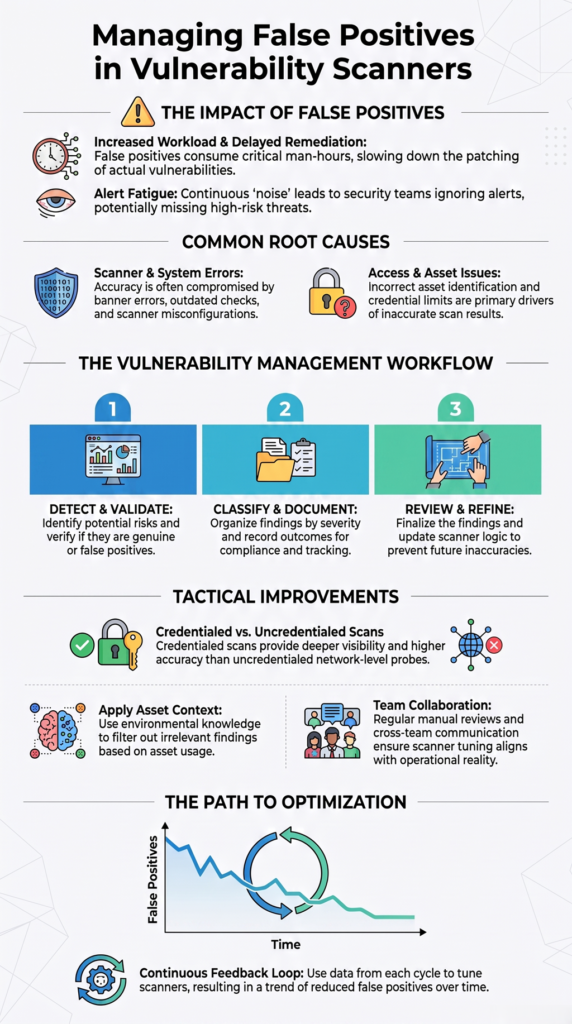
Reducing false positives requires ongoing attention because scanning environments are constantly changing. New systems, application updates, and security control changes can affect how vulnerability scanners interpret findings. Effective managing false positives scanners is not about eliminating alerts but improving the quality of results teams receive.
Organizations can improve scan accuracy by focusing on several practices:
- Review and tune scanner configurations regularly by updating detection rules, refining scan policies, adjusting scan frequency, and removing checks that do not apply.
- Maintain a balance between false positives and false negatives to avoid filtering out findings that may represent real risks.
- Prioritize vulnerabilities based on actual risk, including severity, exploitability, asset importance, exposure, and business impact.
- Encourage collaboration between security teams and system owners to add operational context that automated tools may not capture.
Through our experience helping MSSP teams select and audit security products, we have seen that accurate scanning depends on more than the tool itself. The way a product fits into existing workflows, reporting processes, and review practices also affects outcomes.
At MSSP Security, we evaluate security solutions based on their ability to support practical vulnerability management. Continuous review, validation, and configuration improvements help with reducing scanner false positives while maintaining visibility into important security risks.
The objective is not to create fewer findings at any cost. It is to produce reliable results that help teams make better decisions and focus remediation efforts where they matter most.
FAQ
What Are False Positives In Vulnerability Scanning?
False positives occur when a vulnerability scanner reports a security issue that does not actually exist or does not represent a real risk in the environment. Managing false positives scanners requires teams to review findings carefully because inaccurate results can come from detection rules, limited visibility, outdated checks, or incorrect asset information. Proper validation helps distinguish real vulnerabilities from inaccurate reports.
How Can Organizations Reduce False Positives From Vulnerability Scanners?
Organizations can reduce false positives by improving scanner configuration, updating detection rules, using credentialed scans, and applying asset context during analysis. Reducing scanner false positives also requires regular scanner tuning, manual validation, and reviewing historical findings to improve vulnerability scan accuracy over time.
Why Do Credentialed Scans Help Reduce False Positives?
Credentialed scans provide deeper access to system information, including software versions, installed patches, configurations, and security settings. This visibility helps authenticated scans reduce false positives by allowing scanners to verify findings instead of relying only on external indicators. Credentialed scanning supports more accurate vulnerability assessments and better risk decisions.
Should Security Teams Automatically Suppress False Positive Findings?
No. False positive suppression should be handled through a structured false positive vulnerability management process. Teams should validate findings, document decisions, apply proper approvals, and review exceptions periodically. This approach helps organizations avoid hiding legitimate vulnerabilities while maintaining control over scan results.
How Does MSSP Security Help Improve Vulnerability Scanning Accuracy?
MSSP Security helps organizations evaluate and audit security products by reviewing detection accuracy, reporting quality, and workflow capabilities. Through proper product assessment and vulnerability scanner accuracy improvement, teams can select solutions that better support handling false positives in security scanning, reduce unnecessary alerts, and improve overall vulnerability management processes.
How Can Organizations Better Manage False Positives In Vulnerability Scanners?
Managing false positives in vulnerability scanners requires more than removing inaccurate findings. Organizations need proper configuration, manual validation, asset context, and continuous improvement to maintain reliable security visibility.
Effective managing false positives scanners helps security teams reduce unnecessary investigations, improve scan accuracy, and prioritize real risks through credentialed scanning, scanner tuning, and risk-based workflows.
From our experience helping MSSP teams select and audit security products, we know that tool effectiveness depends on detection quality and operational fit. At MSSP Security, we support vendor-neutral evaluations, audits, and optimization to help organizations improve vulnerability management. Explore how MSSP Security can support your security technology decisions.
References
- https://owasp.org/www-project-security-culture/v11/7-Security_Testing/
- https://docs.cloud.gov/platform/compliance/false-positives/