

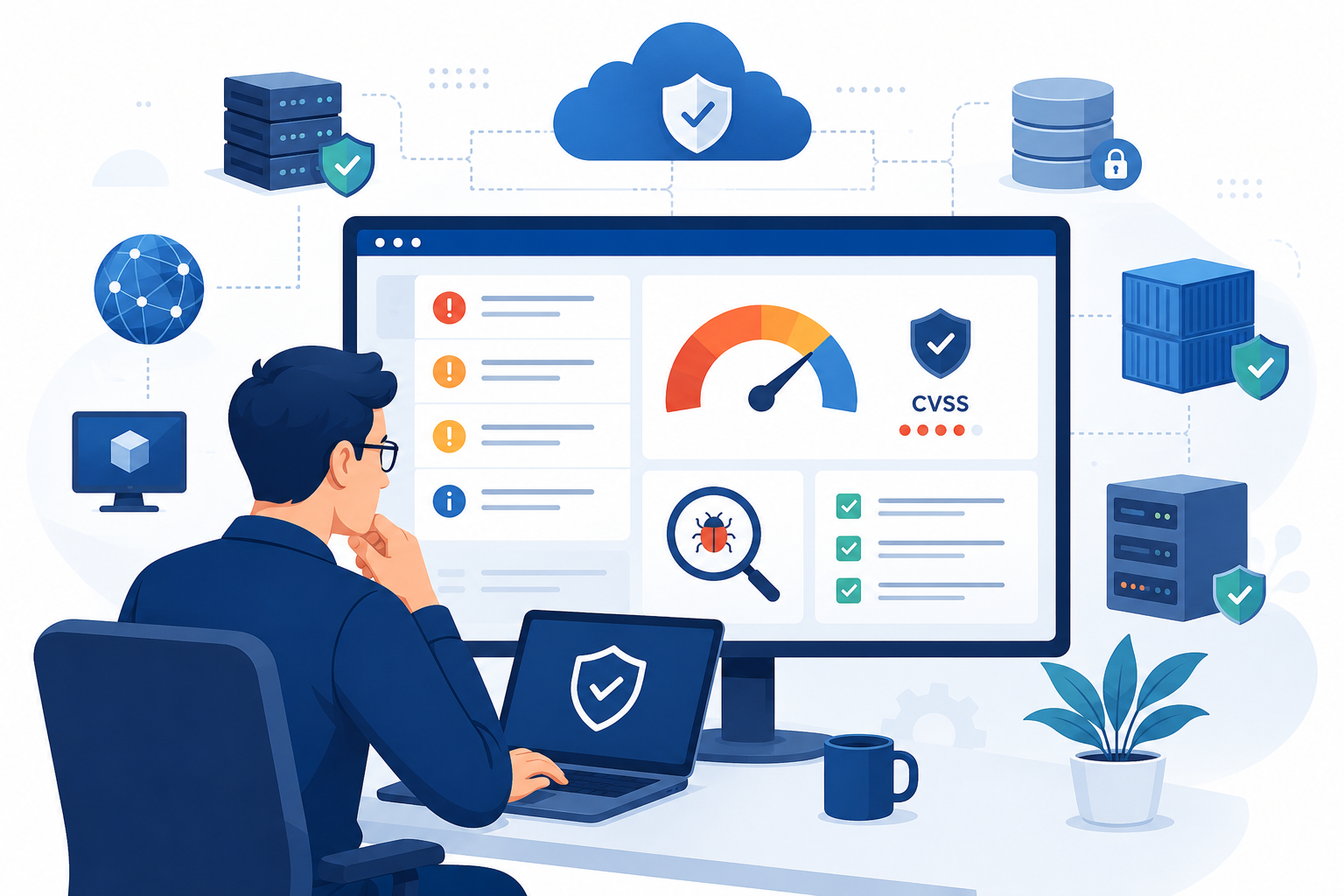
Interpreting vulnerability scan results means identifying which findings present the greatest risk and prioritizing remediation based on business impact, exploitability, and asset criticality, not severity scores alone. Vulnerability scans reveal security weaknesses across networks, applications, cloud environments, and operating systems, but the report is only the starting point.
At MSSP Security, we have seen that reviewing findings in context leads to more effective remediation and smarter resource allocation. This guide explains how to read vulnerability reports, validate findings, and prioritize remediation so organizations can make informed security decisions. Keep reading to learn more.
What Should You Know Before Interpreting Vulnerability Scan Results?
Before diving into the guide, keep these key points in mind:
- Interpreting vulnerability scan results requires balancing severity, business impact, exploitability, and asset criticality to prioritize remediation effectively.
- Effective vulnerability management includes validating findings, addressing misconfigurations, reviewing evidence, and tracking remediation progress.
- Combining automated scan data with expert analysis helps organizations prioritize risks, improve decision-making, and strengthen long-term cybersecurity resilience.
Why Interpreting Vulnerability Scan Results Matters?
A vulnerability scan can identify security weaknesses, but the findings alone do not show which issues deserve immediate attention. Interpreting vulnerability scan results helps organizations turn technical data into practical remediation decisions. While scanners detect vulnerabilities based on software versions, configurations, and exposure, they cannot account for business priorities or operational impact.
Understanding Vulnerability Scanner Technology Explained helps security teams recognize how scanning tools collect data and why additional analysis is needed before prioritizing remediation.
“Vulnerability management seeks to help organizations identify such weaknesses in its security posture so that they can be rectified before they are exploited by attackers.” – OWASP Foundation
From our experience working with MSSPs, we have found that severity scores alone rarely tell the full story. A High severity vulnerability on an isolated test server may present less risk than a Medium severity issue affecting a customer-facing application. Evaluating findings in context leads to more effective prioritization.
When reviewing vulnerability reports, consider:
- Asset criticality and business function
- Exploitability and exposure
- Compliance requirements
- Existing security controls
- Potential business impact
At MSSP Security, we help MSSPs assess and audit security products before deployment. This experience has shown us that a risk-based approach improves remediation efficiency and strengthens an organization’s overall security posture.
What Should You Look for in a Vulnerability Scan Report?
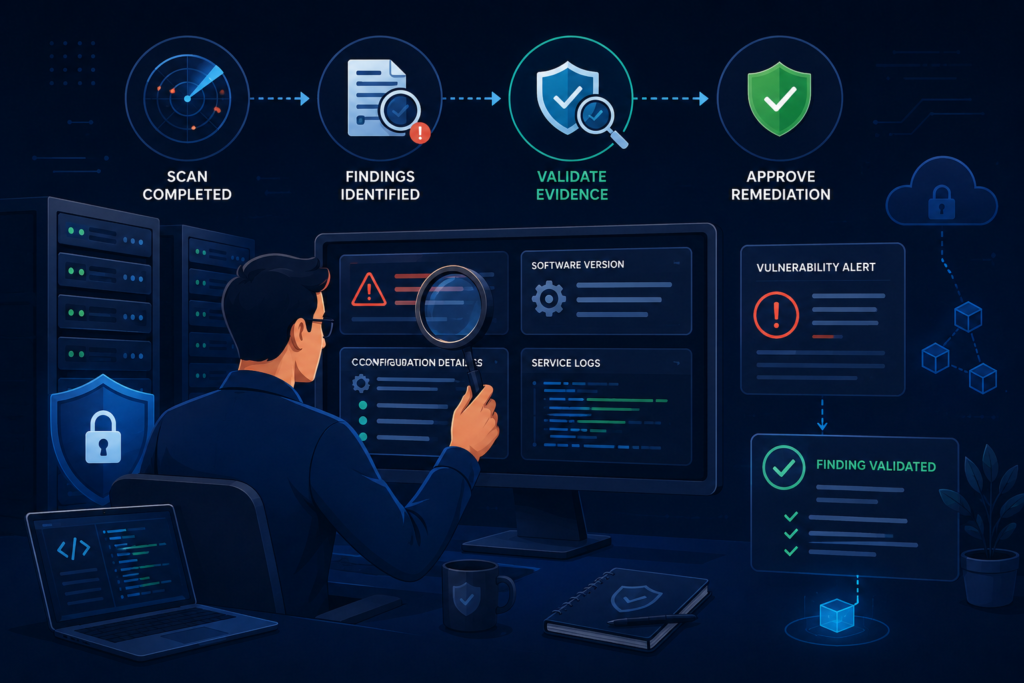
Making good remediation decisions starts with understanding how to read a vulnerability scan report. Every section adds context that supports interpreting vulnerability scan results, helping security teams determine what the findings mean and which actions should come first. Looking beyond the severity rating gives a more complete picture of the actual risk.
Most vulnerability scan reports include:
- Executive summary that highlights the organization’s overall security posture.
- Affected assets showing which systems, applications, or cloud resources are impacted.
- Vulnerability details with CVE references and CVSS scores to explain each finding.
- Technical evidence such as software versions, service banners, configuration settings, or scan logs that support the detection.
- Remediation guidance with recommended steps to reduce or eliminate the identified risk.
When we help MSSPs evaluate and audit new security products, we encourage them to review the evidence before assigning remediation tasks. We have seen cases where validating software versions or configuration details prevented teams from spending time on false positives. At MSSP Security, our experience shows that understanding every section of a vulnerability report leads to better decisions, more accurate remediation planning, and a clearer view of overall security risk.
How Should You Interpret Vulnerability Severity Ratings?
Severity ratings provide a useful starting point for understanding risk, but they should not be the only factor considered when interpreting vulnerability scan results. Most vulnerability scanners use the Common Vulnerability Scoring System (CVSS) to classify findings as Critical, High, Medium, Low, or Informational.
These ratings help measure technical risk, but they do not account for an organization’s business priorities or operational environment. Findings identified by tools such as web application vulnerability scanners may require additional context because application exposure, user interaction, and business impact can influence the actual level of risk.
CVSS scores are calculated using factors such as:
- Attack complexity
- Required privileges
- User interaction
- Impact on confidentiality, integrity, and availability
Looking at severity alone can lead to poor prioritization. For example, a Medium severity vulnerability affecting a public-facing payment portal may create more business risk than a Critical finding on an isolated test server. The surrounding context often matters just as much as the score itself.
| Vulnerability Severity | Example Scenario | Business Risk Consideration | Recommended Priority |
| Critical | Vulnerability affecting an isolated internal test system | Limited exposure and low business impact may reduce urgency | Review and schedule remediation based on risk |
| High | Vulnerability on a production application exposed to the internet | Higher exploitation potential and direct customer impact | Prioritize immediate remediation |
| Medium | Vulnerability affecting a public-facing payment portal | Business impact may be greater due to sensitive transactions | Prioritize based on asset importance |
| Low | Minor configuration issue on a non-critical system | Limited impact but may indicate security weaknesses | Address during routine maintenance |
Reviewing severity ratings together with asset importance, exposure, and business impact provides a more accurate view of risk. This approach helps organizations avoid focusing only on high scores and instead prioritize vulnerabilities that create the greatest security impact.
As we work with MSSPs to evaluate and audit new security products, we regularly compare severity ratings with real-world operational risk before making recommendations. At MSSP Security, we have found that considering exploit availability, asset importance, and system exposure alongside CVSS scores leads to more practical remediation decisions and better use of security resources.
Why Should You Analyze Findings Beyond Severity Ratings?

A CVSS score provides a helpful starting point, but it does not always reflect the actual risk to an organization. When interpreting vulnerability scan results, security teams should also consider how each finding could affect business operations, sensitive data, and critical services. The same vulnerability can carry very different levels of risk depending on where it is found.
To build a more complete picture, evaluate factors such as:
- Whether the affected asset is internet-facing
- The sensitivity of the data it stores or processes
- Its role in critical business operations
- Existing security controls that help reduce exposure
- Exploit availability and current threat activity
Through our work helping MSSPs evaluate and audit new security products, we have seen that organizations make better remediation decisions when technical findings are reviewed alongside business context. At MSSP Security, we use this approach to help identify the vulnerabilities that present the greatest operational risk. Instead of relying only on severity ratings, teams can prioritize remediation more effectively while making better use of their time and security resources.
What Common Findings Should You Look for Beyond Missing Patches?
Missing patches are one of the most common issues identified during vulnerability scans, but they are far from the only findings that matter. Interpreting vulnerability scan results requires looking beyond software updates to understand the full range of risks that could affect an environment. Many reports include configuration problems, insecure services, and cloud security issues that cannot be resolved with patching alone.
Common findings may include:
- Configuration weaknesses
- Unsupported or outdated software
- Cloud security misconfigurations
- Insecure network services
- Web application vulnerabilities
- Weak encryption settings
- Excessive user permissions
- Exposed management interfaces
- Outdated container images
From our experience working with MSSPs, we often see vulnerability reports that combine software flaws with operational and configuration issues. As we help evaluate and audit new security products, we encourage teams to identify the root cause of each finding before planning remediation. At MSSP Security, we have found that this approach helps organizations assign the right teams, whether infrastructure, cloud, development, or network operations, and reduces the chances of the same security issues appearing in future assessments.
How Can You Validate Findings Before Starting Remediation?
Before making changes to production systems, organizations should confirm that detected vulnerabilities are accurate. Interpreting vulnerability scan results requires more than accepting every alert at face value because automated tools can sometimes generate false positives or miss issues due to limited visibility. Reviewing the supporting evidence helps security teams understand why a finding was reported and whether it requires action.
Understanding how vulnerability scanners work can also help teams evaluate scanner limitations, review detection methods, and determine whether additional validation is required before taking action.
During validation, teams should review:
- Software versions and configuration settings
- Service banners and scan logs
- Vendor advisories
- Scan scope and credential access
- Whether vulnerable services are actively running
From our experience helping MSSPs evaluate and audit security products, we have seen how validation prevents unnecessary remediation efforts. At MSSP Security, we encourage teams to confirm findings before making operational changes, especially in complex environments. This approach helps reduce disruption, improve remediation accuracy, and ensure that resources are focused on vulnerabilities that represent real security risks.
How Can You Prioritize Vulnerability Remediation Effectively?
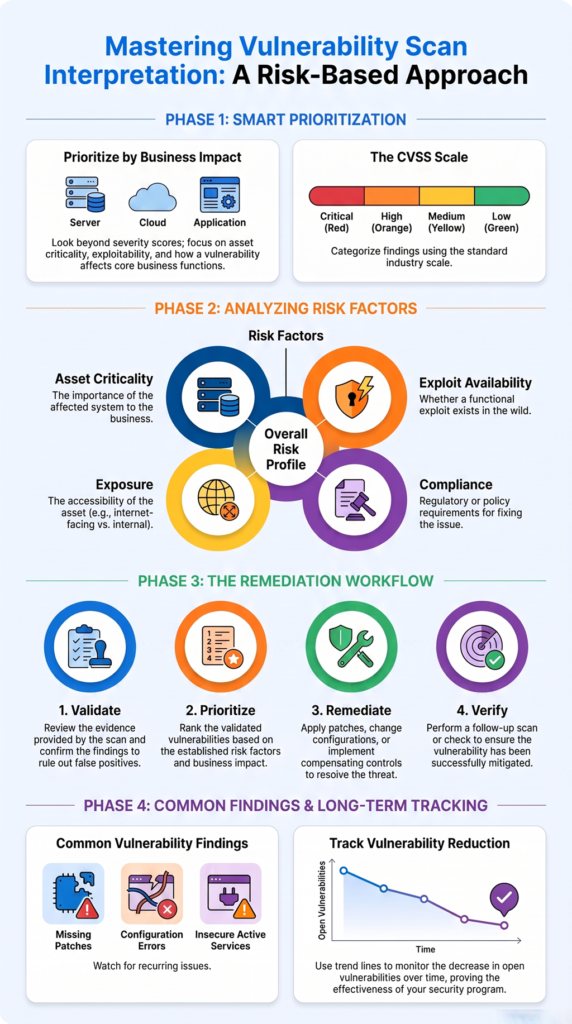
After findings have been validated, organizations need a clear approach for deciding what to fix first. Interpreting vulnerability scan results is not about resolving every issue at the same time, but about identifying which vulnerabilities create the greatest risk to the business. A practical remediation plan considers more than severity scores by looking at the environment where each vulnerability exists.
“The purpose of this document is to assist organizations in planning and conducting technical information security tests and examinations, analyzing findings, and developing mitigation strategies.” – National Institute of Standards and Technology (NIST)
Key factors to consider include:
- Asset importance and business function
- Internet exposure and attack surface
- Exploit availability and threat activity
- Compliance requirements
- Potential operational impact
In our work supporting MSSPs with security product selection and audits, we have seen that remediation becomes more effective when teams connect technical findings with business priorities. At MSSP Security, we help organizations build a structured process that includes validation, ownership assignment, remediation, and follow-up verification. This risk-based approach allows security teams to focus resources on vulnerabilities that can create the greatest reduction in cyber risk while avoiding unnecessary operational disruption.
How Can You Compare Scan Results Over Time?
A single vulnerability scan only shows the security status of an environment at one point in time. To understand whether security efforts are improving, organizations should compare reports across multiple assessment cycles.
Interpreting vulnerability scan results over time helps teams identify trends, measure remediation progress, and uncover recurring issues that may require broader process improvements. Consistent results also depend on using tools that provide reliable visibility across assets, which is why factors such as coverage and reporting capabilities matter when choosing network vulnerability scanner solutions for ongoing assessments.
When reviewing historical scan data, teams should track:
- Changes in Critical and High severity findings
- Average remediation time
- Recurring vulnerabilities
- Patch management improvements
- Risk trends across important assets
Through our experience helping MSSPs evaluate and audit security products, we have seen that consistent reporting provides valuable insight into how tools and processes perform over time. At MSSP Security, we encourage organizations to combine vulnerability data with asset inventories and threat intelligence to understand which systems require greater attention. Reviewing trends instead of isolated reports helps teams address root causes, improve security operations, and make better decisions about future investments.
How Should You Present Scan Results to Different Stakeholders?
Vulnerability reports often contain technical details that are valuable for security teams but difficult for other stakeholders to interpret. Effective communication is an important part of interpreting vulnerability scan results because different audiences need different levels of information to make decisions.
Security teams typically need details such as:
- CVE references and CVSS scores
- Affected assets and technical evidence
- Recommended remediation steps
- Validation and resolution status
Meanwhile, executives and business leaders usually need a clearer view of risk, including potential operational impact, affected services, and remediation priorities. Auditors may require documentation showing that findings were identified, reviewed, and addressed according to security policies.
From our experience helping MSSPs assess and audit security products, we know that clear reporting improves collaboration between technical and business teams. At MSSP Security, we focus on helping organizations translate complex findings into practical insights. By connecting vulnerability data with business context, ticketing workflows, and security monitoring platforms, teams can make informed decisions and maintain better visibility into their overall risk posture.
What Are the Best Practices for Interpreting Vulnerability Scan Results?
Credit: Cloud Stack Studio
Organizations get more value from vulnerability scanning when findings are reviewed carefully and converted into practical security actions. Interpreting vulnerability scan results effectively requires a balance between automated scan data, technical validation, and business context. Treating every finding the same way can create unnecessary workload and make it harder to focus on the risks that matter most.
Some best practices include:
- Validate findings before starting remediation to reduce false positives.
- Consider asset importance, exploitability, and business impact when prioritizing risks.
- Review trends over time to identify recurring vulnerabilities.
- Reduce scan noise by filtering duplicate or low-value findings.
- Document remediation activities and verify fixes through follow-up assessments.
Through our experience helping MSSPs select and audit security products, we have seen that technology alone does not determine vulnerability management success. At MSSP Security, we combine product evaluation expertise with practical security analysis to help organizations make better decisions. A structured, risk-based approach allows teams to improve remediation efforts, strengthen security operations, and maintain better visibility as their environments continue to change.
FAQ
What Is the Purpose of Interpreting Vulnerability Scan Results?
Interpreting vulnerability scan results helps organizations understand which security findings require attention and how they could affect business operations. Instead of focusing only on the number of vulnerabilities detected, teams can evaluate severity, exploitability, asset importance, and business impact to create better remediation priorities.
Should Organizations Fix Every Vulnerability Found in a Scan?
Organizations do not always need to fix every vulnerability immediately. The right approach is to prioritize findings based on risk factors such as asset criticality, exposure, active exploitation, and compliance requirements. A risk-based remediation strategy helps security teams focus resources on vulnerabilities that create the greatest potential impact.
How Do CVSS Scores Help When Reviewing Vulnerability Reports?
CVSS scores provide a standardized way to measure the technical severity of vulnerabilities based on factors such as attack complexity, privileges required, and potential impact. However, CVSS scores should be reviewed alongside business context because a lower-scored vulnerability on a critical system may create more risk than a higher-scored issue on an isolated asset.
Why Is It Important to Validate Vulnerability Scan Findings?
Validation helps confirm whether reported vulnerabilities are accurate before remediation begins. Automated scanners can sometimes produce false positives or miss findings due to limited access, outdated detection methods, or incomplete scan coverage. Reviewing evidence such as software versions, configurations, and scan logs helps organizations avoid unnecessary changes.
How Can Organizations Improve Their Vulnerability Management Process?
Organizations can improve vulnerability management by combining automated scanning with human analysis, maintaining accurate asset inventories, tracking remediation progress, and reviewing trends over time. Working with experienced security teams, such as MSSP Security, can also help MSSPs evaluate security products and ensure vulnerability management tools support effective risk reduction.
How Can Organizations Get More Value From Vulnerability Scan Results?
Interpreting vulnerability scan results requires more than reviewing severity scores. Organizations need to understand each finding, validate risks, and prioritize remediation based on business impact, asset importance, and exploitability. From our experience helping MSSPs evaluate and audit security products, we have seen that effective vulnerability management combines technology with informed analysis.
A structured approach helps teams reduce unnecessary remediation while focusing on critical risks. By turning scan reports into actionable insights, organizations can make better security decisions. MSSPs can also improve their security stack and technology choices with support from MSSP Security consulting services.
References
- https://csrc.nist.gov/pubs/sp/800/115/final
- https://owasp.org/www-project-vulnerability-management-guide/