

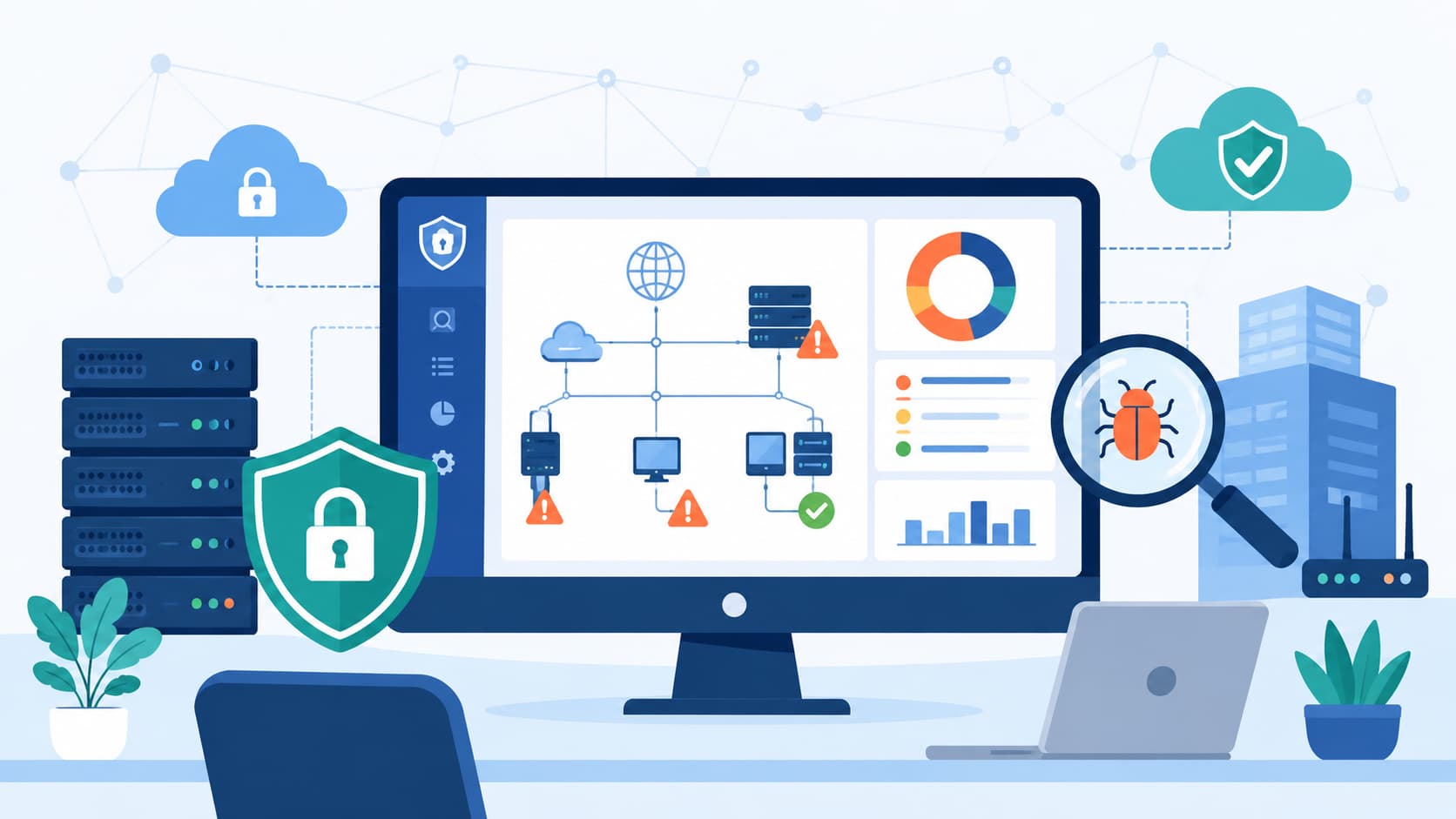
A vulnerability scanner identifies known security weaknesses before attackers can exploit them, helping organizations strengthen their security posture.
At MSSP Security, vulnerability scanning is viewed as the first step in continuous risk management rather than the final goal. Many organizations struggle not because they lack security tools, but because they cannot effectively prioritize and remediate the issues they uncover.
Keep reading to learn how vulnerability scanners work, where their limitations lie, and how security teams turn scan results into meaningful risk reduction.
Vulnerability Scanner Quick Take
Vulnerability scanners help uncover known security risks, but reducing cyber risk depends on accurate scanning, smart prioritization, and consistent remediation.
- Vulnerability scanners identify known security weaknesses, not every possible attack.
- Authenticated scanning consistently delivers more accurate results with fewer false positives.
- CVSS should always be paired with exploitability and business impact for better prioritization.
What Is Vulnerability Scanner Technology?
A vulnerability scanner is an automated security tool that identifies known weaknesses by comparing systems against vulnerability databases, security baselines, and configuration standards. It enables organizations to detect and prioritize security gaps before they can be exploited.
Modern IT environments span on-premises infrastructure, cloud services, containers, APIs, remote endpoints, and IoT devices. As the attack surface grows and thousands of new Common Vulnerabilities and Exposures (CVEs) are disclosed each year, automated vulnerability scanning becomes essential for maintaining security and helping organizations identify known weaknesses more efficiently.
Today’s vulnerability scanners support continuous vulnerability management by providing capabilities such as:
- Asset discovery
- Vulnerability identification
- Configuration auditing
- Risk assessment
- Continuous security monitoring
Unlike antivirus software, which detects active malware, vulnerability scanners focus on finding security weaknesses before an attack occurs. They also complement penetration testing, which validates whether identified vulnerabilities can be successfully exploited.
Effective vulnerability scanners assess a broad range of assets, including:
- Servers and workstations
- Network devices
- Cloud infrastructure
- Containers and Kubernetes environments
- Web applications and APIs
- Databases and IoT devices
How Does a Vulnerability Scanner Actually Work?
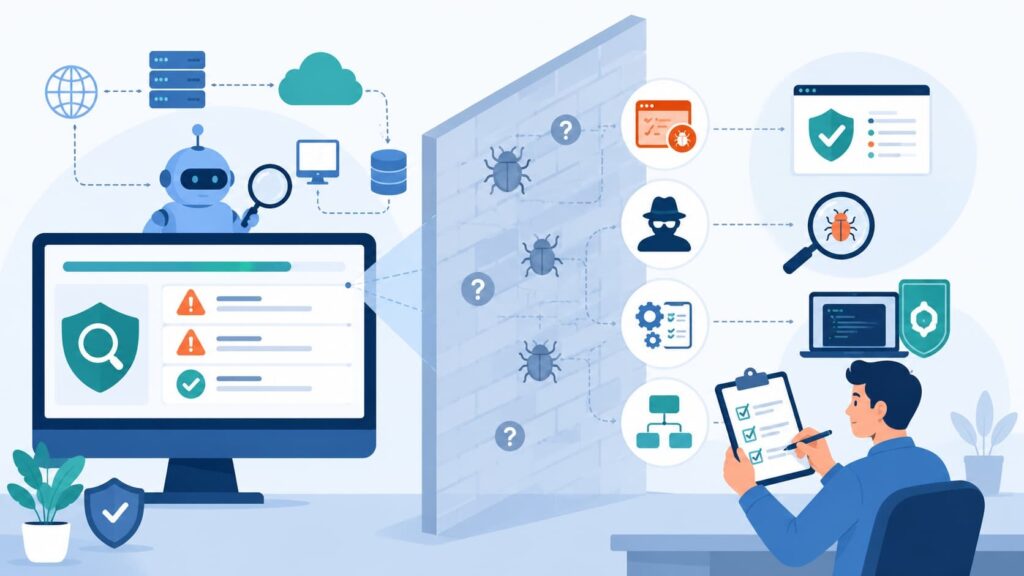
Most scanners follow a basic cycle: find assets, check for flaws, score the risk, and report on what needs fixing.
Understanding how vulnerability scanners work starts with this continuous scanning workflow, where each phase builds on the previous one to improve visibility and remediation. But the first step to knowing what you have is where many security programs stumble.
We’ve run assessments where the biggest surprise wasn’t a critical vulnerability, but the existence of the system itself. It’s common to find legacy servers, abandoned development environments, or cloud instances that were spun up for a project and never shut down.
These forgotten assets, often with weak or default configurations, regularly end up as our highest-priority findings.
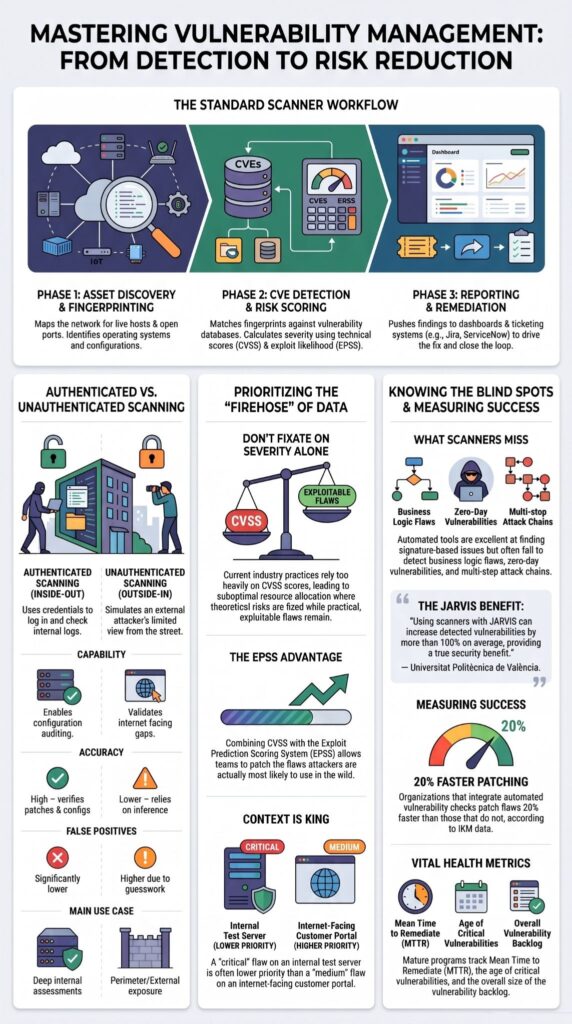
A standard scanner workflow breaks down into a few key phases:
- Asset Discovery: Mapping the network, scanning for live hosts and open ports, and identifying what’s running.
- Fingerprinting: Determining the specific operating systems, applications, and configurations on those assets.
- CVE Detection: Matching that fingerprint against databases of known vulnerabilities.
- Risk Scoring: Calculating the severity (using CVSS) and, more importantly, the real-world exploit likelihood (using EPSS).
- Reporting: Pushing those findings into dashboards, SIEMs, and ticketing systems to drive remediation.
The shift toward EPSS is significant. As defined by FIRST, the Exploit Prediction Scoring System estimates the actual probability a vulnerability will be exploited in the wild.
In our audits, we push for this because it moves teams beyond just patching “critical” flaws to patching the flaws attackers are most likely to use. The technology itself is only as good as the process around it.
We see too many scans where reports are generated, reviewed, and then filed away. The real value comes from consistently acting on the data, closing the loop from detection to fix.
Why Are Authenticated Scans More Accurate?
It’s a common point of frustration: a scanner reports hundreds of vulnerabilities on systems you know are patched. We’ve worked with teams who were ready to return the product, convinced it was broken.
Usually, the issue isn’t the scanner, it’s the scan type. Running an unauthenticated scan is like checking the locks on your house from the street. An authenticated scan is like going inside with a key to check every window, door, and safe.
Credentialed access changes everything. By logging in directly, an authenticated scan reads internal software logs and configuration settings directly, completely eliminating the external guesswork that triggers false alarms Here’s a practical breakdown of what each approach offers:
| Authenticated Scanning | Unauthenticated Scanning |
| Higher accuracy – verifies patches and configurations | Simulates an external attacker’s view |
| Lower false positive rate | Faster to deploy – no credential management |
| Enables configuration auditing | Validates external exposure |
| Provides definitive patch verification | Limited visibility – more inference |
So, does that make unauthenticated scanning useless? Not at all. It provides real value for specific tasks, like validating your internet-facing exposure, meeting certain compliance scan requirements, or for continuous perimeter monitoring.
The security community strongly recommends authenticated scanning for internal networks because it cuts through the noise and tells you exactly what’s wrong, saving countless hours of wasted remediation effort.
The smart approach is to use both. Combine authenticated scans for deep, accurate internal assessment with unauthenticated scans to see your environment the way an attacker does.
Balancing credentialed scans with uncredentialed scans provides both internal validation and an external attacker’s perspective, giving security teams broader coverage.
When we evaluate products for MSSPs, we test how seamlessly a platform can manage and correlate data from both methods.
What Types of Vulnerability Scanners Exist?
Different vulnerability scanners specialize in different environments because no single technology covers every attack vector. As organizations adopt hybrid infrastructure, one scanner rarely provides complete visibility.
Infrastructure, applications, containers, and cloud platforms introduce different security weaknesses requiring specialized analysis.
- Several common scanner categories exist.
- Network security scanners
- Web application vulnerability scanners help identify security weaknesses in websites, APIs, and web-based services.
- Endpoint and agent-based scanners
- Cloud infrastructure vulnerability scanning helps identify risks across virtual machines, cloud services, and misconfigured cloud resources.
- Container image scanners
- API security scanners
Each supports a different stage of security testing and vulnerability discovery. Enterprise security teams frequently combine multiple scanning technologies alongside penetration testing, security analytics, threat intelligence, and continuous monitoring to improve overall security governance.
We’ve observed that mature organizations don’t chase the idea of a perfect scanner. Instead, they build layered visibility that continuously improves security implementation across changing environments.
This layered approach becomes increasingly valuable as cloud infrastructure, remote work, and containerized applications continue expanding.
What Can Vulnerability Scanners Detect?
A vulnerability scanner’s core job is to find the known technical flaws, missing patches, bad configurations, old software before an attacker does. Today’s tools go far beyond version checking.
They analyze configurations, exposed services, encryption settings, and measure systems against security baselines, evaluating thousands of conditions in a single run.
The list of what they can find is extensive, but these are the usual suspects:
- Missing security patches
- Outdated or end-of-life operating systems
- Weak TLS/SSL configurations
- Unnecessarily open ports
- Systems with default credentials still in place
- General misconfigurations
- Vulnerable software libraries (like Log4j)
- Configuration drift from a known secure state
- Direct violations of internal security policies
On its own, a list of flaws is just noise. The real value for an MSSP comes from layering on context. We look for products that can enrich each finding with data like:
- The CVE identifier
- Its CVSS severity score
- The EPSS probability of exploitation
- Who owns the affected asset
- Whether it’s exposed to the internet
- How critical the asset is to the business
- Any relevant compliance requirement (like PCI DSS)
Without this context, vulnerability metrics are overwhelming. Teams can’t tell if they should drop everything to patch a server or if it can wait until the next maintenance window. Industry best practices emphasize continuous monitoring and disciplined patch management to reduce the attack surface.
In our view, that discipline is only possible when the scanner’s raw data is turned into a prioritized, contextualized action plan. The best tools for MSSPs are the ones that make that translation automatic.
Why Does Your Vulnerability Scanner Feel Like a Firehose?
Modern vulnerability scanners generate enormous volumes of findings, making remediation far more difficult than detection. Based on our experience working with customers at MSSP Security, the scanner itself is rarely the problem.
More often, challenges stem from configuration, prioritization, and remediation workflows. The overwhelming volume comes from years of accumulated technical debt combined with rapidly expanding digital infrastructure.
Security engineers repeatedly express deep frustration in community forums. They constantly face too many raw alerts, leaving them feeling overwhelmed by the sheer volume of data.
- Alert fatigue
- SIEM noise
- Limited remediation resources
- These reactions are understandable.
Large enterprises can generate hundreds of thousands of vulnerability records during a single assessment.
The most effective teams reduce noise instead of attempting to fix everything simultaneously.
- Prioritize exposed assets.
- Focus on exploitable vulnerabilities.
- Validate critical findings manually.
- Remove duplicate findings.
- Ignore informational alerts when appropriate.
Our experience suggests that organizations improve security much faster once vulnerability triage becomes part of daily security operations rather than an occasional compliance exercise.
Can Vulnerability Scanners Miss Significant Vulnerabilities?
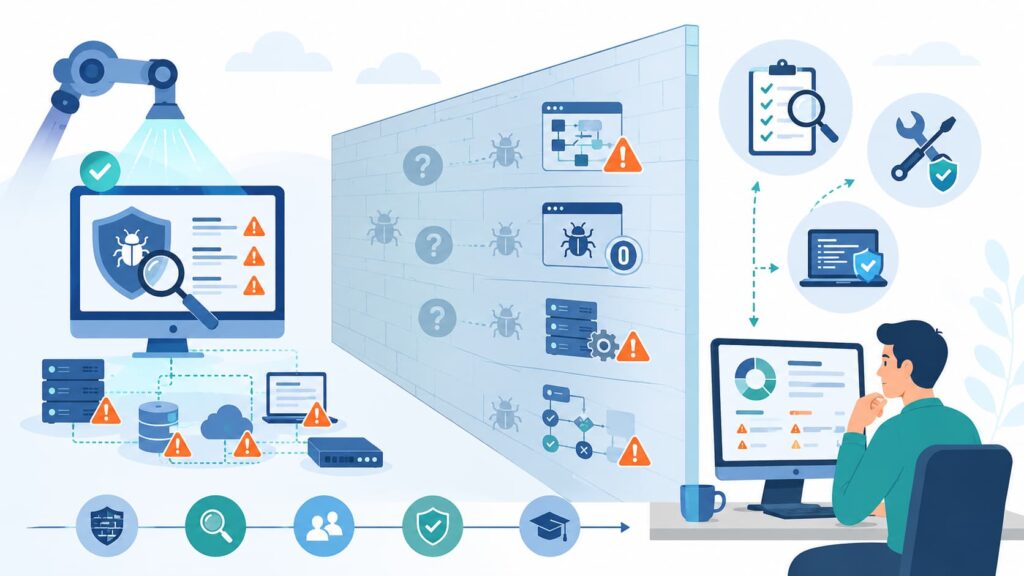
Vulnerability scanners miss things. We see it all the time. They’re great at finding the known, signature-based issues, but they often leave entire classes of real-world flaws untouched.
Industry research consistently shows that the exact detection rate varies by scanner, testing methodology, and environment. However, security researchers generally agree that automated scanners have well-known blind spots, particularly around business logic flaws, authorization issues, and multi-step attack scenarios.
It shows a wide spread in performance. Rule-based engines, specialized models, and new AI-assisted tools all have different blind spots.
As highlighted by Universitat Politècnica de València:
“Using the scanners with JARVIS, the number of detected vulnerabilities can be increased by more than 100% on average compared to using the scanners without JARVIS. A significant fraction of the additionally detected vulnerabilities is security-critical, which means that JARVIS provides a true security benefit.” – Universitat Politècnica de València
In our own assessments, a scanner might give a web app a clean bill of health. Then, during a manual pen test, we find an authentication bypass, a broken business workflow, or a multi-step attack chain. The scanner simply didn’t have a rule for it.
Some things consistently slip through:
- Business logic flaws, because scanners look for technical patterns, not flawed organizational intent.
- Zero-day vulnerabilities, by definition.
- Multi-step attack chains that require linking several actions.
- Hidden or undocumented APIs that aren’t in the crawlable surface area.
- Attacks requiring specific user interaction.
- Complex authorization weaknesses across roles and states.
The scanner can’t understand what the business process is supposed to do, only what it technically does. This isn’t a reason to distrust automated scanning. It’s the reason we build layered security strategies.
Mature programs combine these scans with threat intel, manual validation, and regular penetration testing. One tool can’t do it all, and knowing where each one falls short is how you build a real defense.
Why Do False Positives Happen?
False positives usually result from incomplete visibility, version-based detection, limited permissions, or software packaging differences rather than faulty scanner technology. One of the most common examples involves Linux distributions.
Many enterprise distributions backport security fixes without changing application version numbers. Version-based CVE detection engines may therefore report a vulnerability that has already been remediated.
Several factors commonly contribute to inaccurate findings.
- Backported Linux patches
- Banner-only detection
- Partial authentication
- Network interruptions
- Limited scanner permissions
- Customized software builds
Managing false positives requires a disciplined process that combines accurate scanner configuration, validation, and continuous tuning.
- Enable authenticated scanning.
- Validate high-risk findings manually.
- Tune detection rules regularly.
- Compare findings against vendor advisories.
- Verify installed software directly.
Our teams at MSSP Security have learned that reducing false positives is less about purchasing another security tool and more about improving scanner configuration, authentication, and remediation workflows.
Once teams trust their vulnerability data, remediation accelerates noticeably. Of course, false negatives deserve equal attention because an undetected vulnerability presents a far greater operational risk than an inaccurate alert.
How Should You Prioritize Vulnerabilities?
Interpreting vulnerability scan results starts with more than reviewing CVSS scores. Sorting every vulnerability report by its CVSS score is the default starting point, but it falls apart completely when you’re managing thousands of assets.
The fastest way to reduce real risk is to stop fixating on severity scores alone and start prioritizing based on exploitability and business impact.
Modern risk analysis has to pull from several sources. We evaluate products on how well they integrate these inputs:
- CVSS severity
- EPSS exploit probability
- Internet exposure of the asset
- The sensitivity of the data or service
- Active threat intelligence feeds
- Compliance requirements
- Overall business criticality
FIRST recommends combining CVSS with EPSS for a clearer picture of real-world exploit likelihood, and we agree. A critical flaw on an internal test server is often a lower priority than a medium-severity flaw on an internet-facing customer portal.
Research from IEEE shows:
“Current industry practices rely predominantly on Common Vulnerability Scoring System (CVSS) base scores for vulnerability triage, despite explicit guidance against this approach in the CVSS specification. This misalignment results in suboptimal resource allocation, with organizations addressing theoretical high-severity vulnerabilities while practical exploitable vulnerabilities remain unpatched.” – IEEE
A practical remediation workflow we help MSSPs establish follows a clear sequence:
- Confirm the asset’s exposure (internal vs. external).
- Validate the finding to rule out false positives.
- Assess the specific business impact if exploited.
- Assign clear ownership for the fix.
- Schedule the remediation work.
- Verify the fix through a rescan.
| Priority Factor | Why It Matters |
| Internet exposure | Public-facing systems are probed constantly. |
| EPSS score | Estimates the actual likelihood of exploitation. |
| Business impact | Determines the operational and financial risk. |
| Threat intelligence | Confirms if attackers are actively using the flaw. |
| CVSS score | Measures the technical severity. |
The most significant shift we see in successful programs is a change in the conversation. It moves from “How many critical vulnerabilities do we have?” to “Which vulnerabilities pose a measurable business risk right now?”
That slight change in mindset is what transforms vulnerability management from a reporting chore into an actual risk mitigation program.
Which Vulnerability Scanner Should You Choose?
The best network vulnerability scanner depends on infrastructure, deployment model, reporting requirements, and operational maturity rather than a single feature checklist.
Many buying guides focus exclusively on detection rates, often comparing Nessus, Qualys, and Rapid7 without giving enough attention to operational requirements.
In practice, organizations often gain more value from integration capabilities, security dashboard visibility, automation, and reporting than from marginal differences in signature coverage.
When organizations engage with MSSP Security, we typically recommend selecting technology that complements existing security operations, integrates with remediation workflows, and supports long-term governance instead of chasing feature comparisons.
Several evaluation criteria deserve attention.
- Asset discovery capabilities
- Continuous monitoring support
- Cloud and container coverage
- Configuration auditing
- API integrations
- Security analytics
- Reporting flexibility
- Automation options
Agent-based deployment becomes particularly valuable for remote workforces, cloud-native environments, and segmented networks where traditional network scanning provides incomplete visibility.
Rather than replacing one scanner with another every few years, successful organizations continuously mature their security framework, improve security controls, and refine vulnerability intelligence across the entire vulnerability lifecycle.
How Can You Build a Vulnerability Management Program That Actually Works?
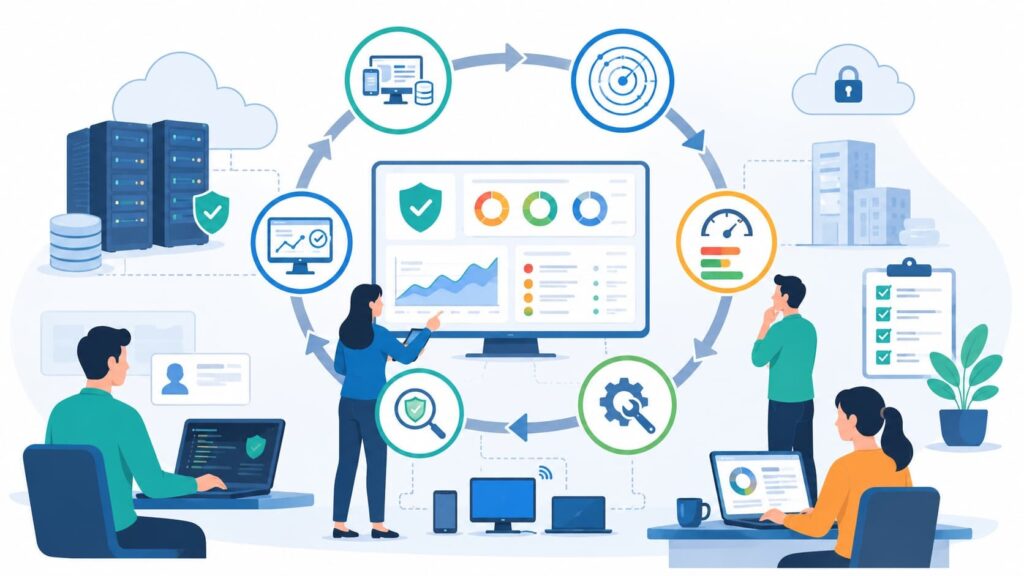
True vulnerability management isn’t a quarterly scan and a report. It’s a continuous operational process that ties together automated scanning, disciplined remediation, validation, and governance.
The organizations that show measurable improvement are the ones that bake it into their daily security operations. In our implementation work, we’ve found the biggest gains don’t usually come from running more scans.
They come from shortening the time it takes to fix things, clarifying who owns each problem, and critically maintaining an accurate list of what you actually have. An effective program is built on a set of recurring activities:
- Defining and updating the scanning scope
- Maintaining complete, automated asset discovery
- Scheduling assessments continuously, not periodically
- Using authenticated scanning wherever possible
- Integrating findings directly into ticketing systems like Jira or ServiceNow
- Measuring and reporting on remediation SLAs
- Manually validating critical findings before major actions
- Continuously tuning scanner rules to reduce noise
- Tracking vulnerability exposure trends over time
This continuous cycle also provides the metrics needed for executive visibility. Key numbers we help MSSPs track include:
- Mean Time to Remediate (MTTR)
- Age of critical vulnerabilities
- Patch compliance rates
- Size of the vulnerability backlog
- Percentage of assets covered
- Trends in overall risk scoring
- Demonstrable security posture improvements
Continuous vulnerability management forms the foundation of a mature security program. However, technology alone is not enough. Sustainable improvement depends on consistent governance, executive support, and collaboration across infrastructure, development, and security teams.
Why Vulnerability Scanning Is Only the First Step
Credits: Cybersecurity Dojo
A vulnerability scanner helps organizations identify known security weaknesses across systems, applications, and networks, but finding vulnerabilities is only the beginning. The scan results must be reviewed, prioritized, and validated because not every finding represents an immediate security risk.
Security teams should focus on the most critical issues, apply patches or configuration changes, and verify that remediation has been successful. Continuous scanning combined with ongoing vulnerability management creates a far stronger security posture than relying on one-time scans alone.
FAQ
How does a vulnerability assessment differ from penetration testing?
A vulnerability assessment identifies known security weaknesses through automated scanning, while penetration testing attempts to exploit those weaknesses to determine whether attackers could successfully compromise a system. Each method serves a different purpose within security testing. Organizations often use both because they improve risk assessment, strengthen security posture, and support effective vulnerability prioritization.
Can security scanning detect every security flaw?
No. Security scanning can identify many known security flaws, perform misconfiguration detection, and support CVE detection by referencing a regularly updated vulnerability database. However, it cannot detect every possible issue. New vulnerabilities, business logic flaws, and sophisticated attack techniques often require manual analysis. Combining scans with continuous monitoring, security analytics, and threat intelligence provides more complete coverage.
Why is CVSS scoring important after a vulnerability scan?
CVSS scoring provides a standardized way to measure vulnerability severity based on factors such as exploitability and potential impact. Security teams use these scores for risk scoring, vulnerability triage, and understanding vulnerability context before deciding what to fix first. This approach improves security remediation, supports risk mitigation, and helps manage the entire vulnerability lifecycle more effectively.
How do organizations reduce false positives during security assessments?
Organizations reduce false positives by validating scan results against actual systems before beginning remediation. They improve accuracy through asset discovery, configuration auditing, and maintaining a consistent security baseline. These practices support false positive reduction, produce more reliable security metrics, improve vulnerability tracking, and create a more efficient remediation workflow for security engineers.
How often should organizations perform network security vulnerability scans?
Organizations should perform vulnerability scans regularly and whenever significant infrastructure, applications, or configurations change. The appropriate frequency depends on business risk, the threat landscape, and compliance requirements. Regular network mapping, port scanning, service enumeration, security monitoring, and timely patch management reduce vulnerability exposure while strengthening security controls, security governance, and overall security management.
Keep Vulnerability Scanning Working for You
A vulnerability scanner can show where problems exist, but it won’t fix them for you. You still need to review the findings, prioritize the highest-risk issues, and continuously improve your security posture. Integrating scanners with patch management helps ensure identified vulnerabilities move efficiently from detection to remediation instead of remaining unresolved. That ongoing process is what helps reduce cyber risk over time.
Treat vulnerability scanning as part of your daily security operations rather than a one-time task. If managing multiple security tools, vendors, and remediation workflows is becoming difficult, our MSSP consulting services can help. We provide vendor-neutral guidance, technology stack optimization, proof-of-concept support, and actionable recommendations to help you build a security environment that fits your operational needs
References
- https://personales.upv.es/thinkmind/IntTech/IntTech_v12_n12_2019/inttech_v12_n12_2019_2.html
- https://ieeexplore.ieee.org/document/11383863
Related Articles
- https://msspsecurity.com/how-vulnerability-scanners-work/
- https://msspsecurity.com/web-application-vulnerability-scanners/
- https://msspsecurity.com/nessus-vs-qualys-vs-rapid7-comparison/
- https://msspsecurity.com/choosing-network-vulnerability-scanner/
- https://msspsecurity.com/credentialed-vs-uncredentialed-scans/
- https://msspsecurity.com/cloud-infrastructure-vulnerability-scanning/
- https://msspsecurity.com/interpreting-vulnerability-scan-results/
- https://msspsecurity.com/managing-false-positives-scanners/
- https://msspsecurity.com/automated-vulnerability-scanning-benefits/
- https://msspsecurity.com/integrating-scanners-patch-management/