


Integrating different SIEM platforms improves security operations when organizations standardize telemetry before correlating events across environments. Many teams assume connectors are the biggest challenge, but inconsistent data and disconnected workflows usually create the real problems.
At MSSP Security, we’ve found that successful integrations begin with consistent data, shared processes, and clear ownership before new technology is introduced. Organizations that build this foundation gain better visibility, stronger detection quality, and more efficient investigations. Keep reading to see how to build an integration strategy that works.
Multi-SIEM Integration Snapshot
Successful SIEM integration depends on standardized data, consistent workflows, and practical architecture choices. Here are the key ideas you’ll take away from this guide.
- Understand the difference between SIEM integration and SIEM consolidation.
- Compare multi-SIEM architecture options for hybrid security environments.
- Learn practical ways to improve detection quality while controlling operational costs.
Why Do Organizations Integrate Different SIEM Platforms?
Organizations integrate different SIEM platforms to improve visibility, protect previous investments, and support modern IT environments that continue to expand across cloud, on-premises, and remote locations.
Security environments rarely stay the same for long. A company may acquire another business, move workloads into the cloud, or operate under different compliance rules across regions. Before long, more than one SIEM is collecting logs. Replacing every platform isn’t always practical. Most teams want better visibility without disrupting daily security operations.
From what we’ve seen at MSSP Security, the biggest challenge isn’t connecting platforms. It’s getting people, processes, and data to work together. We’ve worked with MSSPs that had every connector in place but still struggled because logs were inconsistent and analysts followed different investigation methods. That slowed response times more than the technology itself.
Organizations often choose SIEM integration to:
- Improve security visibility
- Support hybrid environments
- Keep existing investments
- Reduce vendor lock-in
- Standardize SOC workflows
- Meet compliance requirements
When telemetry is shared and normalized, analysts investigate one incident instead of several unrelated alerts. That reduces confusion, improves detection quality, and gives security teams a clearer picture of what’s happening across the environment.
What Does SIEM Integration Actually Mean?
SIEM integration connects security data, detections, investigations, and response actions. It doesn’t always mean replacing every platform with one dashboard.
Many people picture integration as combining everything into a single interface. That rarely solves the real problem. What matters is whether security teams can investigate incidents using consistent data, regardless of where the alerts originated.
We’ve found that successful projects focus on the flow of information first. Once logs are normalized and response workflows are shared, analysts spend less time switching between tools. That’s usually the biggest improvement. Fancy dashboards don’t help if the underlying data isn’t consistent.
| Approach | Main Benefit |
| Integration | Existing SIEMs continue working together |
| Consolidation | One SIEM replaces the others |
Most organizations share:
- Security events
- Threat intelligence
- Incident cases
- Response workflows
- Enriched telemetry
- Normalized logs
Our consulting work usually begins by reviewing operational processes before recommending technology changes, much like the evaluation process discussed in comparing SIEM platforms MSSP uses. Where platform capabilities are assessed alongside operational fit rather than feature lists alone.
That approach avoids unnecessary migration projects and helps MSSPs keep services running while improving visibility. Integration becomes an operational strategy, not a software replacement exercise.
Which Multi-SIEM Architecture Fits Your Environment?
Credits: Cynalytica
The best architecture depends on how security operations are managed, who owns the data, and how investigations are performed across the organization.
There isn’t one design that fits every environment. Some organizations run a centralized SOC with one primary investigation platform. Others allow regional teams to manage their own detections while sharing important alerts with a central security team. Both models can succeed if the underlying telemetry is consistent.
Over the years, we’ve noticed that architecture decisions are often driven by business structure rather than technology. That is also why evaluating the best SIEM platforms for MSSP should focus on operational requirements, scalability, and analyst workflows instead of relying only on technical specifications.
Common approaches include:
- Central investigation platform
- Federated SIEM deployment
- Shared security data pipeline
- Automated response workflows
No matter which model is selected, normalized telemetry remains the foundation. Shared data allows analysts to follow the same investigation process even when logs originate from different environments. We also recommend validating detection coverage with a common framework before expanding automation. It saves time later and reduces gaps that are harder to spot after deployment.
Why Does Normalization Matter More Than Connectors?
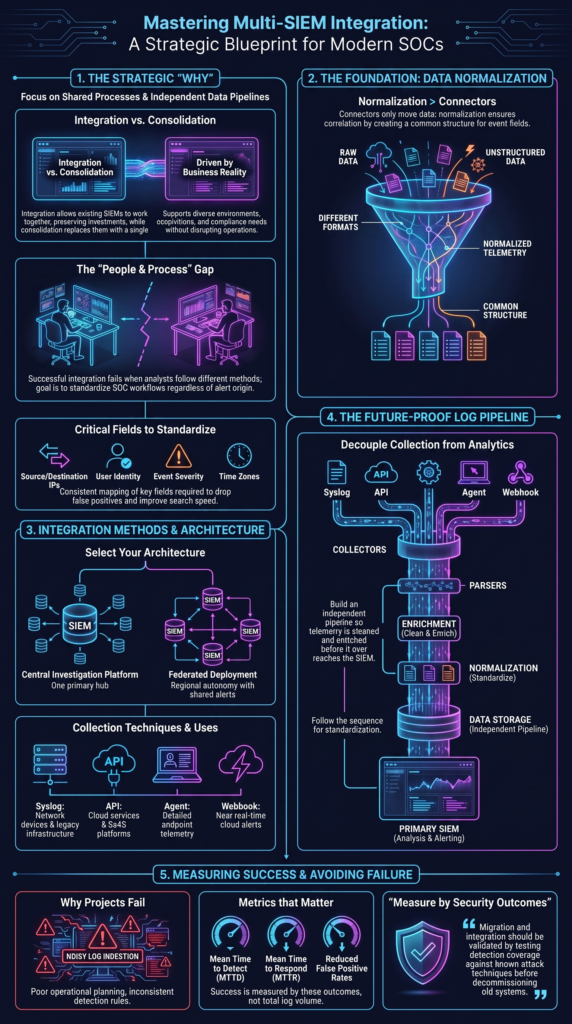
Consistent data matters more than connectors because security tools can only correlate events when they speak the same language.
Many organizations spend weeks connecting products through APIs, agents, or log forwarding. Then they discover their alerts still don’t match correctly. We see this often during product assessments for MSSPs. The connector works, but the data format is different across every source. One platform records a username one way, while another stores the same information under a different field.
Normalizing telemetry fixes that problem before it reaches the SIEM. It creates a common structure for events, making searches, detections, and investigations much more consistent.
Common fields to normalize include:
- Source and destination IPs
- User identity
- Hostname
- Event severity
- Time zone
- Asset identifiers
Our team has reviewed environments where several log formats existed at once. Once everything followed a common schema, false positives dropped, analysts spent less time chasing duplicate alerts, and investigations became easier to follow. It’s one of the highest-impact improvements we recommend because it benefits every detection rule built afterward.
Which Integration Methods Work Best?
The best integration method depends on the type of system, the data being collected, and how quickly that information needs to reach security teams.
Not every log source works the same way. Older infrastructure often relies on Syslog, while cloud services expose APIs or webhooks. Endpoints may require lightweight agents to collect detailed activity. Rather than forcing one method everywhere, organizations usually combine several collection techniques.
We’ve found that successful deployments stay practical. Teams planning new deployments often approach integration alongside choosing SIEM for security outsourcing because collection methods, operational ownership, and long-term service delivery are closely connected. Teams don’t chase every possible data source.
| Method | Best Used For |
| Syslog | Network devices and legacy systems |
| API | Cloud services and SaaS |
| Agent | Endpoint telemetry |
| Webhook | Near real-time cloud alerts |
Most mature environments combine multiple collection methods into one security data pipeline. That approach provides broader visibility without creating unnecessary complexity. It also makes future platform changes easier because collection remains separate from the SIEM itself. In our experience, keeping ingestion flexible gives MSSPs more options as customer environments continue to evolve.
Why Do Multi-SIEM Projects Fail?
Most projects struggle because operational planning falls behind the technology.
Connecting platforms is usually the easy part. Keeping detections accurate, workflows consistent, and analysts aligned takes much more effort. We’ve audited environments where integrations were technically complete, yet investigations still took too long because every team handled alerts differently. Operations matter.
Common problems include:
- Too much log ingestion
- Poor parser configuration
- Missing enrichment
- Inconsistent detection rules
- Staffing limitations
- Weak operational ownership
Another issue is collecting every available log without asking whether the information improves security. More data doesn’t always produce better results. It often increases storage costs and creates additional noise for analysts.
During consulting engagements, we encourage MSSPs to review use cases before expanding telemetry. That keeps costs under control while improving detection quality. Teams that continuously tune rules, remove unnecessary data, and refine workflows usually achieve stronger long-term results than those focused only on adding more sources.
How Can You Build a Future-Proof Log Pipeline?
Build an independent security data pipeline so collection, processing, and analytics remain separate.
Organizations increasingly separate log collection from detection because it creates flexibility. Instead of sending every source directly into a SIEM, telemetry moves through a pipeline where it can be cleaned, enriched, and normalized first.
A typical workflow looks like this:
Collectors → Parsers → Enrichment → Normalization → Data Storage → Primary SIEM
That design offers several advantages:
- Cleaner telemetry
- Better data quality
- Easier migrations
- Lower ingestion costs
- Consistent parsing
- Long-term log retention
We’ve helped MSSPs evaluate architectures where changing SIEM platforms required almost no changes to log collection. That’s because the pipeline already handled normalization before data reached the analytics platform. It reduced migration risk and made future technology decisions much easier.
Keeping collections independent also gives organizations more freedom when evaluating new products. Instead of rebuilding every integration, they can focus on validating detections and analyst workflows.
How Should You Preserve Detection Quality During Migration?
Run both environments together until detections have been tested and validated.
Switching platforms overnight creates unnecessary risk. Even if log collection appears correct, small differences in parsing or rule logic can reduce detection coverage. Running systems in parallel gives security teams time to compare alerts and confirm that important events are still being detected.
We recommend validating:
- Parsing accuracy
- Time synchronization
- Detection rules
- Correlation logic
- Investigation workflows
- Coverage against attack techniques
Research from GovInfoSecurity shows
“Our confidence is strongest for rules whose semantics can be well-covered by generated test cases, and weaker for rules involving rare behaviors, custom schemas or complex temporal correlations.” – GovInfoSecurity
Our audits often reveal small parsing issues that would have been difficult to notice after a full migration. Finding those problems early prevents missed detections later.
Migration should be measured by security outcomes, not by how quickly an old platform is turned off. Taking a little more time during validation usually saves much more time after deployment. Most teams appreciate that tradeoff once they see how much smoother investigations become.
How Can You Measure Success After Integration?
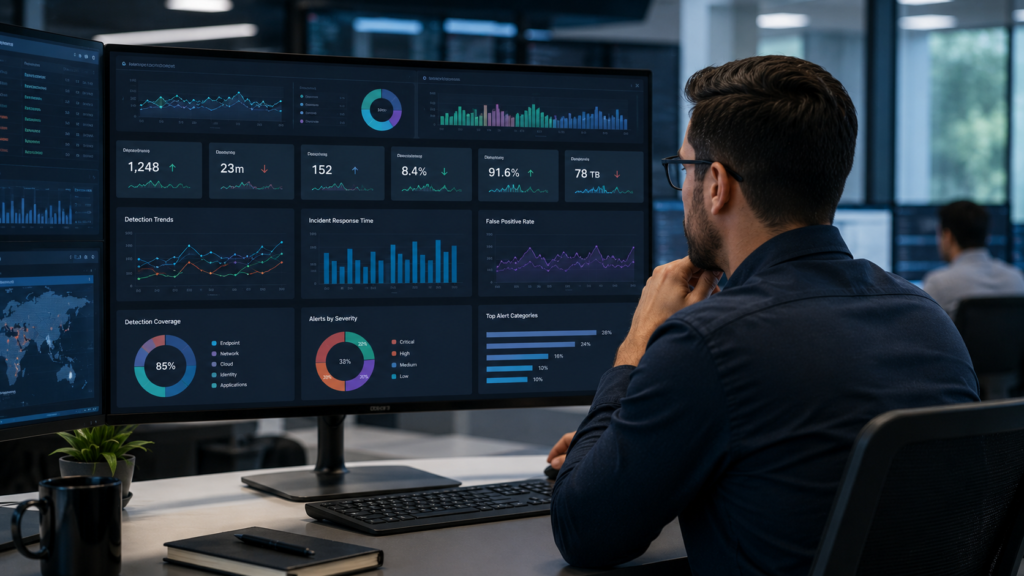
Success should be measured by stronger security operations, not by larger log volumes. It’s easy to focus on how many events are collected each day. But that number says very little about security performance. Organizations should measure improvements that affect investigations and response.
Useful KPIs include:
- Mean time to detect
- Mean time to respond
- False positive rate
- Detection coverage
- Storage efficiency
As highlighted by University of Kansas
“Implementing programmatic analysis decreases false positive ratios and provides mechanisms for the abstraction of human labor functions to a higher analytical plane… ultimately improving process efficiency and decreasing the mean time required to triage and respond to network security events.” – University of Kansas
We’ve found that these metrics tell a much clearer story during product audits. They help MSSPs understand whether an integration is improving operations or simply increasing operational costs.
Analyst feedback also matters. If investigations become faster, alerts are easier to understand, and duplicate cases decrease, the integration is moving in the right direction. Those day-to-day improvements often matter more than raw ingestion numbers because they directly affect the security team’s ability to respond to threats.
FAQ
How does SIEM interoperability improve security visibility?
SIEM interoperability allows different security platforms to exchange and use security data without replacing existing systems. It combines security telemetry, firewall logs, IAM logs, and cloud telemetry into a unified security monitoring process.
This approach gives analysts a complete view of security events, improves alert correlation, and helps teams investigate incidents more efficiently across a multi-vendor security stack.
What should organizations prepare before a SIEM migration?
A successful SIEM migration requires careful planning before any data is moved. Organizations should review parser configuration, field mapping, schema normalization, and time synchronization to ensure data remains consistent.
They should also prepare for detection content migration, dashboard migration, and use case porting. These steps help maintain detection coverage and reduce operational risks during the migration process.
How do log normalization and data enrichment improve threat detection?
Log normalization converts security data into a common event format so different systems can process it consistently. Data enrichment adds useful context to security events by combining information from multiple sources. Together, these processes improve security event correlation, support threat detection engineering, reduce false positives, and help analysts investigate incidents with greater accuracy.
Which integration methods work best for cross-platform SIEM environments?
The best integration method depends on the systems being connected and the type of security data collected. Many organizations use API integration, syslog forwarding, webhook alerts, agent-based collection, and JSON log ingestion together.
A flexible security data pipeline with centralized logging, log aggregation, and reliable connector support improves scalability, reduces ingestion costs, and simplifies future SIEM integration projects.
How can organizations measure successful SIEM integration?
Organizations should measure SIEM integration by evaluating security outcomes instead of counting log volume. Useful metrics include incident triage time, false positive reduction, detection coverage, security compliance, and security operations workflow efficiency.
Teams should also measure incident response automation, threat intelligence integration, SOAR integration, and playbook automation to confirm that the integration improves both security performance and daily operations.
Build a Smarter Multi-SIEM Strategy
Successful SIEM integration depends on practical workflows, consistent telemetry, and clear operational goals. Organizations that focus on improving investigations and detection quality often gain better visibility while reducing unnecessary complexity. Technology supports security operations, but long-term success comes from strong processes and thoughtful planning.
Whether you’re planning a SIEM migration or improving an existing environment, the right strategy can strengthen security outcomes. Modernize your security operations with MSSP Security and support better security decisions.
References
- https://www.govinfosecurity.com/ai-researchers-target-siem-migration-bottleneck-a-31650
- https://people.eecs.ku.edu/~saiedian/Pub/Journal/2020-Saiedian-CS.pdf#6#1